PreparED Study Materials

CHEM 103: General Chemistry I
School: University of Delaware
Number of Notes and Study Guides Available: 3
Notes

Videos
Diprotic Acid Titration: Determining Molar Mass

Want To Learn More? To watch the entire video and ALL of the videos in the series:
full solution
Discover how to find the molar mass of an unknown diprotic acid through a titration experiment with 0.1288 M NaOH. Learn step by step in this chemistry tutorial.
Tailors' Seam Measurements: Precision and Accuracy Analysis
Want To Learn More? To watch the entire video and ALL of the videos in the series:
full solution
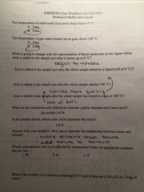
An in-depth analysis of the precision and accuracy in seam measurements by three apprentice tailors: X, Y, and Z, as they measure a pair of trousers. Understand how their measurements compare to the true length of 32.0 inches.
Calculate a Building's Age Using Nickel-63 Decay
Want To Learn More? To watch the entire video and ALL of the videos in the series:
full solution
The scenario involves an archaeologist analyzing iron in an old building containing nickel-63, which has a known half-life of 92 years. With only 0.78% of the original nickel-63 remaining, the goal is to estimate the year when this discovery was made. We delve into the calculations and principles of first-order decay reactions.
Why Fluorine Can't Form FH? or FCl?: Unpacking VSEPR Theory & Electron
Want To Learn More? To watch the entire video and ALL of the videos in the series:
full solution
Explore why fluorine, with its seven valence electrons, doesn't form compounds like FH? or FCl?. Understand the role of VSEPR theory, atomic size, and electronegativity in limiting bond formation. Grasp the interplay of geometric challenges and electron repulsion in compound stability.
Density Explained: Calculating the Density of an Osmium Cube
Want To Learn More? To watch the entire video and ALL of the videos in the series:
full solution
In this tutorial, we break down the principle of density, illustrating it as a measure of mass per unit volume. Using an osmium cube as a practical example, we walk viewers through the steps of computing its density, demonstrating the interplay between mass, volume, and particle arrangement.
Using Avogadro's Number: Calculating Moles of Aluminum & Iron Atoms
Want To Learn More? To watch the entire video and ALL of the videos in the series:
full solution
Learn how to determine the number of moles in a given set of atoms using Avogadro's number. This tutorial breaks down the calculation for Aluminum and Iron, simplifying the concept for better understanding.