PreparED Study Materials

CHM 10629: Introductory Chemistry
School: Grand Valley State University
Number of Notes and Study Guides Available: 0
Videos
Argon Isotopes: Protons, Neutrons & Electrons Breakdown

Want To Learn More? To watch the entire video and ALL of the videos in the series:
full solution
Explore the captivating branches of philosophy, understanding ethics as our moral guide, aesthetics as the interpreter of beauty, and logic as the foundation for clear reasoning. Delight in the insights these disciplines offer, enhancing our perspectives on life, art, and thought.
Weighting Epsom Salts for Baths & CO? in Soda: Molecular Insight
Want To Learn More? To watch the entire video and ALL of the videos in the series:
full solution
Learn the step-by-step process to convert moles into grams using the molecular weight of Epsom salts (MgSO?) and carbon dioxide (CO?). From bathtub to soda bottle understand the science behind the amounts
Mole Fractions, Partial Pressures, and Total Pressure Calculation
Want To Learn More? To watch the entire video and ALL of the videos in the series:
full solution
Explore the calculations for mole fractions, partial pressures, and total pressure in a 22.4 dm³ vessel with H? and N? at 273.15 K.
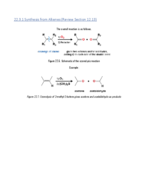
NBS Bromination in CCl4: Light-Induced Chemistry Explained
Want To Learn More? To watch the entire video and ALL of the videos in the series:
full solution
Discover the fascinating world of chemical reactions with N-Bromosuccinimide (NBS) in Carbon Tetrachloride (CCl4), initiated by light. Explore the bromination process and its effects on molecules like cyclopentene, 2,3-dimethylbut-2-ene, and CH3 toluene, leading to valuable insights into organic chemistry.
Key Biochemical Concepts: Polymer, Protein, Nucleic Acid, Catalysis, G
Want To Learn More? To watch the entire video and ALL of the videos in the series:
full solution
In biochemistry, polymers are essential macromolecules, including carbohydrates, lipids, proteins, and nucleic acids, each adopting specific shapes and performing vital functions within cells, with proteins serving diverse roles, nucleic acids carrying genetic information, catalysis expediting reactions, and the genetic code enabling protein synthesis.
Why Fluorine Can't Form FH? or FCl?: Unpacking VSEPR Theory & Electron
Want To Learn More? To watch the entire video and ALL of the videos in the series:
full solution
Explore why fluorine, with its seven valence electrons, doesn't form compounds like FH? or FCl?. Understand the role of VSEPR theory, atomic size, and electronegativity in limiting bond formation. Grasp the interplay of geometric challenges and electron repulsion in compound stability.