PreparED Study Materials

CHEM 110: Chemical Principles I
School: Pennsylvania State University
Number of Notes and Study Guides Available: 83
Notes














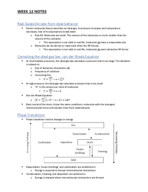





Study Guides





















Videos
Determining Formula Mass: Step-by-Step Approach Using Atomic Masses

Want To Learn More? To watch the entire video and ALL of the videos in the series:
full solution
Discover the method to determine the formula mass for various compounds. Learn about the importance of atomic masses and their role in compounds like Aluminium sulfate, Diphosphorus Trioxide, and more. Understand the step-by-step approach to accurately calculate molecular weights.
Do Rusting and Burning Violate Conservation of Mass?
Want To Learn More? To watch the entire video and ALL of the videos in the series:
full solution
This video explores the processes of rusting in iron and burning a match, addressing whether the observed changes in mass violate the law of conservation of mass, and explains how these processes align with the law.
Rutherford's Gold Foil: The Pivot to the Modern Nuclear Atom Model
Want To Learn More? To watch the entire video and ALL of the videos in the series:
full solution
Discover Rutherford's pivotal Gold Foil Experiment and its impact on atomic theory. Unveil the discrepancies with the Plum Pudding Model. Grasp the birth of the nuclear atom model through unexpected alpha particle deflections.
Protons reveal electron count in atoms. Which statement applies?
Want To Learn More? To watch the entire video and ALL of the videos in the series:
full solution
In this video, we explore the information that knowledge of the number of protons in a neutral element's atom can provide. Options for determining neutron count, electron count, and identifying the element's name are examined, with a conclusion that it allows us to know both the number of electrons and the element's name.
Synthesis, Decomposition Reactions, and Oxidation-Reduction
Want To Learn More? To watch the entire video and ALL of the videos in the series:
full solution
We explore synthesis and decomposition reactions, showcasing examples like the formation of water and its breakdown into simpler substances. We also clarify that while many of these reactions are redox reactions involving electron transfer, some synthesis and decomposition reactions may not necessarily be redox reactions, as seen in specific examples.
Diluting a 5.5 M KCl Solution to 0.100 M
Want To Learn More? To watch the entire video and ALL of the videos in the series:
full solution
Learn the steps to make a 2.5 L of 0.100 M KCl solution from a 5.5 M stock solution in this easy-to-follow tutorial.