PreparED Study Materials

CH 1020: General Chemistry
School: Clemson University
Number of Notes and Study Guides Available: 66
Notes














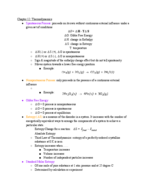
Chapter 4.1-4.2 general chemistry notes (Chemistry)
CH 1020
Clemson University
3 pages | Spring 2016




Ch1020 chapter 12 thermo notes 1/7/2016 (Chemistry)
CH 1020
Clemson University
5 pages | Spring 2016


Study Guides




Videos
Barium Chloride & Sodium Sulfate: Calculating BaSO? Yield

Want To Learn More? To watch the entire video and ALL of the videos in the series:
full solution
Dive into the chemical reaction between Barium Chloride and Sodium Sulfate. Through step-by-step calculations, discover how to determine the resultant mass of Barium Sulfate. Conclude with a real-world example, highlighting the precise amount formed.
Synthesis, Decomposition Reactions, and Oxidation-Reduction
Want To Learn More? To watch the entire video and ALL of the videos in the series:
full solution
We explore synthesis and decomposition reactions, showcasing examples like the formation of water and its breakdown into simpler substances. We also clarify that while many of these reactions are redox reactions involving electron transfer, some synthesis and decomposition reactions may not necessarily be redox reactions, as seen in specific examples.
Molecular Lewis Structures for CH?, CO?, H?Se, and NH?
Want To Learn More? To watch the entire video and ALL of the videos in the series:
full solution
In this video, we demonstrate the creation of Lewis structures for methane, carbon dioxide, hydrogen selenide, and ammonia, highlighting the arrangement of atoms and bonds in each molecule. The video emphasizes the importance of Lewis structures in visualizing atomic bonding and the presence of lone electron pairs.
Calculate oxygen molar concentration in water at 25°C with a partial p
Want To Learn More? To watch the entire video and ALL of the videos in the series:
full solution
This video explores molar concentration (molarity) and demonstrates the calculation of oxygen's molar concentration in water at 25°C, considering a partial pressure of 0.22 atm by employing Henry's Law and the given Henry's Law constant for oxygen, revealing that under these conditions, there are 2.86 x 10?? moles of oxygen per liter of water, highlighting the significance of understanding these concepts for managing gas dissolution in liquids across varying circumstances.
Quantitative vs Non-Quantitative: Precision in Scientific Observations
Want To Learn More? To watch the entire video and ALL of the videos in the series:
full solution
Unpack the difference between quantitative and non-quantitative observations. Examples include a person's weight on the Moon and the depth a hand pump can reach. Learn why precise measurements are crucial in scientific studies.
Quantifying Atoms Molecules & Moles: A Comprehensive Chemistry Guide
Want To Learn More? To watch the entire video and ALL of the videos in the series:
full solution
Grasp the fundamental concept of moles in chemistry by equating it to the universally understood notion of a dozen. This video breaks down the usage of Avogadro's constant demonstrating calculations from moles to particles and vice versa. Using real-world examples like Carbon atoms Sulfur Dioxide molecules and Iron atoms viewers gain a clear understanding of moles and particle conversions