PreparED Study Materials

CHEM 331: Organic Chemistry I
School: Iowa State University
Number of Notes and Study Guides Available: 11
Notes



Study Guides


Videos
Structural Isomers: C4H10, C5H12, C6H14, C2H5Cl, C2H4Cl2, C2H3Cl3

Want To Learn More? To watch the entire video and ALL of the videos in the series:
full solution
Explore the diverse world of structural isomers! Learn how to draw structures for all constitutional isomers with various molecular formulas, including C4H10, C5H12, C6H14, C2H5Cl, C2H4Cl2, and C2H3Cl3.
Atomic Radius Trends: Unveiling Periodic Table Secrets
Want To Learn More? To watch the entire video and ALL of the videos in the series:
full solution
Discover the intricacies of atomic radius and its trends on the periodic table in this video. Unravel the factors influencing atomic size and explore how elements' positions on the periodic table affect their atomic radii.
Mass of Solutions: 12g Sucrose in 4.1%, 3.2%, & 12.5% Cases
Want To Learn More? To watch the entire video and ALL of the videos in the series:
full solution
Determining the total mass of sucrose solutions at varying concentrations: 4.1% 3.2% and 12.5%. Learn step-by-step calculations to find solution masses containing 12 grams of sucrose. Results: ~292.68g ~375g and 96g for each concentration respectively.
Homogeneous vs Heterogeneous Mixtures: Examples & Classification Expla
Want To Learn More? To watch the entire video and ALL of the videos in the series:
full solution
Explore the distinction between homogeneous and heterogeneous mixtures. Through real-world examples like baby oil, chocolate chip cookies, and wine, understand their uniformity, phases, and how components are distributed.
Understanding Polar & Nonpolar Molecules: From Diazene to Nitrogen Dio
Want To Learn More? To watch the entire video and ALL of the videos in the series:
full solution
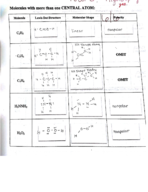
Explore the properties of various molecules like diazene, hydrogen peroxide, and carbon tetrafluoride. Understand the influence of molecular shape and electronegativity on polarity. Discover why some are polar while others are nonpolar based on their structure.
Want To Learn More? To watch the entire video and ALL of the videos in the series:
full solution