PreparED Study Materials

CHEM 331: Organic Chemistry I
School: University of Delaware
Number of Notes and Study Guides Available: 0
Videos
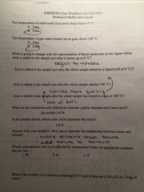
Reaction Rate Impact: Ethanol, Tert-Butyl Bromide & Temp

Want To Learn More? To watch the entire video and ALL of the videos in the series:
full solution
Explore the intricacies of reaction rates with varying concentrations of ethanol and tert-butyl bromide. Understand the principles of SN1 reactions and the impacts of temperature on rate acceleration. Grasp the core elements that influence and optimize chemical reactions in diverse applications.
Density Explained: Calculating the Density of an Osmium Cube
Want To Learn More? To watch the entire video and ALL of the videos in the series:
full solution
In this tutorial, we break down the principle of density, illustrating it as a measure of mass per unit volume. Using an osmium cube as a practical example, we walk viewers through the steps of computing its density, demonstrating the interplay between mass, volume, and particle arrangement.
Drawing the Lewis Structure for Glycine: The Protein Building Block
Want To Learn More? To watch the entire video and ALL of the videos in the series:
full solution
Discover how amino acids, specifically glycine, form the foundation of proteins. Understand and visualize the Lewis structure representation of glycine. Grasp the significance of atomic bonding and electron distribution.
Mole Count in Elemental Samples (Zn, Ar, Ta, Li)
Want To Learn More? To watch the entire video and ALL of the videos in the series:
full solution
This video outlines the process of calculating the number of moles in various elemental samples. It begins by explaining the relationship between molar mass and atomic weight. Each sample's mass is divided by the respective element's molar mass to find the number of moles. It provides detailed calculations for four elemental samples: zinc (Zn), argon (Ar), tantalum (Ta), and lithium (Li), converting results to scientific notation where necessary. The script demonstrates how to determine the mole
Calculating the Mass of a Sucrose Crystal: A Chemistry Insight
Want To Learn More? To watch the entire video and ALL of the videos in the series:
full solution
Explore the fascinating world of chemistry as we calculate the mass of a sugar crystal with 1.8 x 10¹? molecules of sucrose. Using the concept of a mole and Avogadro's number, discover how to convert molecular numbers to milligrams. Grasp foundational principles in a clear, engaging format.
pAg in KI & AgNO3 Titration: Exploring 39mL & 44.30mL Volumes
Want To Learn More? To watch the entire video and ALL of the videos in the series:
full solution
Exploring the titration of 25.00 mL of 0.08230 M KI with 0.05110 M AgNO3. This video breaks down the calculation process for the potential of silver ion at various volumes of added AgNO3: 39.00 mL equivalence point and 44.30 mL. With clear steps and using the solubility product constant understand how the potential of silver ion is determined for each scenario.