PreparED Study Materials

CEM 251: Organic Chemistry I
School: Michigan State University
Number of Notes and Study Guides Available: 37
Notes
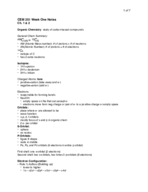


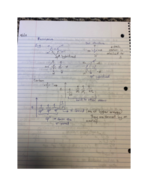
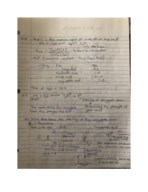

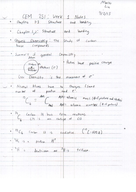
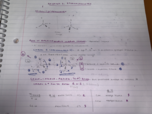

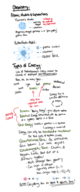
Week three notes organic chemistry (Chemistry)
CEM 251
Michigan State University
9 pages | Fall 2015


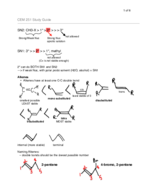
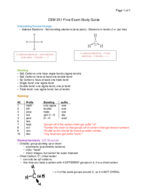
Study Guides




Videos
Identifying Fundamental Units in Rb?O, N?, Fe(NO?)?, and N?F?

Want To Learn More? To watch the entire video and ALL of the videos in the series:
full solution
In this exploration, we delve into the fundamental units of various substances, whether they are single atoms, molecules, or formula units. We examine ionic compounds like Rb?O and Fe(NO?)?, characterized by formula units as their basic components, and covalent compounds like N? and N?F?, where molecules are the fundamental units.
Calculating Percent Error: Insights into Experiment Accuracy & Refinem
Want To Learn More? To watch the entire video and ALL of the videos in the series:
full solution
Discover the importance of calculating percent error to assess the precision of experiments. Through real-world examples like measuring alcohol's density and the mass of gold, learn how this value offers insights into measurement accuracy and ways to refine methods.
Decoding Electron Configurations: From Rubidium to Argon Explained
Want To Learn More? To watch the entire video and ALL of the videos in the series:
full solution
Explore the intricacies of electron configurations around the atomic nucleus. Understand the ordered filling of energy levels in atoms like Rubidium, Germanium, and Argon. A deep look into the ground-state configurations of key elements.
Mole Count in Elemental Samples (Zn, Ar, Ta, Li)
Want To Learn More? To watch the entire video and ALL of the videos in the series:
full solution
This video outlines the process of calculating the number of moles in various elemental samples. It begins by explaining the relationship between molar mass and atomic weight. Each sample's mass is divided by the respective element's molar mass to find the number of moles. It provides detailed calculations for four elemental samples: zinc (Zn), argon (Ar), tantalum (Ta), and lithium (Li), converting results to scientific notation where necessary. The script demonstrates how to determine the mole
Endothermic Rxn: Ba(OH)2·8H2O & NH4NO3 Heat Dynamics
Want To Learn More? To watch the entire video and ALL of the videos in the series:
full solution
Explore the endothermic reaction between Ba(OH)2·8H2O and NH4NO3 observing its impact on surroundings like the freezing water. Discover why touching the beaker feels cold and learn about heat transfer in such chemical reactions. This video is an insightful demonstration of heat absorption in chemical reactions.
Structural Isomers: C4H10, C5H12, C6H14, C2H5Cl, C2H4Cl2, C2H3Cl3
Want To Learn More? To watch the entire video and ALL of the videos in the series:
full solution
Explore the diverse world of structural isomers! Learn how to draw structures for all constitutional isomers with various molecular formulas, including C4H10, C5H12, C6H14, C2H5Cl, C2H4Cl2, and C2H3Cl3.