PreparED Study Materials

Notes









Study Guides

Videos
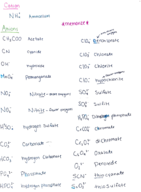
Calculating Formula Masses: From Barium Bromide to Hydrobromic Acid

Want To Learn More? To watch the entire video and ALL of the videos in the series:
full solution
Understand the process of calculating formula masses for various compounds. This video breaks down the atomic masses for elements in barium bromide, dinitrogen trioxide, copper(I) sulfate, and hydrobromic acid. Master the method of summing up the masses considering atom count in each formula.
Electronegativity & Acid Strength: Decoding Acid Formulas
Want To Learn More? To watch the entire video and ALL of the videos in the series:
full solution
This video discusses how the electronegativity of attached groups affects the strength of acids. Comparing pairs such as Chloroacetic vs Fluoroacetic and Acetic vs Nitroacetic acids, we highlight which is the stronger acid in each pair and why.
Physical vs Chemical Changes: Understanding Reactions & Transformation
Want To Learn More? To watch the entire video and ALL of the videos in the series:
full solution
Discover the differences between physical and chemical changes using common examples. Understand how sugar reacts in various scenarios, and how metals undergo changes, either maintaining their substance or forming new compounds.
Pseudo-Noble Gas Configurations: A Unique Path to Atomic Stability
Want To Learn More? To watch the entire video and ALL of the videos in the series:
full solution
Discover the concept of the pseudo-noble gas configuration, differentiating it from the traditional noble gas configuration. Examine examples like tin and indium to illustrate how elements achieve this unique state of stability. Unpack the intriguing intricacies within atomic structures.
Ethylene Glycol & Freezing Point in Antifreeze
Want To Learn More? To watch the entire video and ALL of the videos in the series:
full solution
We explore the impact of increasing the concentration of ethylene glycol in an antifreeze mixture, explaining the resulting effect on the freezing point of the solution by examining its interaction with water molecules.
Comparing Bond Types: Ethane's Nonpolarity vs. Fluoromethane's Ionic L
Want To Learn More? To watch the entire video and ALL of the videos in the series:
full solution
Examine the nature of bonds in methylamine, ethane, fluoromethane, and methanol. Identify ethane's nonpolar covalent bond and understand why fluoromethane's bond leans toward the ionic spectrum. Grasp essential concepts in molecular bonding with this deep analysis.