PreparED Study Materials

CHEM 7254: Chemical Principles I
School: Truman State University
Number of Notes and Study Guides Available: 0
Videos
Determining Bond Types: Ionic, Polar Covalent, or Covalent in Chemical

Want To Learn More? To watch the entire video and ALL of the videos in the series:
full solution
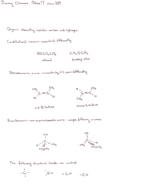
This discussion revolves around the classification of chemical bonds as ionic, polar covalent, or covalent based on the electronegativity difference between the atoms involved. The general criteria for this classification are explained: a difference greater than 1.7 indicates an ionic bond, between 0.5 and 1.7 signifies a polar covalent bond, and less than 0.5 designates a covalent bond. It then applies these criteria to four specific examples, including the CC bond in ethane (H?CCH?), the KI bo
Physical vs Chemical Changes: Understanding Reactions & Transformation
Want To Learn More? To watch the entire video and ALL of the videos in the series:
full solution
Discover the differences between physical and chemical changes using common examples. Understand how sugar reacts in various scenarios, and how metals undergo changes, either maintaining their substance or forming new compounds.
Connecting Volume & Moles: A Deep Look at Gas Stoichiometry & Ideal Ga
Want To Learn More? To watch the entire video and ALL of the videos in the series:
full solution
Understand gas stoichiometry by exploring the Ideal Gas Law, which integrates key laws like Gay-Lussac's, Charles's, Avogadro's, and Boyle's. Discover how this equation helps determine relationships between gas volumes and moles in reactions.
Crafting Ionic and Net Ionic Equations: Step-by-Step Guide with Exampl
Want To Learn More? To watch the entire video and ALL of the videos in the series:
full solution
Discover how to craft balanced, complete ionic, and net ionic equations for various chemical reactions. Learn the significance of aqueous ions and solid state indicators in these equations.
Understanding Polar & Nonpolar Molecules: From Diazene to Nitrogen Dio
Want To Learn More? To watch the entire video and ALL of the videos in the series:
full solution
Explore the properties of various molecules like diazene, hydrogen peroxide, and carbon tetrafluoride. Understand the influence of molecular shape and electronegativity on polarity. Discover why some are polar while others are nonpolar based on their structure.
Drawing Lewis Structures for Potassium, Barium, Aluminum, and Bromine
Want To Learn More? To watch the entire video and ALL of the videos in the series:
full solution
We explore Lewis structures, which depict atom bonding and lone electron pairs. We create Lewis structures for potassium, barium, aluminum, and bromine by using group numbers in the periodic table to determine their valence electrons.