PreparED Study Materials

CHEM 7256: Chemical Principles I
School: Truman State University
Number of Notes and Study Guides Available: 0
Videos
Identifying Fundamental Units in Rb?O, N?, Fe(NO?)?, and N?F?

Want To Learn More? To watch the entire video and ALL of the videos in the series:
full solution
In this exploration, we delve into the fundamental units of various substances, whether they are single atoms, molecules, or formula units. We examine ionic compounds like Rb?O and Fe(NO?)?, characterized by formula units as their basic components, and covalent compounds like N? and N?F?, where molecules are the fundamental units.
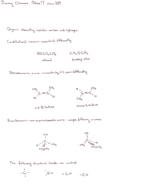
Classifying Formaldehyde, Methanol, Dichloromethane & CO?: Polar or No
Want To Learn More? To watch the entire video and ALL of the videos in the series:
full solution
Explore the classification of select molecules based on their polarity. Understand the electron distribution and molecular shapes of Formaldehyde, Methanol, Dichloromethane, and Carbon dioxide. Discover which ones exhibit a net dipole moment and which ones don't.
Amino Acid Reaction: Peptide Bond Formation and Product Diversity
Want To Learn More? To watch the entire video and ALL of the videos in the series:
full solution
Explore the reaction between alanine and glycine, two amino acids, and unravel whether this process results in multiple reaction products. We'll delve into the intriguing world of peptide bond formation and examine the potential diversity of products that may emerge from this biochemical reaction."
The Wobble Concept: Explaining Codon Variability in Amino Acid Encodin
Want To Learn More? To watch the entire video and ALL of the videos in the series:
full solution
Join us as we delve into the intriguing world of genetic coding and discover how the concept of wobble accounts for variations in codons encoding a single amino acid.
Calculating Percent Composition: Using Molecular Formulas & Atomic Mas
Want To Learn More? To watch the entire video and ALL of the videos in the series:
full solution
Understand the process of calculating percent composition using the molecular formula. Grasp the methodology with compounds like C2H4O2, CH2O2, and more. Discover how atomic masses influence the mass percent of elements in various compounds.
Understanding Average Speed in Kinetic Molecular Theory
Want To Learn More? To watch the entire video and ALL of the videos in the series:
full solution
The kinetic molecular theory of gases describes the random motion and speed distribution of gas molecules in a container, and when considering various statements about the average speeds of these molecules, it's important to understand how they behave under different conditions.