PreparED Study Materials

CHEM 7261: Chemical Principles II
School: Truman State University
Number of Notes and Study Guides Available: 0
Videos
Aluminum & Iron(III) Oxide Reaction: Welding Heat & Calculations

Want To Learn More? To watch the entire video and ALL of the videos in the series:
full solution
Explore the chemical reaction between Aluminum and Iron (III) Oxide commonly used in welding. Learn to calculate the mass of Aluminum Oxide formed and identify the excess reagent. Dive deep into molar mass conversions stoichiometry and real-world applications in this chemistry tutorial.
Structures & Classifications of C?H?? Alkyl Groups: From Primary to Te
Want To Learn More? To watch the entire video and ALL of the videos in the series:
full solution
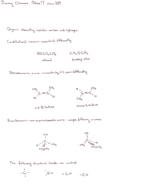
Explore the diverse structures of C?H?? alkyl groups and classify them into primary, secondary, or tertiary categories. Through a visualization of carbon atom arrangements, uncover the nuances of n-pentyl, sec-pentyl, tert-pentyl, isopentyl, and neopentyl structures.
Hypothesis to Theory: The Evolution of Scientific Understanding
Want To Learn More? To watch the entire video and ALL of the videos in the series:
full solution
Delve into the journey of scientific ideas as we discuss how a hypothesis can evolve into a theory, and whether a theory can ever become a law. Uncover the distinctions and connections between these fundamental elements of scientific understanding in this illuminating video.
The original sulfur quantity (tons) for 26M tons SO?
Want To Learn More? To watch the entire video and ALL of the videos in the series:
full solution
Explore the environmental impact of sulfur dioxide production, revealing how 26 million tons of this compound conceal 13 million tons of sulfur. It delves into the chemistry of this transformation, converting atomic and molecular masses, providing valuable insights into emissions from activities like burning coal and auto exhaust."
Ethane Hydrazine or Fluoromethane: Which is Liquid at Room Temp?
Want To Learn More? To watch the entire video and ALL of the videos in the series:
full solution
Explore the states of ethane hydrazine and fluoromethane at room temperature by understanding intermolecular forces. Learn about nonpolar molecules dipole-dipole interactions and the powerful influence of hydrogen bonding. Discover why hydrazine stands out as most likely to be a liquid in everyday conditions.
Deriving the Perfect Gas Equation from Gas Laws
Want To Learn More? To watch the entire video and ALL of the videos in the series:
full solution
Learn how the ideal gas equation is derived from Boyle's law, Charles’ law, and Avogadro's principle, unraveling the fundamentals of gas behavior.