PreparED Study Materials

CHEM 7263: Chemical Principles II
School: Truman State University
Number of Notes and Study Guides Available: 1
Notes

Videos
Identifying Elements, Compounds, and Mixtures

Want To Learn More? To watch the entire video and ALL of the videos in the series:
full solution
Join us in this enlightening video where we unravel the world of chemistry. We'll examine a series of options to identify elements, compounds, and mixtures. Explore the fascinating world of matter and discover how to distinguish these fundamental concepts. Whether you're a student or simply curious about the world of chemistry, this video will help you sharpen your understanding of the building blocks of matter.
Disulfur Decafluoride Disproportionation & Sulfur Oxidation States
Want To Learn More? To watch the entire video and ALL of the videos in the series:
full solution
This video explains the disproportionation reaction of disulfur decafluoride at 150°C. It teaches you to write a balanced equation for this reaction and give the oxidation state of S in each compound.
Decoding Electron Configurations: From Rubidium to Argon Explained
Want To Learn More? To watch the entire video and ALL of the videos in the series:
full solution
Explore the intricacies of electron configurations around the atomic nucleus. Understand the ordered filling of energy levels in atoms like Rubidium, Germanium, and Argon. A deep look into the ground-state configurations of key elements.
Comparing Bond Types: Ethane's Nonpolarity vs. Fluoromethane's Ionic L
Want To Learn More? To watch the entire video and ALL of the videos in the series:
full solution
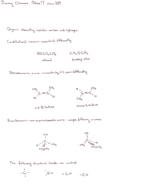
Examine the nature of bonds in methylamine, ethane, fluoromethane, and methanol. Identify ethane's nonpolar covalent bond and understand why fluoromethane's bond leans toward the ionic spectrum. Grasp essential concepts in molecular bonding with this deep analysis.
Quantitative vs Non-Quantitative: Precision in Scientific Observations
Want To Learn More? To watch the entire video and ALL of the videos in the series:
full solution
Unpack the difference between quantitative and non-quantitative observations. Examples include a person's weight on the Moon and the depth a hand pump can reach. Learn why precise measurements are crucial in scientific studies.
Diluting a 5.5 M KCl Solution to 0.100 M
Want To Learn More? To watch the entire video and ALL of the videos in the series:
full solution
Learn the steps to make a 2.5 L of 0.100 M KCl solution from a 5.5 M stock solution in this easy-to-follow tutorial.