PreparED Study Materials

CHEM 1120: General Chemistry II
School: Tennessee Tech University
Number of Notes and Study Guides Available: 3
Notes



Videos
Electronegativity & Acid Strength: Decoding Acid Formulas

Want To Learn More? To watch the entire video and ALL of the videos in the series:
full solution
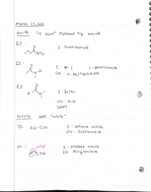
This video discusses how the electronegativity of attached groups affects the strength of acids. Comparing pairs such as Chloroacetic vs Fluoroacetic and Acetic vs Nitroacetic acids, we highlight which is the stronger acid in each pair and why.
Ether Structures: Ethyl to Dipentyl Varieties Drawn
Want To Learn More? To watch the entire video and ALL of the videos in the series:
full solution
Explore the chemical structures of four distinct ethers: ethyl propyl ether dibutyl ether methyl hexyl ether and dipentyl ether. Understand the role of ether groups which involve an oxygen atom connected to two alkyl or aryl groups.
Want To Learn More? To watch the entire video and ALL of the videos in the series:
full solution
Number of molecules in 3.5g H?O, 56.1g N?, 89g CCl?, 19g C?H??O?
Want To Learn More? To watch the entire video and ALL of the videos in the series:
full solution
This video shows how to determine the number of molecules in a given sample by utilizing the concept of moles, Avogadro's number (6.022 x 10²³), and the molar mass of the substance. It provides step-by-step calculations for different substances, converting mass to the number of molecules and highlighting the versatile application of this approach.
Determining Oil & Ball Bearing Density: Physics Explained
Want To Learn More? To watch the entire video and ALL of the videos in the series:
full solution
Discover how to determine the density of mineral oil and a metal ball bearing using a graduated cylinder. Learn the method of calculating the mass difference and volume to deduce the density and radius of the ball. Watch a detailed physics experiment explained step by step.
Density Explained: Calculating the Density of an Osmium Cube
Want To Learn More? To watch the entire video and ALL of the videos in the series:
full solution
In this tutorial, we break down the principle of density, illustrating it as a measure of mass per unit volume. Using an osmium cube as a practical example, we walk viewers through the steps of computing its density, demonstrating the interplay between mass, volume, and particle arrangement.