PreparED Study Materials

CHEM 2810: History of Scientific Thought
School: Tennessee Tech University
Number of Notes and Study Guides Available: 0
Videos
Evolutionary Implications of Cytochromes vs. Hemoglobin and Myoglobin

Want To Learn More? To watch the entire video and ALL of the videos in the series:
full solution
In this video, we delve into the fascinating world of evolutionary adaptations in heme-containing proteins.
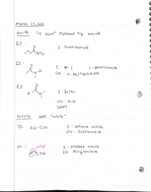
Amino Acid Structural Formulas at Low pH
Want To Learn More? To watch the entire video and ALL of the videos in the series:
full solution
Explore the protonation of amino acids, specifically valine and threonine, when subjected to a pH lower than their isoelectric points, highlighting the structural changes in their carboxyl and amino groups.
Positron Emission Nuclear Equations: Co-55, Na-22, F-18
Want To Learn More? To watch the entire video and ALL of the videos in the series:
full solution
Learn how to write nuclear equations for positron emission with Co-55, Na-22, and F-18. Explore the fascinating world of nuclear reactions.
Identify the 3' and 5' ends of the DNA segment AGTCAT
Want To Learn More? To watch the entire video and ALL of the videos in the series:
full solution
This video discusses the fundamental concept of DNA structure, focusing on the identification of the 3' and 5' ends of a DNA segment, specifically highlighting the sequence AGTCAT and its importance in understanding DNA strand direction for processes like replication and transcription.
Why is the study of chiral molecules important in biochemistry?
Want To Learn More? To watch the entire video and ALL of the videos in the series:
full solution
This discussion highlights the significance of studying chiral molecules in biochemistry, emphasizing their impact on biological activity, molecular recognition, pharmacokinetics, and biomedical research, without revealing specific examples or findings.
Calculate oxygen molar concentration in water at 25°C with a partial p
Want To Learn More? To watch the entire video and ALL of the videos in the series:
full solution
This video explores molar concentration (molarity) and demonstrates the calculation of oxygen's molar concentration in water at 25°C, considering a partial pressure of 0.22 atm by employing Henry's Law and the given Henry's Law constant for oxygen, revealing that under these conditions, there are 2.86 x 10?? moles of oxygen per liter of water, highlighting the significance of understanding these concepts for managing gas dissolution in liquids across varying circumstances.