PreparED Study Materials

CHEM 383: Introduction to Chemistry
School: Old Dominion University
Number of Notes and Study Guides Available: 0
Videos
Classify: (a) Mixture (b) Element (c) Mixture (d) Compound

Want To Learn More? To watch the entire video and ALL of the videos in the series:
full solution
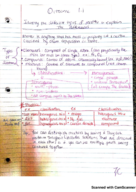
In this video, we classify substances as elements, compounds, or mixtures, with air and soy sauce as mixtures, iron as an element, and table salt as a compound.
Chromium(III) Oxide Reaction: Calculating Precise Quantities
Want To Learn More? To watch the entire video and ALL of the videos in the series:
full solution
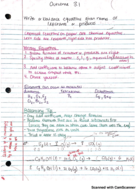
Learn the art of precise chemical calculations in this video. Discover how Chromium(III) oxide reacts with hydrogen sulfide to form chromium(III) sulfide and water, all while unraveling the necessary steps to determine the exact quantities involved.
Mole Fractions, Partial Pressures, and Total Pressure Calculation
Want To Learn More? To watch the entire video and ALL of the videos in the series:
full solution
Explore the calculations for mole fractions, partial pressures, and total pressure in a 22.4 dm³ vessel with H? and N? at 273.15 K.
Mastering Mass, Moles, Formula Units & Atoms
Want To Learn More? To watch the entire video and ALL of the videos in the series:
full solution
Discover how to precisely calculate mass, moles, formula units, and atoms in various compounds. Understand the concept with examples like chromium(III) sulfate decahydrate, dichlorine heptoxide, and lithium sulfate. Master chemistry calculations through a step-by-step guide.
Determining Ionizable H Atoms in Malonic Acid via Neutralization
Want To Learn More? To watch the entire video and ALL of the videos in the series:
full solution
Explore the process of determining ionizable hydrogen atoms in malonic acid using its molecular formula C3H4O4 and a neutralization reaction with Sodium hydroxide. Through methodical calculations involving the given mass of malonic acid and the required volume of Sodium hydroxide for neutralization we uncover that each molecule of malonic acid contains two ionizable H atoms.
Molecular Lewis Structures for CH?, CO?, H?Se, and NH?
Want To Learn More? To watch the entire video and ALL of the videos in the series:
full solution
In this video, we demonstrate the creation of Lewis structures for methane, carbon dioxide, hydrogen selenide, and ammonia, highlighting the arrangement of atoms and bonds in each molecule. The video emphasizes the importance of Lewis structures in visualizing atomic bonding and the presence of lone electron pairs.