PreparED Study Materials

PHY 2050: Philosophy: The Big Questions
School: Wright State University
Number of Notes and Study Guides Available: 12
Notes
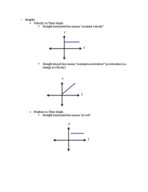
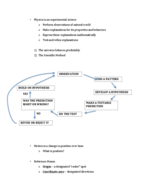
Modern antagonism facing philosophy (Physics)
PHY 2050
Wright State University
2 pages | Summer 2015
Study Guides

Videos
Vector Addition: Can Different Magnitudes Equal Zero?

Want To Learn More? To watch the entire video and ALL of the videos in the series:
full solution
Join us in exploring the fascinating world of vectors and vector addition. In this video, we answer a fundamental question: Can two vectors with different magnitudes ever sum to zero? Delve into the principles of vector mathematics and discover the insights behind this intriguing concept. Tune in for a mind-expanding journey through the world of mathematics!
Angle Conversion: Radians to Degrees and Degrees to Radians
Want To Learn More? To watch the entire video and ALL of the videos in the series:
full solution
Learn how to convert between radians and degrees for various angle measurements, expanding your understanding of angular units.
Warming Inhaled Air: Volume Increase Calculation
Want To Learn More? To watch the entire video and ALL of the videos in the series:
full solution
Explore the fascinating science of air temperature change in this video! We calculate how the volume of inhaled air increases as it warms from 0.0°C to body temperature. Discover the principles of thermal expansion in the human body.
Spacecraft Speed Change in 1 Week with 0.09-N Thrust
Want To Learn More? To watch the entire video and ALL of the videos in the series:
full solution
Discover the impact of a 0.09-N thrust engine on a 480 kg spacecraft's speed during 1 week of maximum power operation. Uncover the assumptions involved in this space physics scenario.
Calculating k, Amplitude & Frequency for Fisherman's Scale
Want To Learn More? To watch the entire video and ALL of the videos in the series:
full solution
In this video we tackle the real-world physics problem of calculating the spring constant for a fisherman's scale along with the amplitude and frequency of its vibrations when a fish is added. We use Hooke's Law to find the spring constant and then apply oscillation formulas to determine the amplitude and frequency of the fish's vibrations
Understanding the Law of Conservation of Mass in Chemical Reactions
Want To Learn More? To watch the entire video and ALL of the videos in the series:
full solution
Explore the fundamental principles of this law, unraveling its implications, and clarifying common misconceptions related to mass preservation in chemical reactions.