PreparED Study Materials

CHM 221: Survey of Analytical Chemistry
School: Grand Valley State University
Number of Notes and Study Guides Available: 0
Videos
Mole Fractions, Partial Pressures, and Total Pressure Calculation

Want To Learn More? To watch the entire video and ALL of the videos in the series:
full solution
Explore the calculations for mole fractions, partial pressures, and total pressure in a 22.4 dm³ vessel with H? and N? at 273.15 K.
Reactions of Isopentyl Bromide with Various Reagents
Want To Learn More? To watch the entire video and ALL of the videos in the series:
full solution
Explore the fascinating reactions of isopentyl bromide with a variety of reagents and uncover the expected products in each scenario.
Molecular Geometry & Polarity: Why CO? & CCl? Are Nonpolar Explained
Want To Learn More? To watch the entire video and ALL of the videos in the series:
full solution
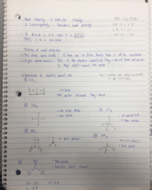
Uncover the intriguing relationship between molecular geometry and polarity in chemistry. Using CO? and CCl? as examples, learn how polar bonds can result in nonpolar molecules. Recognize the role of symmetry in determining molecular polarity.
Reaction Rate Impact: Ethanol, Tert-Butyl Bromide & Temp
Want To Learn More? To watch the entire video and ALL of the videos in the series:
full solution
Explore the intricacies of reaction rates with varying concentrations of ethanol and tert-butyl bromide. Understand the principles of SN1 reactions and the impacts of temperature on rate acceleration. Grasp the core elements that influence and optimize chemical reactions in diverse applications.
Density Explained: Calculating the Density of an Osmium Cube
Want To Learn More? To watch the entire video and ALL of the videos in the series:
full solution
In this tutorial, we break down the principle of density, illustrating it as a measure of mass per unit volume. Using an osmium cube as a practical example, we walk viewers through the steps of computing its density, demonstrating the interplay between mass, volume, and particle arrangement.
Understanding Key Assumptions of Kinetic Molecular Theory in Detail!
Want To Learn More? To watch the entire video and ALL of the videos in the series:
full solution
Dive into the Kinetic Molecular Theory of Matter understanding how atoms and molecules possess kinetic energy which we measure as temperature. Explore the five core assumptions including the constant random motion of gas particles and the relation between kinetic energy and temperature. Demystify the concepts of particle collisions intermolecular interactions and the universal behavior of gases at given temperatures