PreparED Study Materials

CHM 10817: Introductory Chemistry
School: Grand Valley State University
Number of Notes and Study Guides Available: 0
Videos
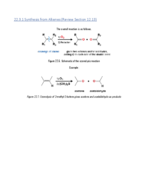
Why geometric isomerism is not possible in alkynes

Want To Learn More? To watch the entire video and ALL of the videos in the series:
full solution
This video provides insights into the concept of geometric isomerism in organic chemistry and explains why alkynes, which contain carbon-carbon triple bonds and adopt a linear structure, cannot exhibit this form of isomerism, unlike alkenes with double bonds that restrict rotation.
Intermolecular Forces in HCl, F?, and C?H??
Want To Learn More? To watch the entire video and ALL of the videos in the series:
full solution
Explore the fascinating world of intermolecular forces in this brief video, featuring HCl, F?, and C?H?? molecules. Learn about the bonds that hold these substances together!
CO?: Linear & Nonpolar with Temp Dipole Moments Explained!
Want To Learn More? To watch the entire video and ALL of the videos in the series:
full solution
Uncover the nuances of the CO? molecule's polarity and its electron dynamics. Understand how bending and stretching motions influence its electron density. Grasp the analogy of CO? to a jumping rope, highlighting its overall nonpolar nature.
Evolutionary Implications of Cytochromes vs. Hemoglobin and Myoglobin
Want To Learn More? To watch the entire video and ALL of the videos in the series:
full solution
In this video, we delve into the fascinating world of evolutionary adaptations in heme-containing proteins.
Mass of Solutions: 12g Sucrose in 4.1%, 3.2%, & 12.5% Cases
Want To Learn More? To watch the entire video and ALL of the videos in the series:
full solution
Determining the total mass of sucrose solutions at varying concentrations: 4.1% 3.2% and 12.5%. Learn step-by-step calculations to find solution masses containing 12 grams of sucrose. Results: ~292.68g ~375g and 96g for each concentration respectively.
Protons reveal electron count in atoms. Which statement applies?
Want To Learn More? To watch the entire video and ALL of the videos in the series:
full solution
In this video, we explore the information that knowledge of the number of protons in a neutral element's atom can provide. Options for determining neutron count, electron count, and identifying the element's name are examined, with a conclusion that it allows us to know both the number of electrons and the element's name.