PreparED Study Materials

CHM 10828: Introductory Chemistry
School: Grand Valley State University
Number of Notes and Study Guides Available: 1
Notes

Videos
Breaking Down Mixtures: Finding Mass Percent of Sodium Compounds

Want To Learn More? To watch the entire video and ALL of the videos in the series:
full solution
Uncover the method to determine mass percentages of Sodium Bromide and Sodium Sulfate in a mixture using the given Sodium content. Walk through a step-by-step calculation leveraging molar masses to derive the composition. Discover the resulting mass percentages: 23.85% for Sodium Bromide and 76.15% for Sodium Sulfate
Molecular Geometries Explained: From N?O to PF? - Shape and Structure
Want To Learn More? To watch the entire video and ALL of the videos in the series:
full solution
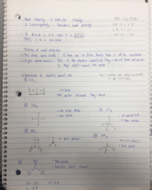
Discover the distinct geometries of molecules like N?O, SO?, H?S, and PF?. Unravel the difference between molecular and electron shapes. Master the basics of linear, bent, tetrahedral, and trigonal pyramidal structures.
Converting Various Units: Weight, Time, Height, and Volume
Want To Learn More? To watch the entire video and ALL of the videos in the series:
full solution
This video focuses on unit conversions and the practical use of conversion factors to translate quantities between different units. It provides clear examples of converting 70 kilograms to pounds, translating 14 billion years into seconds, changing the height of a basketball player from feet and inches to meters, and converting cubic meters to liters, illustrating the importance of this skill in various scientific and everyday scenarios.
Determining Ionizable H Atoms in Malonic Acid via Neutralization
Want To Learn More? To watch the entire video and ALL of the videos in the series:
full solution
Explore the process of determining ionizable hydrogen atoms in malonic acid using its molecular formula C3H4O4 and a neutralization reaction with Sodium hydroxide. Through methodical calculations involving the given mass of malonic acid and the required volume of Sodium hydroxide for neutralization we uncover that each molecule of malonic acid contains two ionizable H atoms.
Molecular Geometry & Polarity: Why CO? & CCl? Are Nonpolar Explained
Want To Learn More? To watch the entire video and ALL of the videos in the series:
full solution
Uncover the intriguing relationship between molecular geometry and polarity in chemistry. Using CO? and CCl? as examples, learn how polar bonds can result in nonpolar molecules. Recognize the role of symmetry in determining molecular polarity.
Lewis Structures with Atom Connections & Charges
Want To Learn More? To watch the entire video and ALL of the videos in the series:
full solution
Learn how to create Lewis structures for various molecules and assign charges where needed. Understand the molecular connectivity and electron distribution.