PreparED Study Materials

Notes


Videos
Determining Formula Mass: Step-by-Step Approach Using Atomic Masses

Want To Learn More? To watch the entire video and ALL of the videos in the series:
full solution
Discover the method to determine the formula mass for various compounds. Learn about the importance of atomic masses and their role in compounds like Aluminium sulfate, Diphosphorus Trioxide, and more. Understand the step-by-step approach to accurately calculate molecular weights.
Unraveling Hydrocarbon Structures: Decoding Degrees of Unsaturation
Want To Learn More? To watch the entire video and ALL of the videos in the series:
full solution
Explore the concept of the degree of unsaturation in hydrocarbons. Understand its importance in revealing double bonds, triple bonds, or rings. Learn through examples like limonene, squalene, and lycopene.
Electron Configuration of Phosphorus: Decoding Atomic & Orbital Struct
Want To Learn More? To watch the entire video and ALL of the videos in the series:
full solution
Discover the intricacies of the electron configuration for phosphorus, from its atomic number to its orbital notation. Learn about unpaired electrons, energy levels, and the significance of inner-shell electrons. Understand how orbital structures define an element's properties.
Strong Base Comparison: H?S?, CH?O?, CH?OH, Cl?, CH?COO?, CH?CHClCOO
Want To Learn More? To watch the entire video and ALL of the videos in the series:
full solution
Explore the reactivity of different bases in this chemistry comparison. We'll analyze the strength of H?S?, CH?O?, CH?OH, Cl?, CH?COO?, and CH?CHClCOO? in various reactions.
Understanding Average Speed in Kinetic Molecular Theory
Want To Learn More? To watch the entire video and ALL of the videos in the series:
full solution
The kinetic molecular theory of gases describes the random motion and speed distribution of gas molecules in a container, and when considering various statements about the average speeds of these molecules, it's important to understand how they behave under different conditions.
Converting Moles to Grams: Aluminum & Chlorine Atomic Mass Breakdown
Want To Learn More? To watch the entire video and ALL of the videos in the series:
full solution
"Explore the intricate world of atomic masses using aluminum and chlorine as examples. Understand the concept of 'mole' and its relevance in chemistry. Learn to calculate masses of moles for elements based on atomic weights.
Textbook Solutions (0)
Top Selling Study Tools

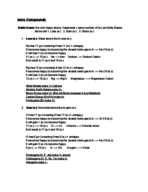
Chem 1332, chapter 10, 11 (week 2) (Chemistry)
CHEM 14833
University of Houston
12 pages | Fall 2016