PreparED Study Materials

Notes
Videos
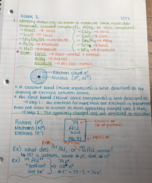
Decoding Ions: Al³?, S²?, I?, Ag? & Their Electron-Proton Dynamics

Want To Learn More? To watch the entire video and ALL of the videos in the series:
full solution
Break down the mysteries of ions like Al³?, S²?, I?, and Ag?. Discover how the electron count impacts ion charge by exploring Aluminium, Sulfur, Iodine, and Silver. Enhance your understanding of protons, electrons, and their relationship in ions.
Finding NaOH Molarity: Titration of 0.200L SO?-Derived H?SO? Solution
Want To Learn More? To watch the entire video and ALL of the videos in the series:
full solution
Determine the molarity of a NaOH solution through titration with sulfurous acid. Starting with the ideal gas equation we derive the concentration of a 0.200L SO?-derived H?SO? solution. Concluding with a molarity of 1.64 M for NaOH using calculated values.
Why is Chloromethane Polar but Methane Nonpolar? Decoding Molecule Sha
Want To Learn More? To watch the entire video and ALL of the videos in the series:
full solution
Explore the polar nature of Chloromethane and the nonpolar characteristics of Methane. Understand the impact of electronegativity differences and bond types. Deciphering molecular polarity through the lens of tetrahedral structures.
Volume of 49.8g HCl Gas at STP: Finding the Answer in Liters
Want To Learn More? To watch the entire video and ALL of the videos in the series:
full solution
This video guides viewers through the process of calculating the volume occupied by Hydrochloric acid gas or HCl at standard temperature and pressure. Using the molar mass of HCl and its properties as an ideal gas the tutorial comprehensively explains each step to determine the volume from a given mass at STP. A must-watch for understanding gas volume conversions in chemistry
Connecting Volume & Moles: A Deep Look at Gas Stoichiometry & Ideal Ga
Want To Learn More? To watch the entire video and ALL of the videos in the series:
full solution
Understand gas stoichiometry by exploring the Ideal Gas Law, which integrates key laws like Gay-Lussac's, Charles's, Avogadro's, and Boyle's. Discover how this equation helps determine relationships between gas volumes and moles in reactions.
Utilizing Chemical Names and Symbols in Copper Cycle Analysis
Want To Learn More? To watch the entire video and ALL of the videos in the series:
full solution
Explore the power of chemical names and symbols in deciphering copper compound formation at each step of the copper cycle, with an illustrative example.