PreparED Study Materials

CHEM 110: Chemical Principles I
School: Pennsylvania State University
Number of Notes and Study Guides Available: 83
Notes














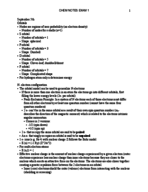
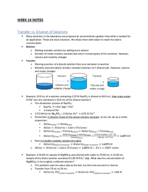


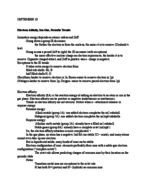



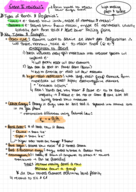
Study Guides























Videos
Ionic vs. Molecular: Classifying Compounds & Metal Ion Varieties!

Want To Learn More? To watch the entire video and ALL of the videos in the series:
full solution
Discover the art of classifying compounds as ionic or molecular based on bonding. Unravel the nuances between ionic and covalent bonds using electronegativity differences as a guide. Classify CoCl2 CF4 BaSO4 and NO with in-depth explanations and predict their properties.
Identifying Fundamental Units in Rb?O, N?, Fe(NO?)?, and N?F?
Want To Learn More? To watch the entire video and ALL of the videos in the series:
full solution
In this exploration, we delve into the fundamental units of various substances, whether they are single atoms, molecules, or formula units. We examine ionic compounds like Rb?O and Fe(NO?)?, characterized by formula units as their basic components, and covalent compounds like N? and N?F?, where molecules are the fundamental units.
Calculate oxygen molar concentration in water at 25°C with a partial p
Want To Learn More? To watch the entire video and ALL of the videos in the series:
full solution
This video explores molar concentration (molarity) and demonstrates the calculation of oxygen's molar concentration in water at 25°C, considering a partial pressure of 0.22 atm by employing Henry's Law and the given Henry's Law constant for oxygen, revealing that under these conditions, there are 2.86 x 10?? moles of oxygen per liter of water, highlighting the significance of understanding these concepts for managing gas dissolution in liquids across varying circumstances.
Classify: (a) Mixture (b) Element (c) Mixture (d) Compound
Want To Learn More? To watch the entire video and ALL of the videos in the series:
full solution
In this video, we classify substances as elements, compounds, or mixtures, with air and soy sauce as mixtures, iron as an element, and table salt as a compound.
Diluting a 5.5 M KCl Solution to 0.100 M
Want To Learn More? To watch the entire video and ALL of the videos in the series:
full solution
Learn the steps to make a 2.5 L of 0.100 M KCl solution from a 5.5 M stock solution in this easy-to-follow tutorial.
Understanding Average Speed in Kinetic Molecular Theory
Want To Learn More? To watch the entire video and ALL of the videos in the series:
full solution
The kinetic molecular theory of gases describes the random motion and speed distribution of gas molecules in a container, and when considering various statements about the average speeds of these molecules, it's important to understand how they behave under different conditions.