PreparED Study Materials

CEM 252: Organic Chemistry II
School: Michigan State University
Number of Notes and Study Guides Available: 29
Notes




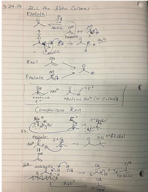


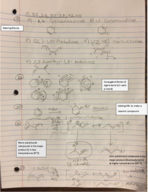
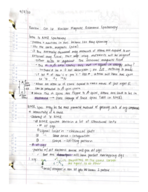




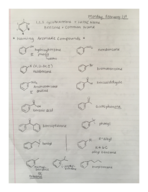

Study Guides

Videos
Copper Bombardment: Calculating X-ray Photon Energy

Want To Learn More? To watch the entire video and ALL of the videos in the series:
full solution
We'll guide you through the process of calculating the energy associated with X-ray photons when the wavelength is 0.154 nm. This video offers a practical application of physics and helps you understand the energy spectrum of X-rays. Whether you're a science enthusiast or a student, you'll gain valuable insights into this intriguing topic.
Homogeneous vs Heterogeneous Mixtures: Examples & Classification Expla
Want To Learn More? To watch the entire video and ALL of the videos in the series:
full solution
Explore the distinction between homogeneous and heterogeneous mixtures. Through real-world examples like baby oil, chocolate chip cookies, and wine, understand their uniformity, phases, and how components are distributed.
Using Avogadro's Number: Calculating Moles of Aluminum & Iron Atoms
Want To Learn More? To watch the entire video and ALL of the videos in the series:
full solution
Learn how to determine the number of moles in a given set of atoms using Avogadro's number. This tutorial breaks down the calculation for Aluminum and Iron, simplifying the concept for better understanding.
Constitution of Compounds: CH4O, CH3Cl, C2H6, CH5N, C2F6, C2H5Br, C3H8
Want To Learn More? To watch the entire video and ALL of the videos in the series:
full solution
Unraveling Molecular Structures: Explore the composition of compounds with molecular formulas CH4O, CH3Cl, C2H6, CH5N, C2F6, C2H5Br, and C3H8. Learn about their unique structures and properties.
Want To Learn More? To watch the entire video and ALL of the videos in the series:
full solution
Dimethylamine vs. Trimethylamine: Structures & Boiling Points
Want To Learn More? To watch the entire video and ALL of the videos in the series:
full solution
Uncover the science behind boiling points and molecular interactions in this video. Explore why Dimethylamine boils at a higher temperature than Trimethylamine, despite having a lower molecular weight, and gain insights into the role of molecular structures in determining physical properties.