PreparED Study Materials

CHEM 107: General College Chemistry
School: Brigham Young University
Number of Notes and Study Guides Available: 7
Notes


Study Guides

Videos
Argon Isotopes: Protons, Neutrons & Electrons Breakdown

Want To Learn More? To watch the entire video and ALL of the videos in the series:
full solution
Explore the captivating branches of philosophy, understanding ethics as our moral guide, aesthetics as the interpreter of beauty, and logic as the foundation for clear reasoning. Delight in the insights these disciplines offer, enhancing our perspectives on life, art, and thought.
Calculating the Mass of a Sucrose Crystal: A Chemistry Insight
Want To Learn More? To watch the entire video and ALL of the videos in the series:
full solution
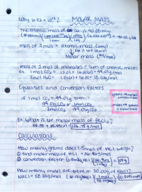
Explore the fascinating world of chemistry as we calculate the mass of a sugar crystal with 1.8 x 10¹? molecules of sucrose. Using the concept of a mole and Avogadro's number, discover how to convert molecular numbers to milligrams. Grasp foundational principles in a clear, engaging format.
Calculating Vapor Pressure & Its Lowering: Urea in Water at 35°C
Want To Learn More? To watch the entire video and ALL of the videos in the series:
full solution
Explore the intriguing process of determining the vapor pressure of a urea-water solution at 35°C. Using Raoult's law we'll calculate the mole fraction of water and urea leading to the solution's vapor pressure. Learn how the solution's composition affects vapor-pressure lowering
Strong vs. Weak Acids: Ionization Differences in Water
Want To Learn More? To watch the entire video and ALL of the videos in the series:
full solution
Uncover the distinct behaviors of hydrochloric acid and acetic acid in water. Learn about the complete ionization of strong acids and the partial ionization of weak ones, emphasizing the differentiation in proton donation.
Calculating [H?] in HNO? Solution Halfway to Equivalence with KOH
Want To Learn More? To watch the entire video and ALL of the videos in the series:
full solution
Unraveling HNO? Titration: Calculating [H?] Halfway with KOH. Harness the Henderson-Hasselbalch equation for pH determination. Discover the pH at midpoint between weak acid and strong base titration.
Determining Ionizable H Atoms in Malonic Acid via Neutralization
Want To Learn More? To watch the entire video and ALL of the videos in the series:
full solution
Explore the process of determining ionizable hydrogen atoms in malonic acid using its molecular formula C3H4O4 and a neutralization reaction with Sodium hydroxide. Through methodical calculations involving the given mass of malonic acid and the required volume of Sodium hydroxide for neutralization we uncover that each molecule of malonic acid contains two ionizable H atoms.