PreparED Study Materials

CHM 2210: Organic Chemistry I
School: Florida State University
Number of Notes and Study Guides Available: 49
Notes














Study Guides




Videos
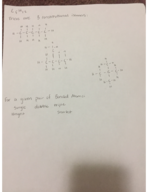
Lewis Structures with Atom Connections & Charges

Want To Learn More? To watch the entire video and ALL of the videos in the series:
full solution
Learn how to create Lewis structures for various molecules and assign charges where needed. Understand the molecular connectivity and electron distribution.
Key Biochemical Concepts: Polymer, Protein, Nucleic Acid, Catalysis, G
Want To Learn More? To watch the entire video and ALL of the videos in the series:
full solution
In biochemistry, polymers are essential macromolecules, including carbohydrates, lipids, proteins, and nucleic acids, each adopting specific shapes and performing vital functions within cells, with proteins serving diverse roles, nucleic acids carrying genetic information, catalysis expediting reactions, and the genetic code enabling protein synthesis.
Making a 0.150 M Ba(OH)? Solution: A Step-by-Step Guide
Want To Learn More? To watch the entire video and ALL of the videos in the series:
full solution
Learn how to calculate the amount of Barium hydroxide, Ba(OH)?, needed to prepare a specific molar concentration. This tutorial breaks down the relationship between moles of hydroxide ions and moles of Ba(OH)?, guiding users through each step for precise results. Embrace the essence of molarity in solution preparation.
pAg in KI & AgNO3 Titration: Exploring 39mL & 44.30mL Volumes
Want To Learn More? To watch the entire video and ALL of the videos in the series:
full solution
Exploring the titration of 25.00 mL of 0.08230 M KI with 0.05110 M AgNO3. This video breaks down the calculation process for the potential of silver ion at various volumes of added AgNO3: 39.00 mL equivalence point and 44.30 mL. With clear steps and using the solubility product constant understand how the potential of silver ion is determined for each scenario.
1828 Synthesis of Urea: Pioneering Steps in Biochemistry
Want To Learn More? To watch the entire video and ALL of the videos in the series:
full solution
Explore the groundbreaking moment in 1828 when Wöhler synthesized urea, the first organic compound. Join us in this video as we trace the profound impact of this achievement on the field of biochemistry and its significance in unraveling the mysteries of life's complex chemistry.
Ionic vs. Molecular: Classifying Compounds & Metal Ion Varieties!
Want To Learn More? To watch the entire video and ALL of the videos in the series:
full solution
Discover the art of classifying compounds as ionic or molecular based on bonding. Unravel the nuances between ionic and covalent bonds using electronegativity differences as a guide. Classify CoCl2 CF4 BaSO4 and NO with in-depth explanations and predict their properties.