PreparED Study Materials

CHEM 0120: General Chemistry II
School: University of Pittsburgh
Number of Notes and Study Guides Available: 24
Notes





Study Guides
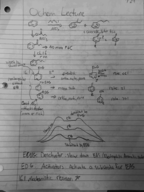
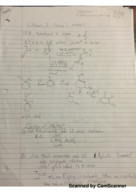
General chemistry 2 exam notes (Chemistry)
CHEM 0120
University of Pittsburgh
19 pages | Spring 2016

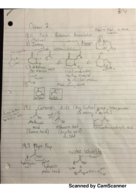
Chapters 13, 18 and 19 outline (Chemistry)
CHEM 0120
University of Pittsburgh
25 pages | Spring 2016

Videos
Element Classification: Rep, Trans, Inner-Trans, Noble Gases

Want To Learn More? To watch the entire video and ALL of the videos in the series:
full solution
We categorize elements into representative, transition, inner-transition, and noble gases based on their positions in the periodic table and general characteristics, without revealing specific element classifications.
Electrons in outer shell of: Potassium, Calcium, Aluminum
Want To Learn More? To watch the entire video and ALL of the videos in the series:
full solution
This video explains the importance of the number of valence electrons in an element's chemical behavior and demonstrates how to determine the valence electrons for potassium, calcium, and aluminum based on their positions in the periodic table. Valence electrons dictate an element's reactivity with other elements, making this knowledge essential for understanding chemical reactions.
Calculating Water's Final Temp after a 345 kJ Heat Boost
Want To Learn More? To watch the entire video and ALL of the videos in the series:
full solution
Discover how to determine the final temperature of a water sample after heat absorption. Utilizing the concept of specific heat capacity and the formula q = mc?T, we calculate the change in temperature and reveal its new state. Experience the transformation from an initial tepid state to a drastically altered thermal condition.
Protons reveal electron count in atoms. Which statement applies?
Want To Learn More? To watch the entire video and ALL of the videos in the series:
full solution
In this video, we explore the information that knowledge of the number of protons in a neutral element's atom can provide. Options for determining neutron count, electron count, and identifying the element's name are examined, with a conclusion that it allows us to know both the number of electrons and the element's name.
Understanding Polar & Nonpolar Molecules: From Diazene to Nitrogen Dio
Want To Learn More? To watch the entire video and ALL of the videos in the series:
full solution
Explore the properties of various molecules like diazene, hydrogen peroxide, and carbon tetrafluoride. Understand the influence of molecular shape and electronegativity on polarity. Discover why some are polar while others are nonpolar based on their structure.
CS?, SO?, CH?, & CH?Cl: Are They Polar or Nonpolar Molecules?
Want To Learn More? To watch the entire video and ALL of the videos in the series:
full solution
Explore the polarity of Carbon disulfide, Sulfur dioxide, Methane, and Chloromethane. Learn how molecular shape influences electron distribution. Understand which molecules possess a net dipole moment and which ones don't.