PreparED Study Materials

CHEM 3053: Organic Chemistry I
School: Oklahoma State University
Number of Notes and Study Guides Available: 14
Notes










Study Guides


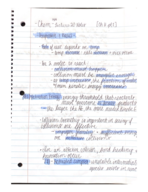
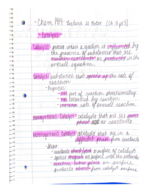
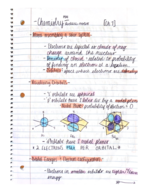
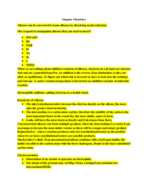
Study guide for exam 3 ochem (Engineering)
CHEM 3053
Oklahoma State University
5 pages | Spring 2016
Videos
Decoding Acid Formulas: From Phosphoric to Sulfurous - Chemistry Insig

Want To Learn More? To watch the entire video and ALL of the videos in the series:
full solution
Explore the distinct chemical formulas of various acids like phosphoric, hydrobromic, and sulfurous acids. Understand their practical applications, from flavoring agents to sanitization in brewing. Highlighting their unique molecular makeup, learn the critical roles they play.
CO?: Linear & Nonpolar with Temp Dipole Moments Explained!
Want To Learn More? To watch the entire video and ALL of the videos in the series:
full solution
Uncover the nuances of the CO? molecule's polarity and its electron dynamics. Understand how bending and stretching motions influence its electron density. Grasp the analogy of CO? to a jumping rope, highlighting its overall nonpolar nature.
Intermolecular Forces in HCl, F?, and C?H??
Want To Learn More? To watch the entire video and ALL of the videos in the series:
full solution
Explore the fascinating world of intermolecular forces in this brief video, featuring HCl, F?, and C?H?? molecules. Learn about the bonds that hold these substances together!
Deriving the Perfect Gas Equation from Gas Laws
Want To Learn More? To watch the entire video and ALL of the videos in the series:
full solution
Learn how the ideal gas equation is derived from Boyle's law, Charles’ law, and Avogadro's principle, unraveling the fundamentals of gas behavior.
The Wobble Concept: Explaining Codon Variability in Amino Acid Encodin
Want To Learn More? To watch the entire video and ALL of the videos in the series:
full solution
Join us as we delve into the intriguing world of genetic coding and discover how the concept of wobble accounts for variations in codons encoding a single amino acid.
Lattice Energy: Always Positive; Hydration Energy: Always Negative
Want To Learn More? To watch the entire video and ALL of the videos in the series:
full solution
In this video we clarify why lattice energy in solids is always a positive value due to the energy needed to separate ions making it an endothermic process. On the flip side hydration energy is always negative as it releases heat when ions dissolve in water making it an exothermic reaction. We use sodium chloride as a real-world example to illustrate these crucial thermodynamic concepts