PreparED Study Materials

CHEM 7594: Chem for Contemp Living W Lab
School: Truman State University
Number of Notes and Study Guides Available: 2
Notes


Videos
Calculate oxygen molar concentration in water at 25°C with a partial p

Want To Learn More? To watch the entire video and ALL of the videos in the series:
full solution
This video explores molar concentration (molarity) and demonstrates the calculation of oxygen's molar concentration in water at 25°C, considering a partial pressure of 0.22 atm by employing Henry's Law and the given Henry's Law constant for oxygen, revealing that under these conditions, there are 2.86 x 10?? moles of oxygen per liter of water, highlighting the significance of understanding these concepts for managing gas dissolution in liquids across varying circumstances.
Strong vs. Weak Acids: Ionization Differences in Water
Want To Learn More? To watch the entire video and ALL of the videos in the series:
full solution
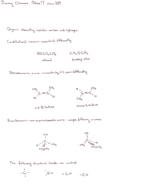
Uncover the distinct behaviors of hydrochloric acid and acetic acid in water. Learn about the complete ionization of strong acids and the partial ionization of weak ones, emphasizing the differentiation in proton donation.
Classifying Formaldehyde, Methanol, Dichloromethane & CO?: Polar or No
Want To Learn More? To watch the entire video and ALL of the videos in the series:
full solution
Explore the classification of select molecules based on their polarity. Understand the electron distribution and molecular shapes of Formaldehyde, Methanol, Dichloromethane, and Carbon dioxide. Discover which ones exhibit a net dipole moment and which ones don't.
Ethylene Glycol: Mass and Volume Calculations
Want To Learn More? To watch the entire video and ALL of the videos in the series:
full solution
Explore how to calculate the mass and volume of ethylene glycol, a common antifreeze, using its density. Understand the essentials of density-related calculations.
Molecular Geometry & Polarity: Why CO? & CCl? Are Nonpolar Explained
Want To Learn More? To watch the entire video and ALL of the videos in the series:
full solution
Uncover the intriguing relationship between molecular geometry and polarity in chemistry. Using CO? and CCl? as examples, learn how polar bonds can result in nonpolar molecules. Recognize the role of symmetry in determining molecular polarity.
Heat Absorption: Lead Weight's Final Temperature
Want To Learn More? To watch the entire video and ALL of the videos in the series:
full solution
Explore the process of heat absorption and discover how to calculate the final temperature of a lead fishing weight after absorbing a specific amount of heat.