PreparED Study Materials

CHEM 7608: Chemical Principles 1
School: Truman State University
Number of Notes and Study Guides Available: 0
Videos
Animal and Plant Energy Storage: Fats and Oils Explained

Want To Learn More? To watch the entire video and ALL of the videos in the series:
full solution
This video delves into the fascinating world of energy storage in animals and plants, offering insights into why fats are the primary energy storage compound in animals (except muscles) and why plants opt for alternative strategies instead of using fats and oils.
Acid Strength Comparison: Isomers and Proton Removal Explained
Want To Learn More? To watch the entire video and ALL of the videos in the series:
full solution
This video provides insights into determining the acid strength of various isomers by examining the ease of proton removal and the stability of the resulting anion. By comparing Propanamine to Trimethylamine and Methoxyethane to Propanol, we determine which compounds are more acidic.
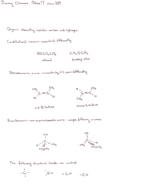
Understanding Boiling Points: Ethylene Glycol, Alcohols & Ethers Expla
Want To Learn More? To watch the entire video and ALL of the videos in the series:
full solution
This video offers insights into the properties and boiling points of different alcohols and ethers, including antifreeze agents like ethylene glycol. We also discuss how molecular structures and interactions impact boiling points, shedding light on key differences among related compounds.
Classifying Formaldehyde, Methanol, Dichloromethane & CO?: Polar or No
Want To Learn More? To watch the entire video and ALL of the videos in the series:
full solution
Explore the classification of select molecules based on their polarity. Understand the electron distribution and molecular shapes of Formaldehyde, Methanol, Dichloromethane, and Carbon dioxide. Discover which ones exhibit a net dipole moment and which ones don't.
Chromium Oxides: Acidity Comparison in Water
Want To Learn More? To watch the entire video and ALL of the videos in the series:
full solution
Compare the acidity of chromium trioxide (CrO?) and chromium (II) oxide (CrO) in water. Chromium trioxide forms strong chromic acid increasing hydronium ions, while chromium (II) oxide has weaker oxidizing properties, resulting in a less acidic solution.
Decoding Compound Names: What's HNO2(aq) Called in Chemistry
Want To Learn More? To watch the entire video and ALL of the videos in the series:
full solution
Discover the process of naming acids based on their anions and oxidation states. This video breaks down the correct naming of HNO2(aq) by distinguishing its anion and determining its place in the world of mineral acids.