PreparED Study Materials

PHY 2131: Gen Physics 1 Lab
School: Wayne State University
Number of Notes and Study Guides Available: 2
Notes


Videos
Gymnast's Forces: Ring Hold and Floor Support

Want To Learn More? To watch the entire video and ALL of the videos in the series:
full solution
Join us as we explore the dynamic world of gymnastics and the forces at play. In this video, we analyze a gymnast's routine on the rings, calculating the forces involved. Learn how the gymnast's body interacts with the rings and the floor, and discover how changes in arm angles affect the forces. Dive into the physics of human movement and gymnastics.
Kinetic Energy: Saturn 5 & Apollo at 11.2 km/s Speed
Want To Learn More? To watch the entire video and ALL of the videos in the series:
full solution
Learn how to calculate the kinetic energy of a Saturn 5 rocket with an Apollo spacecraft attached using physics principles and formulas. Understand the importance of unit conversion and the work-energy theorem as you plug values into the KE = 1/2 mv² formula. Discover that the kinetic energy for this rocket and spacecraft combo is an astonishing 1.82 x 10¹³ Joules.
Track Radius for 5.5g Acceleration: Approximate Value
Want To Learn More? To watch the entire video and ALL of the videos in the series:
full solution
Delve into the physics of high-speed tracks and calculate the radius where drivers experience a 5.5g acceleration, exploring the multiple options and their implications.
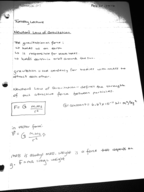
Newton's Third Law and Force Pairs: System of Interest Impact
Want To Learn More? To watch the entire video and ALL of the videos in the series:
full solution
Delve into Newton's third law of motion and explore how the choice of the 'system of interest' influences whether force pairs cancel each other out.
Understanding L-C Circuit Dynamics: Voltage Current & Energy Analysis
Want To Learn More? To watch the entire video and ALL of the videos in the series:
full solution
Explore the intricate dynamics of an L-C circuit as we analyze voltage current and energy transitions between a 60.0 millihenry inductor and a 250 microfarad capacitor. Understand the principles of energy transfer and storage in this system. Uncover key insights from calculations on capacitor charges and inductor energies at specific circuit conditions.
Calculating Jet Engine Thrust for Cruising Speed
Want To Learn More? To watch the entire video and ALL of the videos in the series:
full solution
Dive into the world of aviation as we calculate the thrust required for a medium-sized jet to maintain a cruising speed of 230 m/s at a specific altitude. Explore the impact of air density and drag coefficients on aircraft performance.