PreparED Study Materials

CHEM 123: General Chemistry II
School: Eastern Michigan University
Number of Notes and Study Guides Available: 3
Study Guides



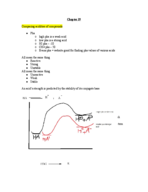
Chem 123 study guide ch 10 & 11 (Chemistry)
CHEM 123
Eastern Michigan University
8 pages | Fall 2016
Videos
Identifying Elements, Compounds, and Mixtures

Want To Learn More? To watch the entire video and ALL of the videos in the series:
full solution
Join us in this enlightening video where we unravel the world of chemistry. We'll examine a series of options to identify elements, compounds, and mixtures. Explore the fascinating world of matter and discover how to distinguish these fundamental concepts. Whether you're a student or simply curious about the world of chemistry, this video will help you sharpen your understanding of the building blocks of matter.
Calculating the Mass Percent Composition of Chloroform (CHCl?)
Want To Learn More? To watch the entire video and ALL of the videos in the series:
full solution
In this video, we delve into the concept of percent composition by mass, exemplified through the compound chloroform (CHCl?), which was once employed as an inhalation anesthetic despite its associated toxicity. By calculating the percent composition for each element within the compound, we gain valuable insights into its composition and its potential effects on health and properties.
Decoding Electron Configurations: From Rubidium to Argon Explained
Want To Learn More? To watch the entire video and ALL of the videos in the series:
full solution
Explore the intricacies of electron configurations around the atomic nucleus. Understand the ordered filling of energy levels in atoms like Rubidium, Germanium, and Argon. A deep look into the ground-state configurations of key elements.
Calculating [H?] in HNO? Solution Halfway to Equivalence with KOH
Want To Learn More? To watch the entire video and ALL of the videos in the series:
full solution
Unraveling HNO? Titration: Calculating [H?] Halfway with KOH. Harness the Henderson-Hasselbalch equation for pH determination. Discover the pH at midpoint between weak acid and strong base titration.
The Wobble Concept: Explaining Codon Variability in Amino Acid Encodin
Want To Learn More? To watch the entire video and ALL of the videos in the series:
full solution
Join us as we delve into the intriguing world of genetic coding and discover how the concept of wobble accounts for variations in codons encoding a single amino acid.
Why Fluorine Can't Form FH? or FCl?: Unpacking VSEPR Theory & Electron
Want To Learn More? To watch the entire video and ALL of the videos in the series:
full solution
Explore why fluorine, with its seven valence electrons, doesn't form compounds like FH? or FCl?. Understand the role of VSEPR theory, atomic size, and electronegativity in limiting bond formation. Grasp the interplay of geometric challenges and electron repulsion in compound stability.