PreparED Study Materials

Notes

Videos
Argon Isotopes: Protons, Neutrons & Electrons Breakdown

Want To Learn More? To watch the entire video and ALL of the videos in the series:
full solution
Explore the captivating branches of philosophy, understanding ethics as our moral guide, aesthetics as the interpreter of beauty, and logic as the foundation for clear reasoning. Delight in the insights these disciplines offer, enhancing our perspectives on life, art, and thought.
Neon Gas Pressure Change in 0.75-L Cylinder
Want To Learn More? To watch the entire video and ALL of the videos in the series:
full solution
In this problem, we are tasked with determining the pressure of neon gas in a 0.75-L cylinder at 30°C after compressing it from a 2.50-L sample at 0.00°C and 1.00 atm using the combined gas law equation, with step-by-step calculations leading to a final pressure value of approximately 3.699 atm.
pAg in KI & AgNO3 Titration: Exploring 39mL & 44.30mL Volumes
Want To Learn More? To watch the entire video and ALL of the videos in the series:
full solution
Exploring the titration of 25.00 mL of 0.08230 M KI with 0.05110 M AgNO3. This video breaks down the calculation process for the potential of silver ion at various volumes of added AgNO3: 39.00 mL equivalence point and 44.30 mL. With clear steps and using the solubility product constant understand how the potential of silver ion is determined for each scenario.
Drawing the Lewis Structure for Glycine: The Protein Building Block
Want To Learn More? To watch the entire video and ALL of the videos in the series:
full solution
Discover how amino acids, specifically glycine, form the foundation of proteins. Understand and visualize the Lewis structure representation of glycine. Grasp the significance of atomic bonding and electron distribution.
Boyle's Law Explained: From Compression to Pressure Calculation
Want To Learn More? To watch the entire video and ALL of the videos in the series:
full solution
Learn the intricacies of Boyle's Law through an example involving isothermal compression of a perfect gas. Watch as we calculate the original pressure using the change in volume and final conditions. This tutorial simplifies complex gas laws for easy comprehension.
Physical vs. Chemical: Chlorine Reactions & Magnetism
Want To Learn More? To watch the entire video and ALL of the videos in the series:
full solution
Explore the differences between physical and chemical properties in substances. Learn some fundamentals of chemistry and understand how substances interact and change.
Textbook Solutions (0)
Top Selling Study Tools

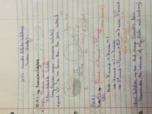
Chem 1332, chapter 10, 11 (week 2) (Chemistry)
CHEM 14833
University of Houston
12 pages | Fall 2016