PreparED Study Materials
CHEM 251: Organic Chemistry 1
School: University of Massachusetts
Number of Notes and Study Guides Available: 59
Notes






































Videos
Drawing Lewis Structures for Ionic Compounds: SrO Li2S CaI2 & RbF

Want To Learn More? To watch the entire video and ALL of the videos in the series:
full solution
Explore the art of constructing Lewis dot structures for ionic compounds such as SrO Li2S CaI2 and RbF. Understand the electron transfer process by diving into each atom's valency and its role in compound formation. Unpack the intricacies of ionic interactions for a deeper chemistry insight.
0.800g Match to SO?: Volume Calculation at 725 Torr & 32°C!
Want To Learn More? To watch the entire video and ALL of the videos in the series:
full solution
Detailed walkthrough of calculating sulfur dioxide gas volume produced from burning tetraphosphorus trisulfide. Utilizes stoichiometry and the Ideal Gas Law to derive results under specific conditions. Step-by-step guide for understanding chemical reactions and gas volume calculations
Double Assurance: Fidelity in Protein Synthesis
Want To Learn More? To watch the entire video and ALL of the videos in the series:
full solution
Discover the Intricate Checks and Balances in Protein Synthesis Fidelity: Join us in this video to unravel the two critical moments when the accuracy of protein synthesis is assured, shedding light on the 'how' and 'when' of this essential process.
Unveiling the Water-to-Salt Ratio in Barium Chloride Hydrate
Want To Learn More? To watch the entire video and ALL of the videos in the series:
full solution
Explore the process of determining the number of water molecules in a barium chloride hydrate. Through a reaction with sulfuric acid, the video highlights how to derive the formation of barium sulfate and its mass calculations. A comprehensive chemical analysis leads to finding the elusive 'x' value, revealing the water-to-salt ratio.
CO?: Linear & Nonpolar with Temp Dipole Moments Explained!
Want To Learn More? To watch the entire video and ALL of the videos in the series:
full solution
Uncover the nuances of the CO? molecule's polarity and its electron dynamics. Understand how bending and stretching motions influence its electron density. Grasp the analogy of CO? to a jumping rope, highlighting its overall nonpolar nature.
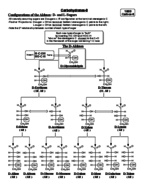
Drawing Open-Chain Structures: A Visual Guide to Four Sugars
Want To Learn More? To watch the entire video and ALL of the videos in the series:
full solution
Learn how to draw open-chain structures for various sugars, from ketotetrose to amino sugars. This video offers visual demonstrations of ketopentose, deoxyaldohexose, and more, highlighting key molecular differences.