PreparED Study Materials

CHM 432: Fundamentals of Biochemistry
School: Miami University
Number of Notes and Study Guides Available: 0
Videos
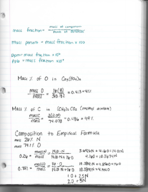
Mole Count in Elemental Samples (Zn, Ar, Ta, Li)

Want To Learn More? To watch the entire video and ALL of the videos in the series:
full solution
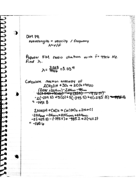
This video outlines the process of calculating the number of moles in various elemental samples. It begins by explaining the relationship between molar mass and atomic weight. Each sample's mass is divided by the respective element's molar mass to find the number of moles. It provides detailed calculations for four elemental samples: zinc (Zn), argon (Ar), tantalum (Ta), and lithium (Li), converting results to scientific notation where necessary. The script demonstrates how to determine the mole
Volume of 49.8g HCl Gas at STP: Finding the Answer in Liters
Want To Learn More? To watch the entire video and ALL of the videos in the series:
full solution
This video guides viewers through the process of calculating the volume occupied by Hydrochloric acid gas or HCl at standard temperature and pressure. Using the molar mass of HCl and its properties as an ideal gas the tutorial comprehensively explains each step to determine the volume from a given mass at STP. A must-watch for understanding gas volume conversions in chemistry
Intermolecular Forces in HCl, F?, and C?H??
Want To Learn More? To watch the entire video and ALL of the videos in the series:
full solution
Explore the fascinating world of intermolecular forces in this brief video, featuring HCl, F?, and C?H?? molecules. Learn about the bonds that hold these substances together!
Classifying Formaldehyde, Methanol, Dichloromethane & CO?: Polar or No
Want To Learn More? To watch the entire video and ALL of the videos in the series:
full solution
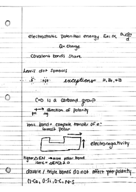
Explore the classification of select molecules based on their polarity. Understand the electron distribution and molecular shapes of Formaldehyde, Methanol, Dichloromethane, and Carbon dioxide. Discover which ones exhibit a net dipole moment and which ones don't.
Dimethylamine vs. Trimethylamine: Structures & Boiling Points
Want To Learn More? To watch the entire video and ALL of the videos in the series:
full solution
Uncover the science behind boiling points and molecular interactions in this video. Explore why Dimethylamine boils at a higher temperature than Trimethylamine, despite having a lower molecular weight, and gain insights into the role of molecular structures in determining physical properties.
Perfecting Perbromate Ion: Achieving Zero Formal Charges
Want To Learn More? To watch the entire video and ALL of the videos in the series:
full solution
Learn how to create a Lewis structure for the perbromate ion, ensuring all atoms achieve zero formal charges. Follow the step-by-step guide to understand the bonding and electron distribution in this chemical compound.