PreparED Study Materials

CHM 1240: Organic Chem 1
School: Wayne State University
Number of Notes and Study Guides Available: 100
Notes






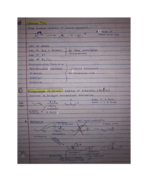



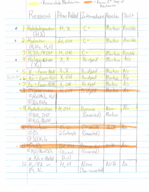


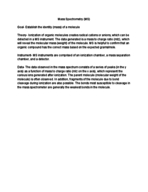


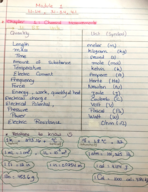
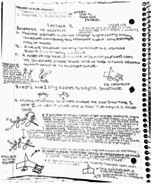
Organic chemistry chapter 1 and 2 (Chemistry)
CHM 1240
Wayne State University
15 pages | Summer 2015


Study Guides




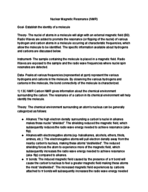
Organic chemistry final exam study (Chemistry)
CHM 1240
Wayne State University
2 pages | Summer 2015






Organic chem 1 exam 1 study guide (Chemistry)
CHM 1240
Wayne State University
48 pages | Summer 2015





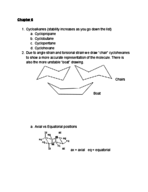
Organic chem 1 exam 2 study guide (Chemistry)
CHM 1240
Wayne State University
11 pages | Summer 2015
Videos
Mass of Fluorine in 24.6g SnF? Toothpaste: A Breakdown

Want To Learn More? To watch the entire video and ALL of the videos in the series:
full solution
Tin(II) Fluoride in Toothpaste: Dive into the chemistry of Tin(II) Fluoride commonly used in toothpaste to prevent tooth decay. Understand molar mass calculations stoichiometry and determine the fluoride content in a given compound
Conjugate Bases of Brønsted Acids: Formulas and Descriptions
Want To Learn More? To watch the entire video and ALL of the videos in the series:
full solution
This video delves into the fundamental concept of conjugate bases in the context of the Brønsted-Lowry theory of acids and bases, explaining how when acids donate protons, they transform into their respective conjugate bases. This understanding is exemplified through the specific reactions of various compounds, illustrating how each Brønsted acid, upon proton donation, gives rise to its corresponding conjugate base.
Mole Count in Elemental Samples (Zn, Ar, Ta, Li)
Want To Learn More? To watch the entire video and ALL of the videos in the series:
full solution
This video outlines the process of calculating the number of moles in various elemental samples. It begins by explaining the relationship between molar mass and atomic weight. Each sample's mass is divided by the respective element's molar mass to find the number of moles. It provides detailed calculations for four elemental samples: zinc (Zn), argon (Ar), tantalum (Ta), and lithium (Li), converting results to scientific notation where necessary. The script demonstrates how to determine the mole
Classify: (a) Mixture (b) Element (c) Mixture (d) Compound
Want To Learn More? To watch the entire video and ALL of the videos in the series:
full solution
In this video, we classify substances as elements, compounds, or mixtures, with air and soy sauce as mixtures, iron as an element, and table salt as a compound.
Hypothesis to Theory: The Evolution of Scientific Understanding
Want To Learn More? To watch the entire video and ALL of the videos in the series:
full solution
Delve into the journey of scientific ideas as we discuss how a hypothesis can evolve into a theory, and whether a theory can ever become a law. Uncover the distinctions and connections between these fundamental elements of scientific understanding in this illuminating video.
Ethylene Glycol & Freezing Point in Antifreeze
Want To Learn More? To watch the entire video and ALL of the videos in the series:
full solution
We explore the impact of increasing the concentration of ethylene glycol in an antifreeze mixture, explaining the resulting effect on the freezing point of the solution by examining its interaction with water molecules.