PreparED Study Materials

CEM 142: General and Inorganic Chemistry
School: Michigan State University
Number of Notes and Study Guides Available: 21
Notes
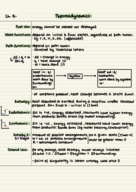




Study Guides




Videos
Mole Fractions, Partial Pressures, and Total Pressure Calculation

Want To Learn More? To watch the entire video and ALL of the videos in the series:
full solution
Explore the calculations for mole fractions, partial pressures, and total pressure in a 22.4 dm³ vessel with H? and N? at 273.15 K.
Physical vs Chemical Changes: Understanding Reactions & Transformation
Want To Learn More? To watch the entire video and ALL of the videos in the series:
full solution
Discover the differences between physical and chemical changes using common examples. Understand how sugar reacts in various scenarios, and how metals undergo changes, either maintaining their substance or forming new compounds.
Deriving the Perfect Gas Equation from Gas Laws
Want To Learn More? To watch the entire video and ALL of the videos in the series:
full solution
Learn how the ideal gas equation is derived from Boyle's law, Charles’ law, and Avogadro's principle, unraveling the fundamentals of gas behavior.
Specific Rotation Calculation: Polarimeter Demystified
Want To Learn More? To watch the entire video and ALL of the videos in the series:
full solution
Discover how to calculate specific rotations of samples using a polarimeter in this informative chemistry tutorial. Explore optical activity and learn step-by-step calculations for two real-world examples. Enhance your understanding of specific rotation and its application in chemical analysis.
Analyzing Molecular Structure Levels in DNA, tRNA, and mRNA
Want To Learn More? To watch the entire video and ALL of the videos in the series:
full solution
This video explores the concept of structural levels (primary, secondary, tertiary, and quaternary) in biomolecules, focusing on double-stranded DNA, tRNA, and mRNA to understand the diverse ways these molecules exhibit these structural layers.
Determining the Equilibrium Constant: Initial & Final Concentrations
Want To Learn More? To watch the entire video and ALL of the videos in the series:
full solution
Explore the method to determine the equilibrium constant for a reaction between iron III ions and thiocyanate ions. Learn to deduce equilibrium concentrations from initial values and reaction stoichiometry. Grasp the importance of the equilibrium constant value of 325.1 in assessing the reaction's favorability.