
Who has a greater opportunity cost of enjoying leisure—a janitor or a surgeon? a. the janitor because his wage is lower b. the surgeon because his wage is higher c. whoever has the greater income effect d. whoever has the greater substitution effect
Read more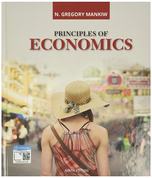
Table of Contents
1
Ten Principles of Economics
3
Interdependence and the Gains from Trade
5
Elasticity and Its Application
6
Supply, Demand, and Government Policies
7
Consumers, Producers, and the Efficiency of Markets
9
Application: International Trade
10
Externalities
11
Public Goods and Common Resources
13
The Costs of Production
15
Monopoly
18
The Markets for the Factors of Production
19
Earnings and Discrimination
20
Income Inequality and Poverty
21
The Theory of Consumer Choice
22
Frontiers of Microeconomics
23
Measuring a Nation's Income
26
Saving, Investment, and the Financial System
27
The Basic Tools of Finance
28
Unemployment
29
The Monetary System
31
Open-Economy Macroeconomics: Basic Concepts
32
A Macroeconomic Theory Of The Open Economy
33
Aggregate Demand and Aggregate Supply
34
The Influence of Monetary and Fiscal Policy on Aggregate Demand
35
The Short-Run Trade-Off between Inflation and Unemployment
36
Six Debates over Macroeconomic Policy
Textbook Solutions for Principles of Economics
Chapter 18 Problem 5
Question
A person works more hours at a higher wage if the substitution effect
a. equals zero.
b. equals the income effect.
c. is smaller than the income effect.
d. is larger than the income effect.
Solution
Step 1 of 2
Given data:
A person works more hours at a higher wage if the substitution effect and the options are given as,
a. equals zero.
b. equals the income effect.
c. is smaller than the income effect.
d. is larger than the income effect.
Subscribe to view the
full solution
full solution
Title
Principles of Economics 9
Author
N. Gregory Mankiw
ISBN
9780357038314
A person works more hours at a higher wage if the substitution effect a. equals zero. b. equals the income effect. c. is smaller than the income effect. d. is larger than the income effect.
Chapter 18 textbook questions
-
Chapter 18: Problem 4 Principles of Economics 9
-
Chapter 18: Problem 10 Principles of Economics 9
A storm destroys several factories, thereby reducing the stock of capital. What effect does this event have on factor markets? a. Wages and the rental price of capital both rise. b. Wages and the rental price of capital both fall. c. Wages rise, and the rental price of capital falls. d. Wages fall, and the rental price of capital rises
Read more -
Chapter 18: Problem 5 Principles of Economics 9
A person works more hours at a higher wage if the substitution effect a. equals zero. b. equals the income effect. c. is smaller than the income effect. d. is larger than the income effect.
Read more