
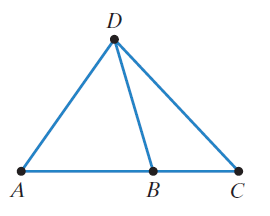
For each graph in Exercises 1–6, a. Is the graph traversable? b. If it is, describe a path that will traverse it.
Read moreTable of Contents
Chapter 5
Number Theory and the Real Number System
1
Problem Solving and Critical Thinking
1.1
Inductive and Deductive Reasoning
1.2
Estimation, Graphs, and Mathematical Models
1.3
Problem Solving
2
Set Theory
2.1
Basic Set Concepts
2.2
Subsets
2.3
Venn Diagrams and Set Operations
2.4
Set Operations and Venn Diagrams with Three Sets
2.5
Survey Problems
3
Logic
3.1
Statements, Negations, and Quantified Statements
3.2
Compound Statements and Connectives
3.3
Truth Tables for Negation, Conjunction, and Disjunction
3.4
Truth Tables for the Conditional and the Biconditional
3.5
Equivalent Statements and Variations of Conditional Statements
3.6
Negations of Conditional Statements and De Morgans Laws
3.7
Arguments and Truth Tables
3.8
Arguments and Euler Diagrams
4
Number ,Representation and Calculation 211
4.1
Our Hindu-Arabic System and Early Positional Systems
4.2
Number Bases in Positional Systems
4.3
Computation in Positional Systems
4.4
Looking Back at Early Numeration Systems
5
Number Theory and the Real Number System
5.1
Number Theory: Prime and Composite Numbers
5.2
The Integers; Order of Operations
5.3
The Rational Numbers
5.4
The Irrational Numbers
5.5
Real Numbers and Their Properties; Clock Addition
5.6
Exponents and Scientific Notation
5.7
Arithmetic and Geometric Sequences
6
Algebra: Equations and Inequalities
6.1
Algebraic Expressions and Formulas
6.2
Linear Equations in One Variable and Proportions
6.3
Applications of Linear Equations
6.4
Linear Inequalities in One Variable
6.5
Quadratic Equations
7
Algebra:Graphs, Functions, and Linear Systems
7.1
Graphing and Functions
7.2
Linear Functions and Their Graphs
7.3
Systems of Linear Equations in Two Variables
7.4
Linear Inequalities in Two Variables
7.5
Linear Programming
7.6
Modeling Data: Exponential, Logarithmic, and Quadratic Functions
8
Personal Finance
8.1
Percent, Sales Tax, and Discounts
8.2
Income Tax
8.3
Simple Interest
8.4
Compound Interest
8.5
Annuities, Methods of Saving, and Investments
8.6
Cars
8.7
The Cost of Home Ownership
8.8
Credit Cards
9
Measurements
9.1
Measuring Length; The Metric System
9.2
Measuring Area and Volume
9.3
Measuring Weight and Temperature
10
Geometry
10.1
Points, Lines, Planes, and Angles
10.2
Triangles
10.3
Polygons, Perimeter, and Tessellations
10.4
Area and Circumference
10.5
Volume and Surface Area
10.6
Right Triangle Trigonometry
10.7
Beyond Euclidean Geometry
11
Counting Methods and Probability Theory
11.1
The Fundamental Counting Principle
11.2
Permutations
11.3
Combinations
11.4
Fundamentals of Probability
11.5
Probability with the Fundamental Counting Principle, Permutations, and Combinations
11.6
Events Involving Not and Or; Odds
11.7
Events Involving And; Conditional Probability
11.8
Expected Value
12
Statistics
12.1
Sampling, Frequency Distributions, and Graphs
12.2
Measures of Central Tendency
12.3
Measures of Dispersion
12.4
The Normal Distribution
12.5
Problem Solving with the Normal Distribution
12.6
Scatter Plots, Correlation, and Regression Lines
13
Voting and Apportionment
13.1
Voting Methods
13.2
Flaws of Voting Methods
13.3
Apportionment Methods
13.4
Flaws of Apportionment Methods
14
Graph Theory
14.1
Graphs, Paths, and Circuits
14.2
Euler Paths and Euler Circuits
14.3
Hamilton Paths and Hamilton Circuits
14.4
Trees
Textbook Solutions for Thinking Mathematically
Chapter 10.7 Problem 1
Question
For each graph in Exercises 1–6, a. Is the graph traversable? b. If it is, describe a path that will traverse it.
Solution
The first step in solving 10.7 problem number 1 trying to solve the problem we have to refer to the textbook question: For each graph in Exercises 1–6, a. Is the graph traversable? b. If it is, describe a path that will traverse it.
From the textbook chapter Beyond Euclidean Geometry you will find a few key concepts needed to solve this.
Visible to paid subscribers only
Step 3 of 7)Visible to paid subscribers only
Subscribe to view the
full solution
full solution
Title
Thinking Mathematically 6
Author
Robert F. Blitzer
ISBN
9780321867322
For each graph in 16, a. Is the graph traversable b. If it
Chapter 10.7 textbook questions
-
Chapter 10: Problem 1 Thinking Mathematically 6
-
Chapter 10: Problem 2 Thinking Mathematically 6
For each graph in Exercises 1–6, a. Is the graph traversable? b. If it is, describe a path that will traverse it.
Read more -
Chapter 10: Problem 3 Thinking Mathematically 6
For each graph in Exercises 1–6, a. Is the graph traversable? b. If it is, describe a path that will traverse it.
Read more -
Chapter 10: Problem 4 Thinking Mathematically 6
For each graph in Exercises 1–6, a. Is the graph traversable? b. If it is, describe a path that will traverse it.
Read more -
Chapter 10: Problem 5 Thinking Mathematically 6
For each graph in Exercises 1–6, a. Is the graph traversable? b. If it is, describe a path that will traverse it.
Read more -
Chapter 10: Problem 6 Thinking Mathematically 6
For each graph in Exercises 1–6, a. Is the graph traversable? b. If it is, describe a path that will traverse it.
Read more -
Chapter 10: Problem 7 Thinking Mathematically 6
The model shows the way that carbon atoms (red) and hydrogen atoms (blue) link together to form a propane molecule. Use the model to answer Exercises 7–9. Using each of the three red carbon atoms as a vertex and each of the eight blue hydrogen atoms as a vertex, draw a graph for the propane molecule.
Read more -
Chapter 10: Problem 8 Thinking Mathematically 6
The model shows the way that carbon atoms (red) and hydrogen atoms (blue) link together to form a propane molecule. Use the model to answer Exercises 7–9. Determine if each vertex of the graph is even or odd.
Read more -
Chapter 10: Problem 9 Thinking Mathematically 6
The model shows the way that carbon atoms (red) and hydrogen atoms (blue) link together to form a propane molecule. Use the model to answer Exercises 7–9. Is the graph traversable?
Read more -
Chapter 10: Problem 10 Thinking Mathematically 6
The figure below on the left shows the floor plan of a four-room house. By representing rooms as vertices, the outside, E, as a vertex, and doors as edges, the figure below on the right is a graph that models the floor plan. Use these figures to solve Exercises 10–13. Use the floor plan to determine how many doors connect the outside, E, to room A. How is this shown in the graph?
Read more -
Chapter 10: Problem 11 Thinking Mathematically 6
The figure below on the left shows the floor plan of a four-room house. By representing rooms as vertices, the outside, E, as a vertex, and doors as edges, the figure below on the right is a graph that models the floor plan. Use these figures to solve Exercises 10–13. Use the floor plan to determine how many doors connect the outside, E, to room C. How is this shown in the graph?
Read more -
Chapter 10: Problem 12 Thinking Mathematically 6
The figure below on the left shows the floor plan of a four-room house. By representing rooms as vertices, the outside, E, as a vertex, and doors as edges, the figure below on the right is a graph that models the floor plan. Use these figures to solve Exercises 10–13. Is the graph traversable? Explain your answer.
Read more -
Chapter 10: Problem 13 Thinking Mathematically 6
The figure below on the left shows the floor plan of a four-room house. By representing rooms as vertices, the outside, E, as a vertex, and doors as edges, the figure below on the right is a graph that models the floor plan. Use these figures to solve Exercises 10–13. If the graph is traversable, determine a path to walk through every room, using each door only once.
Read more -
Chapter 10: Problem 14 Thinking Mathematically 6
In Exercises 14–17, give the genus of each object.
Read more -
Chapter 10: Problem 15 Thinking Mathematically 6
In Exercises 14–17, give the genus of each object.
Read more -
Chapter 10: Problem 16 Thinking Mathematically 6
In Exercises 14–17, give the genus of each object.
Read more -
Chapter 10: Problem 17 Thinking Mathematically 6
In Exercises 14–17, give the genus of each object.
Read more -
Chapter 10: Problem 18 Thinking Mathematically 6
In Exercises 14–17, which objects are topologically equivalent?
Read more -
Chapter 10: Problem 19 Thinking Mathematically 6
Draw (or find and describe) an object of genus 4 or more.
Read more -
Chapter 10: Problem 20 Thinking Mathematically 6
What does the figure shown illustrate about angles in a triangle when the triangle is drawn on a sphere?
Read more -
Chapter 10: Problem 21 Thinking Mathematically 6
The figure shows a quadrilateral that was drawn on the surface of a sphere. Angles C and D are obtuse angles. What does the figure illustrate about the sum of the measures of the four angles in a quadrilateral in elliptic geometry?
Read more -
Chapter 10: Problem 22 Thinking Mathematically 6
In Exercises 22–24, describe whether each figure shown exhibits self-similarity.
Read more -
Chapter 10: Problem 23 Thinking Mathematically 6
In Exercises 22–24, describe whether each figure shown exhibits self-similarity.
Read more -
Chapter 10: Problem 24 Thinking Mathematically 6
In Exercises 22–24, describe whether each figure shown exhibits self-similarity.
Read more -
Chapter 10: Problem 25 Thinking Mathematically 6
Consult an Internet site devoted to fractals and download two fractal images that imitate natures forms. How is selfsimilarity shown in each image?
Read more -
-
Chapter 10: Problem 27 Thinking Mathematically 6
What does it mean if a graph is traversable?
Read more -
Chapter 10: Problem 28 Thinking Mathematically 6
How do you determine whether or not a graph is traversable?
Read more -
Chapter 10: Problem 29 Thinking Mathematically 6
Describe one way in which topology is different than Euclidean geometry.
Read more -
-
Chapter 10: Problem 31 Thinking Mathematically 6
Describe how a rectangular solid and a sphere are topologically equivalent.
Read more -
Chapter 10: Problem 32 Thinking Mathematically 6
State the assumption that Euclid made about parallel lines that was altered in both hyperbolic and elliptic geometry.
Read more -
Chapter 10: Problem 33 Thinking Mathematically 6
How does hyperbolic geometry differ from Euclidean geometry?
Read more -
Chapter 10: Problem 34 Thinking Mathematically 6
How does elliptic geometry differ from Euclidean geometry?
Read more -
Chapter 10: Problem 35 Thinking Mathematically 6
What is self-similarity? Describe an object in nature that has this characteristic.
Read more -
Chapter 10: Problem 36 Thinking Mathematically 6
Some suggest that nature produces its many forms through a combination of both iteration and a touch of randomness. Describe what this means
Read more -
Chapter 10: Problem 37 Thinking Mathematically 6
Find an Internet site devoted to fractals. Use the site to write a paper on a specific use of fractals
Read more -
Chapter 10: Problem 38 Thinking Mathematically 6
Did you know that laid end to end, the veins, arteries, and capillaries of your body would reach over 40,000 miles? However, your vascular system occupies a very small fraction of your bodys volume. Describe a self-similar object in nature, such as your vascular system, with enormous length but relatively small volume
Read more -
Chapter 10: Problem 39 Thinking Mathematically 6
Describe a difference between the shapes of man-made objects and objects that occur in nature.
Read more -
Chapter 10: Problem 40 Thinking Mathematically 6
Explain what this short poem by Jonathan Swift has to do with fractal images: So Nat’ralists observe, A Flea Hath Smaller Fleas that on him prey and these have smaller Fleas to bite’em And so proceed, ad infinitum
Read more -
Chapter 10: Problem 41 Thinking Mathematically 6
In Tom Stoppards play Arcadia, the characters talk about mathematics, including ideas from fractal geometry. Read the play and write a paper on one of the ideas that the characters discuss that is related to something presented in this section
Read more -
Chapter 10: Problem 42 Thinking Mathematically 6
In Exercises 42–45, determine whether each statement makes sense or does not make sense, and explain your reasoning. The most effective way to determine if a graph is traversable is by trial and error.
Read more -
Chapter 10: Problem 43 Thinking Mathematically 6
In Exercises 42–45, determine whether each statement makes sense or does not make sense, and explain your reasoning. Objects that appear to be quite different can be topologically equivalent.
Read more -
Chapter 10: Problem 44 Thinking Mathematically 6
Non-Euclidean geometries can be used to prove that the sum of the measures of a triangle’s angles is \(180^{\circ}\). Text Transcription: 180^circ
Read more -
Chapter 10: Problem 45 Thinking Mathematically 6
Make Sense? In 4245, determine whether each statement makes sense or does not make sense, and explain your reasoningEuclidean geometry serves as an excellent model for describing the diverse forms that arise in nature.
Read more -
Chapter 10: Problem 46 Thinking Mathematically 6
This activity is suggested for two or three people. Research some of the practical applications of topology. Present the results of your research in a seminar to the entire class. You may also want to include a discussion of some of topologys more unusal figures, such as the Klein bottle and the Mbius strip.
Read more -
Chapter 10: Problem 47 Thinking Mathematically 6
Research non-Euclidean geometry and plan a seminar based on your group’s research. Each group member should research one of the following five areas: a. Present an overview of the history of the people who developed non-Euclidean geometry. Who first used the term and why did he never publish his work? b. Present an overview of the connection between Saccheri quadrilaterals and non-Euclidean geometry. Describe the work of Girolamo Saccheri. c. Describe how Albert Einstein applied the ideas of Gauss and Riemann. Discuss the notion of curved space and a fourth dimension. d. Present examples of the work of M. C. Escher that provide ways of visualizing hyperbolic and elliptic geometry. e. Describe how non-Euclidean geometry changed the direction of subsequent research in mathematics. After all research has been completed, the group should plan the order in which each group member will speak. Each person should plan on taking about five minutes for his or her portion of the presentation.
Read more -
Chapter 10: Problem 48 Thinking Mathematically 6
Albert Einstein’s theory of general relativity is concerned with the structure, or the geometry, of the universe. In order to describe the universe, Einstein discovered that he needed four variables: three variables to locate an object in space and a fourth variable describing time. This system is known as space-time. Because we are three-dimensional beings, how can we imagine four dimensions? One interesting approach to visualizing four dimensions is to consider an analogy of a two-dimensional being struggling to understand three dimensions. This approach first appeared in a book called Flatland by Edwin Abbott, written around 1884. Flatland describes an entire civilization of beings who are two dimensional, living on a flat plane, unaware of the existence of anything outside their universe. A house in Flatland would look like a blueprint or a line drawing to us. If we were to draw a closed circle around Flatlanders, they would be imprisoned in a cell with no way to see out or escape because there is no way to move up and over the circle. For a two-dimensional being moving only on a plane, the idea of up would be incomprehensible. We could explain that up means moving in a new direction, perpendicular to the two dimensions they know, but it would be similar to telling us we can move in the fourth dimension by traveling perpendicular to our three dimensions. Group members should obtain copies of or excerpts from Edwin Abbott’s Flatland. We especially recommend The Annotated Flatland, Perseus Publishing, 2002, with fascinating commentary by mathematician and author Ian Stewart. Once all group members have read the story, the following questions are offered for group discussion. a. How does the sphere, the visitor from the third dimension, reflect the same narrow perspective as the Flatlanders? b. What are some of the sociological problems raised in the story? c. What happens when we have a certain way of seeing the world that is challenged by coming into contact with something quite different? Be as specific as possible, citing either personal examples or historical examples. d. How are A. Square’s difficulties in visualizing three dimensions similar to those of a three-dimensional dweller trying to visualize four dimensions? e. How does the author reflect the overt sexism of his time? f. What “upward not northward” ideas do you hold that, if shared, would result in criticism, rejection, or a fate similar to that of the narrator of Flatland?
Read more