
Because g varies so little over the extent of most structures, any structures center of gravity effectively coincides with its center of mass. Here is a fictitious example where g varies more significantly. Figure 12-25 shows an array of six particles, each with mass m, fixed to the edge of a rigid structure of negligible mass. The distance between adjacent particles along the edge is 2.00 m. The following table gives the value of g (m/s2 ) at each particles location. Using the coordinate system shown, find (a) the x coordinate xcom and (b) the y coordinate ycom of the center of mass of the six-particle system.Then find (c) the x coordinate xcog and (d) the y coordinate ycog of the center of gravity of the six-particle system.
Read moreTextbook Solutions for Fundamentals of Physics
Chapter 12 Problem 13
Question
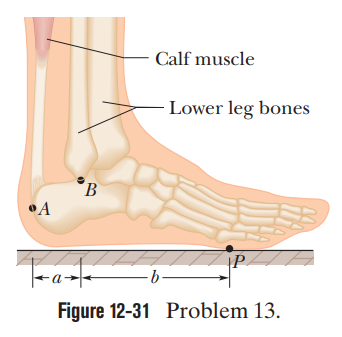
Figure 12-31 shows the anatomical structures in the lower leg and foot that are involved in standing on tiptoe, with the heel raised slightly off the floor so that the foot effectively contacts the floor only at point P. Assume distance a = 5.0 cm, distance b = 15 cm, and the person’s weight W = 900 N. Of the forces acting on the foot, what are the
(a) magnitude and
(b) direction (up or down) of the force at point A from the calf muscle and the
(c) magnitude and
(d) direction (up or down) of the force at point B from the lower leg bones?
Solution
Step 1 of 4
Distance between A to B: \(a=5 \mathrm{~cm}=0.05 \mathrm{~m}\)
Distance between B to point P where tips touches ground: \(b=15 \mathrm{~cm}=0.15 \mathrm{~m}\)
Weight of the person: W = 900 N
It is to be understood that when the person stands tiptoe at a point P, the weight of the person is concentrated at that point. Thus the reactionary force at point P is upwards and equal to the weight of person in magnitude,
\(F_{P}=900 N\) .................................................{1}
Subscribe to view the
full solution
full solution
Title
Fundamentals of Physics 10
Author
David Halliday; Robert Resnick; Jearl Walker
ISBN
9781118230725
Figure 12-31 shows the anatomical structures in the lower
Chapter 12 textbook questions
-
Chapter 12: Problem 1 Fundamentals of Physics 10
-
Chapter 12: Problem 2 Fundamentals of Physics 10
An automobile with a mass of 1360 kg has 3.05 m between the front and rear axles. Its center of gravity is located 1.78 m behind the front axle. With the automobile on level ground, determine the magnitude of the force from the ground on (a) each front wheel (assuming equal forces on the front wheels) and (b) each rear wheel (assuming equal forces on the rear wheels).
Read more -
Chapter 12: Problem 3 Fundamentals of Physics 10
In Fig. 12-26, a uniform sphere of mass m 0.85 kg and radius r 4.2 cm is held in place by a massless rope attached to a frictionless wall a distance L 8.0 cm above the center of the sphere. Find (a) the tension in the rope and (b) the force on the sphere from the wall.
Read more -
Chapter 12: Problem 4 Fundamentals of Physics 10
An archers bow is drawn at its midpoint until the tension in the string is equal to the force exerted by the archer. What is the angle between the two halves of the string?
Read more -
Chapter 12: Problem 5 Fundamentals of Physics 10
A rope of negligible mass is stretched horizontally between two supports that are 3.44 m apart. When an object of weight 3160 N is hung at the center of the rope, the rope is observed to sag by 35.0 cm. What is the tension in the rope?
Read more -
Chapter 12: Problem 6 Fundamentals of Physics 10
A scaffold of mass 60 kg and length 5.0 m is supported in a horizontal position by a vertical cable at each end. A window washer of mass 80 kg stands at a point 1.5 m from one end. What is the tension in (a) the nearer cable and (b) the farther cable?
Read more -
Chapter 12: Problem 7 Fundamentals of Physics 10
A 75 kg window cleaner uses a 10 kg ladder that is 5.0 m long. He places one end on the ground 2.5 m from a wall, rests the upper end against a cracked window, and climbs the ladder. He is 3.0 m up along the ladder when the window breaks. Neglect friction between the ladder and window and assume that the base of the ladder does not slip. When the window is on the verge of breaking, what are (a) the magnitude of the force on the window from the ladder, (b) the magnitude of the force on the ladder from the ground, and (c) the angle (relative to the horizontal) of that force on the ladder?
Read more -
Chapter 12: Problem 8 Fundamentals of Physics 10
A physics Brady Bunch, whose weights in newtons are indicated in Fig. 12-27, is balanced on a seesaw.What is the number of the person who causes the largest torque about the rotation axis at fulcrum f directed (a) out of the page and (b) into the page?
Read more -
Chapter 12: Problem 9 Fundamentals of Physics 10
A meter stick balances horizontally on a knife-edge at the 50.0 cm mark. With two 5.00 g coins stacked over the 12.0 cm mark, the stick is found to balance at the 45.5 cm mark. What is the mass of the meter stick?
Read more -
Chapter 12: Problem 10 Fundamentals of Physics 10
The system in Fig. 12-28 is in equilibrium, with the string in the center exactly horizontal. Block A weighs 40 N, block B weighs 50 N, and angle f is 35. Find (a) tension T1, (b) tension T2, (c) tension T3, and (d) angle u
Read more -
Chapter 12: Problem 11 Fundamentals of Physics 10
Figure 12-29 shows a diver of weight 580 N standing at the end of a diving board with a length of L ! 4.5 m and negligible mass. The board is fixed to two pedestals (supports) that are separated by distance d ! 1.5 m. Of the forces acting on the board, what are the (a) magnitude and (b) direction (up or down) of the force from the left pedestal and the (c) magnitude and (d) direction (up or down) of the force from the right pedestal? (e) Which pedestal (left or right) is being stretched, and (f) which pedestal is being compressed?
Read more -
Chapter 12: Problem 12 Fundamentals of Physics 10
In Fig. 12-30, trying to get his car out of mud, a man ties one end of a rope around the front bumper and the other end tightly around a utility pole 18 m away. He then pushes sideways on the rope at its midpoint with a force of 550 N, displacing the center of the rope 0.30 m, but the car barely moves.What is the magnitude of the force on the car from the rope? (The rope stretches somewhat.)
Read more -
Chapter 12: Problem 13 Fundamentals of Physics 10
Figure 12-31 shows the anatomical structures in the lower leg and foot that are involved in standing on tiptoe, with the heel raised slightly off the floor so that the foot effectively contacts the floor only at point P. Assume distance a ! 5.0 cm, distance b ! 15 cm, and the persons weight W ! 900 N. Of the forces acting on the foot, what are the (a) magnitude and (b) direction (up or down) of the force at point A from the calf muscle and the (c) magnitude and (d) direction (up or down) of the force at point B from the lower leg bones?
Read more -
Chapter 12: Problem 14 Fundamentals of Physics 10
In Fig. 12-32, a horizontal scaffold, of length 2.00 m and uniform mass 50.0 kg, is suspended from a building by two cables. The scaffold has dozens of paint cans stacked on it at various points. The total mass of the paint cans is 75.0 kg. The tension in the cable at the right is 722 N. How far horizontally from that cable is the center of mass of the system of paint cans?
Read more -
Chapter 12: Problem 15 Fundamentals of Physics 10
Forces , , and act on the structure of Fig. 12-33, shown in an overhead view.We wish to put the structure in equilibrium by applying a fourth force, at a point such as P. The fourth force has vector components and .We are given that F a ! 2.0 m b ! 3.0 m, c ! 1.0 m, F1 ! 20 N, F2 ! 10 N, and F3 ! 5.0 N. Find (a) Fh, (b) Fv, and (c) d
Read more -
Chapter 12: Problem 16 Fundamentals of Physics 10
A uniform cubical crate is 0.750 m on each side and weighs 500 N. It rests on a floor with one edge against a very small, fixed obstruction. At what least height above the floor must a horizontal force of magnitude 350 N be applied to the crate to tip it?
Read more -
Chapter 12: Problem 17 Fundamentals of Physics 10
In Fig. 12-34, a uniform beam of weight 500 N and length 3.0 m is suspended horizontally. On the left it is hinged to a wall; on the right it is supported by a cable bolted to the wall at distance D above the beam. The least tension that will snap the cable is 1200 N. (a) What value of D corresponds to that tension? (b) To prevent the cable from snapping, should D be increased or decreased from that value?
Read more -
Chapter 12: Problem 18 Fundamentals of Physics 10
In Fig. 12-35, horizontal scaffold 2, with uniform mass m2 30.0 kg and length L2 ! 2.00 m, hangs from horizontal scaffold 1, with uniform mass m1 ! 50.0 kg. A 20.0 kg box of nails lies on scaffold 2, centered at distance d ! 0.500 m from the left end. What is the tension T in the cable indicated?
Read more -
Chapter 12: Problem 19 Fundamentals of Physics 10
To crack a certain nut in a nutcracker, forces with magnitudes of at least 40 N must act on its shell from both sides. For the nutcracker of Fig. 12-36, with distances L ! 12 cm and d ! 2.6 cm, what are the force components F" (perpendicular to the handles) corresponding to that 40 N?
Read more -
Chapter 12: Problem 20 Fundamentals of Physics 10
A bowler holds a bowling ball (M ! 7.2 kg) in the palm of his hand (Fig. 12 -37). His upper arm is vertical; his lower arm (1.8 kg) is horizontal. What is the magnitude of (a) the force of the biceps muscle on the lower arm and (b) the force between the bony structures at the elbow contact point?
Read more -
Chapter 12: Problem 21 Fundamentals of Physics 10
The system in Fig. 12-38 is in equilibrium. A concrete block of mass 225 kg hangs from the end of the uniform strut of mass 45.0 kg. A cable runs from the ground, over the top of the strut, and down to the block, holding the block in place. For angles f ! 30.0 and u ! 45.0, find (a) the tension T in the cable and the (b) horizontal and (c) vertical components of the force on the strut from the hinge.
Read more -
Chapter 12: Problem 22 Fundamentals of Physics 10
In Fig. 12-39, a 55 kg rock climber is in a lie-back climb along a fissure, with hands pulling on one side of the fissure and feet pressed against the opposite side. The fissure has width w ! 0.20 m, and the center of mass of the climber is a horizontal distance d ! 0.40 m from the fissure. The coefficient of static friction between hands and rock is m1 ! 0.40, and between boots and rock it is m2 ! 1.2. (a) What is the least horizontal pull by the hands and push by the feet that will keep the climber stable? (b) For the horizontal pull of (a), what must be the vertical distance h between hands and feet? If the climber encounters wet rock, so that m1 and m2 are reduced, what happens to (c) the answer to (a) and (d) the answer to (b)?
Read more -
Chapter 12: Problem 23 Fundamentals of Physics 10
In Fig. 12-40, one end of a uniform beam of weight 222 N is hinged to a wall; the other end is supported by a wire that makes angles u ! 30.0 with both wall and beam. Find (a) the tension in the wire and the (b) horizontal and (c) vertical components of the force of the hinge on the beam.
Read more -
Chapter 12: Problem 24 Fundamentals of Physics 10
In Fig. 12-41, a climber with a weight of 533.8 N is held by a belay rope connected to her climbing harness and belay device; the force of the rope on her has a line of action through her center of mass. The indicated angles are u ! 40.0 and f ! 30.0. If her feet are on the verge of sliding on the vertical wall, what is the coefficient of static friction between her climbing shoes and the wall?
Read more -
Chapter 12: Problem 25 Fundamentals of Physics 10
In Fig. 12-42, what magnitude of (constant) force applied horizontally at the axle of the wheel is necessary to raise the wheel over a step obstacle of height h ! 3.00 cm? The wheels radius is r ! 6.00 cm, and its mass is m ! 0.800 kg
Read more -
Chapter 12: Problem 26 Fundamentals of Physics 10
In Fig. 12-43, a climber leans out against a vertical ice wall that has negligible friction. Distance a is 0.914 m and distance L is 2.10 m. His center of mass is distance d ! 0.940 m from the feetground contact point. If he is on the verge of sliding, what is the coefficient of static friction between feet and ground?
Read more -
Chapter 12: Problem 27 Fundamentals of Physics 10
In Fig. 12-44, a 15 kg block is held in place via a pulley system. The persons upper arm is vertical; the forearm is at angle u ! 30 with the horizontal. Forearm and hand together have a mass of 2.0 kg, with a center of mass at distance d1 ! 15 cm from the contact point of the forearm bone and the upper-arm bone (humerus). The triceps muscle pulls vertically upward on the forearm at distance d2 ! 2.5 cm behind that contact point. Distance d3 is 35 cm. What are the (a) magnitude and (b) direction (up or down) of the force on the forearm from the triceps muscle and the (c) magnitude and (d) direction (up or down) of the force on the forearm from the humerus?
Read more -
Chapter 12: Problem 28 Fundamentals of Physics 10
In Fig. 12-45, suppose the length L of the uniform bar is 3.00 m and its weight is 200 N. Also, let the blocks weight W ! 300 N and the angle u ! 30.0. The wire can withstand a maximum tension of 500 N. (a) What is the maximum possible distance x before the wire breaks? With the block placed at this maximum x, what are the (b) horizontal and (c) vertical components of the force on the bar from the hinge at A?
Read more -
Chapter 12: Problem 29 Fundamentals of Physics 10
A door has a height of 2.1 m along a y axis that extends vertically upward and a width of 0.91 m along an x axis that extends outward from the hinged edge of the door.A hinge 0.30 m from the top and a hinge 0.30 m from the bottom each support half the doors mass, which is 27 kg. In unit-vector notation, what are the forces on the door at (a) the top hinge and (b) the bottom hinge?
Read more -
Chapter 12: Problem 30 Fundamentals of Physics 10
In Fig. 12-46, a 50.0 kg uniform square sign, of edge length L ! 2.00 m, is hung from a horizontal rod of length dh ! 3.00 m and negligible mass. A cable is attached to the end of the rod and to a point on the wall at distance dv ! 4.00 m above the point where the rod is hinged to the wall. (a) What is the tension in the cable? What are the (b) magnitude and (c) direction (left or right) of the horizontal component of the force on the rod from the wall, and the (d) magnitude and (e) direction (up or down) of the vertical component of this force?
Read more -
Chapter 12: Problem 31 Fundamentals of Physics 10
In Fig. 12-47, a nonuniform bar is suspended at rest in a horizontal position by two massless cords. One cord makes the angle u ! 36.9 with the vertical; the other makes the angle f ! 53.1 with the vertical. If the length L of the bar is 6.10 m, compute the distance x from the left end of the bar to its center of mass
Read more -
Chapter 12: Problem 32 Fundamentals of Physics 10
In Fig. 12-48, the driver of a car on a horizontal road makes an emergency stop by applying the brakes so that all four wheels lock and skid along the road. The coefficient of kinetic friction between tires and road is 0.40. The separation between the front and rear axles is L ! 4.2 m, and the center of mass of the car is located at distance d ! 1.8 m behind the front axle and distance h ! 0.75 m above the road. The car weighs 11 kN. Find the magnitude of (a) the braking acceleration of the car, (b) the normal force on each rear wheel, (c) the normal force on each front wheel, (d) the braking force on each rear wheel, and (e) the braking force on each front wheel. (Hint: Although the car is not in translational equilibrium, it is in rotational equilibrium.)
Read more -
Chapter 12: Problem 33 Fundamentals of Physics 10
Figure 12-49a shows a vertical uniform beam of length L that is hinged at its lower end. A horizontal force is applied to the beam at distance y from the lower end. The beam remains vertical because of a cable attached at the upper end, at angle u with the horizontal. Figure 12-49b gives the tension T in the cable as a function of the position of the applied force given as a fraction y/L of the beam length. The scale of the T axis is set by Ts ! 600 N. Figure 12-49c gives the magnitude Fh of the horizontal force on the beam from the hinge, also as a function of y/L. Evaluate (a) angle u and (b) the magnitude of .
Read more -
Chapter 12: Problem 34 Fundamentals of Physics 10
In Fig. 12-45, a thin horizontal bar AB of negligible weight and length L is hinged to a vertical wall at A and supported at B by a thin wire BC that makes an angle u with the horizontal. A block of weight W can be moved anywhere along the bar; its position is defined by the distance x from the wall to its center of mass. As a function of x, find (a) the tension in the wire, and the (b) horizontal and (c) vertical components of the force on the bar from the hinge at A
Read more -
Chapter 12: Problem 35 Fundamentals of Physics 10
A cubical box is filled with sand and weighs 890 N. We wish to roll the box by pushing horizontally on one of the upper edges. (a) What minimum force is required? (b) What minimum coefficient of static friction between box and floor is required? (c) If there is a more efficient way to roll the box, find the smallest possible force that would have to be applied directly to the box to roll it. (Hint: At the onset of tipping, where is the normal force located?)
Read more -
Chapter 12: Problem 36 Fundamentals of Physics 10
Figure 12-50 shows a 70 kg climber hanging by only the crimp hold of one hand on the edge of a shallow horizontal ledge in a rock wall. (The fingers are pressed down to gain purchase.) Her feet touch the rock wall at distance H ! 2.0 m directly below her crimped fingers but do not provide any support. Her center of mass is distance a ! 0.20 m from the wall. Assume that the force from the ledge supporting her fingers is equally shared by the four fingers. What are the values of the (a) horizontal component Fh and (b) vertical component Fv of the force on each fingertip?
Read more -
Chapter 12: Problem 37 Fundamentals of Physics 10
In Fig. 12-51, a uniform plank, with a length L of 6.10 m and a weight of 445 N, rests on the ground and against a frictionless roller at the top of a wall of height h ! 3.05 m.The plank remains in equilibrium for any value of u / 70 but slips if u 0 70. Find the coefficient of static friction between the plank and the ground
Read more -
Chapter 12: Problem 38 Fundamentals of Physics 10
In Fig. 12-52, uniform beams A and B are attached to a wall with hinges and loosely bolted together (there is no torque of one on the other). Beam A has length LA ! 2.40 m and mass 54.0 kg; beam B has mass 68.0 kg.The two hinge points are separated by distance d ! 1.80 m. In unit-vector notation, what is the force on (a) beam A due to its hinge, (b) beam A due to the bolt, (c) beam B due to its hinge, and (d) beam B due to the bolt?
Read more -
Chapter 12: Problem 39 Fundamentals of Physics 10
For the stepladder shown in Fig. 12-53, sides AC and CE are each 2.44 m long and hinged at C. Bar BD is a tie-rod 0.762 m long, halfway up. A man weighing 854 N climbs 1.80 m along the ladder. Assuming that the floor is frictionless and neglecting the mass of the ladder, find (a) the tension in the tie-rod and the magnitudes of the forces on the ladder from the floor at (b) A and (c) E. (Hint: Isolate parts of the ladder in applying the equilibrium conditions.)
Read more -
Chapter 12: Problem 40 Fundamentals of Physics 10
Figure 12-54a shows a horizontal uniform beam of mass mb and length L that is supported on the left by a hinge attached to a wall and on the right by a cable at angle u with the horizontal. A package of mass mp is positioned on the beam at a distance x from the left end. The total mass is mb # mp ! 61.22 kg. Figure 12-54b gives the tension T in the cable as a function of the packages position given as a fraction x/L of the beam length. The scale of the T axis is set by Ta ! 500 N and Tb ! 700 N. Evaluate (a) angle u,(b) mass mb,and (c) mass mp
Read more -
Chapter 12: Problem 41 Fundamentals of Physics 10
A crate, in the form of a cube with edge lengths of 1.2 m, contains a piece of machinery; the center of mass of the crate and its contents is located 0.30 m above the crates geometrical center. The crate rests on a ramp that makes an angle u with the horizontal.As u is increased from zero, an angle will be reached at which the crate will either tip over or start to slide down the ramp. If the coefficient of static friction ms between ramp and crate is 0.60, (a) does the crate tip or slide and (b) at what angle u does this occur? If ms ! 0.70, (c) does the crate tip or slide and (d) at what angle u does this occur? (Hint:At the onset of tipping, where is the normal force located?)
Read more -
Chapter 12: Problem 42 Fundamentals of Physics 10
In Fig. 12-7 and the associated sample problem, let the coefficient of static friction ms between the ladder and the pavement be 0.53. How far (in percent) up the ladder must the firefighter go to put the ladder on the verge of sliding?
Read more -
Chapter 12: Problem 43 Fundamentals of Physics 10
A horizontal aluminum rod 4.8 cm in diameter projects 5.3 cm from a wall.A 1200 kg object is suspended from the end of the rod. The shear modulus of aluminum is 3.0 $ 1010 N/m2 . Neglecting the rods mass, find (a) the shear stress on the rod and (b) the vertical deflection of the end of the rod.
Read more -
Chapter 12: Problem 44 Fundamentals of Physics 10
Figure 12-55 shows the stressstrain curve for a material. The scale of the stress axis is set by s ! 300, in units of 106 N/m2 . What are (a) the Youngs modulus and (b) the approximate yield strength for this material?
Read more -
Chapter 12: Problem 45 Fundamentals of Physics 10
In Fig. 12-56, a lead brick rests horizontally on cylinders A and B. The areas of the top faces of the cylinders are related by AA ! 2AB; the Youngs moduli of the cylinders are related by EA ! 2EB. The cylinders had identical lengths before the brick was placed on them. What fraction of the bricks mass is supported (a) by cylinder A and (b) by cylinder B? The horizontal distances between the center of mass of the brick and the centerlines of the cylinders are dA for cylinder A and dB for cylinder B. (c) What is the ratio dA/dB?
Read more -
Chapter 12: Problem 46 Fundamentals of Physics 10
Figure 12-57 shows an approximate plot of stress versus strain for a spider-web thread, out to the point of breaking at a strain of 2.00. The vertical axis scale is set by values a ! 0.12 GN/m2 , b ! 0.30 GN/m2 , and c ! 0.80 GN/m2 . Assume that the thread has an initial length of 0.80 cm, an initial cross- sectional area of 8.0$ 10%12 m2 , and (during stretching) a constant volume. The strain on the thread is the ratio of the change in the threads length to that initial length, and the stress on the thread is the ratio of the collision force to that initial cross-sectional area. Assume that the work done on the thread by the collision force is given by the area under the curve on the graph. Assume also that when the single thread snares a flying insect, the insects kinetic energy is transferred to the stretching of the thread. (a) How much kinetic energy would put the thread on the verge of breaking? What is the kinetic energy of (b) a fruit fly of mass 6.00 mg and speed 1.70 m/s and (c) a bumble bee of mass 0.388 g and speed 0.420 m/s? Would (d) the fruit fly and (e) the bumble bee break the thread?
Read more -
Chapter 12: Problem 47 Fundamentals of Physics 10
A tunnel of length L ! 150 m, height H ! 7.2 m, and width 5.8 m (with a flat roof) is to be constructed at distance d ! 60 m beneath the ground. (See Fig. 12-58.) The tunnel roof is to be supported entirely by square steel columns, each with a cross-sectional area of 960 cm2 . The mass of 1.0 cm3 of the ground material is 2.8 g. (a) What is the total weight of the ground material the columns must support? (b) How many columns are needed to keep the compressive stress on each column at one- half its ultimate strength?
Read more -
Chapter 12: Problem 48 Fundamentals of Physics 10
Figure 12-59 shows the stress versus strain plot for an aluminum wire that is stretched by a machine pulling in opposite directions at the two ends of the wire. The scale of the stress axis is set by s ! 7.0, in units of 107 N/m2 . The wire has an initial length of 0.800 m and an initial cross-sectional area of 2.00 $ 10%6 m2 . How much work does the force from the machine do on the wire to produce a strain of 1.00 $ 10%3 ?
Read more -
Chapter 12: Problem 49 Fundamentals of Physics 10
In Fig. 12-60, a 103 kg uniform log hangs by two steel wires, A and B, both of radius 1.20 mm. Initially, wire A was 2.50 m long and 2.00 mm shorter than wire B. The log is now horizontal. What are the magnitudes of the forces on it from (a) wire A and (b) wire B? (c) What is the ratio dA/dB?
Read more -
Chapter 12: Problem 50 Fundamentals of Physics 10
Figure 12-61 represents an insect caught at the midpoint of a spider-web thread. The thread breaks under a stress of 8.20 $ 108 N/m2 and a strain of 2.00. Initially, it was horizontal and had a length of 2.00 cm and a cross-sectional area of 8.00 $ 10%12 m2 . As the thread was stretched under the weight of the insect, its volume remained constant. If the weight of the insect puts the thread on the verge of breaking, what is the insects mass? (A spiders web is built to break if a potentially harmful insect, such as a bumble bee, becomes snared in the web.)
Read more -
Chapter 12: Problem 51 Fundamentals of Physics 10
Figure 12-62 is an overhead view of a rigid rod that turns about a vertical axle until the identical rubber stoppers A and B are forced against rigid walls at distances rA ! 7.0 cm and rB ! 4.0 cm from the axle. Initially the stoppers touch the walls without being compressed. Then force of magnitude 220 N is applied perpendicular to the rod at a distance R ! 5.0 cm from the axle. Find the magnitude of the force compressing (a) stopper A and (b) stopper B.
Read more -
Chapter 12: Problem 52 Fundamentals of Physics 10
After a fall, a 95 kg rock climber finds himself dangling from the end of a rope that had been 15 m long and 9.6 mm in diameter but has stretched by 2.8 cm. For the rope, calculate (a) the strain, (b) the stress, and (c) the Youngs modulus
Read more -
Chapter 12: Problem 53 Fundamentals of Physics 10
In Fig. 12-63, a rectangular slab of slate rests on a bedrock surface inclined at angle u ! 26. The slab has length L ! 43 m, thickness T ! 2.5 m, and width W ! 12 m, and 1.0 cm3 of it has a mass of 3.2 g. The coefficient of static friction between slab and bedrock is 0.39. (a) Calculate the component of the gravitational force on the slab parallel to the bedrock surface. (b) Calculate the magnitude of the static frictional force on the slab. By comparing (a) and (b), you can see that the slab is in danger of sliding. This is prevented only by chance protrusions of bedrock. (c) To stabilize the slab, bolts are to be driven perpendicular to the bedrock surface (two bolts are shown). If each bolt has a crosssectional area of 6.4 cm2 and will snap under a shearing stress of 3.6 $ 108 N/m2 , what is the minimum number of bolts needed? Assume that the bolts do not affect the normal force
Read more -
Chapter 12: Problem 54 Fundamentals of Physics 10
A uniform ladder whose length is 5.0 m and whose weight is 400 N leans against a frictionless vertical wall. The coefficient of static friction between the level ground and the foot of the ladder is 0.46. What is the greatest distance the foot of the ladder can be placed from the base of the wall without the ladder immediately slipping?
Read more -
Chapter 12: Problem 55 Fundamentals of Physics 10
In Fig. 12-64, block A (mass 10 kg) is in equilibrium, but it would slip if block B (mass 5.0 kg) were any heavier. For angle u ! 30, what is the coefficient of static friction between block A and the surface below it?
Read more -
Chapter 12: Problem 56 Fundamentals of Physics 10
Figure 12-65a shows a uniform ramp between two buildings that allows for motion between the buildings due to strong winds. At its left end, it is hinged to the building wall; at its right end, it has a roller that can roll along the building wall. There is no vertical force on the roller from the building, only a horizontal force with magnitude Fh. The horizontal distance between the buildings is D ! 4.00 m. The rise of the ramp is h ! 0.490 m. A man walks across the ramp from the left. Figure 12-65b gives Fh as a function of the horizontal distance x of the man from the building at the left. The scale of the Fh axis is set by a ! 20 kN and b ! 25 kN. What are the masses of (a) the ramp and (b) the man?
Read more -
Chapter 12: Problem 57 Fundamentals of Physics 10
In Fig. 12-66, a 10 kg sphere is supported on a frictionless plane inclined at angle u ! 45 from the horizontal. Angle f is 25. Calculate the tension in the cable.
Read more -
Chapter 12: Problem 58 Fundamentals of Physics 10
In Fig. 12-67a, a uniform 40.0 kg beam is centered over two rollers. Vertical lines across the beam mark off equal lengths.Two of the lines are centered over the rollers; a 10.0 kg package of tamales is centered over roller B.What are the magnitudes of the forces on the beam from (a) roller A and (b) roller B? The beam is then rolled to the left until the right-hand end is centered over roller B (Fig. 12- 67b). What now are the magnitudes of the forces on the beam from (c) roller A and (d) roller B? Next, the beam is rolled to the right. Assume that it has a length of 0.800 m. (e) What horizontal distance between the package and roller B puts the beam on the verge of losing contact with roller A?
Read more -
Chapter 12: Problem 59 Fundamentals of Physics 10
In Fig. 12-68, an 817 kg construction bucket is suspended by a cable A that is attached at O to two other cables B and C, making angles u1 ! 51.0 and u2 ! 66.0 with the horizontal. Find the tensions in (a) cable A, (b) cable B, and (c) cable C. (Hint: To avoid solving two equations in two unknowns, position the axes as shown in the figure.)
Read more -
Chapter 12: Problem 60 Fundamentals of Physics 10
In Fig. 12-69, a package of mass m hangs from a short cord that is tied to the wall via cord 1 and to the ceiling via cord 2. Cord 1 is at angle f ! 40 with the horizontal; cord 2 is at angle u. (a) For what value of u is the tension in cord 2 minimized? (b) In terms of mg, what is the minimum tension in cord 2?
Read more -
Chapter 12: Problem 61 Fundamentals of Physics 10
The force in Fig. 12-70 keeps the 6.40 kg block and the pulleys in equilibrium. The pulleys have negligible mass and friction. Calculate the tension T in the upper cable. (Hint: When a cable wraps halfway around a pulley as here, the magnitude of its net force on the pulley is twice the tension in the cable.)
Read more -
Chapter 12: Problem 62 Fundamentals of Physics 10
A mine elevator is supported by a single steel cable 2.5 cm in diameter. The total mass of the elevator cage and occupants is 670 kg. By how much does the cable stretch when the elevator hangs by (a) 12 m of cable and (b) 362 m of cable? (Neglect the mass of the cable.)
Read more -
Chapter 12: Problem 63 Fundamentals of Physics 10
Four bricks of length L, identical and uniform, are stacked on top of one another (Fig. 12-71) in such a way that part of each extends beyond the one beneath. Find, in terms of L, the maximum values of (a) a1, (b) a2, (c) a3, (d) a4, and (e) h, such that the stack is in equilibrium, on the verge of falling.
Read more -
Chapter 12: Problem 64 Fundamentals of Physics 10
In Fig. 12-72, two identical, uniform, and frictionless spheres, each of mass m, rest in a rigid rectangular container.A line connecting their centers is at 45 to the horizontal. Find the magnitudes of the forces on the spheres from (a) the bottom of the container, (b) the left side of the container, (c) the right side of the container, and (d) each other. (Hint: The force of one sphere on the other is directed along the centercenter line.)
Read more -
Chapter 12: Problem 65 Fundamentals of Physics 10
In Fig. 12-73, a uniform beam with a weight of 60 N and a length of 3.2 m is hinged at its lower end, and a horizontal force of magnitude 50 N acts at its upper end. The beam is held vertical by a cable that makes angle u ! 25 with the ground and is attached to the beam at height h ! 2.0 m. What are (a) the tension in the cable and (b) the force on the beam from the hinge in unit-vector notation?
Read more -
Chapter 12: Problem 66 Fundamentals of Physics 10
A uniform beam is 5.0 m long and has a mass of 53 kg. In Fig. 12- 74, the beam is supported in a horizontal position by a hinge and a cable, with angle u ! 60. In unit-vector notation,what is the force on the beam from the hinge?
Read more -
Chapter 12: Problem 67 Fundamentals of Physics 10
A solid copper cube has an edge length of 85.5 cm. How much stress must be applied to the cube to reduce the edge length to 85.0 cm? The bulk modulus of copper is 1.4 $ 1011 N/m2
Read more -
Chapter 12: Problem 68 Fundamentals of Physics 10
A construction worker attempts to lift a uniform beam off the floor and raise it to a vertical position. The beam is 2.50 m long and weighs 500 N.At a certain instant the worker holds the beam momentarily at rest with one end at distance d ! 1.50 m above the floor, as shown in Fig. 12-75, by exerting a force on the beam, perpendicular to the beam. (a) What is the magnitude P? (b) What is the magnitude of the (net) force of the floor on the beam? (c) What is the minimum value the coefficient of static friction between beam and floor can have in order for the beam not to slip at this instant?
Read more -
Chapter 12: Problem 69 Fundamentals of Physics 10
In Fig. 12-76, a uniform rod of mass m is hinged to a building at its lower end, while its upper end is held in place by a rope attached to the wall. If angle u1 ! 60, what value must angle u2 have so that the tension in the rope is equal to mg/2?
Read more -
Chapter 12: Problem 70 Fundamentals of Physics 10
A 73 kg man stands on a level bridge of length L. He is at distance L/4 from one end. The bridge is uniform and weighs 2.7 kN. What are the magnitudes of the vertical forces on the bridge from its supports at (a) the end farther from him and (b) the nearer end?
Read more -
Chapter 12: Problem 71 Fundamentals of Physics 10
A uniform cube of side length 8.0 cm rests on a horizontal floor. The coefficient of static friction between cube and floor is m. A horizontal pull is applied perpendicular to one of the vertical faces of the cube, at a distance 7.0 cm above the floor on the vertical midline of the cube face. The magnitude of is gradually increased. During that increase, for what values of m will the cube eventually (a) begin to slide and (b) begin to tip? (Hint: At the onset of tipping, where is the normal force located?)
Read more -
Chapter 12: Problem 72 Fundamentals of Physics 10
The system in Fig. 12-77 is in equilibrium.The angles are u1 ! 60 and u2 ! 20, and the ball has mass M ! 2.0 kg. What is the tension in (a) string ab and (b) string bc?
Read more -
Chapter 12: Problem 73 Fundamentals of Physics 10
A uniform ladder is 10 m long and weighs 200 N. In Fig. 12-78, the ladder leans against a vertical, frictionless wall at height h ! 8.0 m above the ground. A horizontal force is applied to the ladder at distance d ! 2.0 m from its base (measured along the ladder). (a) If force magnitude F ! 50 N, what is the force of the ground on the ladder, in unit-vector notation? (b) If F ! 150 N, what is the force of the ground on the ladder, also in unit-vector notation? (c) Suppose the coefficient of static friction between the ladder and the ground is 0.38; for what minimum value of the force magnitude F will the base of the ladder just barely start to move toward the wall?
Read more -
Chapter 12: Problem 74 Fundamentals of Physics 10
A pan balance is made up of a rigid, massless rod with a hanging pan attached at each end. The rod is supported at and free to rotate about a point not at its center. It is balanced by unequal masses placed in the two pans.When an unknown mass m is placed in the left pan, it is balanced by a mass m1 placed in the right pan; when the mass m is placed in the right pan, it is balanced by a mass m2 in the left pan. Show that m ! 1m1m2.
Read more -
Chapter 12: Problem 75 Fundamentals of Physics 10
The rigid square frame in Fig. 12-79 consists of the four side bars AB, BC, CD, and DA plus two diagonal bars AC and BD, which pass each other freely at E. By means of the turnbuckle G, bar AB is put under tension, as if its ends were subject to horizontal, outward forces of magnitude 535 N. (a) Which of the other bars are in tension? What are the magnitudes of (b) the forces causing the tension in those bars and (c) the forces causing compression in the other bars? (Hint: Symmetry considerations can lead to considerable simplification in this problem.)
Read more -
Chapter 12: Problem 76 Fundamentals of Physics 10
A gymnast with mass 46.0 kg stands on the end of a uniform balance beam as shown in Fig. 12- 80.The beam is 5.00 m long and has a mass of 250 kg (excluding the mass of the two supports). Each support is 0.540 m from its end of the beam. In unit-vector notation, what are the forces on the beam due to (a) support 1 and (b) support 2?
Read more -
Chapter 12: Problem 77 Fundamentals of Physics 10
Figure 12-81 shows a 300 kg cylinder that is horizontal. Three steel wires support the cylinder from a ceiling. Wires 1 and 3 are attached at the ends of the cylinder, and wire 2 is attached at the center. The wires each have a crosssectional area of 2.00 $ 10%6 m2 . Initially (before the cylinder was put in place) wires 1 and 3 were 2.0000 m long and wire 2 was 6.00 mm longer than that. Now (with the cylinder in place) all three wires have been stretched. What is the tension in (a) wire 1 and (b) wire 2?
Read more -
Chapter 12: Problem 78 Fundamentals of Physics 10
In Fig. 12-82, a uniform beam of length 12.0 m is supported by a horizontal cable and a hinge at angle u ! 50.0. The tension in the cable is 400 N. In unit-vector notation, what are (a) the gravitational force on the beam and (b) the force on the beam from the hinge?
Read more -
Chapter 12: Problem 79 Fundamentals of Physics 10
Four bricks of length L, identical and uniform, are stacked on a table in two ways, as shown in Fig. 12- 83 (compare with Problem 63). We seek to maximize the overhang distance h in both arrangements. Find the optimum distances a1, a2, b1, and b2, and calculate h for the two arrangements.
Read more -
Chapter 12: Problem 80 Fundamentals of Physics 10
A cylindrical aluminum rod, with an initial length of 0.8000 m and radius 1000.0 mm, is clamped in place at one end and then stretched by a machine pulling parallel to its length at its other end. Assuming that the rods density (mass per unit volume) does not change, find the force magnitude that is required of the machine to decrease the radius to 999.9 mm. (The yield strength is not exceeded.)
Read more -
Chapter 12: Problem 81 Fundamentals of Physics 10
A beam of length L is carried by three men, one man at one end and the other two supporting the beam between them on a crosspiece placed so that the load of the beam is equally divided among the three men. How far from the beams free end is the crosspiece placed? (Neglect the mass of the crosspiece.)
Read more -
Chapter 12: Problem 82 Fundamentals of Physics 10
If the (square) beam in Fig. 12-6a and the associated sample problem is of Douglas fir, what must be its thickness to keep the compressive stress on it to of its ultimate strength?
Read more -
Chapter 12: Problem 83 Fundamentals of Physics 10
Figure 12-84 shows a stationary arrangement of two crayon boxes and three cords. Box A has a mass of 11.0 kg and is on a ramp at angle u ! 30.0; box B has a mass of 7.00 kg and hangs on a cord. The cord connected to box A is parallel to the ramp, which is frictionless. (a) What is the tension in the upper cord, and (b) what angle does that cord make with the horizontal?
Read more -
Chapter 12: Problem 84 Fundamentals of Physics 10
A makeshift swing is constructed by making a loop in one end of a rope and tying the other end to a tree limb. A child is sitting in the loop with the rope hanging vertically when the childs father pulls on the child with a horizontal force and displaces the child to one side. Just before the child is released from rest, the rope makes an angle of 15( with the vertical and the tension in the rope is 280 N. (a) How much does the child weigh? (b) What is the magnitude of the (horizontal) force of the father on the child just before the child is released? (c) If the maximum horizontal force the father can exert on the child is 93 N, what is the maximum angle with the vertical the rope can make while the father is pulling horizontally?
Read more -
Chapter 12: Problem 85 Fundamentals of Physics 10
Figure 12-85a shows details of a finger in the crimp hold of the climber in Fig. 12-50. A tendon that runs from muscles in the forearm is attached to the far bone in the finger. Along the way, the tendon runs through several guiding sheaths called pulleys. The A2 pulley is attached to the first finger bone; the A4 pulley is attached to the second finger bone. To pull the finger toward the palm, the forearm muscles pull the tendon through the pulleys, much like strings on a marionette can be pulled to move parts of the marionette. Figure 12-85b is a simplified diagram of the second finger bone, which has length d. The tendons pull on the bone acts at the point where the tendon enters the A4 pulley, at distance d/3 along the bone. If the force components on each of the four crimped fingers in Fig. 12-50 are Fh ! 13.4 N and Fv ! 162.4 N, what is the magnitude of ? The result is probably tolerable, but if the climber hangs by only one or two fingers, the A2 and A4 pulleys can be ruptured, a common ailment among rock climbers
Read more -
Chapter 12: Problem 86 Fundamentals of Physics 10
A trap door in a ceiling is 0.91 m square, has a mass of 11 kg, and is hinged along one side, with a catch at the opposite side. If the center of gravity of the door is 10 cm toward the hinged side from the doors center, what are the magnitudes of the forces exerted by the door on (a) the catch and (b) the hinge?
Read more -
Chapter 12: Problem 87 Fundamentals of Physics 10
A particle is acted on by forces given, in newtons, by F ! 8.40 % 5.70 and ! 16.0 # 4.10 . (a) What are the x component and (b) y component of the force that balances the sum of these F : 3 j i F : 2 j i forces? (c) What angle does have relative to the #x axis?
Read more -
Chapter 12: Problem 88 Fundamentals of Physics 10
The leaning Tower of Pisa is 59.1 m high and 7.44 m in diameter. The top of the tower is displaced 4.01 m from the vertical. Treat the tower as a uniform, circular cylinder. (a) What additional displacement, measured at the top, would bring the tower to the verge of toppling? (b) What angle would the tower then make with the vertical?
Read more