
Prove that a nonempty set T. is finite if and only if there is a bijection from T. onto a finite set T
Read more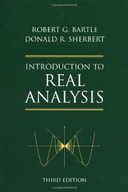
Table of Contents
1.1
Sets and Functions
1.2
Mathematical Induction
1.3
Finite and Infinite Sets
2.1
The Algebraic and Order Properties of IR
2.2
Absolute Value and the Real Line
2.3
The Completeness Property of R
2.4
Applications of the Supremum Property
2.5
Intervals
3.1
Sequences and Their Limits
3.2
Limit Theorems
3.3
MonotoneSequences
3.4
Subsequences and the Bolzano- Weierstrass Theorem
3.5
The Cauchy Criterion
3.6
Properly Divergent Sequences
3.7
Introduction to Infinite Series
4.1
Limits of Functions
4.2
4.2 Limit Theorems
4.3
Some Extensions of the Limit Conceptt
5.1
Continuous Functions
5.2
Combinations of Continuous Functions
5.3
Continuous Functions on Intervals
5.4
Uniform Continuity
5.5
Continuity and Gauges
5.6
Monotone and Inverse Functions
6.1
The Derivative
6.2
The Mean Value Theorem
6.3
L'Hospital's Rules
6.4
Taylor's Theorem
7.1
Riemann Integral
7.2
Riemann Integrable Functions
7.3
The Fundamental Theorem
7.4
Approximate Integration
8.1
Pointwise and Uniform Convergence
8.2
Interchange of Limits
8.3
The Exponential and Logarithmic Functions
8.4
The Trigonometric Functions
9.1
Absolute Convergence
9.2
Tests for Absolute Convergence
9.3
Tests for Nonabsolute Convergence
9.4
Series of Functions
10.1
Definition and Main Properties
10.2
Improper and Lebesgue Integrals
10.3
Infinite Intervals
10.4
Convergence Theorems
11.1
Open and Closed Sets in IR
11.2
Compact Sets
11.3
Continuous Functions
11.4
Metric Spaces
Textbook Solutions for Introduction to Real Analysis
Chapter 1.3 Problem 3
Question
LetS:= {I,2}andT := {a,b, c}. a .. f :- _ (a) DeterminethenumberofdifferentinjectionsfromS intoT.' i' (b) Determine the number of different surjections from T onto S.
Solution
The first step in solving 1.3 problem number 3 trying to solve the problem we have to refer to the textbook question: LetS:= {I,2}andT := {a,b, c}. a .. f :- _ (a) DeterminethenumberofdifferentinjectionsfromS intoT.' i' (b) Determine the number of different surjections from T onto S.
From the textbook chapter Finite and Infinite Sets you will find a few key concepts needed to solve this.
Visible to paid subscribers only
Step 3 of 7)Visible to paid subscribers only
Subscribe to view the
full solution
full solution
Title
Introduction to Real Analysis 3
Author
Robert G. Bartle, Donald R. Sherbert
ISBN
9780471321484
LetS:= {I,2}andT := {a,b, c}. a .. f :- _ (a)
Chapter 1.3 textbook questions
-
Chapter 1: Problem 1 Introduction to Real Analysis 3
-
Chapter 1: Problem 2 Introduction to Real Analysis 3
Prove parts (b) and (c) of Theorem 1.3.
Read more -
Chapter 1: Problem 3 Introduction to Real Analysis 3
LetS:= {I,2}andT := {a,b, c}. a .. f :- _ (a) DeterminethenumberofdifferentinjectionsfromS intoT.' i' (b) Determine the number of different surjections from T onto S.
Read more -
Chapter 1: Problem 4 Introduction to Real Analysis 3
Exhibit a bijection between N and the set of all odd integers greater than 13:"
Read more -
Chapter 1: Problem 5 Introduction to Real Analysis 3
Give an explicit definition of the bijection f from N onto Z described in Example 1.3.7(b).
Read more -
Chapter 1: Problem 6 Introduction to Real Analysis 3
Exhibit a bijection between N and a proper subset of itself.
Read more -
Chapter 1: Problem 7 Introduction to Real Analysis 3
Prove that a set T. is denumerable if and only if there is a bijection from T. onto a denumerable set T
Read more -
Chapter 1: Problem 8 Introduction to Real Analysis 3
Give an example of a countable collection of finite sets whose union is not finite.
Read more -
Chapter 1: Problem 9 Introduction to Real Analysis 3
Prove in detail that if S and T are denumerable, then S U T is denumerable. 1
Read more -
Chapter 1: Problem 10 Introduction to Real Analysis 3
Determine the number of elements in P(S), the collection of all subsets of S, for each of the following sets: (a) S:= {I, 2}, (b) S:= {I, 2, 3}, (c) S:= {I, 2, 3, 4}. Be sure to include the empty set and the set S itself in P(S). 1
Read more -
Chapter 1: Problem 11 Introduction to Real Analysis 3
Use Mathematical Induction to prove that if the set S has n elements, then P(S) has 2n elements. 1
Read more -
Chapter 1: Problem 12 Introduction to Real Analysis 3
Prove that the collection F(N) of allfinite subsets of N is countable.
Read more