PreparED Study Materials

CHEM 210: Organic Chemistry
School: Pennsylvania State University
Number of Notes and Study Guides Available: 13
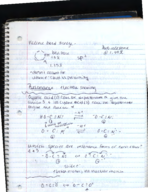
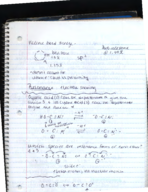
Notes






Study Guides


Videos
Chromium(III) Oxide Reaction: Calculating Precise Quantities

Want To Learn More? To watch the entire video and ALL of the videos in the series:
full solution
Learn the art of precise chemical calculations in this video. Discover how Chromium(III) oxide reacts with hydrogen sulfide to form chromium(III) sulfide and water, all while unraveling the necessary steps to determine the exact quantities involved.
Balancing Equations: From Lead Sulfide to Ammonia Reactions
Want To Learn More? To watch the entire video and ALL of the videos in the series:
full solution
This video shows you how to balance equations from the reaction of lead(II) sulfide with hydrochloric acid to ammonia's interaction with oxygen. Understand the nuances of atom balancing and grasp the precise stoichiometric relationships.
Rutherford's Gold Foil: The Pivot to the Modern Nuclear Atom Model
Want To Learn More? To watch the entire video and ALL of the videos in the series:
full solution
Discover Rutherford's pivotal Gold Foil Experiment and its impact on atomic theory. Unveil the discrepancies with the Plum Pudding Model. Grasp the birth of the nuclear atom model through unexpected alpha particle deflections.
Counting Chlorine Atoms in Key Chemical Compounds: A Detailed Breakdow
Want To Learn More? To watch the entire video and ALL of the videos in the series:
full solution
Uncover the count of chlorine atoms in various chemical compounds. Grasp the calculations in Carbon tetrachloride, Calcium chloride, Phosphorus trichloride, and Sodium chloride. Gain clarity on atomic count across multiple molecules.
Calculating the Mass of CCl4: Using Density and Volume Insights
Want To Learn More? To watch the entire video and ALL of the videos in the series:
full solution
Learn the method to calculate the mass of a substance using its density and volume. This video demonstrates the practical application of density in determining the mass of carbon tetrachloride (CCl4) from a given volume.
Decoding Electron Configurations: From Rubidium to Argon Explained
Want To Learn More? To watch the entire video and ALL of the videos in the series:
full solution
Explore the intricacies of electron configurations around the atomic nucleus. Understand the ordered filling of energy levels in atoms like Rubidium, Germanium, and Argon. A deep look into the ground-state configurations of key elements.