

In Fig. 30-33, a circular loop of wire 10 cm in diameter (seen edge-on) is placed with its normal at an angle u ! 30 with the direction of a uniform magnetic field of magnitude 0.50 T. The loop is then rotated such that rotates in a cone about the field direction at the rate 100 rev/min; angle u remains unchanged during the process. What is the emf induced in the loop?
Read moreTextbook Solutions for Fundamentals of Physics
Chapter 30 Problem 4
Question
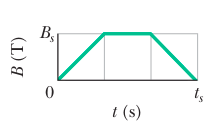
A wire loop of radius 12 cm and resistance 8.5 1 is located in a uniform magnetic field that changes in magnitude as given in Fig. 30-35. The vertical axis scale is set by Bs ! 0.50 T, and the horizontal axis scale is set by ts ! 6.00 s. The loops plane is perpendicular to . What emf is induced in the loop during time intervals (a) 0 to 2.0 s, (b) 2.0 s to 4.0 s, and (c) 4.0 s to 6.0 s?
Solution
Problem 4
A wire loop of radius 12 cm and resistance 8.5 1 is located in a uniform magnetic field that changes in magnitude as given in figure. The vertical axis scale is set by Bs = 0.50 T, and the horizontal axis scale is set by ts = 6.00 s. The loops plane is perpendicular to . What emf is induced in the loop during time intervals (a) 0 to 2.0 s, (b) 2.0 s to 4.0 s, and (c) 4.0 s to 6.0 s?
Step by Step Solution
Step 1 of 3
(a)
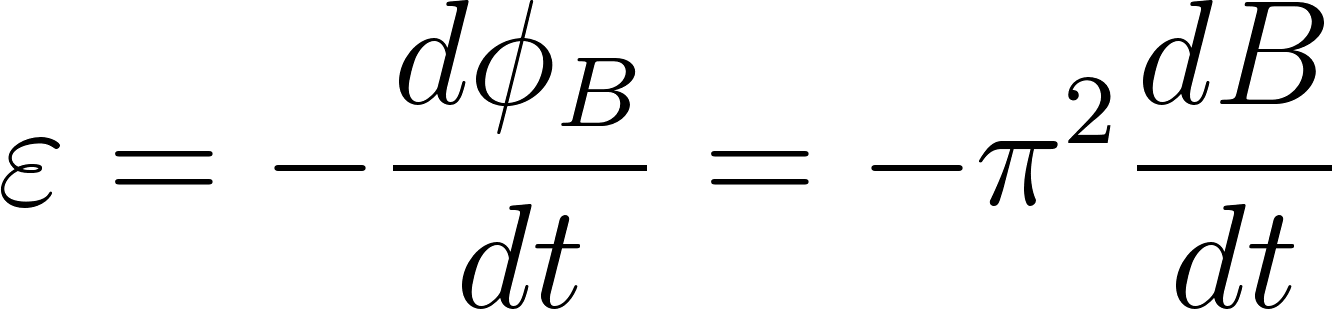
EMF induced in the loop during the time interval 


Subscribe to view the
full solution
full solution
Title
Fundamentals of Physics 10
Author
David Halliday; Robert Resnick; Jearl Walker
ISBN
9781118230725
A wire loop of radius 12 cm and resistance 8.5 1 is
Chapter 30 textbook questions
-
Chapter 30: Problem 1 Fundamentals of Physics 10
-
Chapter 30: Problem 2 Fundamentals of Physics 10
A certain elastic conducting material is stretched into a circular loop of 12.0 cm radius. It is placed with its plane perpendicular to a uniform 0.800 T magnetic field. When released, the radius of the loop starts to shrink at an instantaneous rate of 75.0 cm/s. What emf is induced in the loop at that instant?
Read more -
Chapter 30: Problem 3 Fundamentals of Physics 10
In Fig. 30-34, a 120- turn coil of radius 1.8 cm and resistance 5.3 1 is coaxial with a solenoid of 220 turns/cm and diameter 3.2 cm. The solenoid current drops from 1.5 A to zero in time interval 't ! 25 ms. What current is induced in the coil during 't?
Read more -
Chapter 30: Problem 4 Fundamentals of Physics 10
A wire loop of radius 12 cm and resistance 8.5 1 is located in a uniform magnetic field that changes in magnitude as given in Fig. 30-35. The vertical axis scale is set by Bs ! 0.50 T, and the horizontal axis scale is set by ts ! 6.00 s. The loops plane is perpendicular to . What emf is induced in the loop during time intervals (a) 0 to 2.0 s, (b) 2.0 s to 4.0 s, and (c) 4.0 s to 6.0 s?
Read more -
Chapter 30: Problem 5 Fundamentals of Physics 10
In Fig. 30-36, a wire forms a closed circular loop, of radius R ! 2.0 m and resistance 4.0 1. The circle is centered on a long straight wire; at time t ! 0, the current in the long straight wire is 5.0 A rightward. Thereafter, the current changes according to i ! 5.0 A % (2.0 A/s2 )t 2 . (The straight wire is insulated; so there is no electrical contact between it and the wire of the loop.) What is the magnitude of the current induced in the loop at times t , 0?
Read more -
Chapter 30: Problem 6 Fundamentals of Physics 10
Figure 30-37a shows a circuit consisting of an ideal battery with emf # ! 6.00 mV, a resistance R, and a small wire loop of area 5.0 cm2 . For the time interval t ! 10 s to t ! 20 s, an external magnetic field is set up throughout the loop. The field is uniform, its direction is into the page in Fig. 30-37a, and the field magnitude is given by B ! at, where B is in teslas, a is a constant, and t is in seconds. Figure 30- 37b gives the current i in the circuit before, during, and after the external field is set up. The vertical axis scale is set by is ! 2.0 mA. Find the constant a in the equation for the field magnitude.
Read more -
Chapter 30: Problem 7 Fundamentals of Physics 10
In Fig. 30-38, the magnetic flux ! (4.00 $ through the loop increases according to the relation 0B ! 6.0t 2 & 7.0t, where 0B is in milliwebers and t is in seconds. (a) What is the magnitude of the emf induced in the loop when t 2.0 s? (b) Is the direction of the current through R to the right or left?
Read more -
Chapter 30: Problem 8 Fundamentals of Physics 10
A uniform magnetic field is perpendicular to the plane of a circular loop of diameter 10 cm formed from wire of diameter 2.5 mm and resistivity 1.69 $ 10 %8 1 )m. At what rate must the magnitude of change to induce a 10 A current in the loop?
Read more -
Chapter 30: Problem 9 Fundamentals of Physics 10
A small loop of area 6.8 mm2 is placed inside a long solenoid that has 854 turns/cm and carries a sinusoidally varying current i of amplitude 1.28 A and angular frequency 212 rad/s.The central axes of the loop and solenoid coincide.What is the amplitude of the emf induced in the loop?
Read more -
Chapter 30: Problem 10 Fundamentals of Physics 10
Figure 30-39 shows a closed loop of wire that consists of a pair of equal semicircles, of radius 3.7 cm, lying in mutually perpendicular planes.The loop was formed by folding a flat circular loop along a diameter until the two halves became perpendicular to each other. A uniform magnetic field of magnitude 76 mT is directed perpendicular to the fold diameter and makes equal angles (of 45) with the planes of the semicircles. The magnetic field is reduced to zero at a uniform rate during a time interval of 4.5 ms. During this interval, what are the (a) magnitude and (b) direction (clockwise or counterclockwise when viewed along the direction of ) of the emf induced in the loop?
Read more -
Chapter 30: Problem 11 Fundamentals of Physics 10
A rectangular coil of N turns and of length a and width b is rotated at frequency f in a uniform magnetic field , as indicated in Fig. 30-40. The coil is connected to co-rotating cylinders, against which metal brushes slide to make contact. (a) Show that the emf induced in the coil is given (as a function of time t) by # ! 2pfNabB sin(2pft) ! #0 sin(2pft). This is the principle of the commercial alternating-current generator. (b) What value of Nab gives an emf with #0 ! 150 V when the loop is rotated at 60.0 rev/s in a uniform magnetic field of 0.500 T?
Read more -
Chapter 30: Problem 12 Fundamentals of Physics 10
In Fig. 30-41, a wire loop of lengths L ! 40.0 cm and W 25.0 cm lies in a magnetic field .What are the (a) magnitude and (b) direction (clockwise or counterclockwiseor none if 0)of the emf induced in the loop if What are (c) and (d) the direction if What are (e) and (f) the direction if What are (g) and (h) the direction if What are (i) and (j) the direction if 10 %2T/m)s)yt i?
Read more -
Chapter 30: Problem 13 Fundamentals of Physics 10
One hundred turns of (insulated) copper wire are wrapped around a wooden cylindrical core of cross- sectional area 1.20 $ 10 %3 m2 . The two ends of the wire are connected to a resistor. The total resistance in the circuit is 13.0 1. If an externally applied uniform longitudinal magnetic field in the core changes from 1.60 T in one direction to 1.60 T in the opposite direction, how much charge flows through a point in the circuit during the change?
Read more -
Chapter 30: Problem 14 Fundamentals of Physics 10
In Fig. 30-42a, a uniform magnetic field increases in magnitude with time t as given by Fig. 30-42b, where the vertical axis scale is set by Bs ! 9.0 mT and the horizontal scale is set by ts ! 3.0 s. A circular conducting loop of area 8.0 $ 10%4 m2 lies in the field, in the plane of the page. The amount of charge q passing point A on the loop is given in Fig. 30-42c as a function of t, with the vertical axis scale set by qs ! 6.0 mC and the horizontal axis scale again set by ts ! 3.0 s.What is the loops resistance?
Read more -
Chapter 30: Problem 15 Fundamentals of Physics 10
A square wire loop with 2.00 m sides is perpendicular to a uniform magnetic field, with half the area of the loop in the field as shown in Fig. 30-43. The loop contains an ideal battery with emf # ! 20.0 V. If the magnitude of the field varies with time according to B ! 0.0420 % 0.870t, with B in teslas and t in seconds, what are (a) the net emf in the circuit and (b) the direction of the (net) current around the loop?
Read more -
Chapter 30: Problem 16 Fundamentals of Physics 10
Figure 30-44a shows a wire that forms a rectangle (W ! 20 cm, H ! 30 cm) and has a resistance of 5.0 m . Its interior is split into three equal areas, with magnetic fields , / and . The fields are uniform within each region and directly out of or into the page as indicated. Figure 30-44b gives the change in the z components Bz of the three fields with time t; the vertical axis scale is set by Bs ! 4.0 mT and Bb ! %2.5Bs, and the horizontal axis scale is set by ts ! 2.0 s. What are the (a) magnitude and (b) direction of the current induced in the wire?
Read more -
Chapter 30: Problem 17 Fundamentals of Physics 10
A small circular loop of area 2.00 cm2 is placed in the plane of, and concentric with, a large circular loop of radius 1.00 m. The current in the large loop is changed at a constant rate from 200 A to %200 A (a change in direction) in a time of 1.00 s, starting at t ! 0. What is the magnitude of the magnetic field at the center of the small loop due to the current in the large loop at (a) t ! 0, (b) t ! 0.500 s, and (c) t ! 1.00 s? (d) From t ! 0 to t ! 1.00 s, is reversed? Because the inner loop is small, assume is uniform over its area. (e) What emf is induced in the small loop at t ! 0.500 s?
Read more -
Chapter 30: Problem 18 Fundamentals of Physics 10
In Fig. 30-45, two straight conducting rails form a right angle. A conducting bar in contact with the rails starts at the vertex at time t ! 0 and moves with a constant velocity of 5.20 m/s along them. A magnetic field with B ! 0.350 T is directed out of the page. Calculate (a) the flux through the triangle formed by the rails and bar at t ! 3.00 s and (b) the emf around the triangle at that time. (c) If the emf is # ! at n, where a and n are constants, what is the value of n?
Read more -
Chapter 30: Problem 19 Fundamentals of Physics 10
An electric generator contains a coil of 100 turns of wire, each forming a rectangular loop 50.0 cm by 30.0 cm. The coil is placed entirely in a uniform magnetic field with magnitude B ! 3.50 T and with initially perpendicular to the coils plane. What is the maximum value of the emf produced when the coil is spun at 1000 rev/min about an axis perpendicular to ?
Read more -
Chapter 30: Problem 20 Fundamentals of Physics 10
At a certain place, Earths magnetic field has magnitude B ! 0.590 gauss and is inclined downward at an angle of 70.0" to the horizontal. A flat horizontal circular coil of wire with a radius of 10.0 cm has 1000 turns and a total resistance of 85.0 1. It is connected in series to a meter with 140 1 resistance. The coil is flipped through a half-revolution about a diameter, so that it is again horizontal. How much charge flows through the meter during the flip?
Read more -
Chapter 30: Problem 21 Fundamentals of Physics 10
In Fig. 30-46, a stiff wire bent into a semicircle of radius a ! 2.0 cm is rotated at constant angular speed 40 rev/s in a uniform 20 mT magnetic field. What are the (a) frequency and (b) amplitude of the emf induced in the loop?
Read more -
Chapter 30: Problem 22 Fundamentals of Physics 10
A rectangular loop (area ! 0.15 m2 ) turns in a uniform magnetic field, B ! 0.20 T.When the angle between the field and the normal to the plane of the loop is p/2 rad and increasing at 0.60 rad/s, what emf is induced in the loop?
Read more -
Chapter 30: Problem 23 Fundamentals of Physics 10
Figure 30-47 shows two parallel loops of wire having a common axis.The smaller loop (radius r) is above the larger loop (radius R) by a distance x R. Consequently, the magnetic field due to the counterclockwise current i in the larger loop is nearly uniform throughout the smaller loop. Suppose that x is increasing at the constant rate dx/dt ! v. (a) Find an expression for the magnetic flux through the area of the smaller loop as a function of x. (Hint: See Eq. 29-27.) In the smaller loop, find (b) an expression for the induced emf and (c) the direction of the induced current.
Read more -
Chapter 30: Problem 24 Fundamentals of Physics 10
4 A wire is bent into three circular segments, each of radius r ! 10 cm, as shown in Fig. 30-48. Each segment is a quadrant of a circle, ab lying in the xy plane, bc lying in the yz plane, and ca lying in the zx plane. (a) If a uniform magnetic field points in the positive x direction, what is the magnitude of the emf developed in the wire when B increases at the rate of 3.0 mT/s? (b) What is the direction of the current in segment bc?
Read more -
Chapter 30: Problem 25 Fundamentals of Physics 10
Two long, parallel copper wires of diameter 2.5 mm carry currents of 10 A in opposite directions. (a) Assuming that their central axes are 20 mm apart, calculate the magnetic flux per meter of wire that exists in the space between those axes. (b) What percentage of this flux lies inside the wires? (c) Repeat part (a) for parallel currents.
Read more -
Chapter 30: Problem 26 Fundamentals of Physics 10
For the wire arrangement in Fig. 30-49, a 12.0 cm and b 16.0 cm. The current in the long straight wire is i ! 4.50t 2 % 10.0t, where i is in amperes and t is in seconds. (a) Find the emf in the square loop at t ! 3.00 s. (b) What is the direction of the induced current in the loop?
Read more -
Chapter 30: Problem 27 Fundamentals of Physics 10
As seen in Fig. 30-50, a square loop of wire has sides of length 2.0 cm. A magnetic field is directed out of the page; its magnitude is given by B ! 4.0t 2 y, where B is in teslas, t is in seconds, and y is in meters. At t ! 2.5 s, what are the (a) magnitude and (b) direction of the emf induced in the loop?
Read more -
Chapter 30: Problem 28 Fundamentals of Physics 10
In Fig. 30-51, a rectangular loop of wire with length a 2.2 cm, width b 0.80 cm, and resistance R ! 0.40 m1 is placed near an infinitely long wire carrying current i ! 4.7 A. The loop is then moved away from the wire at constant speed v ! 3.2 mm/s. When the center of the loop is at distance r ! 1.5b, what are (a) the magnitude of the magnetic flux through the loop and (b) the current induced in the loop?
Read more -
Chapter 30: Problem 29 Fundamentals of Physics 10
In Fig. 30-52, a metal rod is forced to move with constant velocity along two parallel metal rails, connected with a strip of metal at one end. A magnetic field of magnitude B ! 0.350 T points out of the page. (a) If the rails are separated by L ! 25.0 cm and the speed of the rod is 55.0 cm/s, what emf is generated? (b) If the rod has a resistance of 18.0 " and the rails and connector have negligible resistance, what is the current in the rod? (c) At what rate is energy being transferred to thermal energy?
Read more -
Chapter 30: Problem 30 Fundamentals of Physics 10
In Fig. 30-53a, a circular loop of wire is concentric with a solenoid and lies in a plane perpendicular to the solenoids central axis. The loop has radius 6.00 cm. The solenoid has radius 2.00 cm, consists of 8000 turns/m, and has a current isol varying with time t as given in Fig. 30-53b, where the vertical axis scale is set by is ! 1.00 A and the horizontal axis scale is set by ts ! 2.0 s. Figure 30-53c shows, as a function of time, the energy Eth that is transferred to thermal energy of the loop; the vertical axis scale is set by Es ! 100.0 nJ.What is the loops resistance?
Read more -
Chapter 30: Problem 31 Fundamentals of Physics 10
If 50.0 cm of copper wire (diameter ! 1.00 mm) is formed into a circular loop and placed perpendicular to a uniform magnetic field that is increasing at the constant rate of 10.0 mT/s, at what rate is thermal energy generated in the loop?
Read more -
Chapter 30: Problem 32 Fundamentals of Physics 10
A loop antenna of area 2.00 cm2 and resistance 5.21 m1 is perpendicular to a uniform magnetic field of magnitude 17.0 mT. The field magnitude drops to zero in 2.96 ms. How much thermal energy is produced in the loop by the change in field?
Read more -
Chapter 30: Problem 33 Fundamentals of Physics 10
Figure 30-54 shows a rod of length L 10.0 cm that is forced to move at constant speed v 5.00 m/s along horizontal rails. The rod, rails, and connecting strip at the right form a conducting loop. The rod has resistance 0.400 1; the rest of the loop has negligible resistance. A current i ! 100 A through the long straight wire at distance a ! 10.0 mm from the loop sets up a (nonuniform) magnetic field through the loop. Find the (a) emf and (b) current induced in the loop. (c) At what rate is thermal energy generated in the rod? (d) What is the magnitude of the force that must be applied to the rod to make it move at constant speed? (e) At what rate does this force do work on the rod?
Read more -
Chapter 30: Problem 34 Fundamentals of Physics 10
In Fig. 30-55, a long rectangular conducting loop, of width L, resistance R, and mass m, is hung in a horizontal, uniform magnetic field that is directed into the page and that exists only above line aa. The loop is then dropped; during its fall, it accelerates until it reaches a certain terminal speed vt . Ignoring air drag, find an expression for vt .
Read more -
Chapter 30: Problem 35 Fundamentals of Physics 10
The conducting rod shown in Fig. 30-52 has length L and is being pulled along horizontal, frictionless conducting rails at a constant velocity . The rails are connected at one end with a metal strip. A uniform magnetic field , directed out of the page, fills the region in which the rod moves. Assume that L ! 10 cm, v ! 5.0 m/s, and B ! 1.2 T. What are the (a) magnitude and (b) direction (up or down the page) of the emf induced in the rod? What are the (c) size and (d) direction of the current in the conducting loop? Assume that the resistance of the rod is 0.40 1 and that the resistance of the rails and metal strip is negligibly small. (e) At what rate is thermal energy being generated in the rod? (f) What external force on the rod is needed to maintain ? (g) At what rate does this force do work on the rod?
Read more -
Chapter 30: Problem 36 Fundamentals of Physics 10
Figure 30-56 shows two circular regions R1 and R2 with radii r1 ! 20.0 cm and r2 ! 30.0 cm. In R1 there is a uniform magnetic field of magnitude B1 ! 50.0 mT directed into the page, and in R2 there is a uniform magnetic field of magnitude B2 ! 75.0 mT directed out of the page (ignore fringing). Both fields are decreasing at the rate of 8.50 mT/s. Calculate for (a) path 1, (b) path 2, and (c) path 3.
Read more -
Chapter 30: Problem 37 Fundamentals of Physics 10
A long solenoid has a diameter of 12.0 cm.When a current i exists in its windings, a uniform magnetic field of magnitude B ! 30.0 mT is produced in its interior. By decreasing i, the field is caused to decrease at the rate of 6.50 mT/s. Calculate the magnitude of the induced electric field (a) 2.20 cm and (b) 8.20 cm from the axis of the solenoid.
Read more -
Chapter 30: Problem 38 Fundamentals of Physics 10
A circular region in an xy plane is penetrated by a uniform magnetic field in the positive direction of the z axis. The fields magnitude B (in teslas) increases with time t (in seconds) according to B ! at, where a is a constant. The magnitude E of the electric field set up by that increase in the magnetic field is given by Fig. 30-57 versus radial distance r; the vertical axis scale is set by Es ! 300 mN/C, and the horizontal axis scale is set by rs ! 4.00 cm. Find a.
Read more -
Chapter 30: Problem 39 Fundamentals of Physics 10
The magnetic field of a cylindrical magnet that has a pole-face diameter of 3.3 cm can be varied sinusoidally between 29.6 T and 30.0 T at a frequency of 15 Hz. (The current in a wire wrapped around a permanent magnet is varied to give this variation in the net field.) At a radial distance of 1.6 cm, what is the amplitude of the electric field induced by the variation?
Read more -
Chapter 30: Problem 40 Fundamentals of Physics 10
The inductance of a closely packed coil of 400 turns is 8.0 mH. Calculate the magnetic flux through the coil when the current is 5.0 mA.
Read more -
Chapter 30: Problem 41 Fundamentals of Physics 10
A circular coil has a 10.0 cm radius and consists of 30.0 closely wound turns of wire. An externally produced magnetic field of magnitude 2.60 mT is perpendicular to the coil. (a) If no current is in the coil, what magnetic flux links its turns? (b) When the current in the coil is 3.80 A in a certain direction, the net flux through the coil is found to vanish. What is the inductance of the coil?
Read more -
Chapter 30: Problem 42 Fundamentals of Physics 10
Figure 30-58 shows a copper strip of width W ! 16.0 cm that has been bent to form a shape that consists of a tube of radius R ! 1.8 cm plus two parallel flat extensions. Current i ! 35 mA is distributed uniformly across the width so that the tube is effectively a one-turn solenoid.Assume that the magnetic field outside the tube is negligible and the field inside the tube is uniform. What are (a) the magnetic field magnitude inside the tube and (b) the inductance of the tube (excluding the flat extensions)?
Read more -
Chapter 30: Problem 43 Fundamentals of Physics 10
Two identical long wires of radius a 1.53 mm are parallel and carry identical currents in opposite directions. Their center-to-center separation is d ! 14.2 cm. Neglect the flux within the wires but consider the flux in the region between the wires. What is the inductance per unit length of the wires?
Read more -
Chapter 30: Problem 44 Fundamentals of Physics 10
A 12 H inductor carries a current of 2.0 A.At what rate must the current be changed to produce a 60 V emf in the inductor?
Read more -
Chapter 30: Problem 45 Fundamentals of Physics 10
At a given instant the current and self-induced emf in an inductor are directed as indicated in Fig. 30- 59. (a) Is the current increasing or decreasing? (b) The induced emf is 17 V, and the rate of change of the current is 25 kA/s; find the inductance.
Read more -
Chapter 30: Problem 46 Fundamentals of Physics 10
The current i through a 4.6 H inductor varies with time t as shown by the graph of Fig. 30-60, where the vertical axis scale is set by is ! 8.0 A and the horizontal axis scale is set by ts ! 6.0 ms. The inductor has a resistance of 12 ". Find the magnitude of the induced emf # during time intervals (a) 0 to 2 ms, (b) 2 ms to 5 ms, and (c) 5 ms to 6 ms. (Ignore the behavior at the ends of the intervals.)
Read more -
Chapter 30: Problem 47 Fundamentals of Physics 10
Inductors in series.Two inductors L1 and L2 are connected in series and are separated by a large distance so that the magnetic field of one cannot affect the other. (a) Show that the equivalent inductance is given by Leq ! L1 $ L2. (Hint: Review the derivations for resistors in series and capacitors in series. Which is similar here?) (b) What is the generalization of (a) for N inductors in series?
Read more -
Chapter 30: Problem 48 Fundamentals of Physics 10
Inductors in parallel. Two inductors L1 and L2 are connected in parallel and separated by a large distance so that the magnetic field of one cannot affect the other. (a) Show that the equivalent inductance is given by (Hint: Review the derivations for resistors in parallel and capacitors in parallel. Which is similar here?) (b) What is the generalization of (a) for N inductors in parallel?
Read more -
Chapter 30: Problem 49 Fundamentals of Physics 10
The inductor arrangement of Fig. 30-61, with L1 ! 30.0 mH, L2 ! 50.0 mH, L3 ! 20.0 mH, and L4 ! 15.0 mH, is to be connected to a varying current source. What is the equivalent inductance of the arrangement? (First see Problems 47 and 48.)
Read more -
Chapter 30: Problem 50 Fundamentals of Physics 10
The current in an RL circuit builds up to one-third of its steady-state value in 5.00 s. Find the inductive time constant.
Read more -
Chapter 30: Problem 51 Fundamentals of Physics 10
The current in an RL circuit drops from 1.0 A to 10 mA in the first second following removal of the battery from the circuit. If L is 10 H, find the resistance R in the circuit.
Read more -
Chapter 30: Problem 52 Fundamentals of Physics 10
The switch in Fig. 30-15 is closed on a at time t ! 0. What is the ratio #L/# of the inductors self-induced emf to the batterys emf (a) just after t ! 0 and (b) at t ! 2.00tL? (c) At what multiple of tL will #L/# ! 0.500?
Read more -
Chapter 30: Problem 53 Fundamentals of Physics 10
A solenoid having an inductance of 6.30 mH is connected in series with a 1.20 k resistor. (a) If a 14.0 V battery is connected across the pair, how long will it take for the current through the resistor to reach 80.0% of its final value? (b) What is the current through the resistor at time t ! 1.0tL?
Read more -
Chapter 30: Problem 54 Fundamentals of Physics 10
In Fig. 30-62, # ! 100 V, R1 ! 10.0 ", R2 ! 20.0 ", R3 ! 30.0 ", and L ! 2.00 H. Immediately after switch S is closed, what are (a) i1 and (b) i2? (Let currents in the indicated directions have positive values and currents in the opposite directions have negative values.) A long time later, what are (c) i1 and (d) i2? The switch is then reopened. Just then, what are (e) i1 and (f) i2? A long time later, what are (g) i1 and (h) i2?
Read more -
Chapter 30: Problem 55 Fundamentals of Physics 10
A battery is connected to a series RL circuit at time t 0. At what multiple of tL will the current be 0.100% less than its equilibrium value?
Read more -
Chapter 30: Problem 56 Fundamentals of Physics 10
In Fig. 30-63, the inductor has 25 turns and the ideal battery has an emf of 16 V. Figure 30-64 gives the magnetic flux # through each turn versus the current i through the inductor. The vertical axis scale is set by #s ! 4.0 & 10'4 T(m2 , and the horizontal axis scale is set by is ! 2.00 A. If switch S is closed at time t ! 0, at what rate di/dt will the current be changing at t ! 1.5tL?
Read more -
Chapter 30: Problem 57 Fundamentals of Physics 10
In Fig. 30-65, R ! 15 ", L 5.0 H, the ideal battery has 10 V, and the fuse in the upper branch is an ideal 3.0 A fuse. It has zero resistance as long as the current through it remains less than 3.0 A. If the current reaches 3.0 A, the fuse blows and thereafter has infinite resistance. Switch S is closed at time t 0. (a) When does the fuse blow? (Hint: Equation 30-41 does not apply. Rethink Eq. 30-39.) (b) Sketch a graph of the current i through the inductor as a function of time. Mark the time at which the fuse blows.
Read more -
Chapter 30: Problem 58 Fundamentals of Physics 10
Suppose the emf of the battery in the circuit shown in Fig. 30-16 varies with time t so that the current is given by i(t) 3.0 $ 5.0t, where i is in amperes and t is in seconds. Take R ! 4.0 " and L ! 6.0 H, and find an expression for the battery emf as a function of t. (Hint: Apply the loop rule.)
Read more -
Chapter 30: Problem 59 Fundamentals of Physics 10
In Fig. 30-66, after switch S is closed at time t 0, the emf of the source is automatically adjusted to maintain a constant current i through S. (a) Find the current through the inductor as a function of time. (b) At what time is the current through the resistor equal to the current through the inductor?
Read more -
Chapter 30: Problem 60 Fundamentals of Physics 10
A wooden toroidal core with a square cross section has an inner radius of 10 cm and an outer radius of 12 cm. It is wound with one layer of wire (of diameter 1.0 mm and resistance per meter 0.020 "/m).What are (a) the inductance and (b) the inductive time constant of the resulting toroid? Ignore the thickness of the insulation on the wire.
Read more -
Chapter 30: Problem 61 Fundamentals of Physics 10
A coil is connected in series with a 10.0 k" resistor. An ideal 50.0 V battery is applied across the two devices, and the current reaches a value of 2.00 mA after 5.00 ms. (a) Find the inductance of the coil. (b) How much energy is stored in the coil at this same moment?
Read more -
Chapter 30: Problem 62 Fundamentals of Physics 10
A coil with an inductance of 2.0 H and a resistance of 10 " is suddenly connected to an ideal battery with # ! 100 V. At 0.10 s after the connection is made, what is the rate at which (a) energy is being stored in the magnetic field, (b) thermal energy is appearing in the resistance, and (c) energy is being delivered by the battery?
Read more -
Chapter 30: Problem 63 Fundamentals of Physics 10
At t ! 0, a battery is connected to a series arrangement of a resistor and an inductor. If the inductive time constant is 37.0 ms, at what time is the rate at which energy is dissipated in the resistor equal to the rate at which energy is stored in the inductors magnetic field?
Read more -
Chapter 30: Problem 64 Fundamentals of Physics 10
At t ! 0, a battery is connected to a series arrangement of a resistor and an inductor. At what multiple of the inductive time constant will the energy stored in the inductors magnetic field be 0.500 its steady-state value?
Read more -
Chapter 30: Problem 65 Fundamentals of Physics 10
For the circuit of Fig. 30-16, assume that # ! 10.0 V, R ! 6.70 , and L !" 5.50 H.The ideal battery is connected at time t ! 0. (a) How much energy is delivered by the battery during the first 2.00 s? (b) How much of this energy is stored in the magnetic field of the inductor? (c) How much of this energy is dissipated in the resistor?
Read more -
Chapter 30: Problem 66 Fundamentals of Physics 10
A circular loop of wire 50 mm in radius carries a current of 100 A. Find the (a) magnetic field strength and (b) energy density at the center of the loop
Read more -
Chapter 30: Problem 67 Fundamentals of Physics 10
A solenoid that is 85.0 cm long has a cross-sectional area of 17.0 cm2 . There are 950 turns of wire carrying a current of 6.60 A. (a) Calculate the energy density of the magnetic field inside the solenoid. (b) Find the total energy stored in the magnetic field there (neglect end effects).
Read more -
Chapter 30: Problem 68 Fundamentals of Physics 10
A toroidal inductor with an inductance of 90.0 mH encloses a volume of 0.0200 m3 . If the average energy density in the toroid is 70.0 J/m3 , what is the current through the inductor?
Read more -
Chapter 30: Problem 69 Fundamentals of Physics 10
What must be the magnitude of a uniform electric field if it is to have the same energy density as that possessed by a 0.50 T magnetic field?
Read more -
Chapter 30: Problem 70 Fundamentals of Physics 10
Figure 30-67a shows, in cross section, two wires that are straight, parallel, and very long. The ratio i1/i2 of the current carried by wire 1 to that carried by wire 2 is 1/3. Wire 1 is fixed in place. Wire 2 can be moved along the positive side of the x axis so as to change the magnetic energy density uB set up by the two currents at the origin. Figure 30-67b gives uB as a function of the position x of wire 2. The curve has an asymptote of uB ! 1.96 nJ/m3 as , and the horizontal axis scale is set by xs ! 60.0 cm. What is the value of (a) i1 and (b) i2?
Read more -
Chapter 30: Problem 71 Fundamentals of Physics 10
A length of copper wire carries a current of 10 A uniformly distributed through its cross section. Calculate the energy density of (a) the magnetic field and (b) the electric field at the surface of the wire. The wire diameter is 2.5 mm, and its resistance per unit length is 3.3 "/km
Read more -
Chapter 30: Problem 72 Fundamentals of Physics 10
Coil 1 has L1 ! 25 mH and N1 ! 100 turns. Coil 2 has L2 ! 40 mH and N2 ! 200 turns. The coils are fixed in place; their mutual inductance M is 3.0 mH.A 6.0 mA current in coil 1 is changing at the rate of 4.0 A/s. (a) What magnetic flux #12 links coil 1, and (b) what self-induced emf appears in that coil? (c) What magnetic flux #21 links coil 2, and (d) what mutually induced emf appears in that coil?
Read more -
Chapter 30: Problem 73 Fundamentals of Physics 10
Two coils are at fixed locations. When coil 1 has no current and the current in coil 2 increases at the rate 15.0 A/s, the emf in coil 1 is 25.0 mV. (a) What is their mutual inductance? (b) When coil 2 has no current and coil 1 has a current of 3.60 A, what is the flux linkage in coil 2?
Read more -
Chapter 30: Problem 74 Fundamentals of Physics 10
Two solenoids are part of the spark coil of an automobile. When the current in one solenoid falls from 6.0 A to zero in 2.5 ms, an emf of 30 kV is induced in the other solenoid. What is the mutual inductance M of the solenoids?
Read more -
Chapter 30: Problem 75 Fundamentals of Physics 10
A rectangular loop of N SSM closely packed turns is positioned near a long straight wire as shown in Fig. 30-68. What is the mutual inductance M for the loopwire combination if N ! 100, a ! 1.0 cm, b ! 8.0 cm, and l ! 30 cm?
Read more -
Chapter 30: Problem 76 Fundamentals of Physics 10
A coil C of N turns is placed around a long solenoid S of radius R and n turns per unit length, as in Fig. 30-69. (a) Show that the mutual inductance for the coilsolenoid combination is given by M ! m0pR2 nN. (b) Explain why M does not depend on the shape, size, or possible lack of close packing of the coil
Read more -
Chapter 30: Problem 77 Fundamentals of Physics 10
Two coils connected as shown in Fig. 30-70 separately have inductances L1 and L2. Their mutual inductance is M. (a) Show that this combination can be replaced by a single coil of equivalent inductance given by Leq ! L1 $ L2 $ 2M. (b) How could the coils in Fig. 30-70 be reconnected to yield an equivalent inductance of Leq ! L1 $ L2 ' 2M? (This problem is an extension of Problem 47, but the requirement that the coils be far apart has been removed.)
Read more -
Chapter 30: Problem 78 Fundamentals of Physics 10
At time t ! 0, a 12.0 V potential difference is suddenly applied to the leads of a coil of inductance 23.0 mH and a certain resistance R. At time t ! 0.150 ms, the current through the inductor is changing at the rate of 280 A/s. Evaluate R.
Read more -
Chapter 30: Problem 79 Fundamentals of Physics 10
In Fig. 30-71, the battery is ideal and 10 V, R1 5.0 , R2 ! 10 ", and L ! 5.0 H. Switch S is closed at time t ! 0. Just afterwards, what are (a) i1, (b) i2, (c) the current iS through the switch, (d) the potential difference V2 across resistor 2, (e) the potential difference VL across the inductor, and (f) the rate of change di2/dt? A long time later, what are (g) i1, (h) i2, (i) iS, (j) V2, (k) VL, and (l) di2/dt?
Read more -
Chapter 30: Problem 80 Fundamentals of Physics 10
In Fig. 30-63, R ! 4.0 k", L ! 8.0 mH, and the ideal battery has # ! 20 V. How long after switch S is closed is the current 2.0 mA?
Read more -
Chapter 30: Problem 81 Fundamentals of Physics 10
Figure 30-72a shows a rectangular conducting loop of resistance R ! 0.020 ", height H ! 1.5 cm, and length D ! 2.5 cm being pulled at constant speed v ! 40 cm/s through two regions of uniform magnetic field. Figure 30-72b gives the current i induced in the loop as a function of the position x of the right side of the loop. The vertical axis scale is set by is ! 3.0 mA. For example, a current equal to is is induced clockwise as the loop enters region 1. What are the (a) magnitude and (b) direction (into or out of the page) of the magnetic field in region 1? What are the (c) magnitude and (d) direction of the magnetic field in region 2?
Read more -
Chapter 30: Problem 82 Fundamentals of Physics 10
A uniform magnetic field is perpendicular to the plane of a circular wire loop of radius r. The magnitude of the field varies with time according to B ! B0e't/t , where B0 and t are constants. Find an expression for the emf in the loop as a function of time.
Read more -
Chapter 30: Problem 83 Fundamentals of Physics 10
Switch S in Fig. 30-63 is closed at time t ! 0, initiating the buildup of current in the 15.0 mH inductor and the 20.0 " resistor. At what time is the emf across the inductor equal to the potential difference across the resistor?
Read more -
Chapter 30: Problem 84 Fundamentals of Physics 10
Figure 30-73a shows two concentric circular regions in which uniform magnetic fields can change. Region 1, with radius r1 ! 1.0 cm, has an outward magnetic field that is increasing in magnitude. Region 2, with radius r2 2.0 cm, has an outward magnetic field that may also be changing. Imagine that a conducting ring of radius R is centered on the two regions and then the emf # around the ring is determined. Figure 30-73b gives emf # as a function of the square R2 of the rings radius, to the outer edge of region 2. The vertical axis scale is set by #s ! 20.0 nV. What are the rates (a) dB1/dt and (b) dB2/dt? (c) Is the magnitude of increasing, decreasing, or remaining constant?
Read more -
Chapter 30: Problem 85 Fundamentals of Physics 10
Figure 30-74 shows a uniform magnetic field confined to a cylindrical volume of radius R. The magnitude of is decreasing at a constant rate of 10 mT/s. In unit-vector notation, what is the initial acceleration of an electron released at (a) point a (radial distance r ! 5.0 cm), (b) point b (r ! 0), and (c) point c (r ! 5.0 cm)?
Read more -
Chapter 30: Problem 86 Fundamentals of Physics 10
In Fig. 30-75a, switch S has been closed on A long enough to establish a steady current in the inductor of inductance L1 5.00 mH and the resistor of resistance R1 25.0 . Similarly, in Fig. 30-75b, switch S has been closed on A long enough to establish a steady current in the inductor of inductance L2 ! 3.00 mH and the resistor of resistance R2 ! 30.0 ". The ratio #02/#01 of the magnetic flux through a turn in inductor 2 to that in inductor 1 is 1.50. At time t ! 0, the two switches are closed on B. At what time t is the flux through a turn in the two inductors equal?
Read more -
Chapter 30: Problem 87 Fundamentals of Physics 10
A square wire loop 20 cm on a side, with resistance 20 m , has its plane normal to a uniform magnetic field of magnitude B ! 2.0 T. If you pull two opposite sides of the loop away from each other, the other two sides automatically draw toward each other, reducing the area enclosed by the loop. If the area is reduced to zero in time )t ! 0.20 s, what are (a) the average emf and (b) the average current induced in the loop during )t?
Read more -
Chapter 30: Problem 88 Fundamentals of Physics 10
A coil with 150 turns has a magnetic flux of 50.0 nT(m2 through each turn when the current is 2.00 mA. (a) What is the inductance of the coil? What are the (b) inductance and (c) flux through each turn when the current is increased to 4.00 mA? (d) What is the maximum emf # across the coil when the current through it is given by i ! (3.00 mA) cos(377t), with t in seconds?
Read more -
Chapter 30: Problem 89 Fundamentals of Physics 10
A coil with an inductance of 2.0 H and a resistance of 10 " is suddenly connected to an ideal battery with # ! 100 V. (a) What is the equilibrium current? (b) How much energy is stored in the magnetic field when this current exists in the coil?
Read more -
Chapter 30: Problem 90 Fundamentals of Physics 10
How long would it take, following the removal of the battery, for the potential difference across the resistor in an RL circuit (with L ! 2.00 H, R ! 3.00 ") to decay to 10.0% of its initial value?
Read more -
Chapter 30: Problem 91 Fundamentals of Physics 10
In the circuit of Fig. 30-76, R1 20 k , R2 20 , L 50 mH, and the ideal battery has # ! 40 V. Switch S has been open for a long time when it is closed at time t ! 0. Just after the switch is closed, what are (a) the current ibat through the battery and (b) the rate dibat/dt? At t ! 3.0 ms, what are (c) ibat and (d) dibat/dt? A long time later, what are (e) ibat and (f) dibat/dt?
Read more -
Chapter 30: Problem 92 Fundamentals of Physics 10
The flux linkage through a certain coil of 0.75 " resistance would be 26 mWb if there were a current of 5.5 A in it. (a) Calculate the inductance of the coil. (b) If a 6.0 V ideal battery were suddenly connected across the coil, how long would it take for the current to rise from 0 to 2.5 A?
Read more -
Chapter 30: Problem 93 Fundamentals of Physics 10
In Fig. 30-63, a 12.0 V ideal battery, a 20.0 " resistor, and an inductor are connected by a switch at time t ! 0.At what rate is the battery transferring energy to the inductors field at t ! 1.61tL?
Read more -
Chapter 30: Problem 94 Fundamentals of Physics 10
A long cylindrical solenoid with 100 turns/cm has a radius of 1.6 cm. Assume that the magnetic field it produces is parallel to its axis and is uniform in its interior. (a) What is its inductance per meter of length? (b) If the current changes at the rate of 13 A/s, what emf is induced per meter?
Read more -
Chapter 30: Problem 95 Fundamentals of Physics 10
In Fig. 30-77, R1 ! 8.0 ", R2 ! 10 ", L1 ! 0.30 H, L2 ! 0.20 H, and the ideal battery has # ! 6.0 V. (a) Just after switch S is closed, at what rate is the current in inductor 1 changing? (b) When the circuit is in the steady state, what is the current in inductor 1?
Read more -
Chapter 30: Problem 96 Fundamentals of Physics 10
A square loop of wire is held in a uniform 0.24 T magnetic field directed perpendicular to the plane of the loop. The length of each side of the square is decreasing at a constant rate of 5.0 cm/s. What emf is induced in the loop when the length is 12 cm?
Read more -
Chapter 30: Problem 97 Fundamentals of Physics 10
At time t ! 0, a 45 V potential difference is suddenly applied to the leads of a coil with inductance L ! 50 mH and resistance R ! 180 ". At what rate is the current through the coil increasing at t ! 1.2 ms?
Read more -
Chapter 30: Problem 98 Fundamentals of Physics 10
The inductance of a closely wound coil is such that an emf of 3.00 mV is induced when the current changes at the rate of 5.00 A/s. A steady current of 8.00 A produces a magnetic flux of 40.0 mWb through each turn. (a) Calculate the inductance of the coil. (b) How many turns does the coil have?
Read more -
Chapter 30: Problem 99 Fundamentals of Physics 10
The magnetic field in the interstellar space of our galaxy has a magnitude of about 10'10 T. How much energy is stored in this field in a cube 10 light-years on edge? (For scale, note that the nearest star is 4.3 light-years distant and the radius of the galaxy is about 8 & 104 light-years.)
Read more -
Chapter 30: Problem 100 Fundamentals of Physics 10
f radius r ! 24.0 cm, centered at O. A straight wire OP can be rotated about O and makes sliding contact with the arc at P. Another straight wire OQ completes the conducting loop. The three wires have cross-sectional area 1.20 mm2 and resistivity 1.70 10'8 " (m, and the apparatus lies in a uniform magnetic field of magnitude B ! 0.150 T directed out of the figure. Wire OP begins from rest at angle u ! 0 and has constant angular acceleration of 12 rad/s2 . As functions of u (in rad), find (a) the loops resistance and (b) the magnetic flux through the loop. (c) For what u is the induced current maximum and (d) what is that maximum?
Read more -
Chapter 30: Problem 101 Fundamentals of Physics 10
A toroid has a 5.00 cm square cross section, an inside radius of 15.0 cm, 500 turns of wire, and a current of 0.800 A. What is the magnetic flux through the cross section?
Read more