
Use MATLAB to generate a matrix W and a vector x by setting W = triu(ones(5)) and x = [1 : 5]_ The columns of W can be used to form an ordered basis F = {w1,w2,w3,w4,w5} Let L : R5 R5 be a linear operator such that L(w1) = w2, L(w2) = w3, L(w3) = w4 and L(w4) = 4w1 + 3w2 + 2w3 + w4 L(w5) = w1 + w2 + w3 + 3w4 + w5 (a) Determine the matrix A representing L with respect to F, and enter it in MATLAB. (b) Use MATLAB to compute the coordinate vector y = W1x of x with respect to F. (c) Use A to compute the coordinate vector z of L(x) with respect to F. (d) W is the transition matrix from F to the standard basis for R5. Use W to compute the coordinate vector of L(x) with respect to the standard basis.
Read more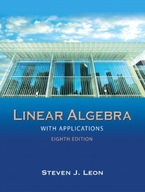
Table of Contents
1
Matrices and Systems of Equations
1.1
Systems of Linear Equations
1.2
Row Echelon Form
1.3
Matrix Arithmetic
1.4
Matrix Algebra
1.5
Elementary Matrices
1.6
Partitioned Matrices
2
Determinants
2.1
The Determinant of a Matrix
2.2
Properties of Determinants
2.3
Additional Topics and Applications
3
Vector Spaces
3.1
Definition and Examples
3.2
Subspaces
3.3
Linear Independence
3.4
Basis and Dimension
3.5
Change of Basis
3.6
Row Space and Column Space
4
Linear Transformations
4.1
Definition and Examples
4.2
Matrix Representations of Linear Transformations
4.3
Similarity
5
Orthogonality
5.1
The Scalar Product in Rn
5.2
Orthogonal Subspaces
5.3
Least Squares Problems
5.4
Inner Product Spaces
5.5
Orthonormal Sets
5.6
The GramSchmidt Orthogonalization Process
5.7
Orthogonal Polynomials
6
Eigenvalues
6.1
Eigenvalues and Eigenvectors
6.2
Systems of Linear Differential Equations
6.3
Diagonalization
6.4
Hermitian Matrices
6.5
The Singular Value Decomposition
6.6
Quadratic Forms
6.7
Positive Definite Matrices
6.8
Nonnegative Matrices
7
Numerical Linear Algebra
7.1
Floating-Point Numbers
7.2
Gaussian Elimination
7.3
Pivoting Strategies
7.4
Matrix Norms and Condition Numbers
7.5
Orthogonal Transformations
7.6
The Eigenvalue Problem
7.7
Least Squares Problems
Textbook Solutions for Linear Algebra with Applications
Chapter 4 Problem 7
Question
Let E = {x1, x2, . . . , xn} be an ordered basis for Rn. If L1 : Rn Rn and L2 : Rn Rn have the same matrix representation with respect to E, then L1 = L2.
Solution
The first step in solving 4 problem number 10 trying to solve the problem we have to refer to the textbook question: Let E = {x1, x2, . . . , xn} be an ordered basis for Rn. If L1 : Rn Rn and L2 : Rn Rn have the same matrix representation with respect to E, then L1 = L2.
From the textbook chapter Linear Transformations you will find a few key concepts needed to solve this.
Visible to paid subscribers only
Step 3 of 7)Visible to paid subscribers only
Subscribe to view the
full solution
full solution
Title
Linear Algebra with Applications 8
Author
Steve Leon
ISBN
9780136009290
Let E = {x1, x2, . . . , xn} be an ordered basis for Rn. If L1 : Rn Rn and L2 : Rn Rn
Chapter 4 textbook questions
-
Chapter 4: Problem 1 Linear Algebra with Applications 8
-
Chapter 4: Problem 2 Linear Algebra with Applications 8
Set A = triu(ones(5)) tril(ones(5)). If L denotes the linear operator defined by L(x) = Ax for all x in Rn, then A is the matrix representing L with respect to the standard basis for R5. Construct a 5 5 matrix U by setting U = hankel(ones(5, 1), 1 : 5) Use the MATLAB function rank to verify that the column vectors of U are linearly independent. Thus, E = {u1, u2, u3, u4, u5} is an ordered basis for R5. The matrix U is the transition matrix from E to the standard basis. (a) Use MATLAB to compute the matrix B representing L with respect to E. (The matrix B should be computed in terms of A, U, and U1.) (b) Generate another matrix by setting V = toeplitz([1, 0, 1, 1, 1]) Use MATLAB to check that V is nonsingular. It follows that the column vectors of V are linearly independent and hence form an ordered basis F for R5. Use MATLAB to compute the matrix C, which represents L with respect to F. (The matrix C should be computed in terms of A, V, and V1.) (c) The matrices B and C from parts (a) and (b) should be similar. Why? Explain. Use MATLAB to compute the transition matrix S from F to E. Compute the matrix C in terms of B, S, and S1. Compare your result with the result from part (b).
Read more -
Chapter 4: Problem 3 Linear Algebra with Applications 8
Let A = toeplitz(1 : 7), S = compan(ones(8, 1)) and set B = S1 A S. The matrices A and B are similar. Use MATLAB to verify that the following properties hold for these two matrices: (a) det(B) = det(A) (b) BT = ST AT (ST ) 1 (c) B1 = S1A1S (d) B9 = S1A9S (e) B 3I = S1(A 3I )S (f) det(B 3I ) = det(A 3I ) (g) tr(B) = tr(A) (Note that the trace of a matrix A can be computed with the MATLAB command trace.) These properties will hold in general for any pair of similar matrices (see Exercises 1115 of Section 3).
Read more -
Chapter 4: Problem 4 Linear Algebra with Applications 8
If L1 rotates each vector x in R2 by 60 and then reflects the resulting vector about the x-axis, and if L2 is a transformation that does the same two operations, but in the reverse order, then L1 = L2.
Read more -
Chapter 4: Problem 5 Linear Algebra with Applications 8
The set of all vectors x used in the homogeneous coordinate system (see the application on computer graphics and animation in Section 2 ) forms a subspace of R3.
Read more -
Chapter 4: Problem 6 Linear Algebra with Applications 8
Let L : R2 R2 be a linear operator, and let A be the standard matrix representation of L. If L2 is defined by L2(x) = L(L(x)) for all x R2 then L2 is a linear operator and its standard matrix representation is A2.
Read more -
Chapter 4: Problem 7 Linear Algebra with Applications 8
Let E = {x1, x2, . . . , xn} be an ordered basis for Rn. If L1 : Rn Rn and L2 : Rn Rn have the same matrix representation with respect to E, then L1 = L2.
Read more -
Chapter 4: Problem 8 Linear Algebra with Applications 8
Let L : Rn Rn be a linear operator. If A is the standard matrix representation of L, then an n n matrix B will also be a matrix representation of L if and only if B is similar to A.
Read more -
Chapter 4: Problem 9 Linear Algebra with Applications 8
Let A, B, and C be n n matrices. If A is similar to B and B is similar to C, then A is similar to C. 1
Read more -
Chapter 4: Problem 10 Linear Algebra with Applications 8
Any two matrices with the same trace are similar. [This statement is the converse of part (b) of Exercise 15 in Section 3.]
Read more