
A 400-kg satellite was placed in a circular orbit 1500 km above the surface of the earth. At this elevation the acceleration of gravity is \(6.43 \ \mathrm{m} / \mathrm{s}^{2}\). Determine the kinetic energy of the satellite, knowing that its orbital speed is \(25.6 \times 10^{3} \ \mathrm{km} / \mathrm{h}\).
Read moreTable of Contents
2
Statics of Particles
3
Rigid Bodies: Equivalent Systems of Forces
4
Equilibrium of Rigid Bodies
5
Distributed Forces: Centroids and Centers of Gravity
6
Analysis of Structures
7
Forces in Beams and Cables
8
Friction
9
Distributed Forces: Moments of Inertia
10
Method of Virtual Work
11
Kinematics of Particles
12
Kinetics of Particles: Newton’s Second Law
13
Kinetics of Particles: Energy and Momentum Methods
14
Systems of Particles
15
Kinematics of Rigid Bodies
16
Plane Motion of Rigid Bodies: Forces and Accelerations
17
Plane Motion of Rigid Bodies: Energy and Momentum Methods
18
Kinetics of Rigid Bodies in Three Dimensions
19
Mechanical Vibrations
Textbook Solutions for Vector Mechanics for Engineers: Dynamics
Chapter 13 Problem 13.108
Question
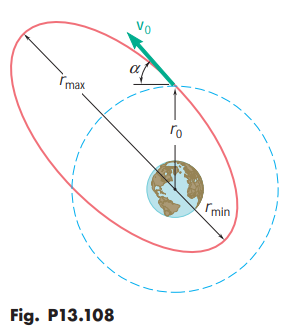
A satellite is projected into space with a velocity \(v_{0}\) at a distance \(r_{0}\) from the center of the earth by the last stage of its launching rocket. The velocity \(v_{0}\) was designed to send the satellite into a circular orbit of radius \(r_{0}\). However, owing to a malfunction of control, the satellite is not projected horizontally but at an angle a with the horizontal and, as a result, is propelled into an elliptic orbit. Determine the maximum and minimum values of the distance from the center of the earth to the satellite.
Solution
The first step in solving 13 problem number 108 trying to solve the problem we have to refer to the textbook question: A satellite is projected into space with a velocity \(v_{0}\) at a distance \(r_{0}\) from the center of the earth by the last stage of its launching rocket. The velocity \(v_{0}\) was designed to send the satellite into a circular orbit of radius \(r_{0}\). However, owing to a malfunction of control, the satellite is not projected horizontally but at an angle a with the horizontal and, as a result, is propelled into an elliptic orbit. Determine the maximum and minimum values of the distance from the center of the earth to the satellite.
From the textbook chapter Kinetics of Particles: Energy and Momentum Methods you will find a few key concepts needed to solve this.
Visible to paid subscribers only
Step 3 of 7)Visible to paid subscribers only
Subscribe to view the
full solution
full solution
Title
Vector Mechanics for Engineers: Dynamics 10
Author
Ferdinand P. Beer
ISBN
9780073398136
A satellite is projected into space with a velocity v0 at
Chapter 13 textbook questions
-
Chapter 13: Problem 13 Vector Mechanics for Engineers: Dynamics 10
-
Chapter 13: Problem 13 Vector Mechanics for Engineers: Dynamics 10
A 1-lb stone is dropped down the “bottomless pit” at Carlsbad Caverns and strikes the ground with a speed of 95 ft/s. Neglecting air resistance, (a) determine the kinetic energy of the stone as it strikes the ground and the height h from which it was dropped. (b) Solve part a assuming that the same stone is dropped down a hole on the moon. (Acceleration of gravity on the moon = \(5.31 \ \mathrm{ft} / \mathrm{s}^{2}\).)
Read more -
Chapter 13: Problem 13 Vector Mechanics for Engineers: Dynamics 10
A baseball player hits a 5.1-oz baseball with an initial velocity of 140 ft/s at an angle of \(40^{\circ}\) with the horizontal as shown. Determine (a) the kinetic energy of the ball immediately after it is hit, (b) the kinetic energy of the ball when it reaches its maximum height, (c) the maximum height above the ground reached by the ball.
Read more -
Chapter 13: Problem 13 Vector Mechanics for Engineers: Dynamics 10
A 500-kg communications satellite is in a circular geosynchronous orbit and completes one revolution about the earth in 23 h and 56 min at an altitude of 35 800 km above the surface of the earth. Knowing that the radius of the earth is 6370 km, determine the kinetic energy of the satellite.
Read more -
Chapter 13: Problem 13 Vector Mechanics for Engineers: Dynamics 10
In an ore-mixing operation, a bucket full of ore is suspended from a traveling crane which moves along a stationary bridge. The bucket is to swing no more than 10 ft horizontally when the crane is brought to a sudden stop. Determine the maximum allowable speed v of the crane.
Read more -
Chapter 13: Problem 13 Vector Mechanics for Engineers: Dynamics 10
In an ore-mixing operation, a bucket full of ore is suspended from a traveling crane which moves along a stationary bridge. The crane is traveling at a speed of 10 ft/s when it is brought to a sudden stop. Determine the maximum horizontal distance through which the bucket will swing.
Read more -
Chapter 13: Problem 13 Vector Mechanics for Engineers: Dynamics 10
Determine the maximum theoretical speed that may be achieved over a distance of 110 m by a car starting from rest assuming there is no slipping. The coefficient of static friction between the tires and pavement is 0.75, and 60 percent of the weight of the car is distributed over its front wheels and 40 percent over its rear wheels. Assume (a) front-wheel drive, (b) rear-wheel drive.
Read more -
Chapter 13: Problem 13 Vector Mechanics for Engineers: Dynamics 10
Skid marks on a drag racetrack indicate that the rear (drive) wheels of a car slip for the first 20 m of the 400-m track. (a) Knowing that the coefficient of kinetic friction is 0.60, determine the speed of the car at the end of the first 20-m portion of the track if it starts from rest and the front wheels are just off the ground. (b) What is the maximum theoretical speed of the car at the finish line if, after skidding for 20 m, it is driven without the wheels slipping for the remainder of the race? Assume that while the car is rolling without slipping, 60 percent of the weight of the car is on the rear wheels and the coefficient of static friction is 0.75. Ignore air resistance and rolling resistance.
Read more -
Chapter 13: Problem 13 Vector Mechanics for Engineers: Dynamics 10
A package is projected up a \(15^{\circ}\) incline at A with an initial velocity of 8 m/s. Knowing that the coefficient of kinetic friction between the package and the incline is 0.12, determine (a) the maximum distance d that the package will move up the incline, (b) the velocity of the package as it returns to its original position.
Read more -
Chapter 13: Problem 13 Vector Mechanics for Engineers: Dynamics 10
A 1.4-kg model rocket is launched vertically from rest with a constant thrust of 25 N until the rocket reaches an altitude of 15 m and the thrust ends. Neglecting air resistance, determine (a) the speed of the rocket when the thrust ends, (b) the maximum height reached by the rocket, (c) the speed of the rocket when it returns to the ground.
Read more -
Chapter 13: Problem 13 Vector Mechanics for Engineers: Dynamics 10
Packages are thrown down an incline at A with a velocity of 1 m/s. The packages slide along the surface ABC to a conveyor belt which moves with a velocity of 2 m/s. Knowing that \(m_{k} = 0.25\) between the packages and the surface ABC, determine the distance d if the packages are to arrive at C with a velocity of 2 m/s.
Read more -
Chapter 13: Problem 13 Vector Mechanics for Engineers: Dynamics 10
Packages are thrown down an incline at A with a velocity of 1 m/s. The packages slide along the surface ABC to a conveyor belt which moves with a velocity of 2 m/s. Knowing that d = 7.5 m and \(m_{k} = 0.25\) between the packages and all surfaces, determine (a) the speed of the package at C, (b) the distance a package will slide on the conveyor belt before it comes to rest relative to the belt.
Read more -
Chapter 13: Problem 13 Vector Mechanics for Engineers: Dynamics 10
Boxes are transported by a conveyor belt with a velocity \(v_{0}\) to a fixed incline at A where they slide and eventually fall off at B. Knowing that \(m_{k} = 0.40\), determine the velocity of the conveyor belt if the boxes leave the incline at B with a velocity of 8 ft/s.
Read more -
Chapter 13: Problem 13 Vector Mechanics for Engineers: Dynamics 10
Boxes are transported by a conveyor belt with a velocity \(v_{0}\) to a fixed incline at A where they slide and eventually fall off at B. Knowing that \(m_{k} = 0.40\), determine the velocity of the conveyor belt if the boxes are to have zero velocity at B.
Read more -
Chapter 13: Problem 13 Vector Mechanics for Engineers: Dynamics 10
A 1200-kg trailer is hitched to a 1400-kg car. The car and trailer are traveling at 72 km/h when the driver applies the brakes on both the car and the trailer. Knowing that the braking forces exerted on the car and the trailer are 5000 N and 4000 N, respectively, determine (a) the distance traveled by the car and trailer before they come to a stop, (b) the horizontal component of the force exerted by the trailer hitch on the car.
Read more -
Chapter 13: Problem 13 Vector Mechanics for Engineers: Dynamics 10
A trailer truck enters a 2 percent uphill grade traveling at 72 km/h and reaches a speed of 108 km/h in 300 m. The cab has a mass of 1800 kg and the trailer 5400 kg. Determine (a) the average force at the wheels of the cab, (b) the average force in the coupling between the cab and the trailer.
Read more -
Chapter 13: Problem 13 Vector Mechanics for Engineers: Dynamics 10
The subway train shown is traveling at a speed of 30 mi/h when the brakes are fully applied on the wheels of cars B and C, causing them to slide on the track, but are not applied on the wheels of car A. Knowing that the coefficient of kinetic friction is 0.35 between the wheels and the track, determine (a) the distance required to bring the train to a stop, (b) the force in each coupling.
Read more -
Chapter 13: Problem 13 Vector Mechanics for Engineers: Dynamics 10
The subway train shown is traveling at a speed of 30 mi/h when the brakes are fully applied on the wheels of car A, causing it to slide on the track, but are not applied on the wheels of cars B or C. Knowing that the coefficient of kinetic friction is 0.35 between the wheels and the track, determine (a) the distance required to bring the train to a stop, (b) the force in each coupling.
Read more -
Chapter 13: Problem 13 Vector Mechanics for Engineers: Dynamics 10
Blocks A and B weigh 25 lb and 10 lb, respectively, and they are both at a height 6 ft above the ground when the system is released from rest. Just before hitting the ground block A is moving at a speed of 9 ft/s. Determine (a) the amount of energy dissipated in friction by the pulley, (b) the tension in each portion of the cord during the motion.
Read more -
Chapter 13: Problem 13 Vector Mechanics for Engineers: Dynamics 10
The system shown is at rest when a constant 30-lb force is applied to collar B. (a) If the force acts through the entire motion, determine the speed of collar B as it strikes the support at C. (b) After what distance d should the 30-lb force be removed if the collar is to reach support C with zero velocity?
Read more -
Chapter 13: Problem 13 Vector Mechanics for Engineers: Dynamics 10
Car B is towing car A at a constant speed of 10 m/s on an uphill grade when the brakes of car A are fully applied causing all four wheels to skid. The driver of car B does not change the throttle setting or change gears. The masses of the cars A and B are 1400 kg and 1200 kg, respectively, and the coefficient of kinetic friction is 0.8. Neglecting air resistance and rolling resistance, determine (a) the distance traveled by the cars before they come to a stop, (b) the tension in the cable.
Read more -
Chapter 13: Problem 13 Vector Mechanics for Engineers: Dynamics 10
The system shown is at rest when a constant 250-N force is applied to block A. Neglecting the masses of the pulleys and the effect of friction in the pulleys and between block A and the horizontal surface, determine (a) the velocity of block B after block A has moved 2 m, (b) the tension in the cable.
Read more -
Chapter 13: Problem 13 Vector Mechanics for Engineers: Dynamics 10
The system shown is at rest when a constant 250-N force is applied to block A. Neglecting the masses of the pulleys and the effect of friction in the pulleys and assuming that the coefficients of friction between block A and the horizontal surface are \(m_{s} = 0.25\) and \(m_{k} = 0.20\), determine (a) the velocity of block B after block A has moved 2 m, (b) the tension in the cable.
Read more -
Chapter 13: Problem 13 Vector Mechanics for Engineers: Dynamics 10
Two blocks A and B, of mass 4 kg and 5 kg, respectively, are connected by a cord which passes over pulleys as shown. A 3-kg collar C is placed on block A and the system is released from rest. After the blocks have moved 0.9 m, collar C is removed and blocks A and B continue to move. Determine the speed of block A just before it strikes the ground.
Read more -
Chapter 13: Problem 13 Vector Mechanics for Engineers: Dynamics 10
Four packages, each weighing 6 lb, are held in place by friction on a conveyor which is disengaged from its drive motor. When the system is released from rest, package 1 leaves the belt at A just as package 4 comes onto the inclined portion of the belt at B. Determine (a) the speed of package 2 as it leaves the belt at A, (b) the speed of package 3 as it leaves the belt at A. Neglect the mass of the belt and rollers.
Read more -
Chapter 13: Problem 13 Vector Mechanics for Engineers: Dynamics 10
A 3-kg block rests on top of a 2-kg block supported by but not attached to a spring of constant 40 N/m. The upper block is suddenly removed. Determine (a) the maximum speed reached by the 2-kg block, (b) the maximum height reached by the 2-kg block.
Read more -
Chapter 13: Problem 13 Vector Mechanics for Engineers: Dynamics 10
Solve Prob. 13.26, assuming that the 2-kg block is attached to the spring.
Read more -
Chapter 13: Problem 13 Vector Mechanics for Engineers: Dynamics 10
An 8-lb collar C slides on a horizontal rod between springs A and B. If the collar is pushed to the right until spring B is compressed 2 in. and released, determine the distance through which the collar will travel assuming (a) no friction between the collar and the rod, (b) a coefficient of friction \(m_{k} = 0.35\).
Read more -
Chapter 13: Problem 13 Vector Mechanics for Engineers: Dynamics 10
A 6-lb block is attached to a cable and to a spring as shown. The constant of the spring is k = 8 lb/in. and the tension in the cable is 3 lb. If the cable is cut, determine (a) the maximum displacement of the block, (b) the maximum speed of the block.
Read more -
Chapter 13: Problem 13 Vector Mechanics for Engineers: Dynamics 10
A 10-kg block is attached to spring A and connected to spring B by a cord and pulley. The block is held in the position shown with both springs unstretched when the support is removed and the block is released with no initial velocity. Knowing that the constant of each spring is 2 kN/m, determine (a) the velocity of the block after it has moved down 50 mm, (b) the maximum velocity achieved by the block.
Read more -
Chapter 13: Problem 13 Vector Mechanics for Engineers: Dynamics 10
A 5-kg collar A is at rest on top of, but not attached to, a spring with stiffness \(k_{1} = 400 \ N/m\) when a constant 150-N force is applied to the cable. Knowing A has a speed of 1 m/s when the upper spring is compressed 75 mm, determine the spring stiffness \(k_{2}\). Ignore friction and the mass of the pulley.
Read more -
Chapter 13: Problem 13 Vector Mechanics for Engineers: Dynamics 10
A piston of mass m and cross-sectional area A is in equilibrium under the pressure p at the center of a cylinder closed at both ends. Assuming that the piston is moved to the left a distance a/2 and released, and knowing that the pressure on each side of the piston varies inversely with the volume, determine the velocity of the piston as it again reaches the center of the cylinder. Neglect friction between the piston and the cylinder and express your answer in terms of m, a, p, and A.
Read more -
Chapter 13: Problem 13 Vector Mechanics for Engineers: Dynamics 10
An uncontrolled automobile traveling at 65 mph strikes squarely a highway crash cushion of the type shown in which the automobile is brought to rest by successively crushing steel barrels. The magnitude F of the force required to crush the barrels is shown as a function of the distance x the automobile has moved into the cushion. Knowing that the weight of the automobile is 2250 lb and neglecting the effect of friction, determine (a) the distance the automobile will move into the cushion before it comes to rest, (b) the maximum deceleration of the automobile.
Read more -
Chapter 13: Problem 13 Vector Mechanics for Engineers: Dynamics 10
Two types of energy-absorbing fenders designed to be used on a pier are statically loaded. The force-deflection curve for each type of fender is given in the graph. Determine the maximum deflection of each fender when a 90-ton ship moving at 1 mi/h strikes the fender and is brought to rest.
Read more -
Chapter 13: Problem 13 Vector Mechanics for Engineers: Dynamics 10
Nonlinear springs are classified as hard or soft, depending upon the curvature of their force-deflection curve (see figure). If a delicate instrument having a mass of 5 kg is placed on a spring of length l so that its base is just touching the undeformed spring and then inadvertently released from that position, determine the maximum deflection \(x_{m}\) of the spring and the maximum force \(F_{m}\) exerted by the spring, assuming (a) a linear spring of constant k = 3 kN/m, (b) a hard, nonlinear spring, for which \(F=(3 \ \mathrm{kN} / \mathrm{m})\left(x+160 x^{3}\right)\).
Read more -
Chapter 13: Problem 13 Vector Mechanics for Engineers: Dynamics 10
A rocket is fired vertically from the surface of the moon with a speed \(v_{0}\). Derive a formula for the ratio \(h_{n} / h_{u}\) of heights reached with a speed v, if Newton’s law of gravitation is used to calculate \(h_{n}\) and a uniform gravitational field is used to calculate \(h_{u}\). Express your answer in terms of the acceleration of gravity \(g_{m}\) on the surface of the moon, the radius \(R_{m}\) of the moon, and the speeds v and \(v_{0}\).
Read more -
Chapter 13: Problem 13 Vector Mechanics for Engineers: Dynamics 10
Express the acceleration of gravity \(g_{h}\) at an altitude h above the surface of the earth in terms of the acceleration of gravity \(g_{0}\) at the surface of the earth, the altitude h, and the radius R of the earth. Determine the percent error if the weight that an object has on the surface of earth is used as its weight at an altitude of (a) 1 km, (b) 1000 km.
Read more -
Chapter 13: Problem 13 Vector Mechanics for Engineers: Dynamics 10
A golf ball struck on earth rises to a maximum height of 60 m and hits the ground 230 m away. How high will the same golf ball travel on the moon if the magnitude and direction of its velocity are the same as they were on earth immediately after the ball was hit? Assume that the ball is hit and lands at the same elevation in both cases and that the effect of the atmosphere on the earth is neglected, so that the trajectory in both cases is a parabola. The acceleration of gravity on the moon is 0.165 times that on earth.
Read more -
Chapter 13: Problem 13 Vector Mechanics for Engineers: Dynamics 10
The sphere at A is given a downward velocity \(v_{0}\) of magnitude 5 m/s and swings in a vertical plane at the end of a rope of length l = 2 m attached to a support at O. Determine the angle u at which the rope will break, knowing that it can withstand a maximum tension equal to twice the weight of the sphere.
Read more -
Chapter 13: Problem 13 Vector Mechanics for Engineers: Dynamics 10
The sphere at A is given a downward velocity \(v_{0}\) and swings in a vertical circle of radius l and center O. Determine the smallest velocity \(v_{0}\) for which the sphere will reach point B as it swings about point O (a) if AO is a rope, (b) if AO is a slender rod of negligible mass.
Read more -
Chapter 13: Problem 13 Vector Mechanics for Engineers: Dynamics 10
A small sphere B of weight W is released from rest in the position shown and swings freely in a vertical plane, first about O and then about the peg A after the cord comes in contact with the peg. Determine the tension in the cord (a) just before the sphere comes in contact with the peg, (b) just after it comes in contact with the peg.
Read more -
Chapter 13: Problem 13 Vector Mechanics for Engineers: Dynamics 10
A roller coaster starts from rest at A, rolls down the track to B, describes a circular loop of 40-ft diameter, and moves up and down past point E. Knowing that h = 60 ft and assuming no energy loss due to friction, determine (a) the force exerted by his seat on a 160-lb rider at B and D, (b) the minimum value of the radius of curvature at E if the roller coaster is not to leave the track at that point.
Read more -
Chapter 13: Problem 13 Vector Mechanics for Engineers: Dynamics 10
In Prob. 13.42, determine the range of values of h for which the roller coaster will not leave the track at D or E, knowing that the radius of curvature at E is r = 75 ft. Assume no energy loss due to friction.
Read more -
Chapter 13: Problem 13 Vector Mechanics for Engineers: Dynamics 10
A small block slides at a speed v on a horizontal surface. Knowing that h = 0.9 m, determine the required speed of the block if it is to leave the cylindrical surface BCD when \(u = 30^{\circ}\).
Read more -
Chapter 13: Problem 13 Vector Mechanics for Engineers: Dynamics 10
A small block slides at a speed v = 8 ft/s on a horizontal surface at a height h = 3 ft above the ground. Determine (a) the angle u at which it will leave the cylindrical surface BCD, (b) the distance x at which it will hit the ground. Neglect friction and air resistance.
Read more -
Chapter 13: Problem 13 Vector Mechanics for Engineers: Dynamics 10
A chair-lift is designed to transport 1000 skiers per hour from the base A to the summit B. The average mass of a skier is 70 kg and the average speed of the lift is 75 m/min. Determine (a) the average power required, (b) the required capacity of the motor if the mechanical efficiency is 85 percent and if a 300-percent overload is to be allowed.
Read more -
Chapter 13: Problem 13 Vector Mechanics for Engineers: Dynamics 10
It takes 15 s to raise a 1200-kg car and the supporting 300-kg hydraulic car-lift platform to a height of 2.8 m. Determine (a) the average output power delivered by the hydraulic pump to lift the system, (b) the average electric power required, knowing that the overall conversion efficiency from electric to mechanical power for the system is 82 percent.
Read more -
Chapter 13: Problem 13 Vector Mechanics for Engineers: Dynamics 10
The velocity of the lift of Prob. 13.47 increases uniformly from zero to its maximum value at mid-height in 7.5 s and then decreases uniformly to zero in 7.5 s. Knowing that the peak power output of the hydraulic pump is 6 kW when the velocity is maximum, determine the maximum lift force provided by the pump.
Read more -
Chapter 13: Problem 13 Vector Mechanics for Engineers: Dynamics 10
(a) A 120-lb woman rides a 15-lb bicycle up a 3-percent slope at a constant speed of 5 ft/s. How much power must be developed by the woman? (b) A 180-lb man on an 18-lb bicycle starts down the same slope and maintains a constant speed of 20 ft/s by braking. How much power is dissipated by the brakes? Ignore air resistance and rolling resistance.
Read more -
Chapter 13: Problem 13 Vector Mechanics for Engineers: Dynamics 10
A power specification formula is to be derived for electric motors which drive conveyor belts moving solid material at different rates to different heights and distances. Denoting the efficiency of a motor by h and neglecting the power needed to drive the belt itself, derive a formula (a) in the SI system of units for the power P in kW, in terms of the mass flow rate m in kg/h, the height b and horizontal distance l in meters and (b) in U.S. customary units, for the power in hp, in terms of the material flow rate w in tons/h, and the height b and horizontal distance l in feet.
Read more -
Chapter 13: Problem 13 Vector Mechanics for Engineers: Dynamics 10
In an automobile drag race, the rear (drive) wheels of a l000-kg car skid for the first 20 m and roll with sliding impending during the remaining 380 m. The front wheels of the car are just off the ground for the first 20 m, and for the remainder of the race 80 percent of the weight is on the rear wheels. Knowing that the coefficients of friction are \(m_{s} = 0.90\) and \(m_{k} = 0.68\), determine the power developed by the car at the drive wheels (a) at the end of the 20-m portion of the race, (b) at the end of the race. Give your answer in kW and in hp. Ignore the effect of air resistance and rolling friction.
Read more -
Chapter 13: Problem 13 Vector Mechanics for Engineers: Dynamics 10
The frictional resistance of a ship is known to vary directly as the 1.75 power of the speed v of the ship. A single tugboat at full power can tow the ship at a constant speed of 4.5 km/h by exerting a constant force of 300 kN. Determine (a) the power developed by the tugboat, (b) the maximum speed at which two tugboats, capable of delivering the same power, can tow the ship.
Read more -
Chapter 13: Problem 13 Vector Mechanics for Engineers: Dynamics 10
A train of total mass equal to 500 Mg starts from rest and accelerates uniformely to a speed of 90 km/h in 50 s. After reaching this speed, the train travels with a constant velocity. The track is horizontal and axle friction and rolling resistance result in a total force of 15 kN in a direction opposite to the direction of motion. Determine the power required as a function of time.
Read more -
Chapter 13: Problem 13 Vector Mechanics for Engineers: Dynamics 10
The elevator E has a weight of 6600 lb when fully loaded and is connected as shown to a counterweight W of weight of 2200 lb. Determine the power in hp delivered by the motor (a) when the elevator is moving down at a constant speed of 1 ft/s, (b) when it has an upward velocity of 1 ft/s and a deceleration of \(0.18 \ ft/s^{2}\) .
Read more -
Chapter 13: Problem 13 Vector Mechanics for Engineers: Dynamics 10
A force P is slowly applied to a plate that is attached to two springs and causes a deflection \(x_{0}\). In each of the two cases shown, derive an expression for the constant \(k_{e}\), in terms of \(k_{1}\) and \(k_{2}\), of the single spring equivalent to the given system, that is, of the single spring which will undergo the same deflection \(x_{0}\) when subjected to the same force P.
Read more -
Chapter 13: Problem 13 Vector Mechanics for Engineers: Dynamics 10
A loaded railroad car of mass m is rolling at a constant velocity \(v_{0}\) when it couples with a massless bumper system. Determine the maximum deflection of the bumper assuming the two springs are (a) in series (as shown), (b) in parallel.
Read more -
Chapter 13: Problem 13 Vector Mechanics for Engineers: Dynamics 10
A 600-g collar C may slide along a horizontal, semicircular rod ABD. The spring CE has an undeformed length of 250 mm and a spring constant of 135 N/m. Knowing that the collar is released from rest at A and neglecting friction, determine the speed of the collar (a) at B, (b) at D.
Read more -
Chapter 13: Problem 13 Vector Mechanics for Engineers: Dynamics 10
A 3-lb collar is attached to a spring and slides without friction along a circular rod in a horizontal plane. The spring has an undeformed length of 7 in. and a constant k = 1.5 lb/in. Knowing that the collar is in equilibrium at A and is given a slight push to get it moving, determine the velocity of the collar (a) as it passes through B, (b) as it passes through C.
Read more -
Chapter 13: Problem 13 Vector Mechanics for Engineers: Dynamics 10
A 3-lb collar C may slide without friction along a horizontal rod. It is attached to three springs, each of constant k = 2 lb/in. and 6-in. undeformed length. Knowing that the collar is released from rest in the position shown, determine the maximum speed it will reach in the ensuing motion.
Read more -
Chapter 13: Problem 13 Vector Mechanics for Engineers: Dynamics 10
A 500-g collar can slide without friction on the curved rod BC in a horizontal plane. Knowing that the undeformed length of the spring is 80 mm and that k = 400 kN/m, determine (a) the velocity that the collar should be given at A to reach B with zero velocity, (b) the velocity of the collar when it eventually reaches C.
Read more -
Chapter 13: Problem 13 Vector Mechanics for Engineers: Dynamics 10
An elastic cord is stretched between two points A and B, located 800 mm apart in the same horizontal plane. When stretched directly between A and B, the tension is 40 N. The cord is then stretched as shown until its midpoint C has moved through 300 mm to \(C^{\prime}\); a force of 240 N is required to hold the cord at \(C^{\prime}\). A 0.1-kg pellet is placed at \(C^{\prime}\), and the cord is released. Determine the speed of the pellet as it passes through C.
Read more -
Chapter 13: Problem 13 Vector Mechanics for Engineers: Dynamics 10
An elastic cable is to be designed for bungee jumping from a tower 130 ft high. The specifications call for the cable to be 85 ft long when unstretched, and to stretch to a total length of 100 ft when a 600-lb weight is attached to it and dropped from the tower. Determine (a) the required spring constant k of the cable, (b) how close to the ground a 186-lb man will come if he uses this cable to jump from the tower.
Read more -
Chapter 13: Problem 13 Vector Mechanics for Engineers: Dynamics 10
It is shown in mechanics of materials that the stiffness of an elastic cable is k = AE/L, where A is the cross-sectional area of the cable, E is the modulus of elasticity, and L is the length of the cable. A winch is lowering a 4000-lb piece of machinery using a constant speed of 3 ft/s when the winch suddenly stops. Knowing that the steel cable has a diameter of 0.4 in., \(E = 29 \times 10^{6} \ lb/in^{2}\), and when the winch stops L = 30 ft, determine the maximum downward displacement of the piece of machinery from the point it was when the winch stopped.
Read more -
Chapter 13: Problem 13 Vector Mechanics for Engineers: Dynamics 10
A 2-kg collar is attached to a spring and slides without friction in a vertical plane along the curved rod ABC. The spring is undeformed when the collar is at C and its constant is 600 N/m. If the collar is released at A with no initial velocity, determine its velocity (a) as it passes through B, (b) as it reaches C.
Read more -
Chapter 13: Problem 13 Vector Mechanics for Engineers: Dynamics 10
A 1-kg collar can slide along the rod shown. It is attached to an elastic cord anchored at F, which has an undeformed length of 250 mm and spring constant of 75 N/m. Knowing that the collar is released from rest at A and neglecting friction, determine the speed of the collar (a) at B, (b) at E.
Read more -
Chapter 13: Problem 13 Vector Mechanics for Engineers: Dynamics 10
A thin circular rod is supported in a vertical plane by a bracket at A. Attached to the bracket and loosely wound around the rod is a spring of constant k = 3 lb/ft and undeformed length equal to the arc of circle AB. An 8-oz collar C, not attached to the spring, can slide without friction along the rod. Knowing that the collar is released from rest at an angle u with the vertical, determine (a) the smallest value of u for which the collar will pass through D and reach point A, (b) the velocity of the collar as it reaches point A.
Read more -
Chapter 13: Problem 13 Vector Mechanics for Engineers: Dynamics 10
The system shown is in equilibrium when f = 0. Knowing that initially \(f = 90^{\circ}\) and that block C is given a slight nudge when the system is in that position, determine the speed of the block as it passes through the equilibrium position f = 0. Neglect the weight of the rod.
Read more -
Chapter 13: Problem 13 Vector Mechanics for Engineers: Dynamics 10
A spring is used to stop a 50-kg package which is moving down a \(20^{\circ}\) incline. The spring has a constant k = 30 kN/m and is held by cables so that it is initially compressed 50 mm. Knowing that the velocity of the package is 2 m/s when it is 8 m from the spring and neglecting friction, determine the maximum additional deformation of the spring in bringing the package to rest.
Read more -
Chapter 13: Problem 13 Vector Mechanics for Engineers: Dynamics 10
Solve Prob. 13.68 assuming the kinetic coefficient of friction between the package and the incline is 0.2.
Read more -
Chapter 13: Problem 13 Vector Mechanics for Engineers: Dynamics 10
A section of track for a roller coaster consists of two circular arcs AB and CD joined by a straight portion BC. The radius of AB is 27 m and the radius of CD is 72 m. The car and its occupants, of total mass 250 kg, reach point A with practically no velocity and then drop freely along the track. Determine the normal force exerted by the track on the car as the car reaches point B. Ignore air resistance and rolling resistance.
Read more -
Chapter 13: Problem 13 Vector Mechanics for Engineers: Dynamics 10
A section of track for a roller coaster consists of two circular arcs AB and CD joined by a straight portion BC. The radius of AB is 27 m and the radius of CD is 72 m. The car and its occupants, of total mass 250 kg, reach point A with practically no velocity and then drop freely along the track. Determine the maximum and minimum values of the normal force exerted by the track on the car as the car travels from A to D. Ignore air resistance and rolling resistance.
Read more -
Chapter 13: Problem 13 Vector Mechanics for Engineers: Dynamics 10
A 1-lb collar is attached to a spring and slides without friction along Problems a circular rod in a vertical plane. The spring has an undeformed length of 5 in. and a constant k = 10 lb/ft. Knowing that the collar is released from being held at A, determine the speed of the collar and the normal force between the collar and the rod as the collar passes through B.
Read more -
Chapter 13: Problem 13 Vector Mechanics for Engineers: Dynamics 10
A 10-lb collar is attached to a spring and slides without friction along a fixed rod in a vertical plane. The spring has an undeformed length of 14 in. and a constant k = 4 lb/in. Knowing that the collar is released from rest in the position shown, determine the force exerted by the rod on the collar at (a) point A, (b) point B. Both these points are on the curved portion of the rod.
Read more -
Chapter 13: Problem 13 Vector Mechanics for Engineers: Dynamics 10
An 8-oz package is projected upward with a velocity \(v_{0}\) by a spring at A; it moves around a frictionless loop and is deposited at C. For each of the two loops shown, determine (a) the smallest velocity \(v_{0}\) for which the package will reach C, (b) the corresponding force exerted by the package on the loop just before the package leaves the loop at C.
Read more -
Chapter 13: Problem 13 Vector Mechanics for Engineers: Dynamics 10
If the package of Prob. 13.74 is not to hit the horizontal surface at C with a speed greater than 10 ft/s, (a) show that this requirement can be satisfied only by the second loop, (b) determine the largest allowable initial velocity \(v_{0}\) when the second loop is used.
Read more -
Chapter 13: Problem 13 Vector Mechanics for Engineers: Dynamics 10
A small package of weight W is projected into a vertical return loop at A with a velocity \(v_{0}\). The package travels without friction along a circle of radius r and is deposited on a horizontal surface at C. For each of the two loops shown, determine (a) the smallest velocity \(v_{0}\) for which the package will reach the horizontal surface at C, (b) the corresponding force exerted by the loop on the package as it passes point B.
Read more -
Chapter 13: Problem 13 Vector Mechanics for Engineers: Dynamics 10
The 1-kg ball at A is suspended by an inextensible cord and given an initial horizontal velocity of 5 m/s. If l = 0.6 m and \(x_{B} = 0\), determine \(y_{B}\) so that the ball will enter the basket.
Read more -
Chapter 13: Problem 13 Vector Mechanics for Engineers: Dynamics 10
Packages are moved from point A on the upper floor of a warehouse to point B on the lower floor, 12 ft directly below A, by means of a chute, the centerline of which is in the shape of a helix of vertical axis y and radius R = 8 ft. The cross section of the chute is to be banked in such a way that each package, after being released at A with no velocity, will slide along the centerline of the chute without ever touching its edges. Neglecting friction, (a) express as a function of the elevation y of a given point P of the centerline the angle f formed by the normal to the surface of the chute at P and the principal normal of the centerline at that point, (b) determine the magnitude and direction of the force exerted by the chute on a 20-lb package as it reaches point B. Hint: The principal normal to the helix at any point P is horizontal and directed toward the y axis, and the radius of curvature of the helix is \(r = R[1 + (h/2pR)^{2}]\).
Read more -
Chapter 13: Problem 13 Vector Mechanics for Engineers: Dynamics 10
Prove that a force F (x, y, z) is conservative if, and only if, the following relations are satisfied: \(\frac{\partial F_{x}}{\partial y}=\frac{\partial F_{y}}{\partial x} \quad \frac{\partial F_{y}}{\partial z}=\frac{\partial F_{z}}{\partial y} \quad \frac{\partial F_{z}}{\partial x}=\frac{\partial F_{x}}{\partial z}\)
Read more -
Chapter 13: Problem 13 Vector Mechanics for Engineers: Dynamics 10
The force F = (yzi + zxj + xyk)/xyz acts on the particle P(x, y, z) which moves in space. (a) Using the relation derived in Prob. 13.79, show that this force is a conservative force. (b) Determine the potential function associated with F.
Read more -
Chapter 13: Problem 13 Vector Mechanics for Engineers: Dynamics 10
A force F acts on a particle P(x, y) which moves in the xy plane. Determine whether F is a conservative force and compute the work of F when P describes in a clockwise sense the path A, B, C, A including the quarter circle \(x^{2}+y^{2}=a^{2}\), if (a) F = kyi, (b) F = k(yi + xj).
Read more -
Chapter 13: Problem 13 Vector Mechanics for Engineers: Dynamics 10
The potential function associated with a force P in space is known to be \(V(x, y, z)=-\left(x^{2}+y^{2}+z^{2}\right)^{1 / 2}\). (a) Determine the x, y, and z components of P. (b) Calculate the work done by P from O to D by integrating along the path OABD, and show that it is equal to the negative of the change in potential from O to D.
Read more -
Chapter 13: Problem 13 Vector Mechanics for Engineers: Dynamics 10
a) Calculate the work done from D to O by the force P of Prob. 13.82 by integrating along the diagonal of the cube. (b) Using the result obtained and the answer to part b of Prob. 13.82, verify that the work done by a conservative force around the closed path OABDO is zero.
Read more -
Chapter 13: Problem 13 Vector Mechanics for Engineers: Dynamics 10
The force \(\mathbf{F}=(x \mathbf{i}+y \mathbf{j}+z \mathbf{k}) /\left(x^{2}+y^{2}+z^{2}\right)^{3 / 2}\) acts on the particle P(x, y, z) which moves in space. (a) Using the relations derived in Prob. 13.79, prove that F is a conservative force. (b) Determine the potential function V(x, y, z) associated with F.
Read more -
Chapter 13: Problem 13 Vector Mechanics for Engineers: Dynamics 10
(a) Determine the kinetic energy per unit mass which a missile must have after being fired from the surface of the earth if it is to reach an infinite distance from the earth. (b) What is the initial velocity of the missile (called the escape velocity)? Give your answers in SI units and show that the answer to part b is independent of the firing angle.
Read more -
Chapter 13: Problem 13 Vector Mechanics for Engineers: Dynamics 10
A satellite describes an elliptic orbit of minimum altitude 606 km above the surface of the earth. The semimajor and semiminor axes are 17 440 km and 13 950 km, respectively. Knowing that the speed of the satellite at point C is 4.78 km/s, determine (a) the speed at point A, the perigee, (b) the speed at point B, the apogee.
Read more -
Chapter 13: Problem 13 Vector Mechanics for Engineers: Dynamics 10
While describing a circular orbit 200 mi above the earth a space vehicle launches a 6000-lb communications satellite. Determine (a) the additional energy required to place the satellite in a geosynchronous orbit at an altitude of 22,000 mi above the surface of the earth, (b) the energy required to place the satellite in the same orbit by launching it from the surface of the earth, excluding the energy needed to overcome air resistance. (A geosynchronous orbit is a circular orbit in which the satellite appears stationary with respect to the ground.)
Read more -
Chapter 13: Problem 13 Vector Mechanics for Engineers: Dynamics 10
A lunar excursion module (LEM) was used in the Apollo moon landing missions to save fuel by making it unnecessary to launch the entire Apollo spacecraft from the moon’s surface on its return trip to earth. Check the effectiveness of this approach by computing the energy per pound required for a spacecraft (as weighed on the earth) to escape the moon’s gravitational field if the spacecraft starts from (a) the moon’s surface, (b) a circular orbit 50 mi above the moon’s surface. Neglect the effect of the earth’s gravitational field. (The radius of the moon is 1081 mi and its mass is 0.0123 times the mass of the earth.)
Read more -
Chapter 13: Problem 13 Vector Mechanics for Engineers: Dynamics 10
Knowing that the velocity of an experimental space probe fired from the earth has a magnitude \(v_{A} = 32.5 \ Mm/h\) at point A, determine the speed of the probe as it passes through point B.
Read more -
Chapter 13: Problem 13 Vector Mechanics for Engineers: Dynamics 10
A spacecraft is describing a circular orbit at an altitude of 1500 km above the surface of the earth. As it passes through point A, its speed is reduced by 40 percent and it enters an elliptic crash trajectory with the apogee at point A. Neglecting air resistance, determine the speed of the spacecraft when it reaches the earth’s surface at point B.
Read more -
Chapter 13: Problem 13 Vector Mechanics for Engineers: Dynamics 10
Observations show that a celestial body traveling at \(1.2 \times 10^{6} \ mi/h\) appears to be describing about point B a circle of radius equal to 60 light years. Point B is suspected of being a very dense concentration of mass called a black hole. Determine the ratio \(M_{B}/M_{S}\) of the mass at B to the mass of the sun. (The mass of the sun is 330,000 times the mass of the earth, and a light year is the distance traveled by light in 1 year at 186,300 mi/s.)
Read more -
Chapter 13: Problem 13 Vector Mechanics for Engineers: Dynamics 10
(a) Show that, by setting r = R + y in the right-hand member of Eq. (13.179) and expanding that member in a power series in y/R, the expression in Eq. (13.16) for the potential energy \(V_{g}\) due to gravity is a first-order approximation for the expression given in Eq. (13.179). (b) Using the same expansion, derive a second-order approximation for \(V_{g}\).
Read more -
Chapter 13: Problem 13 Vector Mechanics for Engineers: Dynamics 10
Collar A has a mass of 3 kg and is attached to a spring of constant 1200 N/m and of undeformed length equal to 0.5 m. The system is set in motion with r = 0.3 m, \(v_{u} = 2 m/s\), and \(v_{r} = 0\). Neglecting the mass of the rod and the effect of friction, determine the radial and transverse components of the velocity of the collar when r = 0.6 m.
Read more -
Chapter 13: Problem 13 Vector Mechanics for Engineers: Dynamics 10
Collar A has a mass of 3 kg and is attached to a spring of constant 1200 N/m and of undeformed length equal to 0.5 m. The system is set in motion with r = 0.3 m, \(v_{u} = 2 m/s\), and \(v_{r} = 0\). Neglecting the mass of the rod and the effect of friction, determine (a) the maximum distance between the origin and the collar, (b) the corresponding speed. (Hint: Solve the equation obtained for r by trial and error.)
Read more -
Chapter 13: Problem 13 Vector Mechanics for Engineers: Dynamics 10
A 4-lb collar A and a 1.5-lb collar B can slide without friction on a frame, consisting of the horizontal rod OE and the vertical rod CD, which is free to rotate about CD. The two collars are connected by a cord running over a pulley that is attached to the frame at O. At the instant shown, the velocity \(v_{A}\) of collar A has a magnitude of 6 ft/s and a stop prevents collar B from moving. If the stop is suddenly removed, determine (a) the velocity of collar A when it is 8 in. from O, (b) the velocity of collar A when collar B comes to rest. (Assume that collar B does not hit O, that collar A does not come off rod OE, and that the mass of the frame is negligible.)
Read more -
Chapter 13: Problem 13 Vector Mechanics for Engineers: Dynamics 10
A 1.5-lb ball that can slide on a horizontal frictionless surface is attached to a fixed point O by means of an elastic cord of constant k = 1 lb/in. and undeformed length 2 ft. The ball is placed at point A, 3 ft from O, and given an initial velocity \(v_{0}\) perpendicular to OA. Determine (a) the smallest allowable value of the initial speed \(v_{0}\) if the cord is not to become slack, (b) the closest distance d that the ball will come to point O if it is given half the initial speed found in part a.
Read more -
Chapter 13: Problem 13 Vector Mechanics for Engineers: Dynamics 10
A 1.5-lb ball that can slide on a horizontal frictionless surface is attached to a fixed point O by means of an elastic cord of constant k = 1 lb/in. and undeformed length 2 ft. The ball is placed at point A, 3 ft from O, and given an initial velocity \(v_{0}\) perpendicular to OA, allowing the ball to come within a distance d = 9 in. of point O after the cord has become slack. Determine (a) the initial speed \(v_{0}\) of the ball, (b) its maximum speed.
Read more -
Chapter 13: Problem 13 Vector Mechanics for Engineers: Dynamics 10
Using the principles of conservation of energy and conservation of angular momentum, solve part a of Sample Prob. 12.9.
Read more -
Chapter 13: Problem 13 Vector Mechanics for Engineers: Dynamics 10
Solve Sample Prob. 13.8, assuming that the elastic cord is replaced by a central force F of magnitude (\(80/r^{2}\) ) N directed toward O.
Read more -
Chapter 13: Problem 13 Vector Mechanics for Engineers: Dynamics 10
A spacecraft is describing an elliptic orbit of minimum altitude \(h_{A} = 2400 km\) and maximum altitude \(h_{B} = 9600 km\) above the surface of the earth. Determine the speed of the spacecraft at A.
Read more -
Chapter 13: Problem 13 Vector Mechanics for Engineers: Dynamics 10
While describing a circular orbit, 185 mi above the surface of the earth, a space shuttle ejects at point A an inertial upper stage (IUS) carrying a communications satellite to be placed in a geosynchronous orbit (see Prob. 13.87) at an altitude of 22,230 mi above the surface of the earth. Determine (a) the velocity of the IUS relative to the shuttle after its engine has been fired at A, (b) the increase in velocity required at B to place the satellite in its final orbit.
Read more -
Chapter 13: Problem 13 Vector Mechanics for Engineers: Dynamics 10
A spacecraft approaching the planet Saturn reaches point A with a velocity \(v_{A}\) of magnitude \(68.8 \times 10^{3} \ \mathrm{ft} / \mathrm{s}\). It is to be placed in an elliptic orbit about Saturn so that it will be able to periodically examine Tethys, one of Saturn’s moons. Tethys is in a circular orbit of radius \(183 \times 10^{3} \ \mathrm{mi}\) about the center of Saturn, traveling at a speed of \(37.2 \times 10^{3} \ \mathrm{ft} / \mathrm{s}\). Determine (a) the decrease in speed required by the spacecraft at A to achieve the desired orbit, (b) the speed of the spacecraft when it reaches the orbit of Tethys at B.
Read more -
Chapter 13: Problem 13 Vector Mechanics for Engineers: Dynamics 10
A spacecraft traveling along a parabolic path toward the planet Jupiter is expected to reach point A with a velocity \(v_{A}\) of magnitude 26.9 km/s. Its engines will then be fired to slow it down, placing it into an elliptic orbit which will bring it to within \(100 \times 10^{3} \ \mathrm{km}\) of Jupiter. Determine the decrease in speed \(\Delta v\) at point A which will place the spacecraft into the required orbit. The mass of Jupiter is 319 times the mass of the earth.
Read more -
Chapter 13: Problem 13 Vector Mechanics for Engineers: Dynamics 10
As a first approximation to the analysis of a space flight from the earth to Mars, it is assumed that the orbits of the earth and Mars are circular and coplanar. The mean distances from the sun to the earth and to Mars are \(149.6 \times 10^{6} \ \mathrm{km}\) and \(227.8 \times 10^{6} \ \mathrm{km}\), respectively. To place the spacecraft into an elliptical transfer orbit at point A, its speed is increased over a short interval of time to \(v_{A}\) which is faster than the earth’s orbital speed. When the spacecraft reaches point B on the elliptical transfer orbit, its speed \(v_{B}\) is increased to the orbital speed of Mars. Knowing that the mass of the sun is \(332.8 \times 10^{3}\) times the mass of the earth, determine the increase in velocity required (a) at A, (b) at B.
Read more -
Chapter 13: Problem 13 Vector Mechanics for Engineers: Dynamics 10
The optimal way of transferring a space vehicle from an inner circular orbit to an outer coplanar circular orbit is to fire its engines as it passes through A to increase its speed and place it in an elliptic transfer orbit. Another increase in speed as it passes through B will place it in the desired circular orbit. For a vehicle in a circular orbit about the earth at an altitude \(h_{1} = 200 mi\), which is to be transferred to a circular orbit at an altitude \(h_{2} = 500 mi\), determine (a) the required increases in speed at A and at B, (b) the total energy per unit mass required to execute the transfer.
Read more -
Chapter 13: Problem 13 Vector Mechanics for Engineers: Dynamics 10
During a flyby of the earth, the velocity of a spacecraft is 10.4 km/s as it reaches its minimum altitude of 990 km above the surface at point A. At point B the spacecraft is observed to have an altitude of 8350 km. Determine (a) the magnitude of the velocity at point B, (b) the angle \(f_{B}\).
Read more -
Chapter 13: Problem 13 Vector Mechanics for Engineers: Dynamics 10
A space platform is in a circular orbit about the earth at an altitude of 300 km. As the platform passes through A, a rocket carrying a communications satellite is launched from the platform with a relative velocity of magnitude 3.44 km/s in a direction tangent to the orbit of the platform. This was intended to place the rocket in an elliptic transfer orbit bringing it to point B, where the rocket would again be fired to place the satellite in a geosynchronous orbit of radius 42 140 km. After launching, it was discovered that the relative velocity imparted to the rocket was too large. Determine the angle g at which the rocket will cross the intended orbit at point C.
Read more -
Chapter 13: Problem 13 Vector Mechanics for Engineers: Dynamics 10
A satellite is projected into space with a velocity \(v_{0}\) at a distance \(r_{0}\) from the center of the earth by the last stage of its launching rocket. The velocity \(v_{0}\) was designed to send the satellite into a circular orbit of radius \(r_{0}\). However, owing to a malfunction of control, the satellite is not projected horizontally but at an angle a with the horizontal and, as a result, is propelled into an elliptic orbit. Determine the maximum and minimum values of the distance from the center of the earth to the satellite.
Read more -
Chapter 13: Problem 13 Vector Mechanics for Engineers: Dynamics 10
Upon the LEM’s return to the command module, the Apollo spacecraft was turned around so that the LEM faced to the rear. The LEM was then cast adrift with a velocity of 200 m/s relative to the command module. Determine the magnitude and direction (angle f formed with the vertical OC) of the velocity \(v_{C}\) of the LEM just before it crashed at C on the moon’s surface.
Read more -
Chapter 13: Problem 13 Vector Mechanics for Engineers: Dynamics 10
A space vehicle is in a circular orbit at an altitude of 225 mi above the earth. To return to earth, it decreases its speed as it passes through A by firing its engine for a short interval of time in a direction opposite to the direction of its motion. Knowing that the velocity of the space vehicle should form an angle \(\mathrm{f}_{B}=60^{\circ}\) with the vertical as it reaches point B at an altitude of 40 mi, determine (a) the required speed of the vehicle as it leaves its circular orbit at A, (b) its speed at point B.
Read more -
Chapter 13: Problem 13 Vector Mechanics for Engineers: Dynamics 10
In Prob. 13.110, the speed of the space vehicle was decreased as it passed through A by firing its engine in a direction opposite to the direction of motion. An alternative strategy for taking the space vehicle out of its circular orbit would be to turn it around so that its engine would point away from the earth and then give it an incremental velocity \(\Delta \mathbf{v}_{A}\) toward the center O of the earth. This would likely require a smaller expenditure of energy when firing the engine at A, but might result in too fast a descent at B. Assuming this strategy is used with only 50 percent of the energy expenditure used in Prob. 13.110, determine the resulting values of \(f_{B}\) and \(v_{B}\).
Read more -
Chapter 13: Problem 13 Vector Mechanics for Engineers: Dynamics 10
Show that the values \(v_{A}\) and \(v_{P}\) of the speed of an earth satellite at the apogee A and the perigee P of an elliptic orbit are defined by the relations \(v_{A}^{2}=\frac{2 G M}{r_{A}+r_{P}} \frac{r_{P}}{r_{A}} \ \quad v_{P}^{2}=\frac{2 G M}{r_{A}+r_{P}} \frac{r_{A}}{r_{P}}\) where M is the mass of the earth, and \(r_{A}\) and \(r_{P}\) represent, respectively, the maximum and minimum distances of the orbit to the center of the earth.
Read more -
Chapter 13: Problem 13 Vector Mechanics for Engineers: Dynamics 10
Show that the total energy E of an earth satellite of mass m describing an elliptic orbit is \(E=-G M m /\left(r_{A}+r_{P}\right)\), where M is the mass of the earth, and \(r_{A}\) and \(r_{P}\) represent, respectively, the maximum and minimum distances of the orbit to the center of the earth. (Recall that the gravitational potential energy of a satellite was defined as being zero at an infinite distance from the earth.)
Read more -
Chapter 13: Problem 13 Vector Mechanics for Engineers: Dynamics 10
A space probe describes a circular orbit of radius nR with a velocity \(v_{0}\) about a planet of radius R and center O. Show that (a) in order for the probe to leave its orbit and hit the planet at an angle u with the vertical, its velocity must be reduced to \(a \mathbf{v}_{0}\), where \(\mathrm{a}=\sin \mathrm{u} \frac{\overline{2(n-1)}}{\mathrm{B} n^{2}-\sin ^{2} \mathrm{u}}\) (b) the probe will not hit the planet if a is larger than \(1 \overline{2 /(1+n)}\).
Read more -
Chapter 13: Problem 13 Vector Mechanics for Engineers: Dynamics 10
A missile is fired from the ground with an initial velocity \(v_{0}\) forming an angle \(f_{0}\) with the vertical. If the missile is to reach a maximum altitude equal to aR, where R is the radius of the earth, (a) show that the required angle \(f_{0}\) is defined by the relation \(\sin \mathrm{f}_{0}=(1+\mathrm{a}) \mathrm{B} \overline{1-\frac{\mathrm{a}}{1+\mathrm{a}}\left(\frac{v_{\text {esc }}}{v_{0}}\right)^{2}}\) where \(v_{\text {esc }}\) is the escape velocity, (b) determine the range of allowable values of \(v_{0}\).
Read more -
Chapter 13: Problem 13 Vector Mechanics for Engineers: Dynamics 10
A spacecraft of mass m describes a circular orbit of radius \(r_{1}\) around the earth. (a) Show that the additional energy \(\Delta E\) which must be imparted to the spacecraft to transfer it to a circular orbit of larger radius \(r_{2}\) is \(\Delta E=\frac{G M m\left(r_{2}-r_{1}\right)}{2 r_{1} r_{2}}\) where M is the mass of the earth. (b) Further show that if the transfer from one circular orbit to the other is executed by placing the spacecraft on a transitional semielliptic path AB, the amounts of energy \(\Delta E_{A}\) and \(\Delta E_{B}\) which must be imparted at A and B are, respectively, proportional to \(r_{2}\) and \(r_{1}\): \(\Delta E_{A}=\frac{r_{2}}{r_{1}+r_{2}} \Delta E \ \ \quad \Delta E_{B}=\frac{r_{1}}{r_{1}+r_{2}} \Delta E\)
Read more -
Chapter 13: Problem 13 Vector Mechanics for Engineers: Dynamics 10
Using the answers obtained in Prob. 13.108, show that the intended circular orbit and the resulting elliptic orbit intersect at the ends of the minor axis of the elliptic orbit.
Read more -
Chapter 13: Problem 13 Vector Mechanics for Engineers: Dynamics 10
(a) Express in terms of \(r_{\min }\) and \(v_{\max }\) the angular momentum per unit mass, h, and the total energy per unit mass, E/m, of a space vehicle moving under the gravitational attraction of a planet of mass M (Fig. 13.15). (b) Eliminating \(v_{\max }\) between the equations obtained, derive the formula \(\frac{1}{r_{\min }}=\frac{G M}{h^{2}}\left[1+ _{\mathrm{B}} \overline{1+\frac{2 E}{m}\left(\frac{h}{G M}\right)^{2}}\right]\) (c) Show that the eccentricity £ of the trajectory of the vehicle can be expressed as \(\mathrm{e}=_{\mathrm{B}} \overline{1+\frac{2 E}{m}\left(\frac{h}{G M}\right)^{2}}\) (d) Further show that the trajectory of the vehicle is a hyperbola, an ellipse, or a parabola, depending on whether E is positive, negative, or zero.
Read more -
Chapter 13: Problem 13 Vector Mechanics for Engineers: Dynamics 10
A 35 000-Mg ocean liner has an initial velocity of 4 km/h. Neglecting the frictional resistance of the water, determine the time required to bring the liner to rest by using a single tugboat which exerts a constant force of 150 kN.
Read more -
Chapter 13: Problem 13 Vector Mechanics for Engineers: Dynamics 10
A 2500-lb automobile is moving at a speed of 60 mi/h when the brakes are fully applied, causing all four wheels to skid. Determine the time required to stop the automobile (a) on dry pavement (\(m_{k} = 0.75\)), (b) on an icy road (\(m_{k} = 0.10\)).
Read more -
Chapter 13: Problem 13 Vector Mechanics for Engineers: Dynamics 10
A sailboat weighing 980 lb with its occupants is running down wind at 8 mi/h when its spinnaker is raised to increase its speed. Determine the net force provided by the spinnaker over the 10-s interval that it takes for the boat to reach a speed of 12 mi/h.
Read more -
Chapter 13: Problem 13 Vector Mechanics for Engineers: Dynamics 10
A truck is hauling a 300-kg log out of a ditch using a winch attached to the back of the truck. Knowing the winch applies a constant force of 2500 N and the coefficient of kinetic friction between the ground and the log is 0.45, determine the time for the log to reach a speed of 0.5 m/s.
Read more -
Chapter 13: Problem 13 Vector Mechanics for Engineers: Dynamics 10
A truck is traveling down a road with a 3-percent grade at a speed of 55 mi/h when the brakes are applied. Knowing the coefficients of friction between the load and the flatbed trailer shown are \(m_{s} = 0.40\) and \(m_{k} = 0.35\), determine the shortest time in which the rig can be brought to a stop if the load is not to shift.
Read more -
Chapter 13: Problem 13 Vector Mechanics for Engineers: Dynamics 10
Steep safety ramps are built beside mountain highways to enable vehicles with defective brakes to stop. A 10-ton truck enters a \(15^{\circ}\) ramp at a high speed \(v_{0} = 108 \ ft/s\) and travels for 6 s before its speed is reduced to 36 ft/s. Assuming constant deceleration, determine (a) the magnitude of the braking force, (b) the additional time required for the truck to stop. Neglect air resistance and rolling resistance.
Read more -
Chapter 13: Problem 13 Vector Mechanics for Engineers: Dynamics 10
Baggage on the floor of the baggage car of a high-speed train is not prevented from moving other than by friction. The train is traveling down a 5-percent grade when it decreases its speed at a constant rate from 120 mi/h to 60 mi/h in a time interval of 12 s. Determine the smallest allowable value of the coefficient of static friction between a trunk and the floor of the baggage car if the trunk is not to slide.
Read more -
Chapter 13: Problem 13 Vector Mechanics for Engineers: Dynamics 10
A 2-kg particle is acted upon by the force, expressed in newtons, \(\mathbf{F}=(8-6 t) \mathbf{i}+\left(4-t^{2}\right) \mathbf{j}+(4+t) \mathbf{k}\). Knowing that the velocity of the particle is \(\mathbf{v}=(150 \ \mathrm{m} / \mathrm{s}) \mathbf{i}+(100 \ \mathrm{m} / \mathrm{s}) \mathbf{j}-(250 \ \mathrm{m} / \mathrm{s}) \mathbf{k}\) at t = 0, determine (a) the time at which the velocity of the particle is parallel to the yz plane, (b) the corresponding velocity of the particle.
Read more -
Chapter 13: Problem 13 Vector Mechanics for Engineers: Dynamics 10
A truck is traveling down a road with a 4-percent grade at a speed of 60 mi/h when its brakes are applied to slow it down to 20 mi/h. An antiskid braking system limits the braking force to a value at which the wheels of the truck are just about to slide. Knowing that the coefficient of static friction between the road and the wheels is 0.60, determine the shortest time needed for the truck to slow down.
Read more -
Chapter 13: Problem 13 Vector Mechanics for Engineers: Dynamics 10
Skid marks on a drag race track indicate that the rear (drive) wheels of a car slip for the first 20 m of the 400-m track. (a) Knowing that the coefficient of kinetic friction is 0.60, determine the shortest possible time for the car to travel the initial 20-m portion of the track if it starts from rest with its front wheels just off the ground. (b) Determine the minimum time for the car to run the whole race if, after skidding for 20 m, the wheels roll without sliding for the remainder of the race. Assume for the rolling portion of the race that 65 percent of the weight is on the rear wheels and that the coefficient of static friction is 0.85. Ignore air resistance and rolling resistance.
Read more -
Chapter 13: Problem 13 Vector Mechanics for Engineers: Dynamics 10
The subway train shown is traveling at a speed of 30 mi/h when the brakes are fully applied on the wheels of cars B and C, causing them to slide on the track, but are not applied on the wheels of car A. Knowing that the coefficient of kinetic friction is 0.35 between the wheels and the track, determine (a) the time required to bring the train to a stop, (b) the force in each coupling.
Read more -
Chapter 13: Problem 13 Vector Mechanics for Engineers: Dynamics 10
Solve Prob. 13.129, assuming that the brakes are applied only on the wheels of car A.
Read more -
Chapter 13: Problem 13 Vector Mechanics for Engineers: Dynamics 10
A trailer truck with a 2000-kg cab and an 8000-kg trailer is traveling on a level road at 90 km/h. The brakes on the trailer fail and the antiskid system of the cab provides the largest possible force which will not cause the wheels of the cab to slide. Knowing that the coefficient of static friction is 0.65, determine (a) the shortest time for the rig to come to a stop, (b) the force in the coupling during that time.
Read more -
Chapter 13: Problem 13 Vector Mechanics for Engineers: Dynamics 10
The system shown is at rest when a constant 150-N force is applied to collar B. Neglecting the effect of friction, determine (a) the time at which the velocity of collar B will be 2.5 m/s to the left, (b) the corresponding tension in the cable.
Read more -
Chapter 13: Problem 13 Vector Mechanics for Engineers: Dynamics 10
An 8-kg cylinder C rests on a 4-kg platform A supported by a cord which passes over the pulleys D and E and is attached to a 4-kg block B. Knowing that the system is released from rest, determine (a) the velocity of block B after 0.8 s, (b) the force exerted by the cylinder on the platform.
Read more -
Chapter 13: Problem 13 Vector Mechanics for Engineers: Dynamics 10
An estimate of the expected load on over-the-shoulder seat belts is to be made before designing prototype belts that will be evaluated in automobile crash tests. Assuming that an automobile traveling at 45 mi/h is brought to a stop in 110 ms, determine (a) the average impulsive force exerted by a 200-lb man on the belt, (b) the maximum force \(F_{m}\) exerted on the belt if the force time diagram has the shape shown.
Read more -
Chapter 13: Problem 13 Vector Mechanics for Engineers: Dynamics 10
A 60-g model rocket is fired vertically. The engine applies a thrust P which varies in magnitude as shown. Neglecting air resistance and the change in mass of the rocket, determine (a) the maximum speed of the rocket as it goes up, (b) the time for the rocket to reach its maximum elevation.
Read more -
Chapter 13: Problem 13 Vector Mechanics for Engineers: Dynamics 10
A simplified model consisting of a single straight line is to be obtained for the variation of pressure inside the 10-mm-diameter barrel of a rifle as a 20-g bullet is fired. Knowing that it takes 1.6 ms for the bullet to travel the length of the barrel and that the velocity of the bullet upon exit is 700 m/s, determine the value of \(p_{0}\).
Read more -
Chapter 13: Problem 13 Vector Mechanics for Engineers: Dynamics 10
A 125-lb block initially at rest is acted upon by a force P Problems which varies as shown. Knowing that the coefficients of friction between the block and the horizontal surface are \(m_{s} = 0.50\) and \(m_{k} = 0.40\), determine (a) the time at which the block will start moving, (b) the maximum speed reached by the block, (c) the time at which the block will stop moving.
Read more -
Chapter 13: Problem 13 Vector Mechanics for Engineers: Dynamics 10
Solve Prob. 13.137, assuming that the weight of the block is 175 lb.
Read more -
Chapter 13: Problem 13 Vector Mechanics for Engineers: Dynamics 10
A baseball player catching a ball can soften the impact by pulling his hand back. Assuming that a 5-oz ball reaches his glove at 90 mi/h and that the player pulls his hand back during the impact at an average speed of 30 ft/s over a distance of 6 in., bringing the ball to a stop, determine the average impulsive force exerted on the player’s hand.
Read more -
Chapter 13: Problem 13 Vector Mechanics for Engineers: Dynamics 10
A 1.62-oz golf ball is hit with a golf club and leaves it with a velocity of 100 mi/h. We assume that for \(0 \leq t \leq t_{0}\), where \(t_{0}\) is the duration of the impact, the magnitude F of the force exerted on the ball can be expressed as \(F=F_{m} \sin \ \left(\mathrm{p} t / t_{0}\right)\). Knowing that \(t_{0}=0.5 \ \mathrm{ms}\), determine the maximum value \(F_{m}\) of the force exerted on the ball.
Read more -
Chapter 13: Problem 13 Vector Mechanics for Engineers: Dynamics 10
The triple jump is a track-and-field event in which an athlete gets a running start and tries to leap as far as he can with a hop, step, and jump. Shown in the figure is the initial hop of the athlete. Assuming that he approaches the takeoff line from the left with a horizontal velocity of 10 m/s, remains in contact with the ground for 0.18 s, and takes off at a \(50^{\circ}\) angle with a velocity of 12 m/s, determine the vertical component of the average impulsive force exerted by the ground on his foot. Give your answer in terms of the weight W of the athlete.
Read more -
Chapter 13: Problem 13 Vector Mechanics for Engineers: Dynamics 10
The last segment of the triple jump track-and-field event is the jump, in which the athlete makes a final leap, landing in a sand filled pit. Assuming that the velocity of a 80-kg athlete just before landing is 9 m/s at an angle of \(35^{\circ}\) with the horizontal and that the athlete comes to a complete stop in 0.22 s after landing, determine the horizontal component of the average impulsive force exerted on his feet during landing.
Read more -
Chapter 13: Problem 13 Vector Mechanics for Engineers: Dynamics 10
The design for a new cementless hip implant is to be studied using an instrumented implant and a fixed simulated femur. Assuming the punch applies an average force of 2 kN over a time of 2 ms to the 200-g implant, determine (a) the velocity of the implant immediately after impact, (b) the average resistance of the implant to penetration if the implant moves 1 mm before coming to rest.
Read more -
Chapter 13: Problem 13 Vector Mechanics for Engineers: Dynamics 10
A 25-g steel-jacketed bullet is fired horizontally with a velocity of 600 m/s and ricochets off a steel plate along the path CD with a velocity of 400 m/s. Knowing that the bullet leaves a 10-mm scratch on the plate and assuming that its average speed is 500 m/s while it is in contact with the plate, determine the magnitude and direction of the average impulsive force exerted by the bullet on the plate.
Read more -
Chapter 13: Problem 13 Vector Mechanics for Engineers: Dynamics 10
A 25-ton railroad car moving at 2.5 mi/h is to be coupled to a 50-ton car which is at rest with locked wheels (\(m_{k} = 0.30\)). Determine (a) the velocity of both cars after the coupling is completed, (b) the time it takes for both cars to come to rest.
Read more -
Chapter 13: Problem 13 Vector Mechanics for Engineers: Dynamics 10
At an intersection car B was traveling south and car A was traveling \(30^{\circ}\) north of east when they slammed into each other. Upon investigation it was found that after the crash the two cars got stuck and skidded off at an angle of \(10^{\circ}\) north of east. Each driver claimed that he was going at the speed limit of 50 km/h and that he tried to slow down but couldn’t avoid the crash because the other driver was going a lot faster. Knowing that the masses of cars A and B were 1500 kg and 1200 kg, respectively, determine (a) which car was going faster, (b) the speed of the faster of the two cars if the slower car was traveling at the speed limit.
Read more -
Chapter 13: Problem 13 Vector Mechanics for Engineers: Dynamics 10
The 650-kg hammer of a drop-hammer pile driver falls from a Problems height of 1.2 m onto the top of a 140-kg pile, driving it 110 mm into the ground. Assuming perfectly plastic impact (e = 0), determine the average resistance of the ground to penetration.
Read more -
Chapter 13: Problem 13 Vector Mechanics for Engineers: Dynamics 10
A small rivet connecting two pieces of sheet metal is being clinched by hammering. Determine the impulse exerted on the rivet and the energy absorbed by the rivet under each blow, knowing that the head of the hammer has a weight of 1.5 lb and that it strikes the rivet with a velocity of 20 ft/s. Assume that the hammer does not rebound and that the anvil is supported by springs and (a) has an infinite mass (rigid support), (b) has a weight of 9 lb.
Read more -
Chapter 13: Problem 13 Vector Mechanics for Engineers: Dynamics 10
Bullet B weighs 0.5 oz and blocks A and C both weigh 3 lb. The coefficient of friction between the blocks and the plane is \(m_{k} = 0.25\). Initially the bullet is moving at \(v_{0}\) and blocks A and C are at rest (Fig. 1). After the bullet passes through A it becomes embedded in block C and all three objects come to stop in the positions shown (Fig. 2). Determine the initial speed of the bullet \(v_{0}\).
Read more -
Chapter 13: Problem 13 Vector Mechanics for Engineers: Dynamics 10
A 180-lb man and a 120-lb woman stand at opposite ends of a 300-lb boat, ready to dive, each with a 16-ft/s velocity relative to the boat. Determine the velocity of the boat after they have both dived, if (a) the woman dives first, (b) the man dives first.
Read more -
Chapter 13: Problem 13 Vector Mechanics for Engineers: Dynamics 10
A 75-g ball is projected from a height of 1.6 m with a horizontal velocity of 2 m/s and bounces from a 400-g smooth plate supported by springs. Knowing that the height of the rebound is 0.6 m, determine (a) the velocity of the plate immediately after the impact, (b) the energy lost due to the impact.
Read more -
Chapter 13: Problem 13 Vector Mechanics for Engineers: Dynamics 10
A 2-kg sphere A is connected to a fixed point O by an inextensible cord of length 1.2 m. The sphere is resting on a frictionless horizontal surface at a distance of 0.5 m from O when it is given a velocity \(v_{0}\) in a direction perpendicular to line OA. It moves freely until it reaches position \(A^{\prime}\), when the cord becomes taut. Determine the maximum allowable velocity \(v_{0}\) if the impulse of the force exerted on the cord is not to exceed \(3 \ N \cdot s\).
Read more -
Chapter 13: Problem 13 Vector Mechanics for Engineers: Dynamics 10
A 1-oz bullet is traveling with a velocity of 1400 ft/s when it impacts and becomes embedded in a 5-lb wooden block. The block can move vertically without friction. Determine (a) the velocity of the bullet and block immediately after the impact, (b) the horizontal and vertical components of the impulse exerted by the block on the bullet.
Read more -
Chapter 13: Problem 13 Vector Mechanics for Engineers: Dynamics 10
In order to test the resistance of a chain to impact, the chain is suspended from a 240-lb rigid beam supported by two columns. A rod attached to the last link is then hit by a 60-lb block dropped from a 5-ft height. Determine the initial impulse exerted on the chain and the energy absorbed by the chain, assuming that the block does not rebound from the rod and that the columns supporting the beam are (a) perfectly rigid, (b) equivalent to two perfectly elastic springs.
Read more -
Chapter 13: Problem 13 Vector Mechanics for Engineers: Dynamics 10
The coefficient of restitution between the two collars is known to be 0.70. Determine (a) their velocities after impact, (b) the energy loss during impact.
Read more -
Chapter 13: Problem 13 Vector Mechanics for Engineers: Dynamics 10
Collars A and B, of the same mass m, are moving toward each other with identical speeds as shown. Knowing that the coefficient of restitution between the collars is e, determine the energy lost in the impact as a function of m, e, and v.
Read more -
Chapter 13: Problem 13 Vector Mechanics for Engineers: Dynamics 10
One of the requirements for tennis balls to be used in official competition is that, when dropped onto a rigid surface from a height of 100 in., the height of the first bounce of the ball must be in the range \(53 in. \leq h \leq 58 in.\) Determine the range of the coefficients of restitution of the tennis balls satisfying this requirement.
Read more -
Chapter 13: Problem 13 Vector Mechanics for Engineers: Dynamics 10
Two disks sliding on a frictionless horizontal plane with opposite velocities of the same magnitude \(v_{0}\) hit each other squarely. Disk A is known to have a weight of 6 lb and is observed to have zero velocity after impact. Determine (a) the weight of disk B, knowing that the coefficient of restitution between the two disks is 0.5, (b) the range of possible values of the weight of disk B if the coefficient of restitution between the two disks is unknown.
Read more -
Chapter 13: Problem 13 Vector Mechanics for Engineers: Dynamics 10
To apply shock loading to an artillery shell, a 20-kg pendulum A is released from a known height and strikes impactor B at a known velocity \(v_{0}\). Impactor B then strikes the 1-kg artillery shell C. Knowing the coefficient of restitution between all objects is e, determine the mass of B to maximize the impulse applied to the artillery shell C.
Read more -
Chapter 13: Problem 13 Vector Mechanics for Engineers: Dynamics 10
Two identical cars A and B are at rest on a loading dock with brakes released. Car C, of a slightly different style but of the same weight, has been pushed by dockworkers and hits car B with a velocity of 1.5 m/s. Knowing that the coefficient of restitution is 0.8 between B and C and 0.5 between A and B, determine the velocity of each car after all collisions have taken place.
Read more -
Chapter 13: Problem 13 Vector Mechanics for Engineers: Dynamics 10
Three steel spheres of equal weight are suspended from the ceiling Problems by cords of equal length which are spaced at a distance slightly greater than the diameter of the spheres. After being pulled back and released, sphere A hits sphere B, which then hits sphere C. Denoting by e the coefficient of restitution between the spheres and by \(v_{0}\) the velocity of A just before it hits B, determine (a) the velocities of A and B immediately after the first collision, (b) the velocities of B and C immediately after the second collision. (c) Assuming now that n spheres are suspended from the ceiling and that the first sphere is pulled back and released as described above, determine the velocity of the last sphere after it is hit for the first time. (d) Use the result of part c to obtain the velocity of the last sphere when n = 5 and e = 0.9.
Read more -
Chapter 13: Problem 13 Vector Mechanics for Engineers: Dynamics 10
At an amusement park there are 200-kg bumper cars A, B, and C that have riders with masses of 40 kg, 60 kg, and 35 kg, respectively. Car A is moving to the right with a velocity \(v_{A} = 2 \ m/s\) and car C has a velocity \(v_{B} = 1.5 \ m/s\) to the left, but car B is initially at rest. The coefficient of restitution between each car is 0.8. Determine the final velocity of each car, after all impacts, assuming (a) cars A and C hit car B at the same time, (b) car A hits car B before car C does.
Read more -
Chapter 13: Problem 13 Vector Mechanics for Engineers: Dynamics 10
At an amusement park there are 200-kg bumper cars A, B, and C that have riders with masses of 40 kg, 60 kg, and 35 kg, respectively. Car A is moving to the right with a velocity \(v_{A} = 2 \ m/s\) when it hits stationary car B. The coefficient of restitution between each car is 0.8. Determine the velocity of car C so that after car B collides with car C the velocity of car B is zero.
Read more -
Chapter 13: Problem 13 Vector Mechanics for Engineers: Dynamics 10
Two identical billiard balls can move freely on a horizontal table. Ball A has a velocity \(v_{0}\) as shown and hits ball B, which is at rest, at a point C defined by \(u = 45^{\circ}\). Knowing that the coefficient of restitution between the two balls is e = 0.8 and assuming no friction, determine the velocity of each ball after impact.
Read more -
Chapter 13: Problem 13 Vector Mechanics for Engineers: Dynamics 10
The coefficient of restitution is 0.9 between the two 2.37-in.- diameter billiard balls A and B. Ball A is moving in the direction shown with a velocity of 3 ft/s when it strikes ball B, which is at rest. Knowing that after impact B is moving in the x direction, determine (a) the angle u, (b) the velocity of B after impact.
Read more -
Chapter 13: Problem 13 Vector Mechanics for Engineers: Dynamics 10
A 600-g ball A is moving with a velocity of magnitude 6 m/s when it is hit as shown by a 1-kg ball B which has a velocity of magnitude 4 m/s. Knowing that the coefficient of restitution is 0.8 and assuming no friction, determine the velocity of each ball after impact.
Read more -
Chapter 13: Problem 13 Vector Mechanics for Engineers: Dynamics 10
Two identical hockey pucks are moving on a hockey rink at the same speed of 3 m/s and in perpendicular directions when they strike each other as shown. Assuming a coefficient of restitution e = 0.9, determine the magnitude and direction of the velocity of each puck after impact.
Read more -
Chapter 13: Problem 13 Vector Mechanics for Engineers: Dynamics 10
Two identical pool balls of 57.15 mm diameter may move freely on a pool table. Ball B is at rest and ball A has an initial velocity \(v = v_{0} i\). (a) Knowing that b = 50 mm and e = 0.7, determine the velocity of each ball after impact. (b) Show that if e = 1, the final velocities of the balls form a right angle for all values of b.
Read more -
Chapter 13: Problem 13 Vector Mechanics for Engineers: Dynamics 10
A boy located at point A halfway between the center O of a semicircular wall and the wall itself throws a ball at the wall in a direction forming an angle of \(45^{\circ}\) with OA. Knowing that after hitting the wall the ball rebounds in a direction parallel to OA, determine the coefficient of restitution between the ball and the wall.
Read more -
Chapter 13: Problem 13 Vector Mechanics for Engineers: Dynamics 10
The Mars Pathfinder spacecraft used large airbags to cushion its impact with the planet’s surface when landing. Assuming the spacecraft had an impact velocity of 18.5 m/s at an angle of \(45^{\circ}\) with respect to the horizontal, the coefficient of restitution is 0.85 and neglecting friction, determine (a) the height of the first bounce, (b) the length of the first bounce. (Acceleration of gravity on \(Mars = 3.73 \ m/s^{2}\).)
Read more -
Chapter 13: Problem 13 Vector Mechanics for Engineers: Dynamics 10
A girl throws a ball at an inclined wall from a height of 3 ft, hitting the wall at A with a horizontal velocity \(v_{0}\) of magnitude 25 ft/s. Knowing that the coefficient of restitution between the ball and the wall is 0.9 and neglecting friction, determine the distance d from the foot of the wall to the point B where the ball will hit the ground after bouncing off the wall.
Read more -
Chapter 13: Problem 13 Vector Mechanics for Engineers: Dynamics 10
A sphere rebounds as shown after striking an inclined plane with a vertical velocity \(v_{0}\) of magnitude \(v_{0} = 5 \ m/s\). Knowing that \(a = 30^{\circ}\) and e = 0.8 between the sphere and the plane, determine the height h reached by the sphere.
Read more -
Chapter 13: Problem 13 Vector Mechanics for Engineers: Dynamics 10
A sphere rebounds as shown after striking an inclined plane with a vertical velocity \(v_{0}\) of magnitude \(v_{0} = 6 \ m/s\). Determine the value of a that will maximize the horizontal distance the ball travels before reaching its maximum height h assuming the coefficient of restitution between the ball and the ground is (a) e = 1, (b) e = 0.8.
Read more -
Chapter 13: Problem 13 Vector Mechanics for Engineers: Dynamics 10
Two cars of the same mass run head-on into each other at C. After the collision, the cars skid with their brakes locked and come to a stop in the positions shown in the lower part of the figure. Knowing that the speed of car A just before impact was 5 mi/h and that the coefficient of kinetic friction between the pavement and the tires of both cars is 0.30, determine (a) the speed of car B just before impact, (b) the effective coefficient of restitution between the two cars.
Read more -
Chapter 13: Problem 13 Vector Mechanics for Engineers: Dynamics 10
A 1-kg block B is moving with a velocity \(v_{0}\) of magnitude \(v{0} = 2 \ m/s\) as it hits the 0.5-kg sphere A, which is at rest and hanging from a cord attached at O. Knowing that \(m_{k} = 0.6\) between the block and the horizontal surface and e = 0.8 between the block and the sphere, determine after impact (a) the maximum height h reached by the sphere, (b) the distance x traveled by the block.
Read more -
Chapter 13: Problem 13 Vector Mechanics for Engineers: Dynamics 10
A 0.25-lb ball thrown with a horizontal velocity \(v_{0}\) strikes a 1.5-lb plate attached to a vertical wall at a height of 36 in. above the ground. It is observed that after rebounding, the ball hits the ground at a distance of 24 in. from the wall when the plate is rigidly attached to the wall (Fig. 1) and at a distance of 10 in. when a foam-rubber mat is placed between the plate and the wall (Fig. 2). Determine (a) the coefficient of restitution e between the ball and the plate, (b) the initial velocity \(v_{0}\) of the ball.
Read more -
Chapter 13: Problem 13 Vector Mechanics for Engineers: Dynamics 10
After having been pushed by an airline employee, an empty 40-kg luggage carrier A hits with a velocity of 5 m/s an identical carrier B containing a 15-kg suitcase equipped with rollers. The impact causes the suitcase to roll into the left wall of carrier B. Knowing that the coefficient of restitution between the two carriers is 0.80 and that the coefficient of restitution between the suitcase and the wall of carrier B is 0.30, determine (a) the velocity of carrier B after the suitcase hits its wall for the first time, (b) the total energy lost in that impact.
Read more -
Chapter 13: Problem 13 Vector Mechanics for Engineers: Dynamics 10
Blocks A and B each weigh 0.8 lb and block C weighs 2.4 lb. The coefficient of friction between the blocks and the plane is \(m_{k} = 0.30\). Initially block A is moving at a speed \(v_{0} = 15 \ ft/s\) and blocks B and C are at rest (Fig. 1). After A strikes B and B strikes C, all three blocks come to a stop in the positions shown (Fig. 2). Determine (a) the coefficients of restitution between A and B and between B and C, (b) the displacement x of block C.
Read more -
Chapter 13: Problem 13 Vector Mechanics for Engineers: Dynamics 10
A 0.5-kg sphere A is dropped from a height of 0.6 m onto a 1.0-kg plate B, which is supported by a nested set of springs and is initially at rest. Knowing that the coefficient of restitution between the sphere and the plate is e = 0.8, determine (a) the height h reached by the sphere after rebound, (b) the constant k of the single spring equivalent to the given set if the maximum deflection of the plate is observed to be equal to 3h.
Read more -
Chapter 13: Problem 13 Vector Mechanics for Engineers: Dynamics 10
A 0.5-kg sphere A is dropped from a height of 0.6 m onto 1.0-kg plate B, which is supported by a nested set of springs and is initially at rest. Knowing that the set of springs is equivalent to a single spring of constant k = 900 N/m, determine (a) the value of the coefficient of restitution between the sphere and the plate for which the height h reached by the sphere after rebound is maximum, (b) the corresponding value of h, (c) the corresponding value of the maximum deflection of the plate.
Read more -
Chapter 13: Problem 13 Vector Mechanics for Engineers: Dynamics 10
The three blocks shown are identical. Blocks B and C are at rest when block B is hit by block A, which is moving with a velocity \(v_{A}\) of 3 ft/s. After the impact, which is assumed to be perfectly plastic (e = 0), the velocity of blocks A and B decreases due to friction, while block C picks up speed, until all three blocks are moving with the same velocity v. Knowing that the coefficient of kinetic friction between all surfaces is \(m_{k} = 0.20\), determine (a) the time required for the three blocks to reach the same velocity, (b) the total distance traveled by each block during that time.
Read more -
Chapter 13: Problem 13 Vector Mechanics for Engineers: Dynamics 10
Block A is released from rest and slides down the frictionless surface of B until it hits a bumper on the right end of B. Block A has a mass of 10 kg and object B has a mass of 30 kg and B can roll freely on the ground. Determine the velocities of A and B immediately after impact when (a) e = 0, (b) e = 0.7.
Read more -
Chapter 13: Problem 13 Vector Mechanics for Engineers: Dynamics 10
A 20-g bullet fired into a 4-kg wooden block suspended from cords AC and BD penetrates the block at point E, halfway between C and D, without hitting cord BD. Determine (a) the maximum height h to which the block and the embedded bullet will swing after impact, (b) the total impulse exerted on the block by the two cords during the impact.
Read more -
Chapter 13: Problem 13 Vector Mechanics for Engineers: Dynamics 10
A 2-lb ball A is suspended from a spring of constant 10 lb/in. and is initially at rest when it is struck by 1-lb ball B as shown. Neglecting friction and knowing the coefficient of restitution between the balls is 0.6, determine (a) the velocities of A and B after the impact, (b) the maximum height reached by A.
Read more -
Chapter 13: Problem 13 Vector Mechanics for Engineers: Dynamics 10
Ball B is hanging from an inextensible cord. An identical ball A is released from rest when it is just touching the cord and drops through the vertical distance \(h_{A} = 8 \ in.\) before striking ball B. Assuming e = 0.9 and no friction, determine the resulting maximum vertical displacement \(h_{B}\) of the ball B.
Read more -
Chapter 13: Problem 13 Vector Mechanics for Engineers: Dynamics 10
A 70-g ball B dropped from a height \(h_{0} = 1.5 \ m\) reaches a height \(h_{2} = 0.25 \ m\) after bouncing twice from identical 210-g plates. Plate A rests directly on hard ground, while plate C rests on a foam-rubber mat. Determine (a) the coefficient of restitution between the ball and the plates, (b) the height \(h_{1}\) of the ball’s first bounce.
Read more -
Chapter 13: Problem 13 Vector Mechanics for Engineers: Dynamics 10
A 700-g sphere A Problems moving with a velocity \(v_{0}\) parallel to the ground strikes the inclined face of a 2.1-kg wedge B which can roll freely on the ground and is initially at rest. After impact the sphere is observed from the ground to be moving straight up. Knowing that the coefficient of restitution between the sphere and the wedge is e = 0.6, determine (a) the angle u that the inclined face of the wedge makes with the horizontal, (b) the energy lost due to the impact.
Read more -
Chapter 13: Problem 13 Vector Mechanics for Engineers: Dynamics 10
When the rope is at an angle of \(a = 30^{\circ}\) the 1-lb sphere A has a speed \(v_{0} = 4 \ ft/s\). The coefficient of restitution between A and the 2-lb wedge B is 0.7 and the length of rope l = 2.6 ft. The spring constant has a value of 2 lb/in. and \(u = 20^{\circ}\). Determine (a) the velocities of A and B immediately after the impact, (b) the maximum deflection of the spring assuming A does not strike B again before this point.
Read more -
Chapter 13: Problem 13 Vector Mechanics for Engineers: Dynamics 10
When the rope is at an angle of \(a = 30^{\circ}\) the 1-kg sphere A has a speed \(v_{0} = 0.6 \ m/s\). The coefficient of restitution between A and the 2-kg wedge B is 0.8 and the length of rope \(l = 0.9 \ m\). The spring constant has a value of 1500 N/m and \(u = 20^{\circ}\). Determine (a) the velocities of A and B immediately after the impact, (b) the maximum deflection of the spring assuming A does not strike B again before this point.
Read more -
Chapter 13: Problem 13 Vector Mechanics for Engineers: Dynamics 10
A 32,000-lb airplane lands on an aircraft carrier and is caught by an arresting cable. The cable is inextensible and is paid out at A and B from mechanisms located below deck and consisting of pistons moving in long oil-filled cylinders. Knowing that the piston-cylinder system maintains a constant tension of 85 kips in the cable during the entire landing, determine the landing speed of the airplane if it travels a distance d = 95 ft after being caught by the cable.
Read more -
Chapter 13: Problem 13 Vector Mechanics for Engineers: Dynamics 10
A 2-oz pellet shot vertically from a spring-loaded pistol on the surface of the earth rises to a height of 300 ft. The same pellet shot from the same pistol on the surface of the moon rises to a height of 1900 ft. Determine the energy dissipated by aerodynamic drag when the pellet is shot on the surface of the earth. (The acceleration of gravity on the surface of the moon is 0.165 times that on the surface of the earth.)
Read more -
Chapter 13: Problem 13 Vector Mechanics for Engineers: Dynamics 10
A satellite describes an elliptic orbit about a planet of mass M. The minimum and maximum values of the distance r from the satellite to the center of the planet are, respectively, \(r_{0}\) and \(r_{1}\). Use the principles of conservation of energy and conservation of angular momentum to derive the relation \(\frac{1}{r_{0}}+\frac{1}{r_{1}}=\frac{2 G M}{h^{2}}\) where h is the angular momentum per unit mass of the satellite and G is the constant of gravitation.
Read more -
Chapter 13: Problem 13 Vector Mechanics for Engineers: Dynamics 10
A 60-g steel sphere attached to a 200-mm cord can swing about point O in a vertical plane. It is subjected to its own weight and to a force F exerted by a small magnet embedded in the ground. The magnitude of that force expressed in newtons is \(F=3000 / r^{2}\), where r is the distance from the magnet to the sphere expressed in millimeters. Knowing that the sphere is released from rest at A, determine its speed as it passes through point B.
Read more -
Chapter 13: Problem 13 Vector Mechanics for Engineers: Dynamics 10
A shuttle is to rendezvous with a space station which is in a circular Review Problems orbit at an altitude of 250 mi above the surface of the earth. The shuttle has reached an altitude of 40 mi when its engine is turned off at point B. Knowing that at that time the velocity \(v_{0}\) of the shuttle forms an angle \(f_{0}=55^{\circ}\) with the vertical, determine the required magnitude of \(v_{0}\) if the trajectory of the shuttle is to be tangent at A to the orbit of the space station.
Read more -
Chapter 13: Problem 13 Vector Mechanics for Engineers: Dynamics 10
A 300-g block is released from rest after a spring of constant k = 600 N/m has been compressed 160 mm. Determine the force exerted by the loop ABCD on the block as the block passes through (a) point A, (b) point B, (c) point C. Assume no friction.
Read more -
Chapter 13: Problem 13 Vector Mechanics for Engineers: Dynamics 10
A small sphere B of mass m is attached to an inextensible cord of length 2a, which passes around the fixed peg A and is attached to a fixed support at O. The sphere is held close to the support at O and released with no initial velocity. It drops freely to point C, where the cord becomes taut, and swings in a vertical plane, first about A and then about O. Determine the vertical distance from line OD to the highest point \(C^{\prime \prime}\) that the sphere will reach.
Read more -
Chapter 13: Problem 13 Vector Mechanics for Engineers: Dynamics 10
A 300-g collar A is released from rest, slides down a frictionless rod, and strikes a 900-g collar B which is at rest and supported by a spring of constant 500 N/m. Knowing that the coefficient of restitution between the two collars is 0.9, determine (a) the maximum distance collar A moves up the rod after impact, (b) the maximum distance collar B moves down the rod after impact.
Read more -
Chapter 13: Problem 13 Vector Mechanics for Engineers: Dynamics 10
Blocks A and B are connected by a cord which passes over pulleys and through a collar C. The system is released from rest when x = 1.7 m. As block A rises, it strikes collar C with perfectly plastic impact (e 5 0). After impact, the two blocks and the collar keep moving until they come to a stop and reverse their motion. As A and C move down, C hits the ledge and blocks A and B keep moving until they come to another stop. Determine (a) the velocity of the blocks and collar immediately after A hits C, (b) the distance the blocks and collar move after the impact before coming to a stop, (c) the value of x at the end of one complete cycle.
Read more -
Chapter 13: Problem 13 Vector Mechanics for Engineers: Dynamics 10
A 2-kg ball B is traveling horizontally at 10 m/s when it strikes 2-kg ball A. Ball A is initially at rest and is attached to a spring with constant 100 N/m and an unstretched length of 1.2 m. Knowing the coefficient of restitution between A and B is 0.8 and friction between all surfaces is negligible, determine the normal force between A and the ground when it is at the bottom of the hill.
Read more -
Chapter 13: Problem 13 Vector Mechanics for Engineers: Dynamics 10
A 2-kg block A is pushed up against a spring compressing it a distance x = 0.1 m. The block is then released from rest and slides down the \(20^{\circ}\) incline until it strikes a 1-kg sphere B which is suspended from a 1-m inextensible rope. The spring constant k = 800 N/m, the coefficient of friction between A and the ground is 0.2, the distance A slides from the unstretched length of the spring d = 1.5 m, and the coefficient of restitution between A and B is 0.8. When \(a = 40^{\circ}\), determine (a) the speed of B, (b) the tension in the rope.
Read more -
Chapter 13: Problem 13 Vector Mechanics for Engineers: Dynamics 10
The 2-lb ball at A is suspended by an inextensible cord and given an initial horizontal velocity of \(v_{0}\). If l = 2 ft, \(x_{B} = 0.3 \ ft\), and \(y_{B} = 0.4 \ ft\), determine the initial velocity \(v_{0}\) so that the ball will enter the basket. (Hint: Use a computer to solve the resulting set of equations.)
Read more