

Referring to Example 26–7 Suppose the convex lens is replaced with a concave lens with a focal length of \(-5.0 \mathrm{~cm}\). (a) Where must the object be placed to form an image with a magnification of 0.50? (b) What is the location of the image in this case? (c) If we now move the object closer to the lens, does the magnification of the image increase, decrease, or stay the same? Equation Transcription: Text Transcription: -5.0cm
Read moreTable of Contents
1
Introduction to Physics
2
One-Dimensional Kinematics
3
Vectors in Physics
4
Two-Dimensional Kinematics
5
Newton’s Laws of Motion
6
Applications of Newton's Laws
7
Work and Kinetic Energy
8
Potential Energy and Conservation of Energy
9
Linear Momentum and Collisions
10
Rotational Kinematics and Energy
11
Rotational Dynamics and Static Equilibrium
12
Gravity
13
Oscillations About Equilibrium
14
Waves and Sound
15
Fluids
16
Temperature and Heat
17
Phases and Phase Changes
18
The Laws of Thermodynamics
19
Electric Charges, Forces, and Fields
20
Electric Potential and Electric Potential Energy
21
Direct-Current Circuits
22
Magnetism
23
Magnetic Flux and Faraday’s Law of Induction
24
Alternating-Current Circuits
25
Electromagnetic Waves
26
Geometrical Optics
27
Optical Instruments
28
Physical Optics: Interference and Diffraction
29
Relativity
30
Quantum Physics
31
Atomic Physics
32
Nuclear Physics and Nuclear Radiation
Textbook Solutions for Physics with MasteringPhysics
Chapter 26 Problem 67P
Question
Problem 67P
While studying physics at the library late one night, you notice the image of the desk lamp reflected from the varnished tabletop. When you turn your Polaroid sunglasses sideways, the reflected image disappears. Tf this occurs when the angle between the incident and reflected rays is 110°, what is the index of refraction of the varnish?
Solution
Step 1 of 2
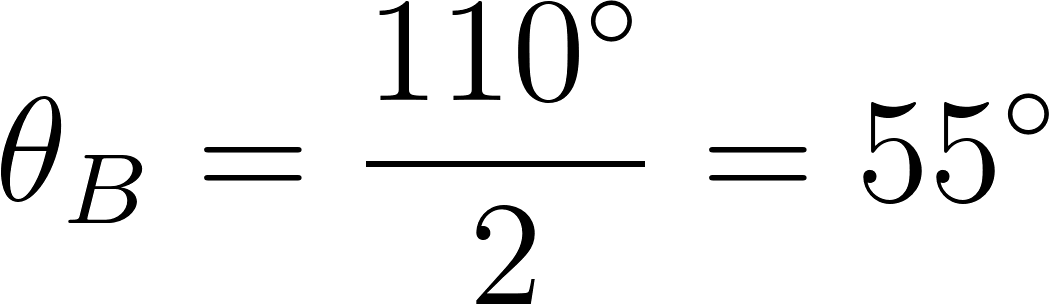
Light from a lamp reflects off and refracts into the varnish on a tabletop. The angle between the incident and reflected rays is 
Since the reflected image disappears when the Polaroid sunglasses are turned sideways. this means that the reflected light is completely polarized parallel to the surface of the table, which also indicates that the light is incident at Brewster's angle on the surface of the table, where Brewster's angle is
Subscribe to view the
full solution
full solution
Title
Physics with MasteringPhysics 4
Author
James S. Walker
ISBN
9780321541635
While studying physics at the library late one night, you
Chapter 26 textbook questions
-
Chapter 26: Problem 131 Physics with MasteringPhysics 4
-
Chapter 26: Problem 1 Physics with MasteringPhysics 4
Problem 1P Alaserbeam is reflected by a plane mirror. Itis observed that the angle between the incident and reflected beams is 28°. If the mirror is now rotated so that the angle of incidence increases by 5.0°, what is the new angle between the incident and reflected beams?
Read more -
Chapter 26: Problem 1 Physics with MasteringPhysics 4
Two plane mirrors meet at right angles at the origin, as indicated in Figure 26–39. Suppose an L-shaped object has the position and orientation labeled A. Draw the location and orientation of all the images of object A formed by the two mirrors.
Read more -
Chapter 26: Problem 2 Physics with MasteringPhysics 4
Two plane mirrors meet at right angles at the origin, as indicated in Figure 26–39. Suppose an L-shaped object has the position and orientation labeled B. Draw the location and orientation of all the images of object B formed by the two mirrors.
Read more -
Chapter 26: Problem 3 Physics with MasteringPhysics 4
Problem 3CQ (Answers to odd-numbered Conceptual Questions can be found in the back of the book.) What is the radius of curvature of a plane mirror? What is its focal length? Explain.
Read more -
Chapter 26: Problem 2 Physics with MasteringPhysics 4
Problem 2P The reflecting surfaces of two mirrors form a vertex with an angle of 120°. If a ray of light strikes mirror 1 with an angle of incidence of 55°, find the angle of reflection of the ray when it leaves mirror 2.
Read more -
Chapter 26: Problem 3 Physics with MasteringPhysics 4
Problem 3P A ray of light reflects from a plane mirror with an angle of incidence of 37°. If the mirror is rotated by an angle ?, through what angle is the reflected ray rotated?
Read more -
Chapter 26: Problem 4 Physics with MasteringPhysics 4
Problem 4CQ (Answers to odd-numbered Conceptual Questions can be found in the back of the book.) Dish receivers for satellite TV always use the concave side of the dish, never the convex side. Explain.
Read more -
Chapter 26: Problem 5 Physics with MasteringPhysics 4
Problem 5CQ (Answers to odd-numbered Conceptual Questions can be found in the back of the book.) Suppose you would like to start a fire by focusing sunlight onto a piece of paper. In Conceptual Checkpoint 26-2 we saw that a concave mirror would be better than a convex mirror for this purpose. At what distance from the mirror should the paper be held for best results?
Read more -
Chapter 26: Problem 4 Physics with MasteringPhysics 4
Problem 4P IP A small vertical mirror hangs on the wall, 1.40 m above the floor. Sunlight strikes the mirror, and the reflected beam forms a spot on the floor 2.S0 m from the wall. Later in the day, you notice that the spot has moved to a point 3.75 m from the wall. (a) Were your two observations made in the morning or in the afternoon? Explain. (b) What was the change in the Sun’s angle of elevation between your two observations?
Read more -
Chapter 26: Problem 6 Physics with MasteringPhysics 4
Problem 6CQ (Answers to odd-numbered Conceptual Questions can be found in the back of the book.) When light propagates from one medium to another, does it always bend toward the normal? Explain.
Read more -
Chapter 26: Problem 6 Physics with MasteringPhysics 4
Problem 6P You stand 1.50 m m front of a wall and gaze downward at a small vertical mirror mounted on it. In this mirror you can see the reflection of your shoes. If your eyes are 1.85 m above your feet, through what angle should the mirror be tilted for you to see your eyes reflected in the mirror? (The location of the mirror remains the same, only its angle to the vertical is changed.)
Read more -
Chapter 26: Problem 5 Physics with MasteringPhysics 4
Sunlight enters a room at an angle of \(32^{\circ}\) above the horizontal and reflects from a small mirror lying flat on the floor. The reflected light forms a spot on a wall that is \(2.0 m\) behind the mirror, as shown in Figure 26–42. If you now place a pencil under the edge of the mirror nearer the wall, tilting it upward by \(5.0^{\circ}\), how much higher on the wall \((\Delta y)) is the spot? Equation Transcription: Text Transcription: 32° 2.0 m 5.0° (\Delta y)
Read more -
Chapter 26: Problem 7 Physics with MasteringPhysics 4
A swimmer at point B in Figure 26–40 needs help. Two lifeguards depart simultaneously from their tower at point A, but they follow different paths. Although both lifeguards run with equal speed on the sand and swim with equal speed in the water, the lifeguard who follows the longer path, ACB, arrives at point B before the lifeguard who follows the shorter, straight- line path from A to B. Explain.
Read more -
Chapter 26: Problem 7 Physics with MasteringPhysics 4
Problem 7P IP Standing 2.3 m in front of a small vertical mirror, you see the reflection of your belt buckle, which is 0.72 m below your eyes. (a) What is the vertical location of the mirror relative to the level of your eyes? (b) What angle do your eyes make with the horizontal when you look at the buckle? (c) If you now move backward until you are 6.0 m from the mirror, will you still see the buckle, or will you see a point on your body that is above or below the buckle? Explain.
Read more -
Chapter 26: Problem 8 Physics with MasteringPhysics 4
Problem 8CQ (Answers to odd-numbered Conceptual Questions can be found in the back of the book.) When you observe a mirage on a hot day, what are you actually seeing when you gaze at the “pool of water” in the distance?
Read more -
Chapter 26: Problem 9 Physics with MasteringPhysics 4
Problem 9CQ (Answers to odd-numbered Conceptual Questions can be found in the back of the book.) Explain the difference between a virtual and a real image.
Read more -
Chapter 26: Problem 9 Physics with MasteringPhysics 4
If you view a clock in a mirror, do the hands rotate clockwise or counterclockwise?
Read more -
Chapter 26: Problem 10 Physics with MasteringPhysics 4
Problem 10CQ (Answers to odd-numbered Conceptual Questions can be found in the back of the book.) Sitting on a deserted beach one evening, you watch as the last bit of the Sun approaches the horizon. Just before the Sun disappears from sight, is the top of the Sim actually above or below the horizon? That is, if Earth’s atmosphere could be instantly removed just before the Sun disappeared, would the Sun still be visible, or would it be below the horizon? Explain.
Read more -
Chapter 26: Problem 11 Physics with MasteringPhysics 4
Problem 11CQ (Answers to odd-numbered Conceptual Questions can be found in the back of the book.) A large, empty coffee mug sits on a table. From your vantage point the bottom of the mug is not visible. When the mug is filled with water, however, you can see the bottom of the mug. Explain.
Read more -
Chapter 26: Problem 8 Physics with MasteringPhysics 4
How many times does the light beam shown in Figure 26–43 reflect from (a) the top and (b) the bottom mirror?
Read more -
Chapter 26: Problem 10 Physics with MasteringPhysics 4
Problem 10P A 12.5-foot-long, nearsighted python is stretched out perpendicular to a plane mirror, admiring its reflected image. If the greatest distance to which the snake can see clearly is 26.0 ft, how close must its head be to the mirror for it to see a clear image of its tail?
Read more -
Chapter 26: Problem 11 Physics with MasteringPhysics 4
Problem 11P (a) How rapidly does the distance between you and your mirror image decrease if you walk directly toward a mirror with a speed of 2.6 m/s? (b) Repeat part (a) for the case in which you walk toward a mirror but at an angle of 38° to its normal.
Read more -
Chapter 26: Problem 12 Physics with MasteringPhysics 4
The Disappearing Eyedropper The accompanying photograph shows eyedroppers partially immersed in oil (left) and water (right). Explain why the dropper is invisible in the oil.
Read more -
Chapter 26: Problem 12 Physics with MasteringPhysics 4
Problem 12P You are 1.9 m tall and stand 3.2 m from a plane mirror that extends vertically upward from the floor. On the floor 1.5 m in front of the mirror is a small table, 0.80 m high. What is the minimum height the mirror must have for you to be able to see the top of the table in the mirror?
Read more -
Chapter 26: Problem 13 Physics with MasteringPhysics 4
The Invisible Man In the H. G. Wells novel The Invisible Man, a person becomes invisible by altering his index of refraction to match that of air. This is the idea behind the disappearing eye- dropper in Conceptual Question 12. If the invisible man could actually do this, would he be able to see? Explain.
Read more -
Chapter 26: Problem 13 Physics with MasteringPhysics 4
Problem 13P The rear window in a car is approximately a rectangle, 1.3 m wide and 0.30 m high. The inside rearview mirror is 0.50 m from the driver’s eyes, and 1.50 m from the rear window. What are the minimum dimensions for the rearview mirror if the driver is to be able to see the entire width and height of the rear window in the mirror without moving her head?
Read more -
Chapter 26: Problem 14 Physics with MasteringPhysics 4
What’s the Secret? The top of Figure 26–41 shows the words SECRET CODE written in different colors. If you place a cylindrical rod of glass or plastic just above the words, you find that SECRET appears inverted, but CODE does not. Explain.
Read more -
Chapter 26: Problem 14 Physics with MasteringPhysics 4
You hold a small plane mirror \(0.50 \mathrm{~m}\) in front of your eyes, as shown in Figure 26–44 (not to scale). The mirror is \(0.32 \mathrm{~cm}\) high, and in it you see the image of a tall building behind you. (a) If the building is \(95 \mathrm{~m}\) behind you, what vertical height of the building, H, can be seen in the mirror at any one time? (b) If you move the mirror closer to your eyes, does your answer to part (a) increase, decrease, or stay the same? Explain. Equation Transcription: Text Transcription: 0.50 m 0.32 cm 95 m
Read more -
Chapter 26: Problem 15 Physics with MasteringPhysics 4
Two rays of light converge toward each other, as shown in Figure 26–45, forming an angle of \(27^{\circ}\). Before they intersect, however, they are reflected from a circular plane mirror with a diameter of \(11 \mathrm{~cm}\). If the mirror can be moved horizontally to Equation Transcription: Text Transcription: 27° 11 cm
Read more -
Chapter 26: Problem 20 Physics with MasteringPhysics 4
Problem 20P Sunlight reflects from a concave piece of broken glass, converging to a point 15 cm from the glass. What is the radius of curvature of the glass?
Read more -
Chapter 26: Problem 21 Physics with MasteringPhysics 4
Problem 21P CE You hold a shiny tablespoon at arm’s length and look at the back side of the spoon. (a) Is the image you see of yourself upright or inverted? (b) Is the image enlarged or reduced? (c) Is the image real or virtual?
Read more -
Chapter 26: Problem 19 Physics with MasteringPhysics 4
Problem 19P A mirrored-glass gazing globe in a garden is 31.9 cm in diameter. What is the focal length of the globe?
Read more -
Chapter 26: Problem 17 Physics with MasteringPhysics 4
Problem 17P CE Astronomers often use large mirrors in their telescopes to gather as much light as possible from faint distant objects. Should the mirror in their telescopes be concave or convex? Explain.
Read more -
Chapter 26: Problem 18 Physics with MasteringPhysics 4
Problem 18P A section of a sphere has a radius of curvature of 0.86 m. If this section is painted with a reflective coating on both sides, what is the focal length of (a) the convex side and (b) the concave side?
Read more -
Chapter 26: Problem 22 Physics with MasteringPhysics 4
Problem 22P CE You hold a shiny tablespoon at arm’s length and look at the front side of the spoon. (a) Is the image you see of yourself upright or inverted? (b) Is the image enlarged or reduced? (c) Is the image real or virtual?
Read more -
Chapter 26: Problem 23 Physics with MasteringPhysics 4
Problem 23P CE An object is placed in front of a convex mirror whose radius of curvature is R. What is the greatest distance behind the mirror that the image can be formed?
Read more -
Chapter 26: Problem 16 Physics with MasteringPhysics 4
Problem 16P For a corner reflector to be effective, its surfaces must be precisely perpendicular. Suppose the surfaces of a comer reflector left on the Moon’s surface by the Apollo astronauts formed a 90.001° angle with each other. If a laser beam is bounced back to Earth from this reflector, how far (in kilometers) from its starting point will the reflected beam strike Earth? For simplicity, assume the beam reflects h-om only two sides of the reflector, and that it strikes the first surface at precisely 45°.
Read more -
Chapter 26: Problem 24 Physics with MasteringPhysics 4
Problem 24P CE An object is placed to the left of a concave mirror, beyond its focal point. In which direction will the image move when the object is moved farther to the left?
Read more -
Chapter 26: Problem 27 Physics with MasteringPhysics 4
Problem 27P Use ray diagrams to show whether the image formed by a convex mirror increases or decreases in size as an object is brought closer to the mirror’s surface.
Read more -
Chapter 26: Problem 25 Physics with MasteringPhysics 4
Problem 25P CE An object is placed to the left of a convex mirror. In which direction will the image move when the object is moved farther to the left?
Read more -
Chapter 26: Problem 26 Physics with MasteringPhysics 4
Problem 26P A small object is located 30.0 cm in front of a concave mirror with a radius of curvature of 40.0 cm, Where will the image be formed?
Read more -
Chapter 26: Problem 28 Physics with MasteringPhysics 4
Problem 28P An object with a height of 46 cm is placed 2.4 m in front of a concave mirror with a focal length of 0.50 m. (a) Determine the approximate location and size of the image using a ray diagram. (b) Is the image upright or inverted?
Read more -
Chapter 26: Problem 30 Physics with MasteringPhysics 4
Problem 30P An object with a height of 46 cm is placed 2.4 m in front of a convex mirror with a focal length of ?0.50 m. (a) Determine the approximate location and size of the image using a ray diagram. (b) Is the image upright or inverted?
Read more -
Chapter 26: Problem 32 Physics with MasteringPhysics 4
Problem 32P During a daytime football game you notice that a player’s reflective helmet forms an image of the Sun 4.8 cm behind the surface of the helmet. What is the radius of curvature of the helmet, assuming it to be roughly spherical?
Read more -
Chapter 26: Problem 33 Physics with MasteringPhysics 4
Problem 33P IP A magician wishes to create the illusion of a 2.74-m-tall elephant. He plans to do this by forming a virtual image of a 50.0-cm-tall model elephant with the help of a spherical mirror. (a) Should the mirror be concave or convex? (b) If the model must be placed 3.00 m from the mirror, what radius of curvature is needed? (c) How far from the mirror will the image be formed?
Read more -
Chapter 26: Problem 29 Physics with MasteringPhysics 4
Problem 29P Find the location and magnification of the image produced by the mirror in Problem using the mirror and magnification equations. Problem 28. An object with a height of 46 cm is placed 2.4 m in front of a concave mirror with a focal length of 0.50 m. (a) Determine the approximate location and size of the image using a ray diagram. (b) Is the image upright or inverted?
Read more -
Chapter 26: Problem 31 Physics with MasteringPhysics 4
Problem 31P Find the location and magnification of Ehe image produced by the mirror in Problem using the mirror and magnification equations. Problem 30. An object with a height of 46 cm is placed 2.4 m in front of a convex mirror with a focal length of ?0.50 m. (a) Determine the approximate location and size of the image using a ray diagram. (b) Is the image upright or inverted?
Read more -
Chapter 26: Problem 34 Physics with MasteringPhysics 4
Problem 34P A person 1.7 m tall stands 0.66 m from a reflecting globe in a garden. (a) If the diameter of the globe is 18 cm, where is the image of the person, relative to the surface of the globe? (b) How large is the person’s image?
Read more -
Chapter 26: Problem 36 Physics with MasteringPhysics 4
Problem 36P The Hale Telescope The 200-inch-diameter concave mirror of the Hale telescope on Mount Falomar has a focal length of 16.9 m. An astronomer stands 20.0 m in front of this mirror. (a) Where is her image located? is it in front of or behind the mirror? (b) Is her image real or virtual? How do you know? (c) What is the magnification of her image?
Read more -
Chapter 26: Problem 35 Physics with MasteringPhysics 4
Problem 35P Shaving /makeup mirrors typically have one flat and one concave (magnifying) surface. You find that you can project a magnified image of a light bulb onto the wall of your bathroom if you hold the mirror 1.8 m from the bulb and 3.5 m from the wall. (a) What is the magnification of the image? (b) Is the image erect or inverted? (c) What is the focal length of the mirror?
Read more -
Chapter 26: Problem 38 Physics with MasteringPhysics 4
Problem 38P A concave mirror produces a real image that is three times as large as the object. (a) If the object is 22 cm in front of the mirror, what is the image distance? (b) What is the focal length of this mirror?
Read more -
Chapter 26: Problem 37 Physics with MasteringPhysics 4
Problem 37P A concave mirror produces a virtual image that is three times as tall as the object. (a) If the object is 28 cm in front of the mirror, what is the image distance? (b) What is the focal length of this mirror?
Read more -
Chapter 26: Problem 39 Physics with MasteringPhysics 4
Problem 39P The virtual image produced by a convex mirror is one-quarter the size of the object. (a) If the object is 36 cm in front of the mirror, what is the image distance? (b) What is the focal length of this mirror?
Read more -
Chapter 26: Problem 40 Physics with MasteringPhysics 4
Problem 40P IP A 5.7-ft tall shopper in a department store is 17 ft from a convex security mirror. The shopper notices that his image in the mirror appears to be only 6.4 in. tali. (a) Ts the shopper’s image upright or inverted? Explain. (b) What is the mirror’s radius of curvature?
Read more -
Chapter 26: Problem 41 Physics with MasteringPhysics 4
Problem 41P You view a nearby tree in a concave mirror. The inverted image of the tree is 3.8 cm high and is located 7.0 cm in front of the mirror. If the tree is 23 m from the mirror, what is its height?
Read more -
Chapter 26: Problem 42 Physics with MasteringPhysics 4
Problem 42P A shaving/makeup mirror produces an erect image that is magnified by a factor of 2.2 when your face is 25 cm from the mirror. What is the mirror’s radius of curvature?
Read more -
Chapter 26: Problem 43 Physics with MasteringPhysics 4
Problem 43P A concave mirror with a focal length of 36 cm produces an image whose distance from the mirror is one-third the object distance. Find the object and image distances.
Read more -
Chapter 26: Problem 45 Physics with MasteringPhysics 4
CE Samurai Fishing A humorous scene in Akira Kurosawa’s classic film The Seven Samurai shows the young samurai Kikuchiyo wading into a small stream and plucking a fish from it for his dinner. (a) As Kikuchiyo looks through the water to the fish, does he see it in the general direction of point 1 or point 2 in Figure 26–46? (b) If the fish looks up at Kikuchiyo, does it see Kikuchiyo’s head in the general direction of point 3 or point 4?
Read more -
Chapter 26: Problem 46 Physics with MasteringPhysics 4
Problem 46P CE When color A and color B are sent through a prism, color A is bent more than color B. Which color travels more rapidly in the prism? Explain.
Read more -
Chapter 26: Problem 44 Physics with MasteringPhysics 4
Problem 44P CE Predict/Explain When a ray of light enters a glass lens surrounded by air, it slows down. (a) As it leaves the glass, does its speed increase, decrease, or stay the same? (b) Choose the best explanation from among the following: I. Its speed increases because the ray is now propagating in a medium with a smaller index of refraction. II. The speed decreases because the speed of light decreases whenever light moves from one medium to another. III. The speed will stay the same because the speed of light is a universal constant.
Read more -
Chapter 26: Problem 47 Physics with MasteringPhysics 4
Problem 47P CE Day Versus Night (a) Imagine for a moment that the Earth has no atmosphere. Over the period of a year, is the number of daylight hours at your home greater than, less than, or equal to the number of nighttime hours? (b) Repeat part (a), only this time take into account the Earth’s atmosphere.
Read more -
Chapter 26: Problem 48 Physics with MasteringPhysics 4
Problem 48P CE Predict/Explain A kitchen has twin side-by-side sinks. One sink is filled with water, the other is empty. (a) Does the sink with water appear to be deeper, shallower, or the same depth as the empty sink? (b) Choose the best explanation from among the following: I. The sink with water appears deeper because you have to look through the water to sec the bottom. II. Water bends the light, making an object under the water appear to be closer to the surface. Thus the water-filled sink appears shallower. III. The sinks are identical, and therefore have the same depth. This doesn’t change by putting water in one of them.
Read more -
Chapter 26: Problem 49 Physics with MasteringPhysics 4
Problem 49P CE A light beam undergoes total internal reflection at the interface between medium A, in which it propagates, and medium B, on the other side of the interface. Which medium has the greater index of refraction? Explain.
Read more -
Chapter 26: Problem 51 Physics with MasteringPhysics 4
Problem 51P Find the ratio of the speed of light in water to the speed of light in diamond.
Read more -
Chapter 26: Problem 50 Physics with MasteringPhysics 4
Problem 50P Light travels a distance of 0.960 m in 4.00 ns in a given substance. What is the index of refraction of this substance?
Read more -
Chapter 26: Problem 53 Physics with MasteringPhysics 4
Problem 53P Light enters a container of benzene at an angle of 43° to the normal; the refracted beam makes an angle of 27° with the normal. Calculate the index of refraction of benzene.
Read more -
Chapter 26: Problem 52 Physics with MasteringPhysics 4
Problem 52P Ptolemy’s Optics One of the many works published by the Greek astronomer Ptolemy (A.D. ca. 100–170) was Optics. In this book Ptolemy reports the results of refraction experiments he conducted by observing light passing from air into water. His results are as follows: angle of incidence = 10.0°, angle of refraction = 8.00°; angle of incidence = 20.0°, angle of refraction = 15.5°. Find the percentage error in the calculated index of refraction of water for each of Ptolemy’s measurements.
Read more -
Chapter 26: Problem 54 Physics with MasteringPhysics 4
Problem 54P The angle of refraction of a ray of light traveling into an ice cube from air is 38°. Find the angle of incidence.
Read more -
Chapter 26: Problem 55 Physics with MasteringPhysics 4
Problem 55P IP (a) Referring to Problem, suppose the ice melts, but the angle of refraction remains the same. Is the corresponding angle of incidence greater than, less than, or the same as it was for ice? Explain. (b) Calculate the angle of incidence for part (a). Problem 54. The angle of refraction of a ray of light traveling into an ice cube from air is 38°. Find the angle of incidence.
Read more -
Chapter 26: Problem 56 Physics with MasteringPhysics 4
Problem 56P A submerged scuba diver looks up toward the calm surface of a freshwater lake and notes that the Sun. appears to be 35° from the vertical. The diver’s friend is standing on the shore of the lake. At what angle above the horizon does the friend see the sun?
Read more -
Chapter 26: Problem 59 Physics with MasteringPhysics 4
You have a semicircular disk of glass with an index of refrac- tion of . Find the incident angle \(\theta\) for which the beam of light in Figure 26–47 will hit the indicated point on the screen. Equation Transcription: Text Transcription: \theta 5.00 cm 20.0 cm
Read more -
Chapter 26: Problem 57 Physics with MasteringPhysics 4
Problem 57P A pond with a total depth (ice + water) of 3.25 m is covered by a transparent layer of ice, with a thickness of 0.38 m. Find the time required for light to travel vertically from the surface of the ice to the bottom of the pond.
Read more -
Chapter 26: Problem 58 Physics with MasteringPhysics 4
Problem 58P Light is refracted as it travels from a point A in medium 1 to a point B in medium 2. If the index of refraction is 1.33 in médium 1 and 1.51 in medium 2, how long does it take light to go from A to B, assuming it travels 331 cm in medium 1 and 151 cm in medium 2?
Read more -
Chapter 26: Problem 60 Physics with MasteringPhysics 4
The observer in Figure 26–48 is positioned so that the far edge of the bottom of the empty glass (not to scale) is just visible. When the glass is filled to the top with water, the center of the bottom of the glass is just visible to the observer. Find the height, H, of the glass, given that its width is \(W=6.2 \mathrm{~cm}\) Equation Transcription: Text Transcription: W=6.2 cm
Read more -
Chapter 26: Problem 62 Physics with MasteringPhysics 4
A ray of light enters the long side of a \(45^{\circ}-90^{\circ}-45^{\circ}\) prism and undergoes two total internal reflections, as indicated in Figure 26–49. The result is a reversal in the ray’s direction of propagation. Find the minimum value of the prism’s index of refraction, n, for these internal reflections to be total. Equation Transcription: Text Transcription: 45°-90°-45°
Read more -
Chapter 26: Problem 61 Physics with MasteringPhysics 4
Problem 61P A coin is lying at the bottom of a pool of water that is 6.5 feet deep. Viewed from directly above the coin, how far below the surface of the water does the coin appear to be? (The coin is assumed to be small in diameter; therefore, we can use the small-angle approximations sin ? ? tan ? ? ?.)
Read more -
Chapter 26: Problem 63 Physics with MasteringPhysics 4
When the prism in Problem 62 is immersed in a fluid with an index of refraction of 1.21, the internal reflections shown in Figure 26–49 are still total. The reflections are no longer total, however, when the prism is immersed in a fluid with n = 1.43.Use this information to set upper and lower limits on the possible values of the prism’s index of refraction.
Read more -
Chapter 26: Problem 64 Physics with MasteringPhysics 4
A glass paperweight with an index of refraction n rests on a desk, as shown in Figure 26–50. An incident ray of light enters the horizontal top surface of the paperweight at an angle \(\theta=77^{\circ}\) to the vertical. (a) Find the minimum value of n for which the internal reflection on the vertical surface of the paperweight is total. (b) If \(\theta\) is decreased, is the minimum value of n increased or decreased? Explain. Equation Transcription: Text Transcription: \theta=77^\circ \theta
Read more -
Chapter 26: Problem 65 Physics with MasteringPhysics 4
Suppose the glass paperweight in Figure 26–50 has an index of refraction n = 1.38. (a) Find the value of \(\theta\) for which the reflection on the vertical surface of the paperweight exactly satisfies the condition for total internal reflection. (b) If \(\theta\) is increased, is the reflection at the vertical surface still total? Explain. Equation Transcription: Text Transcription: \theta \theta ________________
Read more -
Chapter 26: Problem 68 Physics with MasteringPhysics 4
A horizontal beam of light enters a \(45^{\circ}-90^{\circ}-45^{\circ}\) prism at the center of its long side, as shown in Figure 26–51. The emerging ray moves in a direction that is \(34^{\circ}\) below the horizontal. What is the index of refraction of this prism? Equation Transcription: Text Transcription: 45°-90°-45° 34°
Read more -
Chapter 26: Problem 69 Physics with MasteringPhysics 4
A laser beam enters one of the sloping faces of the equilateral glass prism in \((n=1.42)\) Figure 26–52 and refracts through the prism. Within the prism the light travels horizontally. What is the angle between the direction of the incident ray and the direction of the outgoing ray? Equation Transcription: Text Transcription: (n=1.42) \theta
Read more -
Chapter 26: Problem 67 Physics with MasteringPhysics 4
Problem 67P While studying physics at the library late one night, you notice the image of the desk lamp reflected from the varnished tabletop. When you turn your Polaroid sunglasses sideways, the reflected image disappears. Tf this occurs when the angle between the incident and reflected rays is 110°, what is the index of refraction of the varnish?
Read more -
Chapter 26: Problem 66 Physics with MasteringPhysics 4
Consider the physical system shown in Figure 26–47 and described in Problem 59. (a) If the index of refraction of the glass is increased, will the desired value of increase or de- crease? Explain. (b) Find the value of for the case of flint glass \((n=1.66)\) Equation Transcription: Text Transcription: (n=1.66)
Read more -
Chapter 26: Problem 70 Physics with MasteringPhysics 4
(a) Use a ray diagram to determine the approximate location of the image produced by a concave lens when the object is at a distance \(\frac{1}{2}|f|\) from the lens. (b) Is the image upright or in- verted? (c) Is the image real or virtual? Explain. Equation Transcription: Text Transcription: \frac{1}{2}|f|
Read more -
Chapter 26: Problem 71 Physics with MasteringPhysics 4
(a) Use a ray diagram to determine the approximate location of the image produced by a concave lens when the object is at a distance \(2|f|\) from the lens. (b) Is the image upright or in- verted? (c) Is the image real or virtual? Explain. Equation Transcription: Text Transcription: 2|f|
Read more -
Chapter 26: Problem 72 Physics with MasteringPhysics 4
Problem 72P An object is a distance f/2 from a convex lens. (a) Use a ray diagram to find the approximate location of the image. (b) Is the image upright or inverted? (c) Is the image real or virtual? Explain.
Read more -
Chapter 26: Problem 73 Physics with MasteringPhysics 4
Problem 73P An object is a distance 2f from a convex lens. (a) Use a ray diagram to find the approximate location of the image. (b) Is the image upright or inverted? (c) Is the image real or virtual? Explain.
Read more -
Chapter 26: Problem 76 Physics with MasteringPhysics 4
Problem 76P A convex lens is held over a piece of paper outdoors on a sunny day. When the paper is held 26 cm below the lens, the sunlight is focused on the paper and the paper ignites. What is the focal length of the lens?
Read more -
Chapter 26: Problem 74 Physics with MasteringPhysics 4
Two lenses that are 35 cm apart are used to form an image as shown in Figure 26–53. Lens 1 is converging and has a focal length \(f 1=14 \mathrm{~cm}\); lens 2 is diverging and has a focal length \(f 2=7.0 \mathrm{~cm}\). The object is placed 24 cm to the left of lens 1. (a) Use a ray diagram to find the approximate location of the image. (b) Is the image upright or inverted? (c) Is the image real or virtual? Explain. Equation Transcription: Text Transcription: f1=14 cm f2=7.0 cm
Read more -
Chapter 26: Problem 75 Physics with MasteringPhysics 4
Two lenses that are \(35 \mathrm{~cm}\) apart are used to form an image, as shown in Figure 26–54. Lens 1 is diverging and has a focal length of \(f 1=-7.0 \mathrm{~cm}\); lens 2 is converging and has a focal length \(f 2=14 \mathrm{~cm}\). The object is placed 24 cm to the left of lens 1. (a) Use a ray diagram to find the approximate location of the image. (b) Is the image upright or inverted? (c) Is the image real or virtual? Explain. Equation Transcription: Text Transcription: 35 cm f1=-7.0 cm f2=14 cm
Read more -
Chapter 26: Problem 77 Physics with MasteringPhysics 4
Problem 77P A concave lens has a focal length of ?32 cm. Find the image distance and magnification that result when an object is placed 29 cm in front of the lens.
Read more -
Chapter 26: Problem 78 Physics with MasteringPhysics 4
Problem 78P When an object is located 46 cm to the left of a lens, the image is formed 17 cm to the right of the lens. What is the focal length of the lens?
Read more -
Chapter 26: Problem 79 Physics with MasteringPhysics 4
Problem 79P An object with a height of 2.54c misplaced 36.3mm to the left of a lens with a focal length of 35.0 mm. (a) Where is the image located? (b) What is the height of the image?
Read more -
Chapter 26: Problem 80 Physics with MasteringPhysics 4
Problem 80P A lens for a 35-mm camera has a focal length given by ƒ = 55 mm. (a) How close to the film should the lens be placed to form a sharp image of an object that is 5.0 m away? (b) What is the magnification of the image on the film?
Read more -
Chapter 26: Problem 83 Physics with MasteringPhysics 4
(a) Determine the distance from lens 1 to the final image for the system shown in Figure 26–53. (b) What is the magnification of this image?
Read more -
Chapter 26: Problem 84 Physics with MasteringPhysics 4
(a) Determine the distance from lens 1 to the final image for the system shown in Figure 26–54. (b) What is the magnification of this image?
Read more -
Chapter 26: Problem 81 Physics with MasteringPhysics 4
Problem 81P IP An object is located to the left of a convex lens whose focal length is 34 cm. The magnification produced by the lens is m = 3.0. (a) To increase the magnification to 4.0, should the object be moved closer to the lens or farther away? Explain. (b) Calculate the distance through which the object should be moved.
Read more -
Chapter 26: Problem 82 Physics with MasteringPhysics 4
Problem 82P IP You have two lenses at your disposal, one with a focal length f1 = +40.0 cm, the other with a focal length f2 = ?40.0 cm. (a) Which of these two lenses would you use to project an image of a lightbulb onto a wall that is far away? (b) if you want to produce an image of the bulb that is enlarged by a factor of 2.00, how far from the wall should the lens be placed?
Read more -
Chapter 26: Problem 85 Physics with MasteringPhysics 4
An object is located to the left of a concave lens whose focal length is \(-34 \mathrm{~cm}\) . The magnification produced by the lens \(m=\frac{1}{3}\) (a) To decrease the magnification to \(m=\frac{1}{4}\), should the object be moved closer to the lens or farther away? (b) Calculate the distance through which the object should be moved. Equation Transcription: Text Transcription: -34 \mathrm{~cm} m=\frac{1}{3} m=\frac{1}{4}
Read more -
Chapter 26: Problem 91 Physics with MasteringPhysics 4
Problem 91P The index of refraction for red light in a certain liquid is 1.320; the index of refraction for violet light in the same liquid is 1.332. Find the dispersion (?V ? ?r)for red and violet light when both arc incident on the flat surface of the liquid at an angle of 45.00° to the normal.
Read more -
Chapter 26: Problem 89 Physics with MasteringPhysics 4
Problem 89P IP A friend tells you that when she takes off her eyeglasses and holds them 23 cm above a printed page the image of the print is erect but enlarged to 1.5 times its actual size. (a) Is the image real or virtual? How do you bow? (b) What is the focal length of your friend’s glasses? (c) Are the lenses in the glasses concave or convex? Explain.
Read more -
Chapter 26: Problem 90 Physics with MasteringPhysics 4
Problem 90P CE Predict/Explain You take a picture of a rainbow with an infrared camera, and your friend takes a picture at the same time with visible light. (a) Is the height of the rainbow in the infrared picture greater than, less than, or the same as the height of the rainbow in the visible-light picture? (b) Choose the best explanation from among the following: I. The height will be greater because the top of a rainbow is red, and so infrared light would be even higher. II. The height will be less because infrared light is below the visible spectrum. III. A rainbow is the same whether seen in visible light or infrared; therefore the height is the same.
Read more -
Chapter 26: Problem 86 Physics with MasteringPhysics 4
Problem 86P IP BIO Albert is nearsi ghtcd, and wi thou t his eyeglasses he can focus only on objects less than 2.2 m away. (a) Are Albert’s eyeglasses concave or convex? Explain. (b) To correct Albert’s nearsightedness, his eyeglasses must produce a virtual, upright image at a distance of 2.2 m when viewing an infinitely distant object. What is the focal length of Albert’s eyeglasses?
Read more -
Chapter 26: Problem 87 Physics with MasteringPhysics 4
Problem 87P A small insect viewed through a convex lens is 1.4 cm from the lens and appears twice its actual size. What is the focal length of the lens?
Read more -
Chapter 26: Problem 88 Physics with MasteringPhysics 4
Problem 88P IP A friend tells you that when he takes off his eyeglasses and holds them 23 cm above a printed page the image of the print is erect but reduced to 0:67 of its actual size. (a) Is the image real or virtual? How do you know? (b) What is the focal length of your friend’s glasses? (c) Are the lenses in the glasses concave or convex? Explain.
Read more -
Chapter 26: Problem 92 Physics with MasteringPhysics 4
A horizontal incident beam consisting of white light passes through an equilateral prism, like the one shown in Figure 26–52. What is the dispersion \(\left(\theta_{v}-\theta_{r}\right)\) of the outgoing beam if the prism’s index of refraction is \(N_{v}=1.505\) for violet light and \(N_{r}=1.421\) for red light? Equation Transcription: Text Transcription: (\theta_v- \theta_r) Nv=1.505 Nr=1.421
Read more -
Chapter 26: Problem 94 Physics with MasteringPhysics 4
Problem 94GP CE Jurassic Park A T. rex chases the heroes of Steven Spielberg’s Jurassic Park as they desperately try to escape in their Jeep. The T. rex is closing in fast, as they can see in the outside rearview mirror. Near the bottom of the mirror they also see the following helpful message: objects in the mirror are closer than they appear. Is this mirror concave or convex? Explain.
Read more -
Chapter 26: Problem 93 Physics with MasteringPhysics 4
Problem 93P The focal length of a lens is inversely proportional to the quantity (n ? 1), where n is the index of refraction of the lens material. The value of n, however, depends on the wavelength of the light that passes through the lens. For example, one type of flint glass has an index of refraction of nr = 1.572 for red light and nv = 1.605 in violet light. Now, suppose a white object is placed 24.00 an in front of a lens made from this type of glass. If the red light reflected from this object produces a sharp image 55.00 cm from the lens, where will the violet image be found?
Read more -
Chapter 26: Problem 95 Physics with MasteringPhysics 4
Problem 95GP CE The receiver for a dish antenna is placed in front of the concave surface of the dish. If the radius of curvature of the dish is R, how far in front of the dish should the receiver be placed? Explain.
Read more -
Chapter 26: Problem 98 Physics with MasteringPhysics 4
CE Referring to Conceptual Question 12, suppose the same type of glass used in an eyedropper is made into a convex lens with a focal length . If this lens is immersed in the oil of the bottle on the left in the photo, will its focal length be \(0, f / 2,2 f, \text { or } \infty\)? (Hint: See Conceptual Checkpoint 26–5.) Equation Transcription: Text Transcription: 0,f/2, 2f, or \infty
Read more -
Chapter 26: Problem 96 Physics with MasteringPhysics 4
Problem 96GP CE Predict/Explain if a lens is immersed in water, its focal length changes, as discussed in Conceptual Checkpoint 26?5. (a) if a spherical mirror is immersed in water, does its focal length increase, decrease, or stay the same? (b) Choose the best explanation from among the following: I. The focal length will increase because the water will cause more bending of light. II. Water will refract the light. This, combined with the reflection due to the mirror, will result in a decreased focal length. III. The focal length stays the same because it depends on the fact that the angle of incidence is equal to the angle of reflection for a mirror. Thisis unaffected by the presence of the water.
Read more -
Chapter 26: Problem 97 Physics with MasteringPhysics 4
Problem 97GP CE Predict/Explain A glass slab surrounded by air causes a sideways displacement in a beam of light. (a) If die slab is now placed in water, does the displacement it causes increase, decrease, or stay the same? (b) Choose the best explanation from among the following: I. The displacement of the beam increases because of the increased refraction due to the water. II. The displacement of the beam is decreased because with water surrounding the slab there is a smaller difference m index of refraction between the slab and its surroundings III. The displacement stays the same because it is determined only by the properties of the slab; in particular, the material it is made of and its thickness.
Read more -
Chapter 26: Problem 99 Physics with MasteringPhysics 4
Problem 99GP CE Two identical containers are filled with different bans-parent liquids. The container with liquid A appears to have a greater depth than the container with liquid B. Which liquid has the greater index of refraction? Explain.
Read more -
Chapter 26: Problem 100 Physics with MasteringPhysics 4
Problem 100GP CE Is the image you see in a three-dimensional corner reflecter upright or inverted?
Read more -
Chapter 26: Problem 101 Physics with MasteringPhysics 4
Problem 101GP CE Inverse Lenses Suppose we mold a hollow piece of plastic into the shape of a double concave lens. The “lens” is watertight, and its interior is filled with air. We now place this lens in water and shine a beam of light on it. (a) Does the lens converge or diverge the beam of light? Explain. (b) If our hollow lens is double convex instead, does it converge or diverge a beam of light when immersed in water? Explain.
Read more -
Chapter 26: Problem 104 Physics with MasteringPhysics 4
IP Apparent Size of Floats in a Termometro Lentos The Galileo thermometer, or Termometro Lentos (slow ther- mometer in Italian), consists of a vertical, cylindrical flask containing a fluid and several glass floats of different color. The floats all have the same dimensions, but they appear to differ in size depending on their location within the cylinder. (a) Does a float near the front surface of the cylinder (the surface closest to you) appear to be larger or smaller than a float near the back surface? (b) Figure 26–55 shows a ray diagram for a float near the front surface of the cylinder. Draw a ray diagram for a float at the center of the cylinder, and show that the change in apparent size agrees with your answer to part (a).
Read more -
Chapter 26: Problem 103 Physics with MasteringPhysics 4
Problem 103GP Standing 2.0 m in front of a small vertical mirror you see the reflection of your belt buckle, which is 0.70m below your eyes. If you remain 2.0 m from the mirror but climb onto a stool, how high must the stool be to allow you to see your knees in the mirror? Assume that your knees are 1.2 m below your eyes.
Read more -
Chapter 26: Problem 102 Physics with MasteringPhysics 4
Suppose the separation between the two mirrors in Figure 26–43 is increased by moving the top mirror upward. (a) Will this affect the number of reflections made by the beam of light? If so, how? (b) What is the total number of reflections made by the beam of light when the separation between the mirrors is \(145 \mathrm{~cm}\)? Equation Transcription: Text Transcription: 145 cm
Read more -
Chapter 26: Problem 105 Physics with MasteringPhysics 4
Problem 105GP (a) Find the two locations where an object can be placed in front of a concave mirror witlva radius of curvature of 39 cm such that its image is twice its size. (b) In each of these cases, state whether the image is real or virtual upright or inverted.
Read more -
Chapter 26: Problem 108 Physics with MasteringPhysics 4
Problem 108GP The speed of light in substance A is x times greater than the speed of light in substance B. Find the ratio nA/nB interms of x.
Read more -
Chapter 26: Problem 107 Physics with MasteringPhysics 4
The three laser beams shown in Figure 26–56 meet at a point at the back of a solid, transparent sphere. (a) What is the index of refraction of the sphere? (b) Is there a finite index of refraction that will make the three beams come to a focus at the center of the sphere? If your answer is yes, give the required index of refraction; if your answer is no, explain why not. Equation Transcription: Text Transcription: 45^{\circ} 45^{\circ}
Read more -
Chapter 26: Problem 106 Physics with MasteringPhysics 4
Problem 106GP A convex mirror with a focal length of ?85 cm is used to give a truck driver a view behind the vehicle. (a) If a person who is 1.7m tall stands 2.2 m from the mirror, where is the person’s image located? (b) Is the image upright or inverted? (c) What is the size of the image?
Read more -
Chapter 26: Problem 109 Physics with MasteringPhysics 4
IP A film of oil, with an index of refraction of 1.48 and a thickness of \(1.50 \mathrm{~cm}\), floats on a pool of water, as shown in Figure 26–57. A beam of light is incident on the oil at an angle of \(60.0^{\circ}\) to the vertical. (a) Find the angle \(\theta\) the light beam makes with the vertical as it travels through the water. (b) How does your answer to part (a) depend on the thickness of the oil film? Explain. Equation Transcription: Text Transcription: 1.50 cm 60.0° \theta
Read more -
Chapter 26: Problem 110 Physics with MasteringPhysics 4
Consider the physical system shown in Figure 26–57. For this problem we assume that the angle of incidence at the air–oil interface can be varied from 0° to 90°. (a) What is the maximum possible value for the angle of refraction in the water? (b) If an oil with a larger index of refraction is used, does your answer to part (a) increase or decrease? Explain.
Read more -
Chapter 26: Problem 111 Physics with MasteringPhysics 4
Consider the physical system shown in Figure 26–57, only this time let the direction of the light rays be reversed. (a) Find the angle of incidence \(\theta\) at the water–oil interface such that the condition for total internal reflection at the oil–air sur- face is exactly satisfied. (b) If \(\theta\) is decreased, is the reflection at the oil–air interface still total? Explain. Equation Transcription: Text Transcription: \theta \theta
Read more -
Chapter 26: Problem 112 Physics with MasteringPhysics 4
Figure 26–58 shows a ray of light entering one end of an optical fiber at an angle of incidence \(\theta_{i}=50.0^{\circ}\). The index of refraction of the fiber is 1.62. (a) Find the angle \(\theta\) the ray makes with the normal when it reaches the curved surface of the fiber. (b) Show that the internal reflection from the curved sur- face is total. Equation Transcription: Text Transcription: \theta_{i}=50.0^\circ \theta
Read more -
Chapter 26: Problem 113 Physics with MasteringPhysics 4
Suppose the person’s eyes in Figure 26–44 are 1.6 m above the ground and that the small plane mirror can be moved up or down. (a) Find the height of the bottom of the mirror such that the lowest point the person can see on the building is 19.6 m above the ground. (b) With the mirror held at the height found in part (a), what is the highest point on the building the person can see?
Read more -
Chapter 26: Problem 114 Physics with MasteringPhysics 4
An arrow \(2.00 \mathrm{~cm}\) long is located \(75.0 \mathrm{~cm}\) from a lens that has a focal length \(f=30.0 \mathrm{~cm}\) (a) If the arrow is perpendicular to the principal axis of the lens, as in Figure 26–59 (a), what is its lateral magnification, defined as \(h_{i} / h_{0}\)? (b) Suppose, instead, that the arrow lies along the principal axis, extending from \(74.0 \mathrm{~cm} \text { to } 76.0\) from the lens, as indicated in Figure 26–59 (b). What is the longitudinal magnification of the arrow, defined as \(L_{i} / L_{o}\)? (Hint: Use the thin-lens equation to locate the image of each end of the arrow.) Equation Transcription: Text Transcription: 2.00 cm 75.0 cm f=30.0 cm hi/ho 74.0 cm to 76.0 Li/Lo
Read more -
Chapter 26: Problem 115 Physics with MasteringPhysics 4
Repeat Problem 114, this time for a diverging lens with a focal length \(f=-30.0 \mathrm{~cm}\) Equation Transcription: Text Transcription: f=-30.0 cm
Read more -
Chapter 26: Problem 116 Physics with MasteringPhysics 4
Problem 116GP A convex lens with f1 = 20.0cm is mounted 40.0 cm to the left of a concave lens. When an object is placed 30.0 cm to the left of the convex lens, a real image is formed 60.0 cm to the right of the concave lens. What is the focal length f2 of the concave lens?
Read more -
Chapter 26: Problem 118 Physics with MasteringPhysics 4
Problem 118GP When an object is placed a distance do in front of a curved mirror, the resulting image has a magnification m. Find an expression for the focal length of the mirror,f, interms of do and m.
Read more -
Chapter 26: Problem 119 Physics with MasteringPhysics 4
A Slab of Glass Give a symbolic expression for the sideways displacement d of a light ray passing through the slab of glass shown in Figure 26–60. The thickness of the glass is t, its index of refraction is n, and the angle of incidence is \(\theta\) Equation Transcription: Text Transcription: \theta
Read more -
Chapter 26: Problem 117 Physics with MasteringPhysics 4
Problem 117GP Two thin lenses, with focal lengths f1 and ƒ2, are placed in contact. What is the effective focal length of the double lens?
Read more -
Chapter 26: Problem 120 Physics with MasteringPhysics 4
Referring to Figure , show that the internal reflection from the curved surface of the fiber is always total for any incident angle , provided the index of refraction of the fiber exceeds \(\sqrt{2}\) Equation Transcription: Text Transcription: \sqrt 2
Read more -
Chapter 26: Problem 121 Physics with MasteringPhysics 4
Least Time A beam of light propagates from point A in medium 1 to point B in medium 2, as shown in Figure 26–61. The index of refraction is different in these two media; therefore, the light follows a refracted path that obeys Snell’s law. (a) Calculate the time required for light to travel from Ato B along the refracted path. (b) Compare the time found in part (a) with the time it takes for light to travel from Ato B along a straight-line path. (Note that the time on the straight-line path is longer than the time on the refracted path. In general, the shortest time between two points in different media is along the path given by Snell’s law.)
Read more -
Chapter 26: Problem 122 Physics with MasteringPhysics 4
The ray of light shown in Figure 26-62 passes from medium 1 to medium 2 to medium 3. The index of refraction in medium 1 is \(n_{1}\), in medium 2 it is \(n_{2}>n_{1}\), and in medium 3 it is \(n_{3}>n_{2}\), Show that medium 2 can be ignored when calculating the angle of refraction in medium 3 ; that is, show that \(n_{1} \sin \theta_{1}=n_{3} \sin \theta_{3}\). Equation Transcription: Text Transcription: n_1 n_2>n_1 n_3>n_2 n_1sin theta_1=n_3sin theta _3
Read more -
Chapter 26: Problem 123 Physics with MasteringPhysics 4
IP A beam of light enters the sloping side of a \(45^{\circ}-90^{\circ}-45^{\circ}\) glass prism with an index of refraction \(n=1.66\).The situation is similar to that shown in Figure , except that the angle of incidence of the incoming beam can be varied. (a) Find the angle of incidence for which the reflection on the vertical side of the prism exactly satisfies the condition for total internal reflection. (b) If the angle of incidence is increased, is the reflection at the vertical surface still total? Explain. (c) What is the minimum value of such that a horizontal beam like that in Figure undergoes total internal reflection at the vertical side of the prism? Equation Transcription: Text Transcription: 45°-90°-45° n=1.66
Read more -
Chapter 26: Problem 125 Physics with MasteringPhysics 4
Problem 125PP A diverging lens with ƒ = ?12.5 cm is made from ice. What is the focal length of this lens if it is immersed in ethyl alcohol? (Refer to Table.) A. 102 cm B. 105 cm C. 118 cm D. 122 cm
Read more -
Chapter 26: Problem 124 Physics with MasteringPhysics 4
Problem 124PP A converging lens with a focal length in air of ƒ = +5.25 cm is made from ice. What is the focal length of this lens if it is immersed in benzene? (Refer to Table.) A. ?20.7 cm B. ?18.1cm C. ?12.8 cm D. ?11.2 cm
Read more -
Chapter 26: Problem 126 Physics with MasteringPhysics 4
Problem 126PP Calculate the focal length of a lens in water, given that the index of refraction of the lens is nlens = 1.52 and its focal length in air is 25.0 cm. (Refer to Table.) A. 57.8 cm B. 66.0 cm C. 91.0 cm D. 104 cm
Read more -
Chapter 26: Problem 127 Physics with MasteringPhysics 4
Problem 127PP Suppose a lens is made from fused quartz (glass), and that its focal length in air is ?7.75 cm. What is the focal length of this lens if it is immersed in benzene? (Refer to Table.) A. –130 cm B. 134 cm C. 141 cm D. ?145 cm
Read more -
Chapter 26: Problem 128 Physics with MasteringPhysics 4
Problem 128IP Referring to Example Suppose the radius of curvature of the mirror is 5.0 cm. (a) Find the object distance that gives an upright knage with a magnification of 1.5. (b) Find the object distance that gives an inverted image with a magnification of ?1.5.
Read more -
Chapter 26: Problem 129 Physics with MasteringPhysics 4
IP Referring to Example 26–3 An object is 4.5 cm in front of the mirror. (a) What radius of curvature must the mirror have if the image is to be 2.2 cm in front of the mirror? (b) What is the magnification of the image? (c) If the object is moved closer to the mirror, does the magnification of the image increase in magnitude, decrease in magnitude, or stay the same?
Read more -
Chapter 26: Problem 130 Physics with MasteringPhysics 4
Referring to Example 26–7 (a) What object distance is required to give an image with a magnification of \(+2.0\)? ? Assume that the focal length of the lens is \(+5.0 \mathrm{~cm}\). (b) What is the location of the image in this case? Equation Transcription: Text Transcription: +2.0 +5.0 cm
Read more