

Problem 70PE Construct Your Own Problem Consider an airplane headed for a runway in a cross wind. Construct a problem in which you calculate the angle the airplane must fly relative to the air mass in order to have a velocity parallel to the runway. Among the things to consider are the direction of the runway, the wind speed and direction (its velocity) and the speed of the plane relative to the air mass. Also calculate the speed of the airplane relative to the ground. Discuss any last minute maneuvers the pilot might have to perform in order for the plane to land with its wheels pointing straight down the runway.
Read moreTable of Contents
1
Introduction: The Nature of Science and Physics
2
Kinematics
3
Two-Dimensional Kinematics
4
Dynamics: Force and Newton's Laws of Motion
5
Further Applications of Newton's Laws: Friction, Drag, and Elasticity
6
Uniform Circular Motion and Gravitation
7
Work, Energy, and Energy Resources
8
Linear Momentum and Collisions
9
Statics and Torque
10
Rotational Motion and Angular Momentum
11
Fluid Statics
12
Fluid Dynamics and its Biological and Medical Applications
13
Temperature, Kinetic Theory, and the Gas Laws
14
Heat and Heat Transfer Methods
15
Thermodynamics
16
Oscillatory Motion and Waves
17
Physics of Hearing
18
Electric Charge and Electric Field
19
Electric Potential and Electric Field
20
Electric Current, Resistance, and Ohm's Law
21
Circuits and DC Instruments
22
Magnetism
23
Electromagnetic Induction, AC Circuits, and Electrical Technologies
24
Electromagnetic Waves
25
Geometric Optics
26
Vision and Optical Instruments
27
Wave Optics
28
Special Relativity
29
Introduction to Quantum Physics
30
Atomic Physics
31
Radioactivity and Nuclear Physics
32
Medical Applications of Nuclear Physics
33
Particle Physics
34
Frontiers of Physics
Textbook Solutions for College Physics
Chapter 3 Problem 63
Question
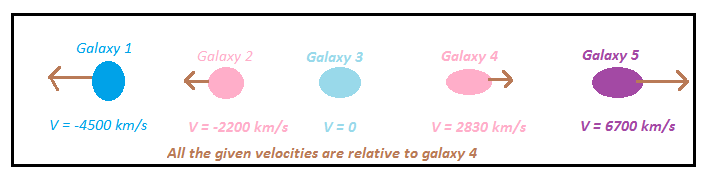
The great astronomer Edwin Hubble discovered that all distant galaxies are receding from our Milky Way Galaxy with velocities proportional to their distances. It appears to an observer on the Earth that we are at the center of an expanding universe. Figure \(3.64\) illustrates this for five galaxies lying along a straight line, with the Milky Way Galaxy at the center. Using the data from the figure, calculate the velocities:
(a) relative to galaxy \(2\) and
(b) relative to galaxy \(5\).
The results mean that observers on all galaxies will see themselves at the center of the expanding universe, and they would likely be aware of relative velocities, concluding that it is not possible to locate the center of expansion with the given information.
Figure \(3.64\) Five galaxies on a straight line, showing their distances and velocities relative to the Milky Way \((MW)\) Galaxy. The distances are in millions of light years \((Mly)\), where a light year is the distance light travels in one year. The velocities are nearly proportional to the distances. The sizes of the galaxies are greatly exaggerated; an average galaxy is about \(0.1 Mly\) across.
Solution
Step 1 of 5
In the given problem, relative velocities are given for five different galaxies as shown in the figure below. The given velocities of the galaxies are relative to galaxy 3. Here we need to calculate the velocities of galaxies relative to galaxy 2 and galaxy 5 using the concept of relative velocity.
Relativity is the branch in which we study about how different observers measure the same process, when both the observes move relative to each other. Whereas relative velocity is the velocity of an object measured from a particular reference frame and it will vary as the refernce frame changes.
Subscribe to view the
full solution
full solution
Title
College Physics 1
Author
Paul Peter Urone, Roger Hinrichs
ISBN
9781938168000
The great astronomer Edwin Hubble discovered that all
Chapter 3 textbook questions
-
Chapter 3: Problem 70 College Physics 1
-
Chapter 3: Problem 1 College Physics 1
Problem 1CQ Which of the following is a vector: a person’s height, the altitude on Mt. Everest, the age of the Earth, the boiling point of water, the cost of this book, the Earth’s population, the acceleration of gravity?
Read more -
Chapter 3: Problem 2 College Physics 1
Give a specific example of a vector, stating its magnitude, units, and direction.
Read more -
Chapter 3: Problem 3 College Physics 1
Problem 3CQ What do vectors and scalars have in common? How do they differ?
Read more -
Chapter 3: Problem 2 College Physics 1
Find the following for path \(B\) in Figure \(3.54\): (a) the total distance traveled, and (b) the magnitude and direction of the displacement from start to finish. Equation Transcription: Text Transcription: B 3.54
Read more -
Chapter 3: Problem 1 College Physics 1
Find the following for path \(A\) in Figure \(3.54\): (a) the total distance traveled, and (b) the magnitude and direction of the displacement from start to finish. Equation Transcription: Text Transcription: A 3.54
Read more -
Chapter 3: Problem 4 College Physics 1
Two campers in a national park hike from their cabin to the same spot on a lake, each taking a different path, as illustrated below. The total distance traveled along Path \(1\) is \(7.5 km\), and that along Path \(2\) is \(8.2 km\). What is the final displacement of each camper? Equation Transcription: Text Transcription: 1 7.5 km 2 8.2 km
Read more -
Chapter 3: Problem 4 College Physics 1
Suppose you walk \(18.0 m\) straight west and then \(25.0 m\) straight north. How far are you from your starting point, and what is the compass direction of a line connecting your starting point to your final position? (If you represent the two legs of the walk as vector displacements \(A\) and \(B\), as in Figure \(3.55\), then this problem asks you to find their sum \(R=A+B\) .) Equation Transcription: Text Transcription: 18.0 m 25.0 m A B 3.55 R=A+B
Read more -
Chapter 3: Problem 5 College Physics 1
If an airplane pilot is told to fly \(123 km\) in a straight line to get from San Francisco to Sacramento, explain why he could end up anywhere on the circle shown in Figure \(3.53\). What other information would he need to get to Sacramento? Equation Transcription: Text Transcription: 123 km 3.53
Read more -
Chapter 3: Problem 5 College Physics 1
Suppose you first walk \(12.0 m\) in a direction \(20^{\circ}\) west of north and then \(20.0 m\) in a direction \(40^{\circ}\) south of west. How far are you from your starting point, and what is the compass direction of a line connecting your starting point to your final position? (If you represent the two legs of the walk as vector displacements \(A\) and \(B\) , as in Figure \(3.56\), then this problem finds their sum \(R=A+B\).) Equation Transcription: Text Transcription: 12.0 m 20 degrees 20.0 40.0 degrees A B 3.56 R=A+B
Read more -
Chapter 3: Problem 6 College Physics 1
Problem 6CQ Suppose you take two steps A and B (that is, two nonzero displacements). Under what circumstances can you end up at your starting point? More generally, under what circumstances can two nonzero vectors add to give zero? Is the maximum distance you can end up from the starting point A + B the sum of the lengths of the two steps?
Read more -
Chapter 3: Problem 6 College Physics 1
Repeat the problem above, but reverse the order of the two legs of the walk; show that you get the same final result. That is, you first walk leg \(B\), which is \(20.0 m\) in a direction exactly \(40^{\circ}\) south of west, and then leg \(A\), which is \(12.0 m\) in a direction exactly \(20^{\circ}\) west of north. (This problem shows that \(A+B=B+A\).) Equation Transcription: Text Transcription: B 20.0 m 40 degrees A 12.0 m 20 degrees A+B=B+A
Read more -
Chapter 3: Problem 7 College Physics 1
Problem 7CQ Explain why it is not possible to add a scalar to a vector.
Read more -
Chapter 3: Problem 7 College Physics 1
(a) Repeat the problem two problems prior, but for the second leg you walk 20.0 m in a direction 40.0º north of east (which is equivalent to subtracting B from A —that is, to finding R? = A ? B). (b) Repeat the problem two problems prior, but now you first walk 20.0 m in a direction 40.0º south of west and then 12.0 m in a direction 20.0º east of south (which is equivalent to subtracting A from B —that is, to finding R?? = B - A = - R?). Show that this is the case.
Read more -
Chapter 3: Problem 8 College Physics 1
Problem 8CQ If you take two steps of different sizes, can you end up at your starting point? More generally, can two vectors with different magnitudes ever add to zero? Can three or more?
Read more -
Chapter 3: Problem 8 College Physics 1
Problem 8PE Show that the order of addition of three vectors does not affect their sum. Show this property by choosing any three vectors A, B, and C, all having different lengths and directions. Find the sum A + B + C then find their sum when added in a different order and show the result is the same. (There are five other orders in which A, B, and C can be added; choose only one.)
Read more -
Chapter 3: Problem 9 College Physics 1
Suppose you add two vectors A and B. What relative direction between them produces the resultant with the greatest magnitude? What is the maximum magnitude? What relative direction between them produces the resultant with the smallest magnitude? What is the minimum magnitude?
Read more -
Chapter 3: Problem 9 College Physics 1
Show that the sum of the vectors discussed in Example \(3.2\) gives the result shown in Figure \(3.24\). Equation Transcription: Text Transcription: 3.2 3.24
Read more -
Chapter 3: Problem 10 College Physics 1
Problem 10CQ Give an example of a nonzero vector that has a component of zero.
Read more -
Chapter 3: Problem 10 College Physics 1
Find the magnitudes of velocities \(v_{A}\) and \(v_{B}\) in Figure \(3.57\). Equation Transcription: Text Transcription: v_A v_B 3.57
Read more -
Chapter 3: Problem 11 College Physics 1
Problem 11CQ Explain why a vector cannot have a component greater than its own magnitude.
Read more -
Chapter 3: Problem 11 College Physics 1
Find the components of \(v_{t o t}\) along the \(x\) -and \(y\) -axes in Figure \(3.57\). Equation Transcription: Text Transcription: v_tot x y 3.57
Read more -
Chapter 3: Problem 12 College Physics 1
Problem 12CQ If the vectors A and B are perpendicular, what is the component of A along the direction of B ? What is the component of B along the direction of A ?
Read more -
Chapter 3: Problem 12 College Physics 1
Find the components of \(v_{t o t}\) along a set of perpendicular axes rotated \(30^{\circ}\) counterclockwise relative to those in Figure \(3.57\). Equation Transcription: Text Transcription: v_tot 30 degrees 3.57
Read more -
Chapter 3: Problem 13 College Physics 1
Problem 13CQ Answer the following questions for projectile motion on level ground assuming negligible air resistance (the initial angle being neither 0º nor 90º): (a) Is the velocity ever zero? (b) When is the velocity a minimum? A maximum? (c) Can the velocity ever be the same as the initial velocity at a time other than at t = 0 ? (d) Can the speed ever be the same as the initial speed at a time other than at t = 0 ?
Read more -
Chapter 3: Problem 13 College Physics 1
Find the following for path \(C\) in Figure \(3.58\) : (a) the total distance traveled and (b) the magnitude and direction of the displacement from start to finish. In this part of the problem, explicitly show how you follow the steps of the analytical method of vector addition. Equation Transcription: Text Transcription: C 3.58
Read more -
Chapter 3: Problem 14 College Physics 1
Answer the following questions for projectile motion on level ground assuming negligible air resistance (the initial angle being neither \(0^{\circ}\) nor \(90^{\circ}\)): (a) Is the acceleration ever zero? (b) Is the acceleration ever in the same direction as a component of velocity? (c) Is the acceleration ever opposite in direction to a component of velocity?
Read more -
Chapter 3: Problem 14 College Physics 1
Find the following for path \(D\) in Figure \(3.58\): (a) the total distance traveled and (b) the magnitude and direction of the displacement from start to finish. In this part of the problem, explicitly show how you follow the steps of the analytical method of vector addition. Equation Transcription: Text Transcription: D 3.58
Read more -
Chapter 3: Problem 15 College Physics 1
For a fixed initial speed, the range of a projectile is determined by the angle at which it is fired. For all but the maximum, there are two angles that give the same range. Considering factors that might affect the ability of an archer to hit a target, such as wind, explain why the smaller angle (closer to the horizontal) is preferable. When would it be necessary for the archer to use the larger angle? Why does the punter in a football game use the higher trajectory?
Read more -
Chapter 3: Problem 15 College Physics 1
Find the north and east components of the displacement from San Francisco to Sacramento shown in Figure \(3.59\). Equation Transcription: Text Transcription: 3.59
Read more -
Chapter 3: Problem 16 College Physics 1
Problem 16CQ During a lecture demonstration, a professor places two coins on the edge of a table. She then flicks one of the coins horizontally off the table, simultaneously nudging the other over the edge. Describe the subsequent motion of the two coins, in particular discussing whether they hit the floor at the same time.
Read more -
Chapter 3: Problem 16 College Physics 1
Solve the following problem using analytical techniques: Suppose you walk \(18.0 m\) straight west and then \(25.0 m\) straight north. How far are you from your starting point, and what is the compass direction of a line connecting your starting point to your final position? (If you represent the two legs of the walk as vector displacements \(A\) and \(B\) , as in Figure \(3.60\), then this problem asks you to find their sum \(R=A+B\).) Equation Transcription: Text Transcription: 18.0 m 25.0 m A B 3.60 R=A+B
Read more -
Chapter 3: Problem 17 College Physics 1
Problem 17CQ What frame or frames of reference do you instinctively use when driving a car? When flying in a commercial jet airplane?
Read more -
Chapter 3: Problem 17 College Physics 1
Repeat Exercise \(3.16\) using analytical techniques, but reverse the order of the two legs of the walk and show that you get the same final result. (This problem shows that adding them in reverse order gives the same result—that is, \(B+A=A+B\).) Discuss how taking another path to reach the same point might help to overcome an obstacle blocking you other path. Equation Transcription: Text Transcription: 3.16 B+A=A+B
Read more -
Chapter 3: Problem 18 College Physics 1
Problem 18CQ A basketball player dribbling down the court usually keeps his eyes fixed on the players around him. He is moving fast. Why doesn’t he need to keep his eyes on the ball?
Read more -
Chapter 3: Problem 18 College Physics 1
Problem 18PE You drive 7.50 km in a straight line in a direction 15º east of north. (a) Find the distances you would have to drive straight east and then straight north to arrive at the same point. (This determination is equivalent to find the components of the displacement along the east and north directions.) (b) Show that you still arrive at the same point if the east and north legs are reversed in order.
Read more -
Chapter 3: Problem 19 College Physics 1
Problem 19CQ If someone is riding in the back of a pickup truck and throws a softball straight backward, is it possible for the ball to fall straight down as viewed by a person standing at the side of the road? Under what condition would this occur? How would the motion of the ball appear to the person who threw it?
Read more -
Chapter 3: Problem 19 College Physics 1
Do Exercise \(3.16\) again using analytical techniques and change the second leg of the walk to \(25.0 m\) straight south. (This is equivalent to subtracting \(B\) from \(A\) —that is, finding \(\mathrm{R}^{\prime}=\mathrm{A}-\mathrm{B}\) (b) Repeat again, but now you first walk \(25.0 m\) north and then \(18.0 m\) east. (This is equivalent to subtract \(A\) from \(B\) —that is, to find \(A=B+C\) . Is that consistent with your result?) Equation Transcription: Text Transcription: 3.16 25.0 m B A R^prime=A-B 18.0 m A=B+C
Read more -
Chapter 3: Problem 20 College Physics 1
Problem 20CQ The hat of a jogger running at constant velocity falls off the back of his head. Draw a sketch showing the path of the hat in the jogger’s frame of reference. Draw its path as viewed by a stationary observer.
Read more -
Chapter 3: Problem 20 College Physics 1
A new landowner has a triangular piece of flat land she wishes to fence. Starting at the west corner, she measures the first side to be \(80.0 m\) long and the next to be \(105 m\). These sides are represented as displacement vectors \(A\) from \(B\) in Figure \(3.61\). She then correctly calculates the length and orientation of the third side \(C\) . What is her result? Equation Transcription: Text Transcription: 80.0 m 105 m A B 3.61 C
Read more -
Chapter 3: Problem 21 College Physics 1
Problem 21CQ A clod of dirt falls from the bed of a moving truck. It strikes the ground directly below the end of the truck. What is the direction of its velocity relative to the truck just before it hits? Is this the same as the direction of its velocity relative to ground just before it hits? Explain your answers.
Read more -
Chapter 3: Problem 21 College Physics 1
Problem 21PE You fly 32.0 km in a straight line in still air in the direction 35.0º south of west. (a) Find the distances you would have to fly straight south and then straight west to arrive at the same point. (This determination is equivalent to finding the components of the displacement along the south and west directions.) (b) Find the distances you would have to fly first in a direction 45.0º south of west and then in a direction 45.0º west of north. These are the components of the displacement along a different set of axes—one rotated 45º.
Read more -
Chapter 3: Problem 22 College Physics 1
A farmer wants to fence off his four-sided plot of flat land. He measures the first three sides, shown as \(A, B\), and \(C\) in Figure \(3.62\), and then correctly calculates the length and orientation of the fourth side \(D\) . What is his result? Equation Transcription: Text Transcription: A, B, and C 3.62 D
Read more -
Chapter 3: Problem 23 College Physics 1
Problem 23PE In an attempt to escape his island, Gilligan builds a raft and sets to sea. The wind shifts a great deal during the day, and he is blown along the following straight lines: 2.50 km 45.0º north of west; then 4.70 km 60.0º south of east; then 1.30 km 25.0º south of west; then 5.10 km straight east; then 1.70 km 5.00º east of north; then 7.20 km 55.0º south of west; and finally 2.80 km 10.0º north of east. What is his final position relative to the island?
Read more -
Chapter 3: Problem 24 College Physics 1
Suppose a pilot flies \(40.0 km\) in a direction \(60^{\circ}\) north of east and then flies \(30.0 km\) in a direction \(15^{\circ}\) north of east as shown in Figure \(3.63\). Find her total distance \(R\) from the starting point and the direction \(\theta\) of the straight-line path to the final position. Discuss qualitatively how this flight would be altered by a wind from the north and how the effect of the wind would depend on both wind speed and the speed of the plane relative to the air mass. Equation Transcription: Text Transcription: 40.0 km 60 degress 30.0 km 15 degrees 3.63 R theta
Read more -
Chapter 3: Problem 25 College Physics 1
Problem 25PE A projectile is launched at ground level with an initial speed of 50.0 m/s at an angle of 30.0º above the horizontal. It strikes a target above the ground 3.00 seconds later. What are the x and y distances from where the projectile was launched to where it lands?
Read more -
Chapter 3: Problem 26 College Physics 1
Problem 26PE A ball is kicked with an initial velocity of 16 m/s in the horizontal direction and 12 m/s in the vertical direction. (a) At what speed does the ball hit the ground? (b) For how long does the ball remain in the air? (c)What maximum height is attained by the ball?
Read more -
Chapter 3: Problem 27 College Physics 1
Problem 27PE A ball is thrown horizontally from the top of a 60.0-m building and lands 100.0 m from the base of the building. Ignore air resistance. (a) How long is the ball in the air? (b) What must have been the initial horizontal component of the velocity? (c) What is the vertical component of the velocity just before the ball hits the ground? (d) What is the velocity (including both the horizontal and vertical components) of the ball just before it hits the ground?
Read more -
Chapter 3: Problem 28 College Physics 1
Problem 28PE (a) A daredevil is attempting to jump his motorcycle over a line of buses parked end to end by driving up a 32º ramp at a speed of 40.0 m/s (144 km/h) . How many buses can he clear if the top of the takeoff ramp is at the same height as the bus tops and the buses are 20.0 m long? (b) Discuss what your answer implies about the margin of error in this act—that is, consider how much greater the range is than the horizontal distance he must travel to miss the end of the last bus. (Neglect air resistance.)
Read more -
Chapter 3: Problem 29 College Physics 1
Problem 29PE An archer shoots an arrow at a 75.0 m distant target; the bull’s-eye of the target is at same height as the release height of the arrow. (a) At what angle must the arrow be released to hit the bull’s-eye if its initial speed is 35.0 m/s? In this part of the problem, explicitly show how you follow the steps involved in solving projectile motion problems. (b) There is a large tree halfway between the archer and the target with an overhanging horizontal branch 3.50 m above the release height of the arrow. Will the arrow go over or under the branch?
Read more -
Chapter 3: Problem 30 College Physics 1
Problem 30PE A rugby player passes the ball 7.00 m across the field, where it is caught at the same height as it left his hand. (a) At what angle was the ball thrown if its initial speed was 12.0 m/ s, assuming that the smaller of the two possible angles was used? (b) What other angle gives the same range, and why would it not be used? (c) How long did this pass take?
Read more -
Chapter 3: Problem 31 College Physics 1
Verify the ranges for the projectiles in Figure \(3.41\) (a) for \(\theta=45^{\circ}\) and the given initial velocities. Equation Transcription: Text Transcription: 3.41 theta=45 degress
Read more -
Chapter 3: Problem 32 College Physics 1
Verify the ranges shown for the projectiles in Figure \(3.41\) (b) for an initial velocity of \(50 \mathrm{~m} / \mathrm{s}\) at the given initial angles Equation Transcription: Text Transcription: 3.41 50 m/s
Read more -
Chapter 3: Problem 33 College Physics 1
Problem 33PE The cannon on a battleship can fire a shell a maximum distance of 32.0 km. (a) Calculate the initial velocity of the shell. (b) What maximum height does it reach? (At its highest, the shell is above 60% of the atmosphere—but air resistance is not really negligible as assumed to make this problem easier.) (c) The ocean is not flat, because the Earth is curved. Assume that the radius of the Earth is 6.37×10³ km . How many meters lower will its surface be 32.0 km from the ship along a horizontal line parallel to the surface at the ship? Does your answer imply that error introduced by the assumption of a flat Earth in projectile motion is significant here?
Read more -
Chapter 3: Problem 34 College Physics 1
An arrow is shot from a height of 1.5 m toward a cliff of height H . It is shot with a velocity of 30 m/s at an angle of 60º above the horizontal. It lands on the top edge of the cliff 4.0 s later. (a) What is the height of the cliff? (b) What is the maximum height reached by the arrow along its trajectory? (c) What is the arrow’s impact speed just before hitting the cliff?
Read more -
Chapter 3: Problem 35 College Physics 1
Problem 35PE In the standing broad jump, one squats and then pushes off with the legs to see how far one can jump. Suppose the extension of the legs from the crouch position is 0.600 m and the acceleration achieved from this position is 1.25 times the acceleration due to gravity, g . How far can they jump? State your assumptions. (Increased range can be achieved by swinging the arms in the direction of the jump.)
Read more -
Chapter 3: Problem 36 College Physics 1
Problem 36PE The world long jump record is 8.95 m (Mike Powell, USA, 1991). Treated as a projectile, what is the maximum range obtainable by a person if he has a take-off speed of 9.5 m/s? State your assumptions.
Read more -
Chapter 3: Problem 37 College Physics 1
Serving at a speed of 170 km/h, a tennis player hits the ball at a height of 2.5 m and an angle ? below the horizontal. The service line is 11.9 m from the net, which is 0.91 m high. What is the angle ? such that the ball just crosses the net? Will the ball land in the service box, whose out line is 6.40 m from the net?
Read more -
Chapter 3: Problem 38 College Physics 1
A football quarterback is moving straight backward at a speed of 2.00 m/s when he throws a pass to a player 18.0 m straight downfield. (a) If the ball is thrown at an angle of 25º relative to the ground and is caught at the same height as it is released, what is its initial speed relative to the ground? (b) How long does it take to get to the receiver? (c) What is its maximum height above its point of release?
Read more -
Chapter 3: Problem 40 College Physics 1
Problem 40PE An eagle is flying horizontally at a speed of 3.00 m/s when the fish in her talons wiggles loose and falls into the lake 5.00 m below. Calculate the velocity of the fish relative to the water when it hits the water.
Read more -
Chapter 3: Problem 41 College Physics 1
Problem 41PE An owl is carrying a mouse to the chicks in its nest. Its position at that time is 4.00 m west and 12.0 m above the center of the 30.0 cm diameter nest. The owl is flying east at 3.50 m/s at an angle 30.0º below the horizontal when it accidentally drops the mouse. Is the owl lucky enough to have the mouse hit the nest? To answer this question, calculate the horizontal position of the mouse when it has fallen 12.0 m.
Read more -
Chapter 3: Problem 39 College Physics 1
Problem 39PE Gun sights are adjusted to aim high to compensate for the effect of gravity, effectively making the gun accurate only for a specific range. (a) If a gun is sighted to hit targets that are at the same height as the gun and 100.0 m away, how low will the bullet hit if aimed directly at a target 150.0 m away? The muzzle velocity of the bullet is 275 m/s. (b) Discuss qualitatively how a larger muzzle velocity would affect this problem and what would be the effect of air resistance.
Read more -
Chapter 3: Problem 43 College Physics 1
Problem 43PE Can a goalkeeper at her/ his goal kick a soccer ball into the opponent’s goal without the ball touching the ground? The distance will be about 95 m. A goalkeeper can give the ball a speed of 30 m/s.
Read more -
Chapter 3: Problem 44 College Physics 1
Problem 44PE The free throw line in basketball is 4.57 m (15 ft) from the basket, which is 3.05 m (10 ft) above the floor. A player standing on the free throw line throws the ball with an initial speed of 7.15 m/s, releasing it at a height of 2.44 m (8 ft) above the floor. At what angle above the horizontal must the ball be thrown to exactly hit the basket? Note that most players will use a large initial angle rather than a flat shot because it allows for a larger margin of error. Explicitly show how you follow the steps involved in solving projectile motion problems.
Read more -
Chapter 3: Problem 46 College Physics 1
Problem 46PE A basketball player is running at 5.00 m/s directly toward the basket when he jumps into the air to dunk the ball. He maintains his horizontal velocity. (a) What vertical velocity does he need to rise 0.750 m above the floor? (b) How far from the basket (measured in the horizontal direction) must he start his jump to reach his maximum height at the same time as he reaches the basket?
Read more -
Chapter 3: Problem 45 College Physics 1
Problem 45PE In 2007, Michael Carter (U.S.) set a world record in the shot put with a throw of 24.77 m. What was the initial speed of the shot if he released it at a height of 2.10 m and threw it at an angle of 38.0º above the horizontal? (Although the maximum distance for a projectile on level ground is achieved at 45º when air resistance is neglected, the actual angle to achieve maximum range is smaller; thus, 38º will give a longer range than 45º in the shot put.)
Read more -
Chapter 3: Problem 47 College Physics 1
A football player punts the ball at a 45.0º angle. Without an effect from the wind, the ball would travel 60.0 m horizontally. (a) What is the initial speed of the ball? (b) When the ball is near its maximum height it experiences a brief gust of wind that reduces its horizontal velocity by 1.50 m/s. What distance does the ball travel horizontally?
Read more -
Chapter 3: Problem 48 College Physics 1
Problem 48PE Prove that the trajectory of a projectile is parabolic, having the form y = ax + bx2 . To obtain this expression, solve the equation x = v0x t for t and substitute it into the expression for y = v0y t – (1 / 2)gt2 (These equations describe the x and y positions of a projectile that starts at the origin.) You should obtain an equation of the form y = ax + bx2 where a and b are constants.
Read more -
Chapter 3: Problem 50 College Physics 1
Problem 50PE Unreasonable Results (a) Find the maximum range of a super cannon that has a muzzle velocity of 4.0 km/s. (b) What is unreasonable about the range you found? (c) Is the premise unreasonable or is the available equation inapplicable? Explain your answer. (d) If such a muzzle velocity could be obtained, discuss the effects of air resistance, thinning air with altitude, and the curvature of the Earth on the range of the super cannon.
Read more -
Chapter 3: Problem 49 College Physics 1
Derive \(R=\frac{v_{0}^{2} \sin 2 \theta_{0}}{g}\) for the range of a projectile on level ground by finding the time \(t\) at which \(y\) becomes zero and substituting this value of \(t\) into the expression for \(x-x_{0}\), noting that \(R=x-x_{0}\) Equation Transcription: Text Transcription: R = v sub 0^2 sin 2 theta_0/g t y x - x_0 R = x - x_0
Read more -
Chapter 3: Problem 51 College Physics 1
Problem 51PE Construct Your Own Problem Consider a ball tossed over a fence. Construct a problem in which you calculate the ball’s needed initial velocity to just clear the fence. Among the things to determine are; the height of the fence, the distance to the fence from the point of release of the ball, and the height at which the ball is released. You should also consider whether it is possible to choose the initial speed for the ball and just calculate the angle at which it is thrown. Also examine the possibility of multiple solutions given the distances and heights you have chosen.
Read more -
Chapter 3: Problem 52 College Physics 1
Problem 52PE Bryan Allen pedaled a human-powered aircraft across the English Channel from the cliffs of Dover to Cap Gris-Nez on June 12, 1979. (a) He flew for 169 min at an average velocity of 3.53 m/s in a direction 45º south of east. What was his total displacement? (b) Allen encountered a headwind averaging 2.00 m/s almost precisely in the opposite direction of his motion relative to the Earth. What was his average velocity relative to the air? (c) What was his total displacement relative to the air mass?
Read more -
Chapter 3: Problem 53 College Physics 1
Problem 53PE A seagull flies at a velocity of 9.00 m/s straight into the wind. (a) If it takes the bird 20.0 min to travel 6.00 km relative to the Earth, what is the velocity of the wind? (b) If the bird turns around and flies with the wind, how long will he take to return 6.00 km? (c) Discuss how the wind affects the total round-trip time compared to what it would be with no wind.
Read more -
Chapter 3: Problem 54 College Physics 1
Problem 54PE Near the end of a marathon race, the first two runners are separated by a distance of 45.0 m. The front runner has a velocity of 3.50 m/s, and the second a velocity of 4.20 m/s. (a) What is the velocity of the second runner relative to the first? (b) If the front runner is 250 m from the finish line, who will win the race, assuming they run at constant velocity? (c) What distance ahead will the winner be when she crosses the finish line?
Read more -
Chapter 3: Problem 56 College Physics 1
Problem 56PE A football quarterback is moving straight backward at a speed of 2.00 m/s when he throws a pass to a player 18.0 m straight downfield. The ball is thrown at an angle of 25.0º relative to the ground and is caught at the same height as it is released. What is the initial velocity of the ball relative to the quarterback ?
Read more -
Chapter 3: Problem 57 College Physics 1
Problem 57PE A ship sets sail from Rotterdam, The Netherlands, heading due north at 7.00 m/s relative to the water. The local ocean current is 1.50 m/s in a direction 40.0º north of east. What is the velocity of the ship relative to the Earth?
Read more -
Chapter 3: Problem 58 College Physics 1
Problem 58PE (a) A jet airplane flying from Darwin, Australia, has an air speed of 260 m/s in a direction 5.0º south of west. It is in the jet stream, which is blowing at 35.0 m/s in a direction 15º south of east. What is the velocity of the airplane relative to the Earth? (b) Discuss whether your answers are consistent with your expectations for the effect of the wind on the plane’s path.
Read more -
Chapter 3: Problem 59 College Physics 1
Problem 59PE (a) In what direction would the ship in Exercise 3.57 have to travel in order to have a velocity straight north relative to the Earth, assuming its speed relative to the water remains 7.00 m/s ? (b) What would its speed be relative to the Earth? Exercise 3.57: A ship sets sail from Rotterdam, The Netherlands, heading due north at 7.00 m/s relative to the water. The local ocean current is 1.50 m/s in a direction 40.0º north of east. What is the velocity of the ship relative to the Earth?
Read more -
Chapter 3: Problem 55 College Physics 1
Verify that the coin dropped by the airline passenger in the Example \(3.8\) travels \(144 m\) horizontally while falling \(1.50 m\) in the frame of reference of the Earth. Equation Transcription: Text Transcription: 3.8 144 m 1.50 m
Read more -
Chapter 3: Problem 60 College Physics 1
Problem 60PE (a) Another airplane is flying in a jet stream that is blowing at 45.0 m/s in a direction 20º south of east (as in Exercise 3.58). Its direction of motion relative to the Earth is 45.0º south of west, while its direction of travel relative to the air is 5.00º south of west. What is the airplane’s speed relative to the air mass? (b) What is the airplane’s speed relative to the Earth? Exercise 3.58: (a) A jet airplane flying from Darwin, Australia, has an air speed of 260 m/s in a direction 5.0º south of west. It is in the jet stream, which is blowing at 35.0 m/s in a direction 15º south of east. What is the velocity of the airplane relative to the Earth? (b) Discuss whether your answers are consistent with your expectations for the effect of the wind on the plane’s path.
Read more -
Chapter 3: Problem 61 College Physics 1
Problem 61PE A sandal is dropped from the top of a 15.0-m-high mast on a ship moving at 1.75 m/s due south. Calculate the velocity of the sandal when it hits the deck of the ship: (a) relative to the ship and (b) relative to a stationary observer on shore. (c) Discuss how the answers give a consistent result for the position at which the sandal hits the deck.
Read more -
Chapter 3: Problem 62 College Physics 1
Problem 62PE The velocity of the wind relative to the water is crucial to sailboats. Suppose a sailboat is in an ocean current that has a velocity of 2.20 m/s in a direction 30.0º east of north relative to the Earth. It encounters a wind that has a velocity of 4.50 m/s in a direction of 50.0º south of west relative to the Earth. What is the velocity of the wind relative to the water?
Read more -
Chapter 3: Problem 64 College Physics 1
(a) Use the distance and velocity data in Figure \(3.64\) to find the rate of expansion as a function of distance. (b) If you extrapolate back in time, how long ago would all of the galaxies have been at approximately the same position? The two parts of this problem give you some idea of how the Hubble constant for universal expansion and the time back to the Big Bang are determined, respectively. Equation Transcription: Text Transcription: 3.64
Read more -
Chapter 3: Problem 65 College Physics 1
An athlete crosses a 25-m-wide river by swimming perpendicular to the water current at a speed of 0.5 m/s relative to the water. He reaches the opposite side at a distance 40 m downstream from his starting point. How fast is the water in the river flowing with respect to the ground? What is the speed of the swimmer with respect to a friend at rest on the ground?
Read more -
Chapter 3: Problem 63 College Physics 1
The great astronomer Edwin Hubble discovered that all distant galaxies are receding from our Milky Way Galaxy with velocities proportional to their distances. It appears to an observer on the Earth that we are at the center of an expanding universe. Figure \(3.64\) illustrates this for five galaxies lying along a straight line, with the Milky Way Galaxy at the center. Using the data from the figure, calculate the velocities: (a) relative to galaxy \(2\) and (b) relative to galaxy \(5\). The results mean that observers on all galaxies will see themselves at the center of the expanding universe, and they would likely be aware of relative velocities, concluding that it is not possible to locate the center of expansion with the given information. Figure \(3.64\) Five galaxies on a straight line, showing their distances and velocities relative to the Milky Way \((MW)\) Galaxy. The distances are in millions of light years \((Mly)\), where a light year is the distance light travels in one year. The velocities are nearly proportional to the distances. The sizes of the galaxies are greatly exaggerated; an average galaxy is about \(0.1 Mly\) across. Equation Transcription: Text Transcription: 3.64 2 5 MW Mly 0.1 Mly
Read more -
Chapter 3: Problem 66 College Physics 1
Problem 66PE A ship sailing in the Gulf Stream is heading 25.0º west of north at a speed of 4.00 m/s relative to the water. Its velocity relative to the Earth is 4.80 m/s 5.00º west of north. What is the velocity of the Gulf Stream? (The velocity obtained is typical for the Gulf Stream a few hundred kilometers off the east coast of the United States.)
Read more -
Chapter 3: Problem 67 College Physics 1
An ice hockey player is moving at \(8.00 \mathrm{~m} / \mathrm{s}\) when he hits the puck toward the goal. The speed of the puck relative to the player is \(29.00 \mathrm{~m} / \mathrm{s}\). The line between the center of the goal and the player makes a \(90.0^{\circ}\) angle relative to his path as shown in Figure \(3.65\). What angle must the puck’s velocity make relative to the player (in his frame of reference) to hit the center of the goal? Figure 3.65 An ice hockey player moving across the rink must shoot backward to give the puck a velocity toward the goal. Equation Transcription: Text Transcription: 8.00 m/s 29.0 m/s 90.0 degress 3.65
Read more -
Chapter 3: Problem 68 College Physics 1
Problem 68PE Unreasonable Results Suppose you wish to shoot supplies straight up to astronauts in an orbit 36,000 km above the surface of the Earth. (a) At what velocity must the supplies be launched? (b) What is unreasonable about this velocity? (c) Is there a problem with the relative velocity between the supplies and the astronauts when the supplies reach their maximum height? (d) Is the premise unreasonable or is the available equation inapplicable? Explain your answer.
Read more -
Chapter 3: Problem 69 College Physics 1
Problem 69PE Unreasonable Results A commercial airplane has an air speed of 280 m/s due east and flies with a strong tailwind. It travels 3000 km in a direction 5º south of east in 1.50 h. (a) What was the velocity of the plane relative to the ground? (b) Calculate the magnitude and direction of the tailwind’s velocity. (c) What is unreasonable about both of these velocities? (d) Which premise is unreasonable?
Read more -
Chapter 3: Problem 42 College Physics 1
Problem 42PE Suppose a soccer player kicks the ball from a distance 30 m toward the goal. Find the initial speed of the ball if it just passes over the goal, 2.4 m above the ground, given the initial direction to be 40º above the horizontal.
Read more -
Chapter : Problem 3 College Physics 1
Find the north and east components of the displacement for the hikers shown in Figure 3.52.
Read more