
Problem 12DQ An automobile is traveling west. Can it have a velocity toward the west and at the same time have an acceleration toward the east? Under what circumstances?
Read moreTable of Contents
1
Units, Physical Quantities, and Vectors
2
Motion Along a Straight Line
3
Work and Kinetic Energy
4
Potential Energy and Energy Conservation
5
Momentum, Impulse, and Collisions
6
Motion in Two or Three Dimensions
7
Rotation of Rigid Bodies
8
Dynamics of Rotational Motion
9
Equilibrium and Elasticity
10
Newton's Laws of Motion
11
Applying Newton's Laws
12
Fluid Mechanics
13
Gravitation
14
Periodic Motion
15
Mechanical Waves
16
Sound and Hearing
17
Temperature and Heat
18
Thermal Properties of Matter
19
The First Law of Thermodynamics
20
The Second Law of Thermodynamics
21
Electric Charge and Electric Field
22
Gauss's Law
23
Electrical Potential
24
Capacitance and Dielectrics
25
Current, Resistance, and Electromotive Force
26
Direct-Current Circuits
Textbook Solutions for University Physics
Chapter 2 Problem 9E
Question
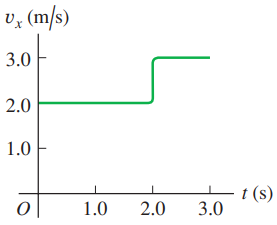
A ball moves in a straight line (the x-axis). The graph in Fig. E2.9 shows this ball’s velocity as a function of time.
(a) What are the ball’s average speed and average velocity during the first 3.0 s?
(b) Suppose that the ball moved in such a way that the graph segment after 2.0 s was -3.0 m/s instead of +3.0 m/s. Find the ball’s average speed and average velocity in this case.
Solution
Step 1 of 4
a) Average speed, s = Total distance travelled by the object/Total time
In this problem, the velocity of the ball in first two seconds is, \(\mathrm{v}_{1}=2 \mathrm{~m} / \mathrm{s}\)
Therefore, the total distance travelled by the object at first two seconds, \(\mathrm{d}_{1}=\mathrm{v}_{1} \mathrm{t}_{1}\)
\(\mathrm{d}_{1}=2 \mathrm{~m} / \mathrm{s} \times 2 \mathrm{~s}=4 \mathrm{~m}\)
The total distance travelled by the object in between 2nd and 3rd second is, \(\mathrm{d}_{2}=\mathrm{v}_{2} \mathrm{t}_{2}\)
\(\mathrm{d}_{2}=3 \mathrm{~m} / \mathrm{s} \times 1 \mathrm{~s}=3 \mathrm{~m}\)
Therefore, the total distance travelled by the object, \(d=d_{1}+d_{2}=4 m+3 m=7 m\)
Total time taken, \(\mathrm{t}=\mathrm{t}_{1}+\mathrm{t}_{2}=2 \mathrm{~s}+1 \mathrm{~s}=3 \mathrm{~s}\)
Average speed of the ball, s = 7 m / 3 s = 2.33 m/s
Subscribe to view the
full solution
full solution
Title
University Physics 13
Author
Hugh D. Young, Roger A. Freedman
ISBN
9780321675460
A ball moves in a straight line (the x-axis). The graph in
Chapter 2 textbook questions
-
Chapter 2: Problem 12 University Physics 13
-
Chapter 2: Problem 11 University Physics 13
A test car travels in a straight line along the x- axis. The graph in Fig. E2.11 shows the car’s position x as a function of time. Find its instantaneous velocity at points A through G.
Read more -
Chapter 2: Problem 12 University Physics 13
Figure E2.12 shows the velocity of a solar-powered car as a function of time. The driver accelerates from a stop sign, cruises for 20 s at a constant speed of 60 km/h, and then brakes to come to a stop 40 s after leaving the stop sign. (a) Compute the average acceleration during these time intervals: (i) t = 0 to t = 10 s; (ii) t = 30 s to t = 40 s; (iii) t = 10 s to t = 30 s; (iv) t = 0 to t = 40 s. (b) What is the instantaneous acceleration at t = 20 s and at t = 35 s?
Read more -
Chapter 2: Problem 11 University Physics 13
Problem 11DQ Can you have zero velocity and nonzero average acceleration? Zero velocity and nonzero acceleration? Use a ?v?x-?t graph to explain, and give an example of such motion.
Read more -
Chapter 2: Problem 13 University Physics 13
Problem 13E The Fastest (and Most Expensive) Car! The table shows test data for the Bugatti Veyron Super Sport, the fastest street car made. The car is moving in a straight line (the x -axis). (a) Sketch a vx-t graph of this car’s velocity (in mi/h) as a function of time. Is its acceleration constant? (b) Calculate the car’s average acceleration (in m/s2) between (i) 0 and 2.1 s; (ii) 2.1 s and 20.0 s; (iii) 20.0 s and 53 s. Are these results consistent with your graph in part (a)? (Before you decide to buy this car, it might be helpful to know that only 300 will be built, it runs out of gas in 12 minutes at top speed, and it costs more than $1.5 million!)
Read more -
Chapter 2: Problem 13 University Physics 13
The official's truck in Fig. 2.2 is at \(x_{1}=277\) m at \(t_{1}=16.0\) s and is at \(x_{2}=19\) m at \(t_{2}=25.0\) s. (a) Sketch two different possible x-t graphs for the motion of the truck. (b) Does the average velocity \(v_{\mathrm{av}-x}\) during the time interval from \(t_1\) to \(t_2\) have the same value for both of your graphs? Why or why not?
Read more -
Chapter 2: Problem 14 University Physics 13
Problem 14DQ Under constant acceleration the average velocity of a particle is half the sum of its initial and final velocities. Is this still true if the acceleration is ?not? constant? Explain.
Read more -
Chapter 2: Problem 14 University Physics 13
Problem 14E CALC? A race car starts from rest and travels east along a straight and level track. For the first 5.0 s of the car’s motion, the eastward component of the car’s velocity is given by vx(t) = (0.860 m/s3)t2. What is the acceleration of the car when vx = 12.0 m/s?
Read more -
Chapter 2: Problem 15 University Physics 13
Problem 15DQ You throw a baseball straight up in the air so that it rises to a maximum height much greater than your height. Is the magnitude of the ball’s acceleration greater while it is being thrown or after it leaves your hand? Explain.
Read more -
Chapter 2: Problem 15 University Physics 13
Problem 15E CALC? A turtle crawls along a straight line, which we will call the x -axis with the positive direction to the right. The equation for the turtle’s position as a function of time is x(t) = 50.0 cm + (2.00 cm/s)t – (0.0625 cm/s2)t2. (a) Find the turtle’s initial velocity, initial position, and initial acceleration. (b) At what time t is the velocity of the turtle zero? (c) How long after starting does it take the turtle to return to its starting point? (d) At what times ?t? is the turtle a distance of 10.0 cm from its starting point? What is the velocity (magnitude and direction) of the turtle at each of those times? (e) Sketch graphs of x versus ?t?, vx versus ?t?, and ax versus ?t?, for the time interval ?t? = 0 to ?t = 40 s.
Read more -
Chapter 2: Problem 16 University Physics 13
Problem 16DQ Prove these statements: (a) As long as you can ignore the effects of the air, if you throw anything vertically upward, it will have the same speed when it returns to the release point as when it was released. (b) The time of flight will be twice the time it takes to get to its highest point.
Read more -
Chapter 2: Problem 16 University Physics 13
Problem 16E An astronaut has left the International Space Station to test a new space scooter. Her partner measures the following velocity changes, each taking place in a 10-s interval. What are the magnitude, the algebraic sign, and the direction of the average acceleration in each interval? Assume that the positive direction is to the right. (a) At the beginning of the interval, the astronaut is moving toward the right along the x -axis at 15.0 m/s, and at the end of the interval she is moving toward the right at 5.0 m/s. (b) At the beginning she is moving toward the left at 5.0 m/s, and at the end she is moving toward the left at 15.0 m/s. (c) At the beginning she is moving toward the right at 15.0 m/s, and at the end she is moving toward the left at 15.0 m/s.
Read more -
Chapter 2: Problem 17 University Physics 13
Problem 17DQ A dripping water faucet steadily releases drops 1.0 s apart. As these drops fall, does the distance between them increase, decrease, or remain the same? Prove your answer.
Read more -
Chapter 2: Problem 17 University Physics 13
Problem 17E CALC? A car’s velocity as a function of time is given by vx(t) = ? + ?t2, where ? = 3.00 m/s and ? = 0.100 m/s3. (a) Calculate the average acceleration for the time interval t = 0 to t = 5.00 s. (b) Calculate the instantaneous acceleration for t = 0 and t = 5.00 s. (c) Draw vx-t and ax-t graphs for the car’s motion between t = 0 and t = 5.00 s.
Read more -
Chapter 2: Problem 18 University Physics 13
Problem 18DQ If you know the initial position and initial velocity of a vehicle and have a record of the acceleration at each instant, can you compute the vehicle’s position after a certain time? If so, explain how this might be done.
Read more -
Chapter 2: Problem 18 University Physics 13
Problem 18E CALC? The position of the front bumper of a test car under microprocessor control is given by x(t) = 2.17 m + (4.80 m/s2)t2 - 1 0.100 m/s6)t6. (a) Find its position and acceleration at the instants when the car has zero velocity. (b) Draw x-t , vx-t , and ax-t graphs for the motion of the bumper between t = 0 and t = 2.00 s.
Read more -
Chapter 2: Problem 19 University Physics 13
Problem 19DQ From the top of a tall building, you throw one ball straight up with speed v0 and one ball straight down with speed v0. (a) Which ball has the greater speed when it reaches the ground? (b) Which ball gets to the ground first? (c) Which ball has a greater displacement when it reaches the ground? (d) Which ball has traveled the greater distance when it hits the ground?
Read more -
Chapter 2: Problem 19 University Physics 13
Problem 19E An antelope moving with constant acceleration covers the distance between two points 70.0 m apart in 7.00 s. Its speed as it passes the second point is 15.0 m/s. (a) What is its speed at the first point? (b) What is its acceleration?
Read more -
Chapter 2: Problem 20 University Physics 13
Problem 20DQ A ball is dropped from rest from the top of a building of height ?h?. At the same instant, a second ball is projected vertically upward from ground level, such that it has zero speed when it reaches the top of the building. When the two balls pass each other, which ball has the greater speed, or do they have the same speed? Explain. Where will the two balls he when they are alongside each other: at height ?h/?2 above the ground below this height, or above this height? Explain.
Read more -
Chapter 2: Problem 20 University Physics 13
Problem 20E BIO Blackout?? A jet fighter pilot wishes to accelerate from rest at a constant acceleration of 5 g to reach Mach 3 (three times the speed of sound) as quickly as possible. Experimental tests reveal that he will black out if this acceleration lasts for more than 5.0 s. Use 331 m/s for the speed of sound. (a) Will the period of acceleration last long enough to cause him to black out? (b) What is the greatest speed he can reach with an acceleration of 5g before he blacks out?
Read more -
Chapter 2: Problem 21 University Physics 13
Problem 21DQ An object is thrown straight up into the air and feels no air resistance. How can the object have an acceleration when it has stopped moving at its highest point?
Read more -
Chapter 2: Problem 21 University Physics 13
Problem 21E A Fast Pitch.? The fastest measured pitched baseball left the pitcher’s hand at a speed of 45.0 m/s. If the pitcher was in contact with the ball over a distance of 1.50 m and produced constant acceleration, (a) what acceleration did he give the ball, and (b) how much time did it take him to pitch it?
Read more -
Chapter 2: Problem 22 University Physics 13
Problem 22DQ When you drop an object from a certain height, it takes time T to reach the ground with no air resistance. If you dropped it from three times that height, how long (in terms of T) would it take to reach the ground?
Read more -
Chapter 2: Problem 22 University Physics 13
Problem 22E A Tennis Serve.? In the fastest measured tennis serve, the ball left the racquet at 73.14 m/s. A served tennis ball is typically in contact with the racquet for 30.0 ms and starts from rest. Assume constant acceleration. (a) What was the ball’s acceleration during this serve? (b) How far did the ball travel during the serve?
Read more -
Chapter 2: Problem 23 University Physics 13
Problem 23E BIO Automobile Air Bags.? The human body can survive an acceleration trauma incident (sudden stop) if the magnitude of the acceleration is less than 250 m/s2. If you are in an automobile accident with an initial speed of 105 km/h (65 mi/h) and are stopped by an airbag that inflates from the dashboard, over what distance must the airbag stop you for you to survive the crash?
Read more -
Chapter 2: Problem 24 University Physics 13
Problem 24E BIO? A pilot who accelerates at more than 4 g begins to “gray out” but doesn’t completely lose consciousness. (a) Assuming constant acceleration, what is the shortest time that a jet pilot starting from rest can take to reach Mach 4 (four times the speed of sound) without graying out? (b) How far would the plane travel during this period of acceleration? (Use 331 m/s for the speed of sound in cold air.)
Read more -
Chapter 2: Problem 25 University Physics 13
Problem 25E BIO Air-Bag Injuries.? During an auto accident, the vehicle’s air bags deploy and slow down the passengers more gently than if they had hit the windshield or steering wheel. According to safety standards, air bags produce a maximum acceleration of 60 g that lasts for only 36 ms (or less). How far (in meters) does a person travel in coming to a complete stop in 36 ms at a constant acceleration of 60 g?
Read more -
Chapter 2: Problem 26 University Physics 13
Problem 26E BIO Prevention of Hip Fractures.? Falls resulting in hip fractures are a major cause of injury and even death to the elderly. Typically, the hip’s speed at impact is about 2.0 m/s. If this can be reduced to 1.3 m/s or less, the hip will usually not fracture. One way to do this is by wearing elastic hip pads. (a) If a typical pad is 5.0 cm thick and compresses by 2.0 cm during the impact of a fall, what constant acceleration (in m/s2 and in g’s) does the hip undergo to reduce its speed from 2.0 m/s to 1.3 m/s? (b) The acceleration you found in part (a) may seem rather large, but to assess its effects on the hip, calculate how long it lasts.
Read more -
Chapter 2: Problem 28 University Physics 13
Problem 28E Entering the Freeway.? A car sits on an entrance ramp to a freeway, waiting for a break in the traffic. Then the driver accelerates with constant acceleration along the ramp and onto the freeway. The car starts from rest, moves in a straight line, and has a speed of 20 m/s (45 mi/h) when it reaches the end of the 120-m-long ramp. (a) What is the acceleration of the car? (b) How much time does it take the car to travel the length of the ramp? (c) The traffic on the freeway is moving at a constant speed of 20 m/s. What distance does the traffic travel while the car is moving the length of the ramp?
Read more -
Chapter 2: Problem 27 University Physics 13
Problem 27E BIO Are We Martians?? It has been suggested, and not facetiously, that life might have originated on Mars and been carried to the earth when a meteor hit Mars and blasted pieces of rock (perhaps containing primitive life) free of the Martian surface. Astronomers know that many Martian rocks have come to the earth this way. (For instance, search the Internet for “ALH 84001.”) One objection to this idea is that microbes would have had to undergo an enormous lethal acceleration during the impact. Let us investigate how large such an acceleration might be. To escape Mars, rock fragments would have to reach its escape velocity of 5.0 km/s, and that would most likely happen over a distance of about 4.0 m during the meteor impact. (a) What would be the acceleration (in m/s2 and g’s) of such a rock fragment, if the acceleration is constant? (b) How long would this acceleration last? (c) In tests, scientists have found that over 40% of ?Bacillus subtilis? bacteria survived after an acceleration of 450,000 g. In light of your answer to part (a), can we rule out the hypothesis that life might have been blasted from Mars to the earth?
Read more -
Chapter 2: Problem 29 University Physics 13
Problem 29E At launch a rocket ship weighs 4.5 million pounds. When it is launched from rest, it takes 8.00 s to reach 161 km/h; at the end of the first 1.00 min, its speed is 1610 km/h. (a) What is the average acceleration (in m/s2) of the rocket (i) during the first 8.00 s and (ii) between 8.00 s and the end of the first 1.00 min? (b) Assuming the acceleration is constant during each time interval (but not necessarily the same in both intervals), what distance does the rocket travel (i) during the first 8.00 s and (ii) during the interval from 8.00 s to 1.00 min?
Read more -
Chapter 2: Problem 30 University Physics 13
Problem 30E A cat walks in a straight line, which we shall call the x-axis, with the positive direction to the right. As an observant physicist, you make measurements of this cat’s motion and construct a graph of the feline’s velocity as a function of time (?Fig. E2.30?). (a) Find the cat’s velocity at t = 4.0 s and at t = 7.0 s. (b) What is the cat’s acceleration at t = 3.0 s? At t = 6.0 s? At t = 7.0 s? (c) What distance does the cat move during the first 4.5 s? From t = 0 to t = 7.5 s? (d) Assuming that the cat started at the origin, sketch clear graphs of the cat’s acceleration and position as functions of time.
Read more -
Chapter 2: Problem 31 University Physics 13
Problem 31E The graph in ?Fig. E2.31? shows the velocity of a motorcycle police officer plotted as a function of time. (a) Find the instantaneous acceleration at t = 3 s, t = 7 s, and t = 11 s. (b) How far does the officer go in the first 5 s? The first 9 s? The first 13 s?
Read more -
Chapter 2: Problem 33 University Physics 13
Problem 33E Mars Landing?. In January 2004, NASA landed exploration vehicles on Mars. Part of the descent consisted of The following stages: Stage A?: Friction with the atmosphere reduced the speed from 19,300 km/h to 1600 km/h in 4.0 min. Stage B:? A parachute then opened to slow it down to 321 km/h in 94 s. Stage C?: Retro rockets then fired to reduce its speed to zero over a distance of 75 m. Assume that each stage followed immediately after the preceding one and that the acceleration during each stage was constant. (a) Find the rocket’s acceleration (in m/s2) during each stage. (b) What total distance (in km) did the rocket travel during stages A, B, and C?
Read more -
Chapter 2: Problem 32 University Physics 13
Problem 32E Two cars, A and B, move Figure E2.32 along the x-axis. Figure E2.32 is a graph of the positions of A and B versus time. (a) In motion diagrams (like Figs. 2.13b and 2.14b), show the position, velocity, and acceleration of each of 10 the two cars at t = 0, t = 1 s, and t = 3 s. (b) At what time(s), if any, do A and B have the same t (s) position? (c) Graph velocity versus time for both A and B. (d) At what time(s), if any, do A and B have the same velocity? (e) At what time(s), if any, does car A pass car B? (At what time(s), if any, does car B pass car A?
Read more -
Chapter 2: Problem 34 University Physics 13
Problem 34E At the instant the traffic light turns green. a car that has been waiting at an intersection starts ahead with a constant acceleration of 3.20 m/s2. At The same instant a truck, traveling with a constant speed of 20.0 m/s, overtakes and passes the car. (a) How far beyond its starting point does the car overtakes the truck? (b) How fast is the car traveling when it overtakes the truck? (c) Sketch an ?x???t? graph of the motion of both vehicles. Take ?x? = 0 at the intersection. (d) Sketch a ?vx???t? graph of the motion of both vehicles.
Read more -
Chapter 2: Problem 35 University Physics 13
Problem 35E (a) If a flea can jump straight up to a height of 0.440 m, what is its initial speed as it leaves the ground? (b) How long is it in the air?
Read more -
Chapter 2: Problem 36 University Physics 13
Problem 36E A small rock is thrown vertically upward with a speed of 18.0 m/s from the edge of the roof of a 30.0-m-tall building. The rock doesn’t hit the building on its way back down and lands in the street below. Air resistance can be neglected. (a) What is the speed of the rock just before it hits the street? (b) How much time elapses from when the rock is thrown until it hits the street?
Read more -
Chapter 2: Problem 37 University Physics 13
Problem 37E A juggler throws a bowling pin straight up with an initial speed of 8.20 m/s. How much time elapses until the bowling pin returns to the juggler’s hand?
Read more -
Chapter 2: Problem 38 University Physics 13
Problem 38E You throw a glob of putty straight up toward the ceiling, which is 3.60 m above the point where the putty leaves your hand. The initial speed of the putty as it leaves your hand is 9.50 m/s. (a) What is the speed of the putty just before it strikes the ceiling? (b) How much time from when it leaves your hand does it take the putty to reach the ceiling?
Read more -
Chapter 2: Problem 39 University Physics 13
Problem 39E A tennis ball on Mars, where the acceleration due to gravity is 0.379 g and air resistance is negligible, is hit directly up-ward and returns to the same level 8.5 s later. (a) How high above its original point did the ball go? (b) How fast was it moving just after it was hit? (c) Sketch graphs of the ball’s vertical position, vertical velocity, and vertical acceleration as functions of time while it’s in the Martian air.
Read more -
Chapter 2: Problem 40 University Physics 13
Problem 40E Touchdown on the Moon.? A lunar lander is making its descent to Moon Base I (?Fig. E2.40?). The lander descends slowly under the retro-thrust of its descent engine. The engine is cut off when the lander is 5.0 m above the surface and has a down-ward speed of 0.8 m/s. With the engine off, the lander is in free fall. What is the speed of the lander just before it touches the surface? The acceleration due to gravity on the moon is 1.6 m/s2.
Read more -
Chapter 2: Problem 41 University Physics 13
Problem 41E A Simple Reaction-Time Test.? A meter stick is held vertically above your hand, with the lower end between your thumb and first finger. When you see the meter stick released, you grab it with those two fingers. You can calculate your reaction time from the distance the meter stick falls, read directly from the point where your fingers grabbed it. (a) Derive a relationship for your reaction time in terms of this measured distance, d. (b) If the measured distance is 17.6 cm, what is your reaction time?
Read more -
Chapter 2: Problem 42 University Physics 13
Problem 42E A brick is dropped (zero initial speed) from the roof of a building. The brick strikes the ground in 2.50 s. You may ignore air resistance, so the brick is in free fall. (a) How tall, in meters, is the building? (b) What is the magnitude of the brick’s velocity just before it reaches the ground? (c) Sketch ?ay???t?, ?vy???t?, and ?y???t graphs for the motion of the brick.
Read more -
Chapter 2: Problem 43 University Physics 13
Problem 43E Launch Failure.? A 7500-kg rocket blasts off vertically from the launch pad with a constant upward acceleration of 2.25 m/s2 and feels no appreciable air resistance. When it has reached a height of 525 m, its engines suddenly fail; the only force acting on it is now gravity. (a) What is the maximum height this rocket will reach above the launch pad? (b) How much time will elapse after engine failure before the rocket comes crashing down to the launch pad, and how fast will it be moving just before it crashes? (c) Sketch ay-t, vy-t, and y-t graphs of the rocket’s motion from the instant of blast-off to the instant just before it strikes the launch pad.
Read more -
Chapter 2: Problem 44 University Physics 13
Problem 44E A hot-air balloonist, rising vertically with a constant velocity of magnitude 5.00 m/s, releases a sandbag at an instant when the balloon is 40.0 m above the ground (?Fig. E2.44?). After the sandbag is released, it is in free fall. (a) Compute the position and velocity of the sandbag at 0.250 s and 1.00 s after its release. (b) How many seconds after its release does the bag strike the ground? (c) With what magnitude of velocity does it strike the ground? (d) What is the greatest height above the ground that the sandbag reaches? (e) Sketch ay-t, vy-t, and y-t graphs for the motion.
Read more -
Chapter 2: Problem 45 University Physics 13
Problem 45E BIO? The rocket-driven sled ?Sonic Wind No. 2,? used for investigating the physiological effects of large accelerations, runs on a straight, level track 1070 m (3500 ft) long. Starting from rest, it can reach a speed of 224 m/s (500 mi/h) in 0.900 s. (a) Compute the acceleration in m/s2, assuming that it is constant. (b) What is the ratio of this acceleration to that of a freely falling body (g)? (c) What distance is covered in 0.900 s? (d) A magazine article states that at the end of a certain run, the speed of the sled de-creased from 283 m/s (632 mi/h) to zero in 1.40 s and that during this time the magnitude of the acceleration was greater than 40 g . Are these figures consistent?
Read more -
Chapter 2: Problem 46 University Physics 13
Problem 46E An egg is thrown nearly vertically upward from a point near the cornice of a tall building. The egg just misses the cornice on the way down and passes a point 30.0 m below its starting point 5.00 s after it leaves the thrower’s hand. Ignore air resistance. (a) What is the initial speed of the egg? (b) How high does it rise above its starting point? (c) What is the magnitude of its velocity at the highest point? (d) What are the magnitude and direction of its acceleration at the highest point? (e) Sketch ay-t, vy-t, and y-t graphs for the motion of the egg.
Read more -
Chapter 2: Problem 47 University Physics 13
A 15-kg rock is dropped from rest on the earth and reaches the ground in 1.75 s. When it is dropped from the same height on Saturn’s satellite Enceladus, it reaches the ground in 18.6 s. What is the acceleration due to gravity on Enceladus?
Read more -
Chapter 2: Problem 48 University Physics 13
Problem 48E A large boulder is ejected vertically upward from a volcano with an initial speed of 40.0 m/s. Ignore air resistance. (a) At what time after being ejected is the boulder moving at 20.0 m/s upward? (b) At what time is it moving at 20.0 m/s downward? (c) When is the displacement of the boulder from its initial position zero? (d) When is the velocity of the boulder zero? (e) What are the magnitude and direction of the acceleration while the boulder is (i) moving upward? (ii) Moving downward? (iii) At the highest point? (f) Sketch ay-t, vy-t, and y-t graphs for the motion.
Read more -
Chapter 2: Problem 49 University Physics 13
Two stones are thrown vertically upward from the ground, one with three times the initial speed of the other. (a) It the faster stone takes 10 s to return to the ground, how long will it take the slower stone to return? (b) If the slower stone reaches a maximum height of H, how high (in terms of H) will the faster stone go? Assume free fall.
Read more -
Chapter 2: Problem 50 University Physics 13
Problem 50E For constant ?ax?, use Eqs. (2.17) and (2.18) to find ?vx? and ?x? as functions of time. Compare your results to Eqs. (2.8) and (2.12).
Read more -
Chapter 2: Problem 51 University Physics 13
Problem 51E CALC? A rocket starts from rest and moves upward from the surface of the earth. For the first 10.0 s of its motion, the vertical acceleration of the rocket is given by ay = 1 2.80 m/s3)t, where the + y-direction is upward. (a) What is the height of the rocket above the surface of the earth at t = 10.0 s? (b) What is the speed of the rocket when it is 325 m above the surface of the earth?
Read more -
Chapter 2: Problem 1 University Physics 13
Problem 1DQ Does the speedometer of a car measure speed or velocity? Explain.
Read more -
Chapter 2: Problem 2 University Physics 13
Problem 2DQ The black dots at the top of F ? ig. Q2.2 represent a series of high-speed photographs of an insect flying in a straight line from left to right (in the positive x -direction). Which of the graphs in Fig. Q2.2 most plausibly depicts this insect’s motion?
Read more -
Chapter 2: Problem 1 University Physics 13
Problem 1E A car travels in the + x-direction on a straight and level road. For the first 4.00 s of its motion, the average velocity of the car is vav-x = 6.25 m/s. How far does the car travel in 4.00 s?
Read more -
Chapter 2: Problem 2 University Physics 13
Problem 2E In an experiment, a shearwater (a seabird) was taken from its nest, flown 5150 km away, and released. The bird found its way back to its nest 13.5 days after release. If we place the origin at the nest and extend the + x-axis to the release point, what was the bird’s average velocity in m/s (a) for the return flight and (b) for the whole episode, from leaving the nest to returning?
Read more -
Chapter 2: Problem 3 University Physics 13
Problem 3DQ Can an object with constant acceleration reverse its direction of travel? Can it reverse its directio? wice?? In both cases, explain your reasoning.
Read more -
Chapter 2: Problem 4 University Physics 13
Problem 4DQ Under what conditions is average velocity equal to instantaneous velocity?
Read more -
Chapter 2: Problem 4 University Physics 13
Problem 4E From Pillar to Post. Starting from a pillar, you run 200 m east (the + x-direction) at an average speed of 5.0 m/s and then run 280 m west at an average speed of 4.0 m/s to a post. Calculate (a) your average speed from pillar to post and (b) your average velocity from pillar to post.
Read more -
Chapter 2: Problem 3 University Physics 13
Problem 3E Trip Home?. You normally drive on the freeway between San Diego and Los Angeles at an average speed of 105 km/h (65 mi/h), and the trip takes 2 h and 20 min. On a Friday afternoon, however, heavy traffic slows you down and you drive the same distance at an average speed of only 70 km/h ( 43 mi/h). How much longer does the trip take?
Read more -
Chapter 2: Problem 5 University Physics 13
Problem 5DQ Is it possible for an object to be (a) slowing down while its acceleration is increasing in magnitude; (b) speeding up while its acceleration is decreasing? In both cases, explain your reasoning.
Read more -
Chapter 2: Problem 5 University Physics 13
Problem 5E Starting from the front door of a ranch house, you walk 60.0 m due east to a windmill, turn around, and then slowly walk 40.0 m west to a bench, where you sit and watch the sunrise. It takes you 28.0 s to walk from the house to the windmill and then 36.0 s to walk from the windmill to the bench. For the entire trip from the front door to the bench, what are your (a) average velocity and (b) average speed?
Read more -
Chapter 2: Problem 6 University Physics 13
Problem 6DQ Under what conditions does the magnitude of the average velocity equal the average speed?
Read more -
Chapter 2: Problem 6 University Physics 13
Problem 6E A Honda Civic travels in a straight line along a road. The car’s distance x from a stop sign is given as a function of time ?t by the equation x(t) = ?t2 - ?t3, where ? = 1.50 m/s2 and ? = 0.0500 m/s3. Calculate the average velocity of the car for each time interval: (a) t = 0 to t = 2.00 s; (b) t = 0 to t = 4.00 s; (c) t = 2.00 s to t = 4.00 s.
Read more -
Chapter 2: Problem 7 University Physics 13
CALC A car is stopped at a traffic light. It then travels along a straight road such that its distance from the light is given by \(x(t)=b t^{2}-c t^{3}\), where \(b=2.40 \mathrm{~m} / \mathrm{s}^{2}\) and \(c=0.120 \mathrm{~m} / \mathrm{s}^{3}\). (a) Calculate the average velocity of the car for the time interval t = 0 to t = 10.0 s. (b) Calculate the instantaneous velocity of the car at t = 0, t = 5.0 s, and t = 10.0 s. (c) How long after starting from rest is the car again at rest?
Read more -
Chapter 2: Problem 8 University Physics 13
Problem 8DQ A driver in Massachusetts was sent to traffic court for speeding. The evidence against the driver was that a policewoman observed the driver’s car alongside a second car at a certain moment, and the policewoman had already clocked the second car going faster than the speed limit. The driver argued, “The second car was passing me. I was not speeding.” The judge ruled against the driver because, in the judge’s words, “If two cars were side by side, both of you were speeding.” If you were a lawyer representing the accused driver, how would you argue this case?
Read more -
Chapter 2: Problem 9 University Physics 13
A ball moves in a straight line (the x-axis). The graph in Fig. E2.9 shows this ball’s velocity as a function of time. (a) What are the ball’s average speed and average velocity during the first 3.0 s? (b) Suppose that the ball moved in such a way that the graph segment after 2.0 s was -3.0 m/s instead of +3.0 m/s. Find the ball’s average speed and average velocity in this case.
Read more -
Chapter 2: Problem 8 University Physics 13
Problem 8E CALC A bird is flying due east. Its distance from a tall building is given by x(t) = 28.0 m + (12.4 m/s)t – (0.0450 m/s3)t3. What is the instantaneous velocity of the bird when t = 8.00s?
Read more -
Chapter 2: Problem 9 University Physics 13
Problem 9DQ Can you have zero displacement and nonzero average velocity? Zero displacement and nonzero velocity? Illustrate your answers on an x-t graph.
Read more -
Chapter 2: Problem 10 University Physics 13
Problem 10DQ Can you have zero acceleration and nonzero velocity? Use a ?v?x-?t? graph to explain.
Read more -
Chapter 2: Problem 10 University Physics 13
A physics professor leaves her house and walks along the sidewalk toward campus. After 5 min it starts to rain, and she returns home. Her distance from her house as a function of time is shown in Fig. E2.10. At which of the labeled points is her velocity (a) zero? (b) constant and positive? (c) constant and negative? (d) increasing in magnitude? (e) decreasing in magnitude?
Read more -
Chapter 2: Problem 7 University Physics 13
Problem 7DQ When a Dodge Viper is at Elwood’s Car Wash, a BMW Z3 is at Elm and Main. Later, when the Dodge reaches Elm and Main, the BMW reaches Elwood’s Car Wash. How are the cars’ average velocities between these two times related?
Read more