
The \(50-\mathrm{kg}\) crate is projected along the floor with an initial speed of \(8 \mathrm{~m} / \mathrm{s}\) at x = 0. The coefficient of kinetic friction is 0.40 . Calculate the time required for the crate to come to rest and the corresponding distance x traveled.
Read moreTextbook Solutions for Engineering Mechanics: Dynamics
Chapter 3 Problem 3/167
Question
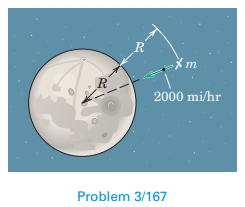
A spacecraft m is heading toward the center of the moon with a velocity of \(2000 \mathrm{mi} / \mathrm{hr}\) at a distance from the moon's surface equal to the radius R of the moon. Compute the impact velocity v with the surface of the moon if the spacecraft is unable to fire its retro-rockets. Consider the moon fixed in space. The radius R of the moon is \(1080 \mathrm{mi}\), and the acceleration due to gravity at its surface is \(5.32 \mathrm{ft} / \mathrm{sec}^2\).
Solution
The first step in solving 3 problem number 167 trying to solve the problem we have to refer to the textbook question: A spacecraft m is heading toward the center of the moon with a velocity of \(2000 \mathrm{mi} / \mathrm{hr}\) at a distance from the moon's surface equal to the radius R of the moon. Compute the impact velocity v with the surface of the moon if the spacecraft is unable to fire its retro-rockets. Consider the moon fixed in space. The radius R of the moon is \(1080 \mathrm{mi}\), and the acceleration due to gravity at its surface is \(5.32 \mathrm{ft} / \mathrm{sec}^2\).
From the textbook chapter KINETICS OF PARTICLES
you will find a few key concepts needed to solve this.
Visible to paid subscribers only
Step 3 of 7)Visible to paid subscribers only
Subscribe to view the
full solution
full solution
Title
Engineering Mechanics: Dynamics 8
Author
James L. Meriam, L. G. Kraige, J. N. Bolton
ISBN
9781118885840
A spacecraft m is heading toward the center of themoon with a velocity of 2000 mi /hr at
Chapter 3 textbook questions
-
 Chapter 3: Problem 3 Engineering Mechanics: Dynamics 8
 -
Chapter 3: Problem 3 Engineering Mechanics: Dynamics 8
The \(50-\mathrm{kg}\) crate is stationary when the force P is applied. Determine the resulting acceleration of the crate if (a) P = 0, (b) \(P=150 \mathrm{~N}\), and (c) \(P=300 \mathrm{~N}\).
Read more -
Chapter 3: Problem 3 Engineering Mechanics: Dynamics 8
At a certain instant, the 80 -lb crate has a velocity of \(30 \mathrm{ft} / \mathrm{sec}\) up the \(20^{\circ}\) incline. Calculate the time t required for the crate to come to rest and the corresponding distance d traveled. Also, determine the distance \(d^{\prime}\) traveled when the crate speed has been reduced to \(15 \mathrm{ft} / \mathrm{sec}\).
Read more -
Chapter 3: Problem 3 Engineering Mechanics: Dynamics 8
A man pulls himself up the \(15^{\circ}\) incline by the method shown. If the combined mass of the man and cart is \(100 \mathrm{~kg}\), determine the acceleration of the cart if the man exerts a pull of \(175 \mathrm{~N}\) on the rope. Neglect all friction and the mass of the rope, pulleys, and wheels.
Read more -
Chapter 3: Problem 3 Engineering Mechanics: Dynamics 8
The 10-Mg truck hauls the 20-Mg trailer. If the unit starts from rest on a level road with a tractive force of \(20 \mathrm{kN}\) between the driving wheels of the truck and the road, compute the tension T in the horizontal drawbar and the acceleration a of the rig.
Read more -
Chapter 3: Problem 3 Engineering Mechanics: Dynamics 8
A 60-kg woman holds a 9-kg package as she stands within an elevator which briefly accelerates upward at a rate of g/4. Determine the force R which the elevator floor exerts on her feet and the lifting force L which she exerts on the package during the acceleration interval. If the elevator support cables suddenly and completely fail, what values would R and L acquire?
Read more -
Chapter 3: Problem 3 Engineering Mechanics: Dynamics 8
During a brake test, the rear-engine car is stopped from an initial speed of \(100 \mathrm{~km} / \mathrm{h}\) in a distance of \(50 \mathrm{~m}\). If it is known that all four wheels contribute equally to the braking force, determine the braking force F at each wheel. Assume a constant deceleration for the 1500-kg car.
Read more -
Chapter 3: Problem 3 Engineering Mechanics: Dynamics 8
A skier starts from rest on the \(40^{\circ}\) slope at time t = 0 and is clocked at \(t=2.58 \mathrm{~s}\) as he passes a speed checkpoint \(20 \mathrm{~m}\) down the slope. Determine the coefficient of kinetic friction between the snow and the skis. Neglect wind resistance.
Read more -
Chapter 3: Problem 3 Engineering Mechanics: Dynamics 8
The inexperienced driver of an all-wheel-drive car applies too much throttle as he attempts to accelerate from rest up the slippery 10-percent incline. The result is wheel spin at all four tires, each of which has the same gripping ability. Determine the vehicle acceleration for the conditions of (a) light snow, \(\mu_k= 0.12\) and (b) ice, \(\mu_k=0.05\).
Read more -
Chapter 3: Problem 3 Engineering Mechanics: Dynamics 8
Determine the steady-state angle \(\alpha\) if the constant force P is applied to the cart of mass M. The pendulum bob has mass m and the rigid bar of length L has negligible mass. Ignore all friction. Evaluate your expression for P = 0.
Read more -
Chapter 3: Problem 3 Engineering Mechanics: Dynamics 8
The 300-Mg jet airliner has three engines, each of which produces a nearly constant thrust of \(240 \mathrm{kN}\) during the takeoff roll. Determine the length s of runway required if the takeoff speed is \(220 \mathrm{~km} / \mathrm{h}\). Compute s first for an uphill takeoff direction from A to B and second for a downhill takeoff from B to A on the slightly inclined runway. Neglect air and rolling resistance.
Read more -
Chapter 3: Problem 3 Engineering Mechanics: Dynamics 8
For a given horizontal force P, determine the normal reaction forces at A and B. The mass of the cylinder is m and that of the cart is M. Neglect all friction.
Read more -
Chapter 3: Problem 3 Engineering Mechanics: Dynamics 8
The system of the previous problem is now placed on the \(15^{\circ}\) incline. What force P will cause the normal reaction force at B to be zero?
Read more -
Chapter 3: Problem 3 Engineering Mechanics: Dynamics 8
The 750,000-lb jetliner A has four engines, each of which produces a nearly constant thrust of \(40,000 \mathrm{lb}\) during the takeoff roll. A small commuter aircraft B taxis toward the end of the runway at a constant speed \(v_B=15 \mathrm{mi} / \mathrm{hr}\). Determine the velocity and acceleration which A appears to have relative to an observer in B10 seconds after A begins its takeoff roll. Neglect air and rolling resistance.
Read more -
Chapter 3: Problem 3 Engineering Mechanics: Dynamics 8
The drive system of the 350 -ton tugboat causes an external thrust \(P=7000 \mathrm{lb}\) to be applied as indicated in the figure. If the tugboat pushes an 800-ton coal barge starting from rest, what is the acceleration of the combined unit? Also, determine the force R of interaction between tugboat and barge. Neglect water resistance.
Read more -
Chapter 3: Problem 3 Engineering Mechanics: Dynamics 8
Determine the tension P in the cable which will give the 100 -lb block a steady acceleration of \(5 \mathrm{ft} / \mathrm{sec}^2\) up the incline.
Read more -
Chapter 3: Problem 3 Engineering Mechanics: Dynamics 8
A cesium-ion engine for deep-space propulsion is designed to produce a constant thrust of \(2.5 \mathrm{~N}\) for long periods of time. If the engine is to propel a \(70-\mathrm{Mg}\) spacecraft on an interplanetary mission, compute the time t required for a speed increase from \(40000 \mathrm{~km} / \mathrm{h}\) to \(65000 \mathrm{~km} / \mathrm{h}\). Also find the distance s traveled during this interval. Assume that the spacecraft is moving in a remote region of space where the thrust from its ion engine is the only force acting on the spacecraft in the direction of its motion.
Read more -
Chapter 3: Problem 3 Engineering Mechanics: Dynamics 8
A toy train has magnetic couplers whose maximum attractive force is \(0.2 \mathrm{lb}\) between adjacent cars. What is the maximum force P with which a child can pull the locomotive and not break the train apart at a coupler? If P is slightly exceeded, which coupler fails? Neglect the mass and friction associated with all wheels.
Read more -
Chapter 3: Problem 3 Engineering Mechanics: Dynamics 8
A worker develops a tension T in the cable as he attempts to move the \(50-\mathrm{kg}\) cart up the \(20^{\circ}\) incline. Determine the resulting acceleration of the cart if (a) \(T=150 \mathrm{~N}\) and (b) \(T=200 \mathrm{~N}\). Neglect all friction, except that at the worker's feet.
Read more -
Chapter 3: Problem 3 Engineering Mechanics: Dynamics 8
The wheeled cart of Prob. 3/19 is now replaced with a \(50-\mathrm{kg}\) sliding wooden crate. The coefficients of static and kinetic friction are given in the figure. Determine the acceleration of the crate if (a) \(T=300 \mathrm{~N}\) and (b) \(T=400 \mathrm{~N}\). Neglect friction at the pulley.
Read more -
Chapter 3: Problem 3 Engineering Mechanics: Dynamics 8
A small package is deposited by the conveyor belt onto the \(30^{\circ}\) ramp at A with a velocity of \(0.8 \mathrm{~m} / \mathrm{s}\). Calculate the distance s on the level surface BC at which the package comes to rest. The coefficient of kinetic friction for the package and supporting surface from A to C is 0.30 .
Read more -
Chapter 3: Problem 3 Engineering Mechanics: Dynamics 8
A bicyclist finds that she descends the slope \(\theta_1= 3^{\circ}\) at a certain constant speed with no braking or pedaling required. The slope changes fairly abruptly to \(\theta_2\) at point A. If the bicyclist takes no action but continues to coast, determine the acceleration a of the bike just after it passes point A for the conditions (a) \(\theta_2=5^{\circ}\) and (b) \(\theta_2=0\).
Read more -
Chapter 3: Problem 3 Engineering Mechanics: Dynamics 8
The 5-oz pinewood-derby car is released from rest at the starting line A and crosses the finish line C \(2.75 \mathrm{sec}\) later. The transition at B is small and smooth. Assume that the net retarding force is constant throughout the run and find this force.
Read more -
Chapter 3: Problem 3 Engineering Mechanics: Dynamics 8
The coefficient of static friction between the flat bed of the truck and the crate it carries is 0.30 . Determine the minimum stopping distance s which the truck can have from a speed of \(70 \mathrm{~km} / \mathrm{h}\) with constant deceleration if the crate is not to slip forward.
Read more -
Chapter 3: Problem 3 Engineering Mechanics: Dynamics 8
If the truck of Prob. 3/24 comes to a stop from an initial forward speed of \(70 \mathrm{~km} / \mathrm{h}\) in a distance of \(50 \mathrm{~m}\) with uniform deceleration, determine whether or not the crate strikes the wall at the forward end of the flat bed. If the crate does strike the wall, calculate its speed relative to the truck as the impact occurs. Use the friction coefficients \(\mu_s=0.30\) and \(\mu_k=0.25\).
Read more -
Chapter 3: Problem 3 Engineering Mechanics: Dynamics 8
The winch takes in cable at the rate of \(200 \mathrm{~mm} / \mathrm{s}\), and this rate is momentarily increasing at \(500 \mathrm{~mm} / \mathrm{s}\) each second. Determine the tensions in the three cables. Neglect the weights of the pulleys.
Read more -
Chapter 3: Problem 3 Engineering Mechanics: Dynamics 8
Determine the vertical acceleration of the 60-lb cylinder for each of the two cases. Neglect friction and the mass of the pulleys.
Read more -
Chapter 3: Problem 3 Engineering Mechanics: Dynamics 8
Determine the weight of cylinder B which would cause block A to accelerate (a) \(5 \mathrm{ft} / \mathrm{sec}^2\) down the incline and (b) \(5 \mathrm{ft} / \mathrm{sec}^2\) up the incline. Neglect all friction.
Read more -
Chapter 3: Problem 3 Engineering Mechanics: Dynamics 8
A player pitches a baseball horizontally toward a speed-sensing radar gun. The baseball weighs \(5 \frac{1}{8} \mathrm{oz}\) and has a circumference of \(9 \frac{1}{8}\) in. If the speed at x= 0 is \(v_0=90 \mathrm{mi} / \mathrm{hr}\), estimate the speed as a function of x. Assume that the horizontal aerodynamic drag on the baseball is given by \(D=C_D\left(\frac{1}{2} \rho v^2\right) S\), where \(C_D\) is the drag coefficient, \(\rho\) is the air density, v is the speed, and S is the cross-sectional area of the baseball. Use a value of 0.3 for \(C_D\). Neglect the vertical component of the motion but comment on the validity of this assumption. Evaluate your answer for \(x=60 \mathrm{ft}\), which is the approximate distance between a pitcher's hand and home plate.
Read more -
Chapter 3: Problem 3 Engineering Mechanics: Dynamics 8
If the rider presses on the pedal with a force \(P= 160 \mathrm{~N}\) as shown, determine the resulting forward acceleration of the bicycle. Neglect the effects of the mass of rotating parts, and assume no slippage at the rear wheel. The radii of sprockets A and B are \(45 \mathrm{~mm}\) and \(90 \mathrm{~mm}\), respectively. The mass of the bicycle is \(13 \mathrm{~kg}\) and that of the rider is \(65 \mathrm{~kg}\). Treat the rider as a particle moving with the bicycle frame, and neglect drivetrain friction.
Read more -
Chapter 3: Problem 3 Engineering Mechanics: Dynamics 8
The rack has a mass \(m=50 \mathrm{~kg}\). What moment M must be exerted on the gear wheel by the motor in order to accelerate the rack up the \(60^{\circ}\) incline at a rate \(a=g / 4\) ? The fixed motor which drives the gear wheel via the shaft at O is not shown. Neglect the effects of the mass of the gear wheel.
Read more -
Chapter 3: Problem 3 Engineering Mechanics: Dynamics 8
A jet airplane with a mass of \(5 \mathrm{Mg}\) has a touchdown speed of \(300 \mathrm{~km} / \mathrm{h}\), at which instant the braking parachute is deployed and the power shut off. If the total drag on the aircraft varies with velocity as shown in the accompanying graph, calculate the distance x along the runway required to reduce the speed to \(150 \mathrm{~km} / \mathrm{h}\). Approximate the variation of the drag by an equation of the form \(D=k v^2\), where k is a constant.
Read more -
Chapter 3: Problem 3 Engineering Mechanics: Dynamics 8
During its final approach to the runway, the aircraft speed is reduced from \(300 \mathrm{~km} / \mathrm{h}\) at A to \(200 \mathrm{~km} / \mathrm{h}\) at B. Determine the net external aerodynamic force R which acts on the 200-Mg aircraft during this interval, and find the components of this force which are parallel to and normal to the flight path.
Read more -
Chapter 3: Problem 3 Engineering Mechanics: Dynamics 8
A heavy chain with a mass \(\rho\) per unit length is pulled by the constant force P along a horizontal surface consisting of a smooth section and a rough section. The chain is initially at rest on the rough surface with x = 0. If the coefficient of kinetic friction between the chain and the rough surface is \(\mu_k\), determine the velocity v of the chain when x = L. The force P is greater than \(\mu_k \rho g L\) in order to initiate motion.
Read more -
Chapter 3: Problem 3 Engineering Mechanics: Dynamics 8
The sliders A and B are connected by a light rigid bar of length \(l=0.5 \mathrm{~m}\) and move with negligible friction in the slots, both of which lie in a horizontal plane. For the position where \(x_A=0.4 \mathrm{~m}\), the velocity of A is \(v_A=0.9 \mathrm{~m} / \mathrm{s}\) to the right. Determine the acceleration of each slider and the force in the bar at this instant.
Read more -
Chapter 3: Problem 3 Engineering Mechanics: Dynamics 8
The spring of constant \(k=200 \mathrm{~N} / \mathrm{m}\) is attached to both the support and the \(2- \mathrm{kg}\) cylinder, which slides freely on the horizontal guide. If a constant \(10-\mathrm{N}\) force is applied to the cylinder at time t = 0 when the spring is undeformed and the system is at rest, determine the velocity of the cylinder when \(x=40 \mathrm{~mm}\). Also determine the maximum displacement of the cylinder.
Read more -
Chapter 3: Problem 3 Engineering Mechanics: Dynamics 8
The 4-lb collar is released from rest against the light elastic spring, which has a stiffness of \(10 \mathrm{lb} / \mathrm{in}\). and has been compressed a distance of 6 in. Determine the acceleration a of the collar as a function of the vertical displacement x of the collar measured in feet from the point of release. Find the velocity v of the collar when \(x=0.5 \mathrm{ft}\). Friction is negligible.
Read more -
Chapter 3: Problem 3 Engineering Mechanics: Dynamics 8
Two configurations for raising an elevator are shown. Elevator A with attached hoisting motor and drum has a total mass of \(900 \mathrm{~kg}\). Elevator B without motor and drum also has a mass of \(900 \mathrm{~kg}\). If the motor supplies a constant torque of \(600 \mathrm{~N} \cdot \mathrm{m}\) to its 250-mm-diameter drum for \(2 \mathrm{~s}\) in each case, select the configuration which results in the greater upward acceleration and determine the corresponding velocity v of the elevator \(1.2 \mathrm{~s}\) after it starts from rest. The mass of the motorized drum is small, thus permitting it to be analyzed as though it were in equilibrium. Neglect the mass of cables and pulleys and all friction.
Read more -
Chapter 3: Problem 3 Engineering Mechanics: Dynamics 8
Determine the range of applied force P over which the block of mass \(m_2\) will not slip on the wedge shaped block of mass \(m_1\). Neglect friction associated with the wheels of the tapered block.
Read more -
Chapter 3: Problem 3 Engineering Mechanics: Dynamics 8
A spring-loaded device imparts an initial vertical velocity of \(50 \mathrm{~m} / \mathrm{s}\) to a \(0.15-\mathrm{kg}\) ball. The drag force on the ball is \(F_D=0.002 v^2\), where \(F_D\) is in newtons when the speed v is in meters per second. Determine the maximum altitude h attained by the ball (a) with drag considered and (b) with drag neglected.
Read more -
Chapter 3: Problem 3 Engineering Mechanics: Dynamics 8
The sliders A and B are connected by a light rigid bar and move with negligible friction in the slots, both of which lie in a horizontal plane. For the position shown, the velocity of A is \(0.4 \mathrm{~m} / \mathrm{s}\) to the right. Determine the acceleration of each slider and the force in the bar at this instant.
Read more -
Chapter 3: Problem 3 Engineering Mechanics: Dynamics 8
The design of a lunar mission calls for a \(1200-\mathrm{kg}\) spacecraft to lift off from the surface of the moon and travel in a straight line from point A and pass point B. If the spacecraft motor has a constant thrust of \(2500 \mathrm{~N}\), determine the speed of the spacecraft as it passes point B. Use Table D/2 and the gravitational law from Chapter 1 as needed.
Read more -
Chapter 3: Problem 3 Engineering Mechanics: Dynamics 8
The system is released from rest in the configuration shown at time t = 0. Determine the time t when the block of mass \(m_1\) contacts the lower stop of the body of mass \(m_2\). Also, determine the corresponding distance \(s_2\) traveled by \(m_2\). Use the values \(m_1=0.5 \mathrm{~kg}, m_2=2 \mathrm{~kg}, \mu_s=0.25, \mu_k=0.20\) and \(d=0.4 \mathrm{~m}\).
Read more -
Chapter 3: Problem 3 Engineering Mechanics: Dynamics 8
The system of Prob. 3/43 is reconsidered here, only now the interface between the two bodies is not smooth. Use the values \(\mu_s=0.10\) and \(\mu_k=0.08\) between the two bodies. Determine the time t when \(m_1\) contacts the lower stop on \(m_2\) and the corresponding distance \(s_2\) traveled by \(m_2\).
Read more -
Chapter 3: Problem 3 Engineering Mechanics: Dynamics 8
The rod of the fixed hydraulic cylinder is moving to the left with a speed of \(100 \mathrm{~mm} / \mathrm{s}\), and this speed is momentarily increasing at a rate of \(400 \mathrm{~mm} / \mathrm{s}\) each second at the instant when \(s_A=425 \mathrm{~mm}\). Determine the tension in the cord at that instant. The mass of slider B is \(0.5 \mathrm{~kg}\), the length of the cord is \(1050 \mathrm{~mm}\), and the effects of the radius and friction of the small pulley at A are negligible. Find results for cases (a) negligible friction at slider B and (b) \(\mu_k=0.40\) at slider B. The action is in a vertical plane.
Read more -
Chapter 3: Problem 3 Engineering Mechanics: Dynamics 8
Two iron spheres, each of which is \(100 \mathrm{~mm}\) in diameter, are released from rest with a center-to-center separation of \(1 \mathrm{~m}\). Assume an environment in space with no forces other than the force of mutual gravitational attraction and calculate the time t required for the spheres to contact each other and the absolute speed v of each sphere upon contact.
Read more -
Chapter 3: Problem 3 Engineering Mechanics: Dynamics 8
The small 2-kg block A slides down the curved path and passes the lowest point B with a speed of \(4 \mathrm{~m} / \mathrm{s}\). If the radius of curvature of the path at B is \(1.5 \mathrm{~m}\), determine the normal force N exerted on the block by the path at this point. Is knowledge of the friction properties necessary?
Read more -
Chapter 3: Problem 3 Engineering Mechanics: Dynamics 8
If the 2-kg block passes over the top B of the circular portion of the path with a speed of \(3.5 \mathrm{~m} / \mathrm{s}\), calculate the magnitude \(N_B\) of the normal force exerted by the path on the block. Determine the maximum speed v which the block can have at A without losing contact with the path.
Read more -
Chapter 3: Problem 3 Engineering Mechanics: Dynamics 8
The particle of mass m is attached to the light rigid rod, and the assembly rotates about a horizontal axis through O with a constant angular velocity \(\dot{\theta}=\omega\). Determine the tension T in the rod as a function of \(\theta\).
Read more -
Chapter 3: Problem 3 Engineering Mechanics: Dynamics 8
If the 180 -lb ski-jumper attains a speed of \(80 \mathrm{ft} / \mathrm{sec}\) as he approaches the takeoff position, calculate the magnitude N of the normal force exerted by the snow on his skis just before he reaches A.
Read more -
Chapter 3: Problem 3 Engineering Mechanics: Dynamics 8
The 4-oz slider has a speed \(v=3 \mathrm{ft} / \mathrm{sec}\) as it passes point A of the smooth guide, which lies in a horizontal plane. Determine the magnitude R of the force which the guide exerts on the slider (a) just before it passes point A of the guide and (b) as it passes point B.
Read more -
Chapter 3: Problem 3 Engineering Mechanics: Dynamics 8
A jet transport plane flies in the trajectory shown in order to allow astronauts to experience the "weightless" condition similar to that aboard orbiting spacecraft. If the speed at the highest point is \(600 \mathrm{mi} / \mathrm{hr}\), what is the radius of curvature \(\rho\) necessary to exactly simulate the orbital "free-fall" environment?
Read more -
Chapter 3: Problem 3 Engineering Mechanics: Dynamics 8
In the design of a space station to operate outside the earth’s gravitational field, it is desired to give the structure a rotational speed N which will simulate the effect of the earth’s gravity for members of the crew. If the centers of the crew’s quarters are to be located \(12 \mathrm{m}\) from the axis of rotation, calculate the necessary rotational speed N of the space station in revolutions per minute.
Read more -
Chapter 3: Problem 3 Engineering Mechanics: Dynamics 8
Determine the speed which the 630-kg four-man bobsled must have in order to negotiate the turn without reliance on friction. Also find the net normal force exerted on the bobsled by the track.
Read more -
Chapter 3: Problem 3 Engineering Mechanics: Dynamics 8
The hollow tube is pivoted about a horizontal axis through point O and is made to rotate in the vertical plane with a constant counterclockwise angular velocity \(\dot{\theta}=3 \mathrm{rad} / \mathrm{sec}\). If a 0.2 -lb particle is sliding in the tube toward O with a velocity of \(6 \mathrm{ft} / \mathrm{sec}\) relative to the tube when the position \(\theta=30^{\circ}\) is passed, calculate the magnitude N of the normal force exerted by the wall of the tube on the particle at this instant.
Read more -
Chapter 3: Problem 3 Engineering Mechanics: Dynamics 8
A Formula-1 car encounters a hump which has a circular shape with smooth transitions at both ends. (a) What speed \(v_B\) will cause the car to lose contact with the road at the topmost point B ? (b) For a speed \(v_A=190 \mathrm{~km} / \mathrm{h}\), what is the normal force exerted by the road on the \(640-\mathrm{kg}\) car as it passes point A ?
Read more -
Chapter 3: Problem 3 Engineering Mechanics: Dynamics 8
The small spheres are free to move on the inner surface of the rotating spherical chambers shown in section with radius \(R=200 \mathrm{~mm}\). If the spheres reach a steady-state angular position \(\beta=45^{\circ}\), determine the angular velocity \(\Omega\) of the device.
Read more -
Chapter 3: Problem 3 Engineering Mechanics: Dynamics 8
A 180 -lb snowboarder has speed \(v=15 \mathrm{ft} / \mathrm{sec}\) when in the position shown on the halfpipe. Determine the normal force on his snowboard and the magnitude of his total acceleration at the instant depicted. Use a value \(\mu_k=0.10\) for the coefficient of kinetic friction between the snowboard and the surface. Neglect the weight of the snowboard and assume that the mass center G of the snowboarder is 3 feet from the surface of the snow.
Read more -
Chapter 3: Problem 3 Engineering Mechanics: Dynamics 8
A child twirls a small 50-g ball attached to the end of a 1-m string so that the ball traces a circle in a vertical plane as shown. What is the minimum speed v which the ball must have when in position 1? If this speed is maintained throughout the circle, calculate the tension T in the string when the ball is in position 2. Neglect any small motion of the child's hand.
Read more -
Chapter 3: Problem 3 Engineering Mechanics: Dynamics 8
A small object A is held against the vertical side of the rotating cylindrical container of radius r by centrifugal action. If the coefficient of static friction between the object and the container is \(\mu_{\mathrm{s}}\), determine the expression for the minimum rotational rate \(\dot{\theta}=\omega\) of the container which will keep the object from slipping down the vertical side.
Read more -
Chapter 3: Problem 3 Engineering Mechanics: Dynamics 8
The standard test to determine the maximum lateral acceleration of a car is to drive it around a 200-ft-diameter circle painted on a level asphalt surface. The driver slowly increases the vehicle speed until he is no longer able to keep both wheel pairs straddling the line. If this maximum speed is \(35 \mathrm{mi} / \mathrm{hr}\) for a \(3000-\mathrm{lb}\) car, determine its lateral acceleration capability \(a_n\) in g 's and compute the magnitude F of the total friction force exerted by the pavement on the car tires.
Read more -
Chapter 3: Problem 3 Engineering Mechanics: Dynamics 8
The car of Prob. 3/61 is traveling at \(25 \mathrm{mi} / \mathrm{hr}\) when the driver applies the brakes, and the car continues to move along the circular path. What is the maximum deceleration possible if the tires are limited to a total horizontal friction force of \(2400 \mathrm{lb}\) ?
Read more -
Chapter 3: Problem 3 Engineering Mechanics: Dynamics 8
The flatbed truck carries a large section of circular pipe secured only by the two fixed blocks A and B of height h. The truck is in a left turn of radius \(\rho\). Determine the maximum speed for which the pipe will be restrained. Use the values \(\rho=60 \mathrm{~m}, h=0.1 \mathrm{~m}\), and \(R=0.8 \mathrm{~m}\).
Read more -
Chapter 3: Problem 3 Engineering Mechanics: Dynamics 8
The particle of mass \(m=0.2 \mathrm{~kg}\) travels with constant speed v in a circular path around the conical body. Determine the tension T in the cord. Neglect all friction, and use the values \(h=0.8 \mathrm{~m}\) and \(v= 0.6 \mathrm{~m} / \mathrm{s}\). For what value of v does the normal force go to zero?
Read more -
Chapter 3: Problem 3 Engineering Mechanics: Dynamics 8
Calculate the necessary rotational speed N for the aerial ride in an amusement park in order that the arms of the gondolas will assume an angle \(\theta=60^{\circ}\) with the vertical. Neglect the mass of the arms to which the gondolas are attached and treat each gondola as a particle.
Read more -
Chapter 3: Problem 3 Engineering Mechanics: Dynamics 8
A \(0.2-\mathrm{kg}\) particle P is constrained to move along the vertical-plane circular slot of radius \(r=0.5 \mathrm{~m}\) and is confined to the slot of arm OA, which rotates about a horizontal axis through O with a constant angular rate \(\Omega=3 \mathrm{rad} / \mathrm{s}\). For the instant when \(\beta= 20^{\circ}\), determine the force N exerted on the particle by the circular constraint and the force R exerted on it by the slotted arm.
Read more -
Chapter 3: Problem 3 Engineering Mechanics: Dynamics 8
Repeat the previous problem, only now the slotted arm is rotating with angular velocity \(\Omega=3 \mathrm{rad} / \mathrm{s}\), and this rate is increasing at \(5 \mathrm{rad} / \mathrm{s}^2\).
Read more -
Chapter 3: Problem 3 Engineering Mechanics: Dynamics 8
At the instant under consideration, the cable attached to the cart of mass \(m_1\) is tangent to the circular path of the cart. If the upward speed of the cylinder of mass \(m_2\) is \(v_2=1.2 \mathrm{~m} / \mathrm{s}\), determine the acceleration of \(m_1\) and the tension T in the cable. What would be the maximum speed of \(m_2\) for which \(m_1\) remains in contact with the surface? Use the values \(R=1.75 \mathrm{~m}, m_1=0.4 \mathrm{~kg}, m_2=0.6 \mathrm{~kg}\), and \(\beta=30^{\circ}\).
Read more -
Chapter 3: Problem 3 Engineering Mechanics: Dynamics 8
The hollow tube assembly rotates about a vertical axis with angular velocity \(\omega=\dot{\theta}=4 \mathrm{rad} / \mathrm{s}\) and \(\dot{\omega}=\ddot{\theta}=-2 \mathrm{rad} / \mathrm{s}^2\). A small \(0.2-\mathrm{kg}\) slider P moves inside the horizontal tube portion under the control of the string which passes out the bottom of the assembly. If \(r=0.8 \mathrm{~m}, \dot{r}=-2 \mathrm{~m} / \mathrm{s}\), and \(\ddot{r}=4 \mathrm{~m} / \mathrm{s}^2\), determine the tension T in the string and the horizontal force \(F_\theta\) exerted on the slider by the tube.
Read more -
Chapter 3: Problem 3 Engineering Mechanics: Dynamics 8
The slotted arm OA rotates about a fixed axis through O. At the instant under consideration, \(\theta= 30^{\circ}, \dot{\theta}=45 \mathrm{deg} / \mathrm{s}\), and \(\ddot{\theta}=20 \mathrm{deg} / \mathrm{s}^2\). Determine the forces applied by both arm OA and the sides of the slot to the \(0.2-\mathrm{kg}\) slider B. Neglect all friction, and let \(L=0.6 \mathrm{~m}\). The motion occurs in a vertical plane.
Read more -
Chapter 3: Problem 3 Engineering Mechanics: Dynamics 8
The configuration of Prob. 3/70 is now modified as shown in the figure. Use all the data of Prob. 3/70 and determine the forces applied to the slider B by both arm OA and the sides of the slot. Neglect all friction.
Read more -
Chapter 3: Problem 3 Engineering Mechanics: Dynamics 8
Determine the altitude h (in kilometers) above the surface of the earth at which a satellite in a circular orbit has the same period, \(23.9344 \mathrm{~h}\), as the earth's absolute rotation. If such an orbit lies in the equatorial plane of the earth, it is said to be geosynchronous, because the satellite does not appear to move relative to an earth-fixed observer.
Read more -
Chapter 3: Problem 3 Engineering Mechanics: Dynamics 8
The quarter-circular slotted arm OA is rotating about a horizontal axis through point O with a constant counterclockwise angular velocity \(\Omega= 7 \mathrm{rad} / \mathrm{sec}\). The 0.1-lb particle P is epoxied to the arm at the position \(\beta=60^{\circ}\). Determine the tangential force F parallel to the slot which the epoxy must support so that the particle does not move along the slot. The value of \(R=1.4 \mathrm{ft}\).
Read more -
Chapter 3: Problem 3 Engineering Mechanics: Dynamics 8
A \(2-\mathrm{kg}\) sphere S is being moved in a vertical plane by a robotic arm. When the angle \(\theta\) is \(30^{\circ}\), the angular velocity of the arm about a horizontal axis through O is \(50 \mathrm{deg} / \mathrm{s}\) clockwise and its angular acceleration is \(200 \mathrm{deg} / \mathrm{s}^2\) counterclockwise. In addition, the hydraulic element is being shortened at the constant rate of \(500 \mathrm{~mm} / \mathrm{s}\). Determine the necessary minimum gripping force P if the coefficient of static friction between the sphere and the gripping surfaces is 0.50 . Compare P with the minimum gripping force \(P_s\) required to hold the sphere in static equilibrium in the \(30^{\circ}\) position.
Read more -
Chapter 3: Problem 3 Engineering Mechanics: Dynamics 8
The cars of an amusement park ride have a speed \(v_A=22 \mathrm{~m} / \mathrm{s}\) at A and a speed \(v_B=12 \mathrm{~m} / \mathrm{s}\) at B. If a 75-kg rider sits on a spring scale (which registers the normal force exerted on it), determine the scale readings as the car passes points A and B. Assume that the person's arms and legs do not support appreciable force.
Read more -
Chapter 3: Problem 3 Engineering Mechanics: Dynamics 8
The rocket moves in a vertical plane and is being propelled by a thrust T of \(32 \mathrm{kN}\). It is also subjected to an atmospheric resistance R of \(9.6 \mathrm{kN}\). If the rocket has a velocity of \( \mathrm{~km} / \mathrm{s}\) and if the gravitational acceleration is \(6 \mathrm{~m} / \mathrm{s}^2\) at the altitude of the rocket, calculate the radius of curvature \(\rho\) of its path for the position described and the time-rate of-change of the magnitude v of the velocity of the rocket. The mass of the rocket at the instant considered is \(2000 \mathrm{~kg}\).
Read more -
Chapter 3: Problem 3 Engineering Mechanics: Dynamics 8
The robot arm is elevating and extending simultaneously. At a given instant, \(\theta=30^{\circ}, \dot{\theta}=40 \mathrm{deg} / \mathrm{s}\), \(\ddot{\theta}=120 \mathrm{deg} / \mathrm{s}^2, l=0.5 \mathrm{~m}, \dot{l}=0.4 \mathrm{~m} / \mathrm{s}\), and \(\ddot{l}=-0.3 \mathrm{m} / \mathrm{s}^2\). Compute the radial and transverse forces \(F_r\) and \(F_\theta\) that the arm must exert on the gripped part P, which has a mass of \(1.2 \mathrm{~kg}\). Compare with the case of static equilibrium in the same position.
Read more -
Chapter 3: Problem 3 Engineering Mechanics: Dynamics 8
The 0.1-lb projectile A is subjected to a drag force of magnitude \(k v^2\), where the constant \(k= 0.0002 \mathrm{lb}-\mathrm{sec}^2 / \mathrm{ft}^2\). This drag force always opposes the velocity \(\mathbf{v}\). At the instant depicted, \(v=100 \mathrm{ft} / \mathrm{sec}\), \(\theta=45^{\circ}\), and \(r=400 \mathrm{ft}\). Determine the corresponding values of \(\ddot{r}\) and \(\ddot{\theta}\).
Read more -
Chapter 3: Problem 3 Engineering Mechanics: Dynamics 8
Determine the speed v at which the race car will have no tendency to slip sideways on the banked track, that is, the speed at which there is no reliance on friction. In addition, determine the minimum and maximum speeds, using the coefficient of static friction \(\mu_s=0.90\). State any assumptions.
Read more -
Chapter 3: Problem 3 Engineering Mechanics: Dynamics 8
The small object is placed on the inner surface of the conical dish at the radius shown. If the coefficient of static friction between the object and the conical surface is 0.30 , for what range of angular velocities \(\omega\) about the vertical axis will the block remain on the dish without slipping? Assume that speed changes are made slowly so that any angular acceleration may be neglected.
Read more -
Chapter 3: Problem 3 Engineering Mechanics: Dynamics 8
The small object of mass m is placed on the rotating conical surface at the radius shown. If the coefficient of static friction between the object and the rotating surface is 0.80 , calculate the maximum angular velocity \(\omega\) of the cone about the vertical axis for which the object will not slip. Assume very gradual angular-velocity changes.
Read more -
Chapter 3: Problem 3 Engineering Mechanics: Dynamics 8
The spring-mounted \(0.8-\mathrm{kg}\) collar A oscillates along the horizontal rod, which is rotating at the constant angular rate \(\dot{\theta}=6 \mathrm{rad} / \mathrm{s}\). At a certain instant, r is increasing at the rate of \(800 \mathrm{~mm} / \mathrm{s}\). If the coefficient of kinetic friction between the collar and the rod is 0.40 , calculate the friction force F exerted by the rod on the collar at this instant.
Read more -
Chapter 3: Problem 3 Engineering Mechanics: Dynamics 8
The slotted arm revolves in the horizontal plane about the fixed vertical axis through point O. The 3-lb slider C is drawn toward O at the constant rate of \(2 \mathrm{in.} / \mathrm{sec}\) by pulling the cord S. At the instant for which \(r=9 \mathrm{in.}\), the arm has a counterclockwise angular velocity \(\omega=6 \mathrm{rad} / \mathrm{sec}\) and is slowing down at the rate of \(2 \mathrm{rad} / \mathrm{sec}^2\). For this instant, determine the tension T in the cord and the magnitude N of the force exerted on the slider by the sides of the smooth radial slot. Indicate which side, A or B, of the slot contacts the slider.
Read more -
Chapter 3: Problem 3 Engineering Mechanics: Dynamics 8
Beginning from rest when \(\theta=20^{\circ}\), a \(35-\mathrm{kg}\) child slides with negligible friction down the sliding board which is in the shape of a \(2.5-\mathrm{m}\) circular arc. Determine the tangential acceleration and speed of the child, and the normal force exerted on her (a) when \(\theta=30^{\circ}\) and (b) when \(\theta=90^{\circ}\).
Read more -
Chapter 3: Problem 3 Engineering Mechanics: Dynamics 8
A small coin is placed on the horizontal surface of the rotating disk. If the disk starts from rest and is given a constant angular acceleration \(\ddot{\theta}=\alpha\), determine an expression for the number of revolutions N through which the disk turns before the coin slips. The coefficient of static friction between the coin and the disk is \(\mu_s\).
Read more -
Chapter 3: Problem 3 Engineering Mechanics: Dynamics 8
The rotating drum of a clothes dryer is shown in the figure. Determine the angular velocity \(\Omega\) of the drum which results in loss of contact between the clothes and the drum at \(\theta=50^{\circ}\). Assume that the small vanes prevent slipping until loss of contact.
Read more -
Chapter 3: Problem 3 Engineering Mechanics: Dynamics 8
The disk spins about the fixed axis BB, which is inclined at the angle \(\alpha\) to the vertical z-axis. A small block A is placed on the disk in its lowest position P at a distance r from the axis when the disk is at rest. The angular velocity \(\omega=\dot{\theta}\) is then increased very slowly, starting from zero. At what value of \(\omega\) will the block slip, and at what value of \(\theta\) will the slip first occur? Use the values \(\alpha=20^{\circ}, r=0.4 \mathrm{~m}\), and \(\mu_s=0.60\). What is the critical value of \(\omega\) if \(\alpha=0\) ?
Read more -
Chapter 3: Problem 3 Engineering Mechanics: Dynamics 8
The particle P is released at time t = 0 from the position \(r=r_0\) inside the smooth tube with no velocity relative to the tube, which is driven at the constant angular velocity \(\omega_0\) about a vertical axis. Determine the radial velocity \(v_r\), the radial position r, and the transverse velocity \(v_\theta\) as functions of time t. Explain why the radial velocity increases with time in the absence of radial forces. Plot the absolute path of the particle during the time it is inside the tube for \(r_0=0.1 \mathrm{~m}, l=1 \mathrm{~m}\), and \(\omega_0=1 \mathrm{rad} / \mathrm{s}\).
Read more -
Chapter 3: Problem 3 Engineering Mechanics: Dynamics 8
Remove the assumption of smooth surfaces as stated in Prob. 3/88 and assume a coefficient of kinetic friction \(\mu_k\) between the particle and rotating tube. Determine the radial position r of the particle as a function of time t if it is released with no relative velocity at \(r=r_0\) when t = 0. Assume that static friction is overcome.
Read more -
Chapter 3: Problem 3 Engineering Mechanics: Dynamics 8
A small vehicle enters the top A of the circular path with a horizontal velocity \(v_0\) and gathers speed as it moves down the path. Determine an expression for the angle \(\beta\) which locates the point where the vehicle leaves the path and becomes a projectile. Evaluate your expression for \(v_0=0\). Neglect friction and treat the vehicle as a particle.
Read more -
Chapter 3: Problem 3 Engineering Mechanics: Dynamics 8
The spacecraft P is in the elliptical orbit shown. At the instant represented, its speed is \(v=13,244 \mathrm{ft} / \mathrm{sec}\). Determine the corresponding values of \(\dot{r}, \dot{\theta}, \ddot{r}\), and \(\ddot{\theta}\). Use \(g=32.23 \mathrm{ft} / \mathrm{sec}^2\) as the acceleration of gravity on the surface of the earth and \(R=3959 \mathrm{mi}\) as the radius of the earth.
Read more -
Chapter 3: Problem 3 Engineering Mechanics: Dynamics 8
The uniform slender rod of length L, mass m, and cross-sectional area A is rotating in a horizontal plane about the vertical central axis \(O-\mathrm{O}\) at a constant high angular velocity \(\omega\). By analyzing the horizontal forces on the accelerating differential element shown, derive an expression for the tensile stress \(\sigma\) in the rod as a function of r. The stress, commonly referred to as centrifugal stress, equals the tensile force divided by the cross-sectional area A.
Read more -
Chapter 3: Problem 3 Engineering Mechanics: Dynamics 8
A small object is released from rest at A and slides with friction down the circular path. If the coefficient of friction is 0.20 , determine the velocity of the object as it passes B. (Hint: Write the equations of motion in the n- and t-directions, eliminate N, and substitute \(v d v=a_t r d \theta\). The resulting equation is a linear nonhomogeneous differential equation of the form dy/dx + f(x)y = g(x), the solution of which is well known.)
Read more -
Chapter 3: Problem 3 Engineering Mechanics: Dynamics 8
The slotted arm OB rotates in a horizontal plane about point O of the fixed circular cam with constant angular velocity \(\dot{\theta}=15 \mathrm{rad} / \mathrm{s}\). The spring has a stiffness of \(5 \mathrm{kN} / \mathrm{m}\) and is uncompressed when \(\theta=0\). The smooth roller A has a mass of \(0.5 \mathrm{~kg}\). Determine the normal force N which the cam exerts on A and also the force R exerted on A by the sides of the slot when \(\theta=45^{\circ}\). All surfaces are smooth. Neglect the small diameter of the roller.
Read more -
Chapter 3: Problem 3 Engineering Mechanics: Dynamics 8
Each tire on the \(1350-\mathrm{kg}\) car can support a maximum friction force parallel to the road surface of \(2500 \mathrm{~N}\). This force limit is nearly constant over all possible rectilinear and curvilinear car motions and is attainable only if the car does not skid. Under this maximum braking, determine the total stopping distance s if the brakes are first applied at point A when the car speed is \(25 \mathrm{~m} / \mathrm{s}\) and if the car follows the centerline of the road.
Read more -
Chapter 3: Problem 3 Engineering Mechanics: Dynamics 8
A small collar of mass m is given an initial velocity of magnitude \(v_0\) on the horizontal circular track fabricated from a slender rod. If the coefficient of kinetic friction is \(\mu_k\), determine the distance traveled before the collar comes to rest. (Hint: Recognize that the friction force depends on the net normal force.)
Read more -
Chapter 3: Problem 3 Engineering Mechanics: Dynamics 8
The spring is unstretched at the position x = 0. Under the action of a force P, the cart moves from the initial position \(x_1=-6 \mathrm{in.}\) to the final position \(x_2=3 \mathrm{in.}\) Determine (a) the work done on the cart by the spring and (b) the work done on the cart by its weight.
Read more -
Chapter 3: Problem 3 Engineering Mechanics: Dynamics 8
The small cart has a speed \(v_A=4 \mathrm{~m} / \mathrm{s}\) as it passes point A. It moves without appreciable friction and passes over the top hump of the track. Determine the cart speed as it passes point B. Is knowledge of the shape of the track necessary?
Read more -
Chapter 3: Problem 3 Engineering Mechanics: Dynamics 8
In the design of a spring bumper for a \(3500-\mathrm{lb}\) car, it is desired to bring the car to a stop from a speed of \(5 \mathrm{mi} / \mathrm{hr}\) in a distance equal to \)6 \mathrm{in}\). of spring deformation. Specify the required stiffness k for each of the two springs behind the bumper. The springs are undeformed at the start of impact.
Read more -
Chapter 3: Problem 3 Engineering Mechanics: Dynamics 8
The \(2-\mathrm{kg}\) collar is at rest in position A when the constant force P is applied as shown. Determine the speed of the collar as it passes position B if (a) \(P=25 \mathrm{~N}\) and (b) \(P=40 \mathrm{~N}\). The curved rod lies in a vertical plane, and friction is negligible.
Read more -
Chapter 3: Problem 3 Engineering Mechanics: Dynamics 8
The \(0.5-\mathrm{kg}\) collar C starts from rest at A and slides with negligible friction on the fixed rod in the vertical plane. Determine the velocity v with which the collar strikes end B when acted upon by the \(5-\mathrm{N}\) force, which is constant in direction. Neglect the small dimensions of the collar.
Read more -
Chapter 3: Problem 3 Engineering Mechanics: Dynamics 8
The small 0.1-kg slider enters the "loop-the-loop" with a speed \(v_A=12 \mathrm{~m} / \mathrm{s}\) as it passes point A, and it has a speed \(v_B=10 \mathrm{~m} / \mathrm{s}\) as it exits at point B. Determine the work done by friction between points A and B. The track lies in a vertical plane. Assume that contact is maintained throughout.
Read more -
Chapter 3: Problem 3 Engineering Mechanics: Dynamics 8
The man and his bicycle together weigh \(200 \mathrm{lb}\). What power P is the man developing in riding up a 5 -percent grade at a constant speed of \(15 \mathrm{mi} / \mathrm{hr}\) ?
Read more -
Chapter 3: Problem 3 Engineering Mechanics: Dynamics 8
The car is moving with a speed \(v_0=65 \mathrm{mi} / \mathrm{hr}\) up the 6-percent grade, and the driver applies the brakes at point A, causing all wheels to skid. The coefficient of kinetic friction for the rain-slicked road is \(\mu_k=0.60\). Determine the stopping distance \(s_{A B}\). Repeat your calculations for the case when the car is moving downhill from B to A.
Read more -
Chapter 3: Problem 3 Engineering Mechanics: Dynamics 8
The small \(0.2-\mathrm{kg}\) slider is known to move from position A to position B along the vertical-plane slot. Determine (a) the work done on the body by its weight and (b) the work done on the body by the spring. The distance \(R=0.8 \mathrm{~m}\), the spring modulus \(k=180 \mathrm{~N} / \mathrm{m}\), and the unstretched length of the spring is \(0.6 \mathrm{~m}\).
Read more -
Chapter 3: Problem 3 Engineering Mechanics: Dynamics 8
The 2-kg collar is released from rest at A and slides down the inclined fixed rod in the vertical plane. The coefficient of kinetic friction is 0.40 . Calculate (a) the velocity v of the collar as it strikes the spring and (b) the maximum deflection x of the spring.
Read more -
Chapter 3: Problem 3 Engineering Mechanics: Dynamics 8
The 30 -lb collar A is released from rest in the position shown and slides with negligible friction up the fixed rod inclined \(30^{\circ}\) from the horizontal under the action of a constant force \(P=50 \mathrm{lb}\) applied to the cable. Calculate the required stiffness k of the spring so that its maximum deflection equals 6 in. The position of the small pulley at B is fixed.
Read more -
Chapter 3: Problem 3 Engineering Mechanics: Dynamics 8
Each of the two systems is released from rest. Calculate the speed v of each 60 -lb cylinder after the 40-lb cylinder has dropped \(2 \mathrm{ft}\). The 30 -lb cylinder of case (a) is replaced by a 30 -lb force in case (b).
Read more -
Chapter 3: Problem 3 Engineering Mechanics: Dynamics 8
Each of the two systems is released from rest. Calculate the speed v of each 60 -lb cylinder after the 40 -lb cylinder has dropped \(2 \mathrm{ft}\). The 30 -lb cylinder of case (a) is replaced by a 30 -lb force in case (b).
Read more -
Chapter 3: Problem 3 Engineering Mechanics: Dynamics 8
The 0.8-kg collar travels with negligible friction on the vertical rod under the action of the constant force \(P=20 \mathrm{~N}\). If the collar starts from rest at A, determine its speed as it passes point B. The value of \(R=1.6 \mathrm{~m}\).
Read more -
Chapter 3: Problem 3 Engineering Mechanics: Dynamics 8
The system of the previous problem is rearranged as shown. For what constant force P will the 0.8 -kg collar just reach position B with no speed after beginning from rest at position A ? Friction is negligible, and \(R=1.6 \mathrm{~m}\).
Read more -
Chapter 3: Problem 3 Engineering Mechanics: Dynamics 8
The 120-lb woman jogs up the flight of stairs in 5 seconds. Determine her average power output. Convert all given information to SI units and repeat your calculation.
Read more -
Chapter 3: Problem 3 Engineering Mechanics: Dynamics 8
The 0.8-kg collar slides freely on the fixed circular rod. Calculate the velocity v of the collar as it hits the stop at B if it is elevated from rest at A by the action of the constant \(40-\mathrm{N}\) force in the cord. The cord is guided by the small fixed pulleys.
Read more -
Chapter 3: Problem 3 Engineering Mechanics: Dynamics 8
The 4-kg ball and the attached light rod rotate in the vertical plane about the fixed axis at O. If the assembly is released from rest at \(\theta=0\) and moves under the action of the \(60-\mathrm{N}\) force, which is maintained normal to the rod, determine the velocity v of the ball as \(\theta\) approaches \(90^{\circ}\). Treat the ball as a particle.
Read more -
Chapter 3: Problem 3 Engineering Mechanics: Dynamics 8
The position vector of a particle is given by \(\mathbf{r}= 8 t \mathbf{i}+1.2 t^2 \mathbf{j}-0.5\left(t^3-1\right) \mathbf{k}\), where t is the time in seconds from the start of the motion and where \(\mathbf{r}\) is expressed in meters. For the condition when \(t= 4 \mathrm{~s}\), determine the power P developed by the force \(\mathbf{F}=40 \mathbf{i}-20 \mathbf{j}-36 \mathbf{k} \mathrm{N}\) which acts on the particle.
Read more -
Chapter 3: Problem 3 Engineering Mechanics: Dynamics 8
An escalator handles a steady load of 30 people per minute in elevating them from the first to the second floor through a vertical rise of \(24 \mathrm{ft}\). The average person weighs \(140 \mathrm{lb}\). If the motor which drives the unit delivers \(4 \mathrm{hp}\), calculate the mechanical efficiency e of the system.
Read more -
Chapter 3: Problem 3 Engineering Mechanics: Dynamics 8
A \(3600- \mathrm{lb}\) car travels up the 6-percent incline shown. The car is subjected to a \(60- \mathrm{lb}\) aerodynamic drag force and a \(50- \mathrm{lb}\) force due to all other factors such as rolling resistance. Determine the power output required at a speed of \(65 \mathrm{mi} / \mathrm{hr}\) if (a) the speed is constant and (b) the speed is increasing at the rate of \(0.05 \mathrm{~g}\).
Read more -
Chapter 3: Problem 3 Engineering Mechanics: Dynamics 8
The \(15- \mathrm{lb}\) cylindrical collar is released from rest in the position shown and drops onto the spring. Calculate the velocity v of the cylinder when the spring has been compressed \(2- \mathrm{in}\).
Read more -
Chapter 3: Problem 3 Engineering Mechanics: Dynamics 8
In the design of a conveyor-belt system, small metal blocks are discharged with a velocity of \(0.4 \mathrm{~m} / \mathrm{s}\) onto a ramp by the upper conveyor belt shown. If the coefficient of kinetic friction between the blocks and the ramp is 0.30 , calculate the angle \(\theta\) which the ramp must make with the horizontal so that the blocks will transfer without slipping to the lower conveyor belt moving at the speed of \(0.14 \mathrm{~m} / \mathrm{s}\).
Read more -
Chapter 3: Problem 3 Engineering Mechanics: Dynamics 8
The collar of mass m is released from rest while in position A and subsequently travels with negligible friction along the vertical-plane circular guide. Determine the normal force (magnitude and direction) exerted by the guide on the collar (a) just before the collar passes point B, (b) just after the collar passes point B (i.e., the collar is now on the curved portion of the guide), (c) as the collar passes point C, and (d) just before the collar passes point D. Use the values \(m=0.4 \mathrm{~kg}\), \(R=1.2 \mathrm{~m}\), and \(k=200 \mathrm{~N} / \mathrm{m}\). The unstretched length of the spring is 0.8R.
Read more -
Chapter 3: Problem 3 Engineering Mechanics: Dynamics 8
A nonlinear automobile spring is tested by having a 150 -lb cylinder impact it with a speed \(v_0= 12 \mathrm{ft} / \mathrm{sec}\). The spring resistance is shown in the accompanying graph. Determine the maximum deflection \(\delta\) of the spring with and without the nonlinear term present. The small platform at the top of the spring has negligible weight.
Read more -
Chapter 3: Problem 3 Engineering Mechanics: Dynamics 8
The motor unit A is used to elevate the \(300-\mathrm{kg}\) cylinder at a constant rate of \(2 \mathrm{~m} / \mathrm{s}\). If the power meter B registers an electrical input of \(2.20 \mathrm{~kW}\), calculate the combined electrical and mechanical efficiency e of the system.
Read more -
Chapter 3: Problem 3 Engineering Mechanics: Dynamics 8
A 90 -lb boy starts from rest at the bottom A of a 10 -percent incline and increases his speed at a constant rate to \(5 \mathrm{mi} / \mathrm{hr}\) as he passes B, \(50 \mathrm{ft}\) along the incline from A. Determine his power output as he approaches B.
Read more -
Chapter 3: Problem 3 Engineering Mechanics: Dynamics 8
A projectile is launched from the north pole with an initial vertical velocity \(v_0\). What value of \(v_0\) will result in a maximum altitude of R/3? Neglect aerodynamic drag and use \(g=9.825 \mathrm{~m} / \mathrm{s}^2\) as the surface-level acceleration due to gravity.
Read more -
Chapter 3: Problem 3 Engineering Mechanics: Dynamics 8
Two \(425,000-\mathrm{lb}\) locomotives pull fifty \(200,000-\mathrm{lb}\) coal hoppers. The train starts from rest and accelerates uniformly to a speed of \(40 \mathrm{mi} / \mathrm{hr}\) over a distance of \(8000 \mathrm{ft}\) on a level track. The constant rolling resistance of each car is 0.005 times its weight. Neglect all other retarding forces and assume that each locomotive contributes equally to the tractive force. Determine (a) the tractive force exerted by each locomotive at \(20 \mathrm{mi} / \mathrm{hr}\), (b) the power required from each locomotive at \(20 \mathrm{mi} / \mathrm{hr}\), (c) the power required from each locomotive as the train speed approaches \(40 \mathrm{mi} / \mathrm{hr}\), and (d) the power required from each locomotive if the train cruises at a steady \(40 \mathrm{mi} / \mathrm{hr}\).
Read more -
Chapter 3: Problem 3 Engineering Mechanics: Dynamics 8
A car with a mass of \(1500 \mathrm{~kg}\) starts from rest at the bottom of a 10-percent grade and acquires a speed of \(50 \mathrm{~km} / \mathrm{h}\) in a distance of \(100 \mathrm{~m}\) with constant acceleration up the grade. What is the power P delivered to the drive wheels by the engine when the car reaches this speed?
Read more -
Chapter 3: Problem 3 Engineering Mechanics: Dynamics 8
The third stage of a rocket fired vertically up over the north pole coasts to a maximum altitude of \(500 \mathrm{~km}\) following burnout of its rocket motor. Calculate the downward velocity v of the rocket when it has fallen \(100 \mathrm{~km}\) from its position of maximum altitude. (Use the mean value of \(9.825 \mathrm{~m} / \mathrm{s}^2\) for g and \(6371 \mathrm{~km}\) for the mean radius of the earth.)
Read more -
Chapter 3: Problem 3 Engineering Mechanics: Dynamics 8
The small slider of mass m is released from rest while in position A and then slides along the vertical-plane track. The track is smooth from A to D and rough (coefficient of kinetic friction \(\mu_k\) ) from point D on. Determine (a) the normal force \(N_B\) exerted by the track on the slider just after it passes point B, (b) the normal force \(N_C\) exerted by the track on the slider as it passes the bottom point C, and (c) the distance s traveled along the incline past point D before the slider stops.
Read more -
Chapter 3: Problem 3 Engineering Mechanics: Dynamics 8
In a railroad classification yard, a \(68-\mathrm{Mg}\) freight car moving at \(0.5 \mathrm{~m} / \mathrm{s}\) at A encounters a retarder section of track at B which exerts a retarding force of \(32 \mathrm{kN}\) on the car in the direction opposite to motion. Over what distance x should the retarder be activated in order to limit the speed of the car to \(3 \mathrm{~m} / \mathrm{s}\) at C?
Read more -
Chapter 3: Problem 3 Engineering Mechanics: Dynamics 8
The system is released from rest with no slack in the cable and with the spring unstretched. Determine the distance s traveled by the 4 -kg cart before it comes to rest (a) if m approaches zero and (b) if \(m=3 \mathrm{~kg}\). Assume no mechanical interference and no friction, and state whether the distance traveled is up or down the incline.
Read more -
Chapter 3: Problem 3 Engineering Mechanics: Dynamics 8
The system is released from rest with no slack in the cable and with the spring stretched \(200 \mathrm{~mm}\). Determine the distance s traveled by the 4 -kg cart before it comes to rest (a) if m approaches zero and (b) if \(m=3 \mathrm{~kg}\). Assume no mechanical interference and no friction, and state whether the distance traveled is up or down the incline.
Read more -
Chapter 3: Problem 3 Engineering Mechanics: Dynamics 8
It is experimentally determined that the drive wheels of a car must exert a tractive force of \(560 \mathrm{~N}\) on the road surface in order to maintain a steady vehicle speed of \(90 \mathrm{~km} / \mathrm{h}\) on a horizontal road. If it is known that the overall drivetrain efficiency is \(e_m=0.70\), determine the required motor power output P.
Read more -
Chapter 3: Problem 3 Engineering Mechanics: Dynamics 8
Once under way at a steady speed, the \(1000-\mathrm{kg}\) elevator A rises at the rate of 1 story \((3 \mathrm{~m})\) per second. Determine the power input \(P_{\text {in }}\) into the motor unit M if the combined mechanical and electrical efficiency of the system is e = 0.8.
Read more -
Chapter 3: Problem 3 Engineering Mechanics: Dynamics 8
Calculate the horizontal velocity v with which the 48-lb carriage must strike the spring in order to compress it a maximum of 4 in. The spring is known as a "hardening" spring, since its stiffness increases with deflection as shown in the accompanying graph.
Read more -
Chapter 3: Problem 3 Engineering Mechanics: Dynamics 8
The 6-kg cylinder is released from rest in the position shown and falls on the spring, which has been initially precompressed \(50 \mathrm{~mm}\) by the light strap and restraining wires. If the stiffness of the spring is \(4 \mathrm{kN} / \mathrm{m}\), compute the additional deflection \(\delta\) of the spring produced by the falling cylinder before it rebounds.
Read more -
Chapter 3: Problem 3 Engineering Mechanics: Dynamics 8
The nest of two springs is used to bring the \(0.5-\mathrm{kg}\) plunger A to a stop from a speed of \(5 \mathrm{~m} / \mathrm{s}\) and reverse its direction of motion. The inner spring increases the deceleration, and the adjustment of its position is used to control the exact point at which the reversal takes place. If this point is to correspond to a maximum deflection \(\delta=200 \mathrm{~mm}\) for the outer spring, specify the adjustment of the inner spring by determining the distance s. The outer spring has a stiffness of \(300 \mathrm{~N} / \mathrm{m}\) and the inner one a stiffness of \(150 \mathrm{~N} / \mathrm{m}\).
Read more -
Chapter 3: Problem 3 Engineering Mechanics: Dynamics 8
Extensive testing of an experimental 2000-lb automobile reveals the aerodynamic drag force \(F_D\) and the total non aerodynamic rolling-resistance force \(F_R\) to be as shown in the plot. Determine (a) the power required for steady speeds of 30 and \(60 \mathrm{mi} / \mathrm{hr}\) on a level road, (b) the power required for a steady speed of \(60 \mathrm{mi} / \mathrm{hr}\) both up and down a 6-percent incline, and (c) the steady speed at which no power is required going down the 6-percent incline.
Read more -
Chapter 3: Problem 3 Engineering Mechanics: Dynamics 8
The vertical motion of the 50 -lb block is controlled by the two forces P applied to the ends A and B of the linkage, where A and B are constrained to move in the horizontal guide. If forces \(P=250 \mathrm{lb}\) are applied with the linkage initially at rest with \(\theta=60^{\circ}\), determine the upward velocity v of the block as \(\theta\) approaches \(180^{\circ}\). Neglect friction and the weight of the links and note that P is greater than its equilibrium value of \((5 \mathrm{~W} / 2) \cot 30^{\circ}=217 \mathrm{lb}\).
Read more -
Chapter 3: Problem 3 Engineering Mechanics: Dynamics 8
The two particles of equal mass are joined by a rod of negligible mass. If they are released from rest in the position shown and slide on the smooth guide in the vertical plane, calculate their velocity v when A reaches B's position and B is at \(B^{\prime}\).
Read more -
Chapter 3: Problem 3 Engineering Mechanics: Dynamics 8
The 1.2-kg slider is released from rest in position A and slides without friction along the vertical-plane guide shown. Determine (a) the speed \(v_B\) of the slider as it passes position B and (b) the maximum deflection \(\delta\) of the spring.
Read more -
Chapter 3: Problem 3 Engineering Mechanics: Dynamics 8
The 2-kg plunger is released from rest in the position shown where the spring of stiffness \(k=500 \mathrm{~N} / \mathrm{m}\) has been compressed to one-half its uncompressed length of \(200 \mathrm{~mm}\). Calculate the maximum height h above the starting position reached by the plunger.
Read more -
Chapter 3: Problem 3 Engineering Mechanics: Dynamics 8
The system is released from rest with the spring initially stretched \(3 \mathrm{in}\). Calculate the velocity v of the cylinder after it has dropped \(0.5 \mathrm{in}\). The spring has a stiffness of \(6 \mathrm{lb} / \mathrm{in}\). Neglect the mass of the small pulley.
Read more -
Chapter 3: Problem 3 Engineering Mechanics: Dynamics 8
The 3 -lb collar is released from rest at A and slides freely down the inclined rod. If the spring constant \(k=4 \mathrm{lb} / \mathrm{ft}\) and the unstretched length of the spring is 50 in., determine the speed of the collar as it passes point B.
Read more -
Chapter 3: Problem 3 Engineering Mechanics: Dynamics 8
Determine the unstretched spring length which would cause the 3 -lb collar of the previous problem to have no speed as it arrives at position B. All other conditions of the previous problem remain the same.
Read more -
Chapter 3: Problem 3 Engineering Mechanics: Dynamics 8
A bead with a mass of \(0.25 \mathrm{~kg}\) is released from rest at A and slides down and around the fixed smooth wire. Determine the force N between the wire and the bead as it passes point B.
Read more -
Chapter 3: Problem 3 Engineering Mechanics: Dynamics 8
The 0.8-kg particle is attached to the system of two light rigid bars, all of which move in a vertical plane. The spring is compressed an amount b/2 when \(\theta=0\), and the length \(b=0.30 \mathrm{~m}\). The system is released from rest in a position slightly above that for \(\theta=0\). (a) If the maximum value of \(\theta\) is observed to be \(50^{\circ}\), determine the spring constant k. (b) For \(k=400 \mathrm{~N} / \mathrm{m}\), determine the speed v of the particle when \(\theta=25^{\circ}\). Also find the corresponding value of \(\dot{\theta}\).
Read more -
Chapter 3: Problem 3 Engineering Mechanics: Dynamics 8
The light rod is pivoted at O and carries the 8 - and 10-lb particles. If the rod is released from rest at \(\theta=30^{\circ}\) and swings in the vertical plane, calculate (a) the velocity v of the 8 -lb particle just before it hits the spring and (b) the maximum compression x of the spring. Assume that x is small so that the position of the rod when the spring is compressed is essentially vertical.
Read more -
Chapter 3: Problem 3 Engineering Mechanics: Dynamics 8
The two springs, each of stiffness \(k=1.2 \mathrm{kN} / \mathrm{m}\), are of equal length and undeformed when \(\theta=0\). If the mechanism is released from rest in the position \(\theta=20^{\circ}\), determine its angular velocity \(\dot{\theta}\) when \(\theta=0\). The mass m of each sphere is \(3 \mathrm{~kg}\). Treat the spheres as particles and neglect the masses of the light rods and springs.
Read more -
Chapter 3: Problem 3 Engineering Mechanics: Dynamics 8
The particle of mass \(m=1.2 \mathrm{~kg}\) is attached to the end of the light rigid bar of length \(L=0.6 \mathrm{~m}\). The system is released from rest while in the horizontal position shown, at which the torsional spring is undeflected. The bar is then observed to rotate \(30^{\circ}\) before stopping momentarily. (a) Determine the value of the torsional spring constant \(k_T\) (b) For this value of \(k_T\), determine the speed v of the particle when \(\theta=15^{\circ}\).
Read more -
Chapter 3: Problem 3 Engineering Mechanics: Dynamics 8
The 10-kg collar slides on the smooth vertical rod and has a velocity \(v_1=2 \mathrm{~m} / \mathrm{s}\) in position A where each spring is stretched \(0.1 \mathrm{~m}\). Calculate the velocity \(v_2\) of the collar as it passes point B.
Read more -
Chapter 3: Problem 3 Engineering Mechanics: Dynamics 8
The system is released from rest with the spring initially stretched \(2 \mathrm{in}\). Calculate the velocity of the 100 -lb cylinder after it has dropped \(6 \mathrm{in}\). Also determine the maximum drop distance of the cylinder. Neglect the mass and friction of the pulleys.
Read more -
Chapter 3: Problem 3 Engineering Mechanics: Dynamics 8
The spring has an unstretched length of\( 25 \mathrm{in}\). If the system is released from rest in the position shown, determine the speed v of the ball (a) when it has dropped a vertical distance of \(10 \mathrm{in.}\) and (b) when the rod has rotated \(35^{\circ}\).
Read more -
Chapter 3: Problem 3 Engineering Mechanics: Dynamics 8
The two wheels consisting of hoops and spokes of negligible mass rotate about their respective centers and are pressed together sufficiently to prevent any slipping. The 3 -lb and 2-lb eccentric masses are mounted on the rims of the wheels. If the wheels are given a slight nudge from rest in the equilibrium positions shown, compute the angular velocity \(\dot{\theta}\) of the larger of the two wheels when it has revolved through a quarter of a revolution and put the eccentric masses in the dashed positions shown. Note that the angular velocity of the small wheel is twice that of the large wheel. Neglect any friction in the wheel bearings.
Read more -
Chapter 3: Problem 3 Engineering Mechanics: Dynamics 8
The slider of mass m is released from rest in position A and slides without friction along the vertical-plane guide shown. Determine the height h such that the normal force exerted by the guide on the slider is zero as the slider passes point C. For this value of h, determine the normal force as the slider passes point B.
Read more -
Chapter 3: Problem 3 Engineering Mechanics: Dynamics 8
The two \(1.5-\mathrm{kg}\) spheres are released from rest and gently nudged outward from the position \(\theta=0\) and then rotate in a vertical plane about the fixed centers of their attached gears, thus maintaining the same angle \(\theta\) for both rods. Determine the velocity v of each sphere as the rods pass the position \(\theta=30^{\circ}\). The spring is unstretched when \(\theta=0\), and the masses of the two identical rods and the two gear wheels may be neglected.
Read more -
Chapter 3: Problem 3 Engineering Mechanics: Dynamics 8
In the design of an inside loop for an amusement park ride, it is desired to maintain the same centripetal acceleration throughout the loop. Assume negligible loss of energy during the motion and determine the radius of curvature \(\rho\) of the path as a function of the height y above the low point A, where the velocity and radius of curvature are \(v_0\) and \(\rho_0\), respectively. For a given value of \(\rho_0\), what is the minimum value of \(v_0\) for which the vehicle will not leave the track at the top of the loop?
Read more -
Chapter 3: Problem 3 Engineering Mechanics: Dynamics 8
A rocket launches an unpowered space capsule at point A with an absolute velocity \(v_A=8000 \mathrm{mi} / \mathrm{hr}\) at an altitude of \(25 \mathrm{mi}\). After the capsule has traveled a distance of \(250 \mathrm{mi}\) measured along its absolute space trajectory, its velocity at B is \(7600 \mathrm{mi} / \mathrm{hr}\) and its altitude is \(50 \mathrm{mi}\). Determine the average resistance P to motion in the rarified atmosphere. The earth weight of the capsule is \(48 \mathrm{lb}\), and the mean radius of the earth is \(3959 \mathrm{mi}\). Consider the center of the earth fixed in space.
Read more -
Chapter 3: Problem 3 Engineering Mechanics: Dynamics 8
The projectile of Prob. 3/124 is repeated here. By the method of this article, determine the vertical launch velocity \(v_0\) which will result in a maximum altitude of R/3. The launch is from the north pole and aerodynamic drag can be neglected. Use \(g=9.825 \mathrm{~m} / \mathrm{s}^2\) as the surface-level acceleration due to gravity.
Read more -
Chapter 3: Problem 3 Engineering Mechanics: Dynamics 8
The small bodies A and B each of mass m are connected and supported by the pivoted links of negligible mass. If A is released from rest in the position shown, calculate its velocity \(v_A\) as it crosses the vertical centerline. Neglect any friction.
Read more -
Chapter 3: Problem 3 Engineering Mechanics: Dynamics 8
Upon its return voyage from a space mission, the spacecraft has a velocity of \(24000 \mathrm{~km} / \mathrm{h}\) at point A, which is \(7000 \mathrm{~km}\) from the center of the earth. Determine the velocity of the spacecraft when it reaches point B, which is \(6500 \mathrm{~km}\) from the center of the earth. The trajectory between these two points is outside the effect of the earth's atmosphere.
Read more -
Chapter 3: Problem 3 Engineering Mechanics: Dynamics 8
A 175 -lb pole vaulter carrying a uniform 16 -ft, 10-lb pole approaches the jump with a velocity v and manages to barely clear the bar set at a height of \(18 \mathrm{ft}\). As he clears the bar, his velocity and that of the pole are essentially zero. Calculate the minimum possible value of v required for him to make the jump. Both the horizontal pole and the center of gravity of the vaulter are 42 in. above the ground during the approach.
Read more -
Chapter 3: Problem 3 Engineering Mechanics: Dynamics 8
When the mechanism is released from rest in the position where \(\theta=60^{\circ}\), the \(4-\mathrm{kg}\) carriage drops and the \(6-\mathrm{kg}\) sphere rises. Determine the velocity v of the sphere when \(\theta=180^{\circ}\). Neglect the mass of the links and treat the sphere as a particle.
Read more -
Chapter 3: Problem 3 Engineering Mechanics: Dynamics 8
The cars of an amusement-park ride have a speed \(v_1=90 \mathrm{~km} / \mathrm{h}\) at the lowest part of the track. Determine their speed \(v_2\) at the highest part of the track. Neglect energy loss due to friction. (Caution: Give careful thought to the change in potential energy of the system of cars.)
Read more -
Chapter 3: Problem 3 Engineering Mechanics: Dynamics 8
A satellite is put into an elliptical orbit around the earth and has a velocity \(v_P\) at the perigee position P. Determine the expression for the velocity \(v_A\) at the apogee position A. The radii to A and P are, respectively, \(r_A\) and \(r_P\). Note that the total energy remains constant.
Read more -
Chapter 3: Problem 3 Engineering Mechanics: Dynamics 8
Calculate the maximum velocity of slider B if the system is released from rest with x = y. Motion is in the vertical plane. Assume that friction is negligible. The sliders have equal masses, and the motion is restricted to \(y \geq 0\).
Read more -
Chapter 3: Problem 3 Engineering Mechanics: Dynamics 8
The system is initially moving with the cable taut, the \(10-\mathrm{kg}\) block moving down the rough incline with a speed of \(0.3 \mathrm{~m} / \mathrm{s}\), and the spring stretched \(25 \mathrm{~mm}\). By the method of this article, (a) determine the velocity v of the block after it has traveled \(100 \mathrm{~mm}\), and (b) calculate the distance traveled by the block before it comes to rest.
Read more -
Chapter 3: Problem 3 Engineering Mechanics: Dynamics 8
A spacecraft m is heading toward the center of the moon with a velocity of \(2000 \mathrm{mi} / \mathrm{hr}\) at a distance from the moon's surface equal to the radius R of the moon. Compute the impact velocity v with the surface of the moon if the spacecraft is unable to fire its retro-rockets. Consider the moon fixed in space. The radius R of the moon is \(1080 \mathrm{mi}\), and the acceleration due to gravity at its surface is \(5.32 \mathrm{ft} / \mathrm{sec}^2\).
Read more -
Chapter 3: Problem 3 Engineering Mechanics: Dynamics 8
When the 10 -lb plunger is released from rest in its vertical guide at \(\theta=0\), each spring of stiffness \(k=20 \mathrm{lb} / \mathrm{in}\). is uncompressed. The links are free to slide through their pivoted collars and compress their springs. Calculate the velocity v of the plunger when the position \(\theta=30^{\circ}\) is passed.
Read more -
Chapter 3: Problem 3 Engineering Mechanics: Dynamics 8
The system is released from rest with the angle \(\theta=90^{\circ}\). Determine \(\dot{\theta}\) when \(\theta\) reaches \(60^{\circ}\). Use the values \(m_1=1 \mathrm{~kg}, m_2=1.25 \mathrm{~kg}\), and \(b=0.40 \mathrm{~m}\). Neglect friction and the mass of bar OB, and treat the body B as a particle.
Read more -
Chapter 3: Problem 3 Engineering Mechanics: Dynamics 8
The system is at rest with the spring unstretched when \(\theta=0\). The \(3-\mathrm{kg}\) particle is then given a slight nudge to the right. (a) If the system comes to momentary rest at \(\theta=40^{\circ}\), determine the spring constant k. (b) For the value \(k=100 \mathrm{~N} / \mathrm{m}\), find the speed of the particle when \(\theta=25^{\circ}\). Use the value \(b=0.40 \mathrm{~m}\) throughout and neglect friction.
Read more -
Chapter 3: Problem 3 Engineering Mechanics: Dynamics 8
The \(0.6-\mathrm{kg}\) slider is released from rest at A and slides down the smooth parabolic guide (which lies in a vertical plane) under the influence of its own weight and of the spring of constant \(120 \mathrm{~N} / \mathrm{m}\). Determine the speed of the slider as it passes point B and the corresponding normal force exerted on it by the guide. The unstretched length of the spring is \(200 \mathrm{~mm}\).
Read more -
Chapter 3: Problem 3 Engineering Mechanics: Dynamics 8
The two particles of mass m and 2m, respectively, are connected by a rigid rod of negligible mass and slide with negligible friction in a circular path of radius r on the inside of the vertical circular ring. If the unit is released from rest at \(\theta=0\), determine (a) the velocity v of the particles when the rod passes the horizontal position, (b) the maximum velocity \(v_{\max }\) of the particles, and (c) the maximum value of \(\theta\).
Read more -
Chapter 3: Problem 3 Engineering Mechanics: Dynamics 8
A \(0.2-\mathrm{kg}\) wad of clay is released from rest and drops \(2 \mathrm{~m}\) to a concrete floor. The clay does not rebound, and the collision lasts \(0.04 \mathrm{~s}\). Determine the time average of the force which the floor exerts on the clay during the impact.
Read more -
Chapter 3: Problem 3 Engineering Mechanics: Dynamics 8
The two orbital maneuvering engines of the space shuttle develop \(26 \mathrm{kN}\) of thrust each. If the shuttle is traveling in orbit at a speed of \(28000 \mathrm{~km} / \mathrm{h}\), how long would it take to reach a speed of \(28100 \mathrm{~km} / \mathrm{h}\) after the two engines are fired? The mass of the shuttle is \(90 \mathrm{Mg}\).
Read more -
Chapter 3: Problem 3 Engineering Mechanics: Dynamics 8
A jet-propelled airplane with a mass of \(10 \mathrm{Mg}\) is flying horizontally at a constant speed of \(1000 \mathrm{~km} / \mathrm{h}\) under the action of the engine thrust T and the equal and opposite air resistance R. The pilot ignites two rocket-assist units, each of which develops a forward thrust \(T_0\) of \(8 \mathrm{kN}\) for \(9 \mathrm{~s}\). If the velocity of the airplane in its horizontal flight is \(1050 \mathrm{~km} / \mathrm{h}\) at the end of the \(9 \mathrm{~s}\), calculate the time average increase \(\Delta R\) in air resistance. The mass of the rocket fuel used is negligible compared with that of the airplane.
Read more -
Chapter 3: Problem 3 Engineering Mechanics: Dynamics 8
The velocity of a 1.2-kg particle is given by \(\mathbf{v}= 1.5 t^3 \mathbf{i}+\left(2.4-3 t^2\right) \mathbf{j}+5 \mathbf{k}\), where \(\mathbf{v}\) is in meters per second and the time t is in seconds. Determine the linear momentum \(\mathbf{G}\) of the particle, its magnitude G, and the net force \(\mathbf{R}\) which acts on the particle when \(t=2 \mathrm{~s}\).
Read more -
Chapter 3: Problem 3 Engineering Mechanics: Dynamics 8
A \(75-\mathrm{g}\) projectile traveling at \(600 \mathrm{~m} / \mathrm{s}\) strikes and becomes embedded in the \(40-\mathrm{kg}\) block, which is initially stationary. Compute the energy lost during the impact. Express your answer as an absolute value \(|\Delta E|\) and as a percentage n of the original system energy E.
Read more -
Chapter 3: Problem 3 Engineering Mechanics: Dynamics 8
A \(60-\mathrm{g}\) bullet is fired horizontally with a velocity \(v_1=600 \mathrm{~m} / \mathrm{s}\) into the \(3-\mathrm{kg}\) block of soft wood initially at rest on the horizontal surface. The bullet emerges from the block with the velocity \(v_2=400 \mathrm{~m} / \mathrm{s}\), and the block is observed to slide a distance of \(2.70 \mathrm{~m}\) before coming to rest. Determine the coefficient of kinetic friction \(\mu_k\) between the block and the supporting surface.
Read more -
Chapter 3: Problem 3 Engineering Mechanics: Dynamics 8
Careful measurements made during the impact of the \(200-\mathrm{g}\) metal cylinder with the spring-loaded plate reveal a semielliptical relation between the contact force F and the time t of impact as shown. Determine the rebound velocity v of the cylinder if it strikes the plate with a velocity of \(6 \mathrm{~m} / \mathrm{s}\).
Read more -
Chapter 3: Problem 3 Engineering Mechanics: Dynamics 8
A \(0.25-\mathrm{kg}\) particle is moving with a velocity \(\mathbf{v}_1= 2 \mathbf{i}+\mathbf{j}-\mathbf{k} \mathrm{m} / \mathrm{s}\) at time \(t_1=2 \mathrm{~s}\). If the single force \(\mathbf{F}=(4+2 t) \mathbf{i}+\left(t^2-2\right) \mathbf{j}+5 \mathbf{k} \mathbf{N}\) acts on the particle, determine its velocity \(\mathbf{v}_2\) at time \(t_2=4 \mathrm{~s}\).
Read more -
Chapter 3: Problem 3 Engineering Mechanics: Dynamics 8
The \(90-\mathrm{kg}\) man dives from the \(40-\mathrm{kg}\) canoe. The velocity indicated in the figure is that of the man relative to the canoe just after loss of contact. If the man, woman, and canoe are initially at rest, determine the horizontal component of the absolute velocity of the canoe just after separation. Neglect drag on the canoe, and assume that the \(60-\mathrm{kg}\) woman remains motionless relative to the canoe.
Read more -
Chapter 3: Problem 3 Engineering Mechanics: Dynamics 8
A \(4-\mathrm{kg}\) object, which is moving on a smooth horizontal surface with a velocity of \(10 \mathrm{~m} / \mathrm{s}\) in the -x-direction, is subjected to a force \(F_x\) which varies with time as shown. Approximate the experimental data by the dashed line and determine the velocity of the object (a) at \(t=0.6 \mathrm{~s}\) and (b) at \(t=0.9 \mathrm{~s}\).
Read more -
Chapter 3: Problem 3 Engineering Mechanics: Dynamics 8
Crate A is traveling down the incline with a speed of \(4 \mathrm{~m} / \mathrm{s}\) when in the position shown. It later strikes and becomes attached to crate B. Determine the distance d moved by the pair after the collision. The coefficient of kinetic friction is \(\mu_k= 0.40\) for both crates.
Read more -
Chapter 3: Problem 3 Engineering Mechanics: Dynamics 8
The \(15200-\mathrm{kg}\) lunar lander is descending onto the moon's surface with a velocity of \(2 \mathrm{~m} / \mathrm{s}\) when its retro-engine is fired. If the engine produces a thrust T for \(4 \mathrm{~s}\) which varies with time as shown and then cuts off, calculate the velocity of the lander when \(t=5 \mathrm{~s}\), assuming that it has not yet landed. Gravitational acceleration at the moon's surface is \(1.62 \mathrm{~m} / \mathrm{s}^2\).
Read more -
Chapter 3: Problem 3 Engineering Mechanics: Dynamics 8
A boy weighing \(100 \mathrm{lb}\) runs and jumps on his \(20-\mathrm{lb}\) sled with a horizontal velocity of \(15 \mathrm{ft} / \mathrm{sec}\). If the sled and boy coast \(80 \mathrm{ft}\) on the level snow before coming to rest, compute the coefficient of kinetic friction \(\mu_k\) between the snow and the runners of the sled.
Read more -
Chapter 3: Problem 3 Engineering Mechanics: Dynamics 8
The snowboarder is traveling with a velocity of \(6 \mathrm{~m} / \mathrm{s}\) as shown when he lands on the incline with no rebound. If the impact has a time duration of \(0.1 \mathrm{~s}\), determine his speed v along the incline just after impact and the total time-average normal force exerted by the incline on the snowboard during the impact. The combined mass of the athlete and his snowboard is \(60 \mathrm{~kg}\).
Read more -
Chapter 3: Problem 3 Engineering Mechanics: Dynamics 8
The tow truck with attached \(1200-\mathrm{kg}\) car accelerates uniformly from \(30 \mathrm{~km} / \mathrm{h}\) to \(70 \mathrm{~km} / \mathrm{h}\) over a 15-s interval. The average rolling resistance for the car over this speed interval is \(500 \mathrm{~N}\). Assume that the \(60^{\circ}\) angle shown represents the time average configuration and determine the average tension in the tow cable.
Read more -
Chapter 3: Problem 3 Engineering Mechanics: Dynamics 8
Car A weighing \(3200 \mathrm{lb}\) and traveling north at \(20 \mathrm{mi} / \mathrm{hr}\) collides with car B weighing \(3600 \mathrm{lb}\) and traveling at \(30 \mathrm{mi} / \mathrm{hr}\) as shown. If the two cars become entangled and move together as a unit after the crash, compute the magnitude v of their common velocity immediately after the impact and the angle \(\theta\) made by the velocity vector with the north direction.
Read more -
Chapter 3: Problem 3 Engineering Mechanics: Dynamics 8
A railroad car of mass m and initial speed v collides with and becomes coupled with the two identical cars. Compute the final speed \(v^{\prime}\) of the group of three cars and the fractional loss n of energy if (a) the initial separation distance d = 0 (that is, the two stationary cars are initially coupled together with no slack in the coupling) and (b) the distance \(d \neq 0\) so that the cars are uncoupled and slightly separated. Neglect rolling resistance.
Read more -
Chapter 3: Problem 3 Engineering Mechanics: Dynamics 8
The \(600,000-\mathrm{lb}\) jet airliner has a touchdown velocity \(v=120 \mathrm{mi} / \mathrm{hr}\) directed \(\theta=0.5^{\circ}\) below the horizontal. The touchdown process of the eight main wheels takes \(0.6 \mathrm{sec}\) to complete. Treat the aircraft as a particle and estimate the average normal reaction force at each wheel during this \(0.6-\mathrm{sec}\) process, during which tires deflect, struts compress, etc. Assume that the aircraft lift equals the aircraft weight during the touchdown.
Read more -
Chapter 3: Problem 3 Engineering Mechanics: Dynamics 8
The collar of mass m slides on the rough horizontal shaft under the action of the force F of constant magnitude \(F \leq m g\) but variable direction. If \(\theta=k t\) where k is a constant, and if the collar has a speed \(v_1\) to the right when \(\theta=0\), determine the velocity \(v_2\) of the collar when \(\theta\) reaches \(90^{\circ}\). Also determine the value of F which renders \(v_2=v_1\).
Read more -
Chapter 3: Problem 3 Engineering Mechanics: Dynamics 8
The \(140-\mathrm{g}\) projectile is fired with a velocity of \(600 \mathrm{~m} / \mathrm{s}\) and picks up three washers, each with a mass of \(100 \mathrm{~g}\). Find the common velocity v of the projectile and washers. Determine also the loss \(|\Delta E|\) of energy during the interaction.
Read more -
Chapter 3: Problem 3 Engineering Mechanics: Dynamics 8
The third and fourth stages of a rocket are coasting in space with a velocity of \(18000 \mathrm{~km} / \mathrm{h}\) when a small explosive charge between the stages separates them. Immediately after separation the fourth stage has increased its velocity to \(v_4=18060 \mathrm{~km} / \mathrm{h}\). What is the corresponding velocity \(v_3\) of the third stage? At separation the third and fourth stages have masses of 400 and \(200 \mathrm{~kg}\), respectively.
Read more -
Chapter 3: Problem 3 Engineering Mechanics: Dynamics 8
The initially stationary \(20-\mathrm{kg}\) block is subjected to the time-varying horizontal force whose magnitude P is shown in the plot. Note that the force is zero for all times greater than \(3 \mathrm{~s}\). Determine the time \(t_s\) at which the block comes to rest.
Read more -
Chapter 3: Problem 3 Engineering Mechanics: Dynamics 8
All elements of the previous problem remain unchanged, except that the force P is now held at a constant \(30^{\circ}\) angle relative to the horizontal. Determine the time \(t_s\) at which the initially stationary \(20-\mathrm{kg}\) block comes to rest.
Read more -
Chapter 3: Problem 3 Engineering Mechanics: Dynamics 8
The spring of modulus \(k=200 \mathrm{~N} / \mathrm{m}\) is compressed a distance of \(300 \mathrm{~mm}\) and suddenly released with the system at rest. Determine the absolute velocities of both masses when the spring is unstretched. Neglect friction.
Read more -
Chapter 3: Problem 3 Engineering Mechanics: Dynamics 8
The pilot of a 90,000-lb airplane which is originally flying horizontally at a speed of 400 mi / hr cuts off all engine power and enters a \(5^{\circ}\) glide path as shown. After 120 seconds the airspeed is 360 mi / hr. Calculate the time-average drag force D (air resistance to motion along the flight path).
Read more -
Chapter 3: Problem 3 Engineering Mechanics: Dynamics 8
The space shuttle launches an 800-kg satellite by ejecting it from the cargo bay as shown. The ejection mechanism is activated and is in contact with the satellite for 4 s to give it a velocity of 0.3 m/s in the z-direction relative to the shuttle. The mass of the shuttle is 90 Mg. Determine the component of velocity \(v_{f}\) of the shuttle in the minus z-direction resulting from the ejection. Also find the time average \(F_{\text {av }}\) of the ejection force.
Read more -
Chapter 3: Problem 3 Engineering Mechanics: Dynamics 8
The hydraulic braking system for the truck and trailer is set to produce equal braking forces for the two units. If the brakes are applied uniformly for 5 seconds to bring the rig to a stop from a speed of 20 mi / hr down the 10-percent grade, determine the force P in the coupling between the trailer and the truck. The truck weighs 20,000 lb and the trailer weighs 15,000 lb.
Read more -
Chapter 3: Problem 3 Engineering Mechanics: Dynamics 8
The 100-lb block is stationary at time t = 0, and then it is subjected to the force P shown. Note that the force is zero for all times beyond t = 15 sec. Determine the velocity v of the block at time t = 15 sec. Also calculate the time t at which the block again comes to rest
Read more -
Chapter 3: Problem 3 Engineering Mechanics: Dynamics 8
Car B is initially stationary and is struck by car A moving with initial speed \(v_{1}=20 \mathrm{\ mi} / \mathrm{hr}\). The cars become entangled and move together with speed \(v^{\prime}\) after the collision. If the time duration of the collision is 0.1 sec, determine (a) the common final speed \(v^{\prime}\), (b) the average acceleration of each car during the collision, and (c) the magnitude R of the average force exerted by each car on the other car during the impact. All brakes are released during the collision.
Read more -
Chapter 3: Problem 3 Engineering Mechanics: Dynamics 8
The 2.4-kg particle moves in the horizontal x-y plane and has the velocity shown at time t = 0. If the force \(F=2+3 t^{2} / 4\) newtons, where t is time in seconds, is applied to the particle in the y-direction beginning at time t = 0, determine the velocity v of the particle 4 seconds after F is applied and specify the corresponding angle \(\theta\) measured counterclockwise from the x-axis to the direction of the velocity.
Read more -
Chapter 3: Problem 3 Engineering Mechanics: Dynamics 8
The 1.62-oz golf ball is struck by the five-iron and acquires the velocity shown in a time period of 0.001 sec. Determine the magnitude R of the average force exerted by the club on the ball. What acceleration magnitude a does this force cause, and what is the distance d over which the launch velocity is achieved, assuming constant acceleration?
Read more -
Chapter 3: Problem 3 Engineering Mechanics: Dynamics 8
The ice-hockey puck with a mass of 0.20 kg has a velocity of 12 m /s before being struck by the hockey stick. After the impact the puck moves in the new direction shown with a velocity of 18 m /s. If the stick is in contact with the puck for 0.04 s, compute the magnitude of the average force F exerted by the stick on the puck during contact, and find the angle \(\beta\) made by F with the x-direction.
Read more -
Chapter 3: Problem 3 Engineering Mechanics: Dynamics 8
The baseball is traveling with a horizontal velocity of 85 mi / hr just before impact with the bat. Just after the impact, the velocity of the \(5 \frac{1}{8}-\mathrm{oz}\) ball is 130 mi / hr directed at \(35^{\circ}\) to the horizontal as shown. Determine the x- and y-components of the average force R exerted by the bat on the baseball during the 0.005-sec impact. Comment on the treatment of the weight of the baseball (a) during the impact and (b) over the first few seconds after impact.
Read more -
Chapter 3: Problem 3 Engineering Mechanics: Dynamics 8
A spacecraft in deep space is programmed to increase its speed by a desired amount \(\Delta v\) by burning its engine for a specified time duration t. Twenty-five percent of the way through the burn, the engine suddenly malfunctions and thereafter produces only half of its normal thrust. What percent n of \(\Delta v\) is achieved if the rocket motor is fired for the planned time t? How much extra time \(t^{\prime}\) would the rocket need to operate in order to compensate for the failure?
Read more -
Chapter 3: Problem 3 Engineering Mechanics: Dynamics 8
The slider of mass \(m_{1}=0.4\) kg moves along the smooth support surface with velocity \(v_{1}=5\) m /s when in the position shown. After negotiating the curved portion, it moves onto the inclined face of an initially stationary block of mass \(m_{2}=2\) kg. The coefficient of kinetic friction between the slider and the block is \(\mu_{k}=0.30\). Determine the velocity \(v^{\prime}\) of the system after the slider has come to rest relative to the block. Neglect friction at the small wheels, and neglect any effects associated with the transition.
Read more -
Chapter 3: Problem 3 Engineering Mechanics: Dynamics 8
The 1.2-lb sphere is moving in the horizontal x-y plane with a velocity of 10 ft /sec in the direction shown and encounters a steady flow of air in the x-direction. If the air stream exerts an essentially constant force of 0.2 lb on the sphere in the x-direction, determine the time t required for the sphere to cross the y-axis again.
Read more -
Chapter 3: Problem 3 Engineering Mechanics: Dynamics 8
The ballistic pendulum is a simple device to measure projectile velocity v by observing the maximum angle \(\theta\) to which the box of sand with embedded projectile swings. Calculate the angle if the 2-oz projectile is fired horizontally into the suspended 50-lb box of sand with a velocity v = 2000 ft /sec. Also find the percentage of energy lost during impact.
Read more -
Chapter 3: Problem 3 Engineering Mechanics: Dynamics 8
A tennis player strikes the tennis ball with her racket while the ball is still rising. The ball speed before impact with the racket is \(v_{1}=15\) m /s and after impact its speed is \(v_{2}=22\) m /s, with directions as shown in the figure. If the 60-g ball is in contact with the racket for 0.05 s, determine the magnitude of the average force R exerted by the racket on the ball. Find the angle \(\beta\) made by R with the horizontal. Comment on the treatment of the ball weight during impact.
Read more -
Chapter 3: Problem 3 Engineering Mechanics: Dynamics 8
The 80-lb boy has taken a running jump from the upper surface and lands on his 10-lb skateboard with a velocity of 16 ft /sec in the plane of the figure as shown. If his impact with the skateboard has a time duration of 0.05 sec, determine the final speed v along the horizontal surface and the total normal force N exerted by the surface on the skateboard wheels during the impact.
Read more -
Chapter 3: Problem 3 Engineering Mechanics: Dynamics 8
The wad of clay A is projected as shown at the same instant that cylinder B is released. The two bodies collide and stick together at C and then ultimately strike the horizontal surface at D. Determine the horizontal distance d. Use the values \(v_{0}=12\) m /s, \(\theta=40^{\circ}\), L = 6 m, \(m_{A}=0.1\) kg, and \(m_{B}=0.2\) kg.
Read more -
Chapter 3: Problem 3 Engineering Mechanics: Dynamics 8
The two mine cars of equal mass are connected by a rope which is initially slack. Car A is given a shove which imparts to it a velocity of 4 ft /sec with car B initially at rest. When the slack is taken up, the rope suffers a tension impact which imparts a velocity to car B and reduces the velocity of car A. (a) If 40 percent of the kinetic energy of car A is lost during the rope impact, calculate the velocity \(v_{B}\) imparted to car B. (b) Following the initial impact, car B overtakes car A and the two are coupled together. Calculate their final common velocity \(v_{C}\).
Read more -
Chapter 3: Problem 3 Engineering Mechanics: Dynamics 8
Two barges, each with a displacement (mass) of 500 Mg, are loosely moored in calm water. A stunt driver starts his 1500-kg car from rest at A, drives along the deck, and leaves the end of the \(15^{\circ}\) ramp at a speed of 50 km / h relative to the barge and ramp. The driver successfully jumps the gap and brings his car to rest relative to barge 2 at B. Calculate the velocity \(v_{2}\) imparted to barge 2 just after the car has come to rest on the barge. Neglect the resistance of the water to motion at the low velocities involved.
Read more -
Chapter 3: Problem 3 Engineering Mechanics: Dynamics 8
Determine the magnitude \(H_{O}\) of the angular momentum of the 2-kg sphere about point O (a) by using the vector definition of angular momentum and (b) by using an equivalent scalar approach. The center of the sphere lies in the x-y plane.
Read more -
Chapter 3: Problem 3 Engineering Mechanics: Dynamics 8
At a certain instant, the particle of mass m has the position and velocity shown in the figure, and it is acted upon by the force F. Determine its angular momentum about point O and the time rate of change of this angular momentum.
Read more -
Chapter 3: Problem 3 Engineering Mechanics: Dynamics 8
The 3-kg sphere moves in the x-y plane and has the indicated velocity at a particular instant. Determine its (a) linear momentum, (b) angular momentum about point O, and (c) kinetic energy.
Read more -
Chapter 3: Problem 3 Engineering Mechanics: Dynamics 8
The particle of mass m is gently nudged from the equilibrium position A and subsequently slides along the smooth elliptical path which lies in a vertical plane. Determine the magnitude of its angular momentum about point O as it passes (a) point B and (b) point C. In each case, determine the time rate of change of \(H_{O}\).
Read more -
Chapter 3: Problem 3 Engineering Mechanics: Dynamics 8
The assembly starts from rest and reaches an angular speed of 150 rev /min under the action of a 20-N force T applied to the string for t seconds. Determine t. Neglect friction and all masses except those of the four 3-kg spheres, which may be treated as particles.
Read more -
Chapter 3: Problem 3 Engineering Mechanics: Dynamics 8
Just after launch from the earth, the space-shuttle orbiter is in the \(37 \times 137\)–mi orbit shown. At the apogee point A, its speed is 17,290 mi / hr. If nothing were done to modify the orbit, what would be its speed at the perigee P? Neglect aerodynamic drag. (Note that the normal practice is to add speed at A, which raises the perigee altitude to a value that is well above the bulk of the atmosphere.)
Read more -
Chapter 3: Problem 3 Engineering Mechanics: Dynamics 8
The rigid assembly which consists of light rods and two 1.2-kg spheres rotates freely about a vertical axis. The assembly is initially at rest and then a constant couple \(M=2 \mathrm{\ N} \cdot \mathrm{m}\) is applied for 5 s. Determine the final angular velocity of the assembly. Treat the small spheres as particles.
Read more -
Chapter 3: Problem 3 Engineering Mechanics: Dynamics 8
All conditions of the previous problem remain the same, except now the applied couple varies with time according to M = 2t, where t is in seconds and M is in newton-meters. Determine the angular velocity of the assembly at time t = 5 s.
Read more -
Chapter 3: Problem 3 Engineering Mechanics: Dynamics 8
The small particle of mass m and its restraining cord are spinning with an angular velocity \(\omega\) on the horizontal surface of a smooth disk, shown in section. As the force F is slightly relaxed, r increases and \(\omega\) changes. Determine the rate of change of \(\omega\) with respect to r and show that the work done by F during a movement dr equals the change in kinetic energy of the particle.
Read more -
Chapter 3: Problem 3 Engineering Mechanics: Dynamics 8
A particle with a mass of 4 kg has a position vector in meters given by \(\mathbf{r}=3 t^{2} \mathbf{i}-2 t \mathbf{j}-3 \mathbf{k}\), where t is the time in seconds. For t = 5 s determine the angular momentum of the particle and the moment of all forces on the particle, both about the origin O of coordinates.
Read more -
Chapter 3: Problem 3 Engineering Mechanics: Dynamics 8
The 6-kg sphere and 4-kg block (shown in section) are secured to the arm of negligible mass which rotates in the vertical plane about a horizontal axis at O. The 2-kg plug is released from rest at A and falls into the recess in the block when the arm has reached the horizontal position. An instant before engagement, the arm has an angular velocity \(\omega_{0}=2 \mathrm{\ rad} / \mathrm{s}\). Determine the angular velocity \(\omega\) of the arm immediately after the plug has wedged itself in the block.
Read more -
Chapter 3: Problem 3 Engineering Mechanics: Dynamics 8
A 0.7-lb particle is located at the position \(\mathbf{r}_{1}=2 \mathbf{i}+3 \mathbf{j}+\mathbf{k}\) ft and has the velocity \(\mathbf{v}_{1}=\mathbf{i}+\mathbf{j}+2 \mathbf{k}\) ft /sec at time t = 0. If the particle is acted upon by a single force which has the moment \(\mathbf{M}_{O}=(4+2 t) \mathbf{i}+\left(3-t^{2}\right) \mathbf{j}+5 \mathbf{k}\) lb-ft about the origin O of the coordinate system in use, determine the angular momentum about O of the particle when t = 4 sec.
Read more -
Chapter 3: Problem 3 Engineering Mechanics: Dynamics 8
The two spheres of equal mass m are able to slide along the horizontal rotating rod. If they are initially latched in position a distance r from the rotating axis with the assembly rotating freely with an angular velocity \(\omega_{0}\), determine the new angular velocity \(\omega\) after the spheres are released and finally assume positions at the ends of the rod at a radial distance of 2r. Also find the fraction n of the initial kinetic energy of the system which is lost. Neglect the small mass of the rod and shaft.
Read more -
Chapter 3: Problem 3 Engineering Mechanics: Dynamics 8
A particle of mass m moves with negligible friction on a horizontal surface and is connected to a light spring fastened at O. At position A the particle has the velocity \(v_{A}=4\) m /s. Determine the velocity \(v_{B}\) of the particle as it passes position B.
Read more -
Chapter 3: Problem 3 Engineering Mechanics: Dynamics 8
The small spheres, which have the masses and initial velocities shown in the figure, strike and become attached to the spiked ends of the rod, which is freely pivoted at O and is initially at rest. Determine the angular velocity \(\omega\) of the assembly after impact. Neglect the mass of the rod.
Read more -
Chapter 3: Problem 3 Engineering Mechanics: Dynamics 8
The particle of mass m is launched from point O with a horizontal velocity u at time t = 0. Determine its angular momentum \(\mathbf{H}_{O}\) relative to point O as a function of time.
Read more -
Chapter 3: Problem 3 Engineering Mechanics: Dynamics 8
A wad of clay of mass \(m_{1}\) with an initial horizontal velocity \(v_{1}\) hits and adheres to the massless rigid bar which supports the body of mass \(m_{2}\), which can be assumed to be a particle. The pendulum assembly is freely pivoted at O and is initially stationary. Determine the angular velocity \(\dot{\theta}\) of the combined body just after impact. Why is linear momentum of the system not conserved?
Read more -
Chapter 3: Problem 3 Engineering Mechanics: Dynamics 8
A particle of mass m is released from rest in position A and then slides down the smooth vertical plane track. Determine its angular momentum about both points A and D (a) as it passes position B and (b) as it passes position C.
Read more -
Chapter 3: Problem 3 Engineering Mechanics: Dynamics 8
At the point A of closest approach to the sun, a comet has a velocity \(v_{A}=188,500\) ft /sec. Determine the radial and transverse components of its velocity \(v_{B}\) at point B, where the radial distance from the sun is \(75\left(10^{6}\right)\) mi.
Read more -
Chapter 3: Problem 3 Engineering Mechanics: Dynamics 8
A particle moves on the inside surface of a smooth conical shell and is given an initial velocity \(\mathbf{v}_{0}\) tangent to the horizontal rim of the surface at A. As the particle slides past point B, a distance z below A, its velocity v makes an angle \(\theta\) with the horizontal tangent to the surface through B. Determine expressions for \(\theta\) and the speed v.
Read more -
Chapter 3: Problem 3 Engineering Mechanics: Dynamics 8
A pendulum consists of two 3.2-kg concentrated masses positioned as shown on a light but rigid bar. The pendulum is swinging through the vertical position with a clockwise angular velocity \(\omega=6\) rad/s when a 50-g bullet traveling with velocity v = 300 m/s in the direction shown strikes the lower mass and becomes embedded in it. Calculate the angular velocity \(\omega^{\prime}\) which the pendulum has immediately after impact and find the maximum angular deflection \(\theta\) of the pendulum.
Read more -
Chapter 3: Problem 3 Engineering Mechanics: Dynamics 8
The central attractive force F on an earth satellite can have no moment about the center O of the earth. For the particular elliptical orbit with major and minor axes as shown, a satellite will have a velocity of 33 880 km/ h at the perigee altitude of 390 km. Determine the velocity of the satellite at point B and at apogee A. The radius of the earth is 6371 km.
Read more -
Chapter 3: Problem 3 Engineering Mechanics: Dynamics 8
A particle is launched with a horizontal velocity \(v_{0}=0.55\) m/s from the \(30^{\circ}\) position shown and then slides without friction along the funnel-like surface. Determine the angle \(\theta\) which its velocity vector makes with the horizontal as the particle passes level O-O. The value of r is 0.9 m.
Read more -
Chapter 3: Problem 3 Engineering Mechanics: Dynamics 8
The 0.4-lb ball and its supporting cord are revolving about the vertical axis on the fi xed smooth conical surface with an angular velocity of 4 rad /sec. The ball is held in the position b = 14 in. by the tension T in the cord. If the distance b is reduced to the constant value of 9 in. by increasing the tension T in the cord, compute the new angular velocity \(\omega\) and the work \(U_{1-2}^{\prime}\) done on the system by T.
Read more -
Chapter 3: Problem 3 Engineering Mechanics: Dynamics 8
The 0.02-kg particle moves along the dashed trajectory shown and has the indicated velocities at positions A and B. Calculate the time average of the moment about O of the resultant force P acting on the particle during the 0.5 second required for it to go from A to B.
Read more -
Chapter 3: Problem 3 Engineering Mechanics: Dynamics 8
The assembly of two 5-kg spheres is rotating freely about the vertical axis at 40 rev/min with \(\). If the force F which maintains the given position is increased to raise the base collar and reduce to \(\), determine the new angular velocity \(\). Also determine the work U done by F in changing the configuration of the system. Assume that the mass of the arms and collars is negligible.
Read more -
Chapter 3: Problem 3 Engineering Mechanics: Dynamics 8
As a check of the basketball before the start of a game, the referee releases the ball from the overhead position shown, and the ball rebounds to about waist level. Determine the coefficient of restitution e and the percentage n of the original energy lost during the impact.
Read more -
Chapter 3: Problem 3 Engineering Mechanics: Dynamics 8
Compute the final velocities \(v_{1}^{\prime}\) and \(v_{2}^{\prime}\) after collision of the two cylinders which slide on the smooth horizontal shaft. The coefficient of restitution is e = 0.8.
Read more -
Chapter 3: Problem 3 Engineering Mechanics: Dynamics 8
Car B is initially stationary and is struck by car A, which is moving with speed v. The mass of car B is pm, where m is the mass of car A and p is a positive constant. If the coefficient of restitution is e = 0.1, express the speeds \(v_{A}^{\prime}\) and \(v_{B}^{\prime}\) of the two cars at the end of the impact in terms of p and v. Evaluate your expressions for p = 0.5.
Read more -
Chapter 3: Problem 3 Engineering Mechanics: Dynamics 8
The sphere of mass \(m_{1}\) travels with an initial velocity \(v_{1}\) directed as shown and strikes the stationary sphere of mass \(m_{1}\). For a given coefficient of restitution e, what condition on the mass ratio \(m_{1} / m_{2}\) ensures that the final velocity of \(m_{2}\) is greater than \(v_{1}\)?
Read more -
Chapter 3: Problem 3 Engineering Mechanics: Dynamics 8
A tennis ball is projected toward a smooth surface with speed v as shown. Determine the rebound angle \(\theta^{\prime}\) and the final speed \(v^{\prime}\). The coefficient of restitution is 0.6.
Read more -
Chapter 3: Problem 3 Engineering Mechanics: Dynamics 8
Determine the coefficient of restitution e for a steel ball dropped from rest at a height h above a heavy horizontal steel plate if the height of the second rebound is \(h_{2}\).
Read more -
Chapter 3: Problem 3 Engineering Mechanics: Dynamics 8
Determine the value of the coefficient of restitution e for which the outgoing angle is one-half of the incoming angle \(\theta\) as shown. Evaluate your general expression for \(\theta=40^{\circ}\).
Read more -
Chapter 3: Problem 3 Engineering Mechanics: Dynamics 8
To pass inspection, steel balls designed for use in ball bearings must clear the fixed bar A at the top of their rebound when dropped from rest through the vertical distance H = 36 in. onto the heavy inclined steel plate. If balls which have a coefficient of restitution of less than 0.7 with the rebound plate are to be rejected, determine the position of the bar by specifying h and s. Neglect any friction during impact.
Read more -
Chapter 3: Problem 3 Engineering Mechanics: Dynamics 8
The cart of mass \(m_{1}=3\) kg is moving to the right with a speed \(v_{1}=6\) m /s when it collides with the initially stationary barrier of mass \(m_{1}=5\) kg. The coefficient of restitution for this collision is e = 0.75. Determine the maximum deflection \(\delta\) of the barrier, which is connected to three springs, each of which has a modulus of 4 kN/m and is undeformed before the impact.
Read more -
Chapter 3: Problem 3 Engineering Mechanics: Dynamics 8
If the center of the ping-pong ball is to clear the net as shown, at what height h should the ball be horizontally served? Also determine \(h_{1}\). The coefficient of restitution for the impacts between ball and table is e = 0.9, and the radius of the ball is r = 0.75 in.
Read more -
Chapter 3: Problem 3 Engineering Mechanics: Dynamics 8
Two steel balls of the same diameter are connected by a rigid bar of negligible mass as shown and are dropped in the horizontal position from a height of 150 mm above the heavy steel and brass base plates. If the coefficient of restitution between the ball and the steel base is 0.6 and that between the other ball and the brass base is 0.4, determine the angular velocity \(\omega\) of the bar immediately after impact. Assume that the two impacts are simultaneous.
Read more -
Chapter 3: Problem 3 Engineering Mechanics: Dynamics 8
Freight car A of mass \(m_{A}\) is rolling to the right when it collides with freight car B of mass \(m_{B}\) initially at rest. If the two cars are coupled together at impact, show that the fractional loss of energy equals \(m_{B} /\left(m_{A}+m_{B}\right)\).
Read more -
Chapter 3: Problem 3 Engineering Mechanics: Dynamics 8
A small ball is projected horizontally toward an incline as shown. Determine the slant range R. The initial speed is \(v_{0}=16\) m /s, and the coefficient of restitution for the impact at A is e = 0.6.
Read more -
Chapter 3: Problem 3 Engineering Mechanics: Dynamics 8
A miniature-golf shot from position A to the hole D is to be accomplished by “banking off” the \(45^{\circ}\) wall. Using the theory of this article, determine the location x for which the shot can be made. The coefficient of restitution associated with the wall collision is e = 0.8.
Read more -
Chapter 3: Problem 3 Engineering Mechanics: Dynamics 8
The pendulum is released from the \(60^{\circ}\) position and then strikes the initially stationary cylinder of mass \(m_{2}\) when OA is vertical. Determine the maximum spring compression \(\delta\). Use the values \(m_{1}=3 \mathrm{\ kg}, m_{2}=2 \mathrm{\ kg}, \overline{O A}=0.8 \mathrm{\ m},\), e = 0.7, and k = 6 kN/ m. Assume that the bar of the pendulum is light so that the mass \(m_{1}\) is effectively concentrated at point A. The rubber cushion S stops the pendulum just after the collision is over. Neglect all friction.
Read more -
Chapter 3: Problem 3 Engineering Mechanics: Dynamics 8
A 0.1-kg meteor and a 1000-kg spacecraft have the indicated absolute velocities just before colliding. The meteor punches a hole entirely through the spacecraft. Instruments indicate that the velocity of the meteor relative to the spacecraft just after the collision is \(\mathbf{v}_{m / s^{\prime}}=-1880 \mathbf{i}-6898 \mathbf{j}\) m /s. Determine the direction of the absolute velocity of the spacecraft after the collision.
Read more -
Chapter 3: Problem 3 Engineering Mechanics: Dynamics 8
In a pool game the cue ball A must strike the eight ball in the position shown in order to send it to the pocket P with a velocity \(v_{2}^{\prime}\). The cue ball has a velocity \(v_{1}\) before impact and a velocity \(v_{1}^{\prime}\) after impact. The coefficient of restitution is 0.9. Both balls have the same mass and diameter. Calculate the rebound angle \(\theta\) and the fraction n of the kinetic energy which is lost during the impact.
Read more -
Chapter 3: Problem 3 Engineering Mechanics: Dynamics 8
Determine the coefficient of restitution e which will allow the ball to bounce down the steps as shown. The tread and riser dimensions, d and h, respectively, are the same for every step, and the ball bounces the same distance \(h^{\prime}\) above each step. What horizontal velocity \(v_{x}\) is required so that the ball lands in the center of each tread?
Read more -
Chapter 3: Problem 3 Engineering Mechanics: Dynamics 8
Sphere A has a mass of 23 kg and a radius of 75 mm, while sphere B has a mass of 4 kg and a radius of 50 mm. If the spheres are traveling initially along the parallel paths with the speeds shown, determine the velocities of the spheres immediately after impact. Specify the angles \(\theta_{A}\) and \(\theta_{B}\) with respect to the x-axis made by the rebound velocity vectors. The coefficient of restitution is 0.4 and friction is neglected.
Read more -
Chapter 3: Problem 3 Engineering Mechanics: Dynamics 8
During a pregame warmup period, two basketballs collide above the hoop when in the positions shown. Just before impact, ball 1 has a velocity \(v_{1}\) which makes a \(30^{\circ}\) angle with the horizontal. If the velocity \(v_{2}\) of ball 2 just before impact has the same magnitude as \(v_{1}\), determine the two possible values of the angle \(\theta\), measured from the horizontal, which will cause ball 1 to go directly through the center of the basket. The coefficient of restitution is e = 0.8.
Read more -
Chapter 3: Problem 3 Engineering Mechanics: Dynamics 8
Two identical hockey pucks moving with initial velocities \(v_{A}\) and \(v_{B}\) collide as shown. If the coefficient of restitution is e = 0.75, determine the velocity (magnitude and direction \(\theta\) with respect to the positive x-axis) of each puck just after impact. Also calculate the percentage loss n of system kinetic energy.
Read more -
Chapter 3: Problem 3 Engineering Mechanics: Dynamics 8
Repeat the previous problem, only now the mass of puck B is twice that of puck A.
Read more -
Chapter 3: Problem 3 Engineering Mechanics: Dynamics 8
The 3000-kg anvil A of the drop forge is mounted on a nest of heavy coil springs having a combined stiffness of \(2.8\left(10^{6}\right)\) N/ m. The 600-kg hammer B falls 500 mm from rest and strikes the anvil, which suffers a maximum downward deflection of 24 mm from its equilibrium position. Determine the height h of rebound of the hammer and the coefficient of restitution e which applies.
Read more -
Chapter 3: Problem 3 Engineering Mechanics: Dynamics 8
The 0.5-kg cylinder A is released from rest from the position shown and drops the distance \(h_{1}=0.6\) m. It then collides with the 0.4-kg block B; the coefficient of restitution is e = 0.8. Determine the maximum downward displacement \(h_{2}\) of block B. Neglect all friction and assume that block B is initially held in place by a hidden mechanism until the collision begins. The two springs of modulus k = 500 N/ m are initially unstretched, and the distance d = 0.8 m.
Read more -
Chapter 3: Problem 3 Engineering Mechanics: Dynamics 8
The elements of a device designed to measure the coefficient of restitution of bat–baseball collisions are shown. The 1-lb “bat” A is a short length of wood or aluminum which is projected to the right with a speed \(v_{A}=60\) ft /sec within the confines of the horizontal slot. Just before and after the moment of impact, body A is free to move horizontally. The baseball B weighs 5.125 oz and has an initial speed \(v_{B}=125\) ft /sec. If the coefficient of restitution is e = 0.5, determine the final speed of the baseball and the angle which its final velocity makes with the horizontal.
Read more -
Chapter 3: Problem 3 Engineering Mechanics: Dynamics 8
A child throws a ball from point A with a speed of 50 ft /sec. It strikes the wall at point B and then returns exactly to point A. Determine the necessary angle \(\alpha\) if the coefficient of restitution in the wall impact is e = 0.5.
Read more -
Chapter 3: Problem 3 Engineering Mechanics: Dynamics 8
The 2-kg sphere is projected horizontally with a velocity of 10 m /s against the 10-kg carriage which is backed up by the spring with stiffness of 1600 N/ m. The carriage is initially at rest with the spring uncompressed. If the coefficient of restitution is 0.6, calculate the rebound velocity \(v^{\prime}\), the rebound angle \(\theta\), and the maximum travel \(\delta\) of the carriage after impact.
Read more -
Chapter 3: Problem 3 Engineering Mechanics: Dynamics 8
A small ball is projected horizontally as shown and bounces at point A. Determine the range of initial speed \(v_{0}\) for which the ball will ultimately land on the horizontal surface at B. The coefficient of restitution at A is e = 0.8 and the distance d = 4 m.
Read more -
Chapter 3: Problem 3 Engineering Mechanics: Dynamics 8
Calculate the velocity of a spacecraft which orbits the moon in a circular path of 80-km altitude.
Read more -
Chapter 3: Problem 3 Engineering Mechanics: Dynamics 8
What velocity v must the space shuttle have in order to release the Hubble space telescope in a circular earth orbit 590 km above the surface of the earth?
Read more -
Chapter 3: Problem 3 Engineering Mechanics: Dynamics 8
Show that the path of the moon is concave toward the sun at the position shown. Assume that the sun, earth, and moon are in the same line.
Read more -
Chapter 3: Problem 3 Engineering Mechanics: Dynamics 8
A satellite is in a circular polar orbit of altitude 300 km. Determine the separation d at the equator between the ground tracks (shown dashed) associated with two successive overhead passes of the satellite.
Read more -
Chapter 3: Problem 3 Engineering Mechanics: Dynamics 8
Determine the apparent velocity \(v_{\text {rel }}\) of a satellite moving in a circular equatorial orbit 200 mi above the earth as measured by an observer on the equator (a) for a west-to-east orbit and (b) for an east-to-west orbit. Why is the west-to-east orbit more easily achieved?
Read more -
Chapter 3: Problem 3 Engineering Mechanics: Dynamics 8
A spacecraft is in an initial circular orbit with an altitude of 350 km. As it passes point P, onboard thrusters give it a velocity boost of 25 m /s. Determine the resulting altitude gain \(\Delta h\) at point A.
Read more -
Chapter 3: Problem 3 Engineering Mechanics: Dynamics 8
If the perigee altitude of an earth satellite is 240 km and the apogee altitude is 400 km, compute the eccentricity e of the orbit and the period \(\tau\) of one complete orbit in space.
Read more -
Chapter 3: Problem 3 Engineering Mechanics: Dynamics 8
Determine the energy difference \(\Delta E\) between an 80 000-kg space-shuttle orbiter on the launch pad in Cape Canaveral (latitude \(28.5^{\circ}\)) and the same orbiter in a circular orbit of altitude h = 300 km.
Read more -
Chapter 3: Problem 3 Engineering Mechanics: Dynamics 8
The Mars orbiter for the Viking mission was designed to make one complete trip around the planet in exactly the same time that it takes Mars to revolve once about its own axis. This time is 24 h, 37 min, 23 s. In this way, it is possible for the orbiter to pass over the landing site of the lander capsule at the same time in each Martian day at the orbiter’s minimum (periapsis) altitude. For the Viking I mission, the periapsis altitude of the orbiter was 1508 km. Make use of the data in Table D /2 in Appendix D and compute the maximum (apoapsis) altitude \(h_{a}\) for the orbiter in its elliptical path.
Read more -
Chapter 3: Problem 3 Engineering Mechanics: Dynamics 8
A “drag-free” satellite is one which carries a small mass inside a chamber as shown. If the satellite speed decreases because of drag, the mass speed will not, and so the mass moves relative to the chamber as indicated. Sensors detect this change in the position of the mass within the chamber, and the satellite thruster is periodically fired to recenter the mass. In this manner, compensation is made for drag. If the satellite is in a circular earth orbit of 200-km altitude and a total thruster burn time of 300 seconds occurs during 10 orbits, determine the drag force D acting on the 100-kg satellite. The thruster force T is 2 N.
Read more -
Chapter 3: Problem 3 Engineering Mechanics: Dynamics 8
Determine the speed v required of an earth satellite at point A for (a) a circular orbit, (b) an elliptical orbit of eccentricity e = 0.1, (c) an elliptical orbit of eccentricity e = 0.9, and (d) a parabolic orbit. In cases (b), (c), and (d), A is the orbit perigee.
Read more -
Chapter 3: Problem 3 Engineering Mechanics: Dynamics 8
Initially in the 240-km circular orbit, the spacecraft S receives a velocity boost at P which will take it to \(r \rightarrow \infty\) with no speed at that point. Determine the required velocity increment \(\Delta v\) at point P and also determine the speed when \(r=2 r_{P}\). At what value of \(\theta\) does r become \(2 r_{P}\)?
Read more -
Chapter 3: Problem 3 Engineering Mechanics: Dynamics 8
The binary star system consists of stars A and B, both of which orbit about the system mass center. Compare the orbital period \(\tau_{f}\) calculated with the assumption of a fixed star A with the period \(\tau_{n f}\) calculated without this assumption.
Read more -
Chapter 3: Problem 3 Engineering Mechanics: Dynamics 8
If the earth were suddenly deprived of its orbital velocity around the sun, find the time t which it would take for the earth to “fall” to the location of the center of the sun. (Hint: The time would be one-half the period of a degenerate elliptical orbit around the sun with the semiminor axis approaching zero.) Refer to Table D /2 for the exact period of the earth around the sun.
Read more -
Chapter 3: Problem 3 Engineering Mechanics: Dynamics 8
Just after launch from the earth, the space-shuttle orbiter is in the \(37 \times 137-\mathrm{mi}\) orbit shown. The first time that the orbiter passes the apogee A, its two orbital-maneuvering-system (OMS) engines are fired to circularize the orbit. If the weight of the orbiter is 175,000 lb and the OMS engines have a thrust of 6000 lb each, determine the required time duration \(\Delta t\) of the burn.
Read more -
Chapter 3: Problem 3 Engineering Mechanics: Dynamics 8
A spacecraft is in a circular orbit of radius 3R around the moon. At point A, the spacecraft ejects a probe which is designed to arrive at the surface of the moon at point B. Determine the necessary velocity \(v_{r}\) of the probe relative to the spacecraft just after ejection. Also calculate the position \(\theta\) of the spacecraft when the probe arrives at point B.
Read more -
Chapter 3: Problem 3 Engineering Mechanics: Dynamics 8
A projectile is launched from B with a speed of 2000 m /s at an angle \(\alpha\) of \(30^{\circ}\) with the horizontal as shown. Determine the maximum altitude \(h_{\max }\).
Read more -
Chapter 3: Problem 3 Engineering Mechanics: Dynamics 8
Compute the magnitude of the necessary launch velocity at B if the projectile trajectory is to intersect the earth’s surface so that the angle \(\beta\) equals \(90^{\circ}\). The altitude at the highest point of the trajectory is 0.5R
Read more -
Chapter 3: Problem 3 Engineering Mechanics: Dynamics 8
Compute the necessary launch angle at point B for the trajectory prescribed in Prob. 3 /286.
Read more -
Chapter 3: Problem 3 Engineering Mechanics: Dynamics 8
Two satellites B and C are in the same circular orbit of altitude 500 miles. Satellite B is 1000 mi ahead of satellite C as indicated. Show that C can catch up to B by “putting on the brakes.” Specifically, by what amount \(\Delta v\) should the circular-orbit velocity of C be reduced so that it will rendezvous with B after one period in its new elliptical orbit? Check to see that C does not strike the earth in the elliptical orbit.
Read more -
Chapter 3: Problem 3 Engineering Mechanics: Dynamics 8
Determine the necessary amount \(\Delta v\) by which the circular-orbit velocity of satellite C should be reduced if the catch-up maneuver of Prob. 3 /288 is to be accomplished with not one but two periods in a new elliptical orbit.
Read more -
Chapter 3: Problem 3 Engineering Mechanics: Dynamics 8
The 175,000-lb space-shuttle orbiter is in a circular orbit of altitude 200 miles. The two orbital maneuvering-system (OMS) engines, each of which has a thrust of 6000 lb, are fired in retro thrust for 150 seconds. Determine the angle \(\beta\) which locates the intersection of the shuttle trajectory with the earth’s surface. Assume that the shuttle position B corresponds to the completion of the OMS burn and that no loss of altitude occurs during the burn.
Read more -
Chapter 3: Problem 3 Engineering Mechanics: Dynamics 8
Compare the orbital period of the moon calculated with the assumption of a fixed earth with the period calculated without this assumption.
Read more -
Chapter 3: Problem 3 Engineering Mechanics: Dynamics 8
A satellite is placed in a circular polar orbit a distance H above the earth. As the satellite goes over the north pole at A, its retro-rocket is activated to produce a burst of negative thrust which reduces its velocity to a value which will ensure an equatorial landing. Derive the expression for the required reduction \(\Delta v_{A}\) of velocity at A. Note that A is the apogee of the elliptical path.
Read more -
Chapter 3: Problem 3 Engineering Mechanics: Dynamics 8
The perigee and apogee altitudes above the surface of the earth of an artificial satellite are \(h_{p}\) and \(h_{a}\), respectively. Derive the expression for the radius of curvature \(\rho_{p}\) of the orbit at the perigee position. The radius of the earth is R.
Read more -
Chapter 3: Problem 3 Engineering Mechanics: Dynamics 8
A spacecraft moving in a west-to-east equatorial orbit is observed by a tracking station located on the equator. If the spacecraft has a perigee altitude H = 150 km and velocity v when directly over the station and an apogee altitude of 1500 km, determine an expression for the angular rate p (relative to the earth) at which the antenna dish must be rotated when the spacecraft is directly overhead. Compute p. The angular velocity of the earth is \(\omega=0.7292\left(10^{-4}\right)\) rad /s.
Read more -
Chapter 3: Problem 3 Engineering Mechanics: Dynamics 8
Sometime after launch from the earth, a spacecraft S is in the orbital path of the earth at some distance from the earth at position P. What velocity boost \(\Delta v\) at P is required so that the spacecraft arrives at the orbit of Mars at A as shown?
Read more -
Chapter 3: Problem 3 Engineering Mechanics: Dynamics 8
In 1995 a spacecraft called the Solar and Heliospheric Observatory (SOHO) was placed into a circular orbit about the sun and inside that of the earth as shown. Determine the distance h so that the period of the spacecraft orbit will match that of the earth, with the result that the spacecraft will remain between the earth and the sun in a “halo” orbit.
Read more -
Chapter 3: Problem 3 Engineering Mechanics: Dynamics 8
A space vehicle moving in a circular orbit of radius \(r_{1}\) transfers to a larger circular orbit of radius \(r_{2}\) by means of an elliptical path between A and B. (This transfer path is known as the Hohmann transfer ellipse.) The transfer is accomplished by a burst of speed \(\Delta v_{A}\) at A and a second burst of speed \(\Delta v_{B}\) at B. Write expressions for \(\Delta v_{A}\) and \(\Delta v_{B}\) in terms of the radii shown and the value of g of the acceleration due to gravity at the earth’s surface. If each \(\Delta v\) is positive, how can the velocity for path 2 be less than the velocity for path 1? Compute each \(\Delta v\) if \(r_{2}=(6371+500)\) km and \(r_{2}=(6371+35800)\) km. Note that \(r_{2}\) has been chosen as the radius of a geosynchronous orbit.
Read more -
Chapter 3: Problem 3 Engineering Mechanics: Dynamics 8
At the instant represented in the figure, a small experimental satellite A is ejected from the shuttle orbiter with a velocity \(v_{r}=100\) m /s relative to the shuttle, directed toward the center of the earth. The shuttle is in a circular orbit of altitude h = 200 km. For the resulting elliptical orbit of the satellite, determine the semimajor axis a and its orientation, the period \(\tau\), eccentricity e, apogee speed \(v_{a}\), perigee speed \(v_{p}, r_{\max }\), and \(r_{\min }\). Sketch the satellite orbit.
Read more -
Chapter 3: Problem 3 Engineering Mechanics: Dynamics 8
A spacecraft in an elliptical orbit has the position and velocity indicated in the figure at a certain instant. Determine the semi major axis length a of the orbit and find the acute angle \(\alpha\) between the semimajor axis and the line l. Does the spacecraft eventually strike the earth?
Read more -
Chapter 3: Problem 3 Engineering Mechanics: Dynamics 8
The satellite has a velocity at B of 3200 m /s in the direction indicated. Determine the angle \(\beta\) which locates the point C of impact with the earth.
Read more -
Chapter 3: Problem 3 Engineering Mechanics: Dynamics 8
The flatbed truck is traveling at the constant speed of 60 km / h up the 15-percent grade when the 100-kg crate which it carries is given a shove which imparts to it an initial relative velocity \(\) m /s toward the rear of the truck. If the crate slides a distance x = 2 m measured on the truck bed before coming to rest on the bed, compute the coefficient of kinetic friction \(\) between the crate and the truck bed.
Read more -
Chapter 3: Problem 3 Engineering Mechanics: Dynamics 8
If the spring of constant k is compressed a distance \(\delta\) as indicated, calculate the acceleration \(a_{\mathrm{rel}}\) of the block of mass \(m_{1}\) relative to the frame of mass \(m_{2}\) upon release of the spring. The system is initially stationary.
Read more -
Chapter 3: Problem 3 Engineering Mechanics: Dynamics 8
The cart with attached x-y axes moves with an absolute speed v = 2 m /s to the right. Simultaneously, the light arm of length l = 0.5 m rotates about point B of the cart with angular velocity \(\dot{\theta}=2\) rad /s. The mass of the sphere is m = 3 kg. Determine the following quantities for the sphere when \(\theta=0\): G, \(\mathbf{G}_{\mathrm{rel}}\), T, \(T_{\mathrm{rel}}, \mathbf{H}_{O},\left(\mathbf{H}_{B}\right)_{\mathrm{rel}}\) where the subscript “rel” indicates measurement relative to the x-y axes. Point O is an inertially fixed point coincident with point B at the instant under consideration.
Read more -
Chapter 3: Problem 3 Engineering Mechanics: Dynamics 8
The aircraft carrier is moving at a constant speed and launches a jet plane with a mass of 3 Mg in a distance of 75 m along the deck by means of a steam-driven catapult. If the plane leaves the deck with a velocity of 240 km / h relative to the carrier and if the jet thrust is constant at 22 kN during takeoff, compute the constant force P exerted by the catapult on the airplane during the 75-m travel of the launch carriage.
Read more -
Chapter 3: Problem 3 Engineering Mechanics: Dynamics 8
The 4000-lb van is driven from position A to position B on the barge, which is towed at a constant speed \(v_{0}=10\) mi / hr. The van starts from rest relative to the barge at A, accelerates to v = 15 mi / hr relative to the barge over a distance of 80 ft, and then stops with a deceleration of the same magnitude. Determine the magnitude of the net force F between the tires of the van and the barge during this maneuver.
Read more -
Chapter 3: Problem 3 Engineering Mechanics: Dynamics 8
The launch catapult of the aircraft carrier gives the 7-Mg jet airplane a constant acceleration and launches the airplane in a distance of 100 m measured along the angled takeoff ramp. The carrier is moving at a steady speed \(v_{C}=16\) m /s. If an absolute aircraft speed of 90 m /s is desired for takeoff, determine the net force F supplied by the catapult and the aircraft engines.
Read more -
Chapter 3: Problem 3 Engineering Mechanics: Dynamics 8
The coefficients of friction between the flatbed of the truck and crate are \(\mu_{s}=0.80\) and \(\mu_{k}=0.70\). The coefficient of kinetic friction between the truck tires and the road surface is 0.90. If the truck stops from an initial speed of 15 m /s with maximum braking (wheels skidding), determine where on the bed the crate finally comes to rest or the velocity \(v_{\text {rel }}\) relative to the truck with which the crate strikes the wall at the forward edge of the bed.
Read more -
Chapter 3: Problem 3 Engineering Mechanics: Dynamics 8
A boy of mass m is standing initially at rest relative to the moving walkway, which has a constant horizontal speed u. He decides to accelerate his progress and starts to walk from point A with a steadily increasing speed and reaches point B with a speed \(\dot{x}=v\) relative to the walkway. During his acceleration he generates an average horizontal force F between his shoes and the walkway. Write the work-energy equations for his absolute and relative motions and explain the meaning of the term muv.
Read more -
Chapter 3: Problem 3 Engineering Mechanics: Dynamics 8
The block of mass m is attached to the frame by the spring of stiffness k and moves horizontally with negligible friction within the frame. The frame and block are initially at rest with \(x=x_{0}\), the uncompressed length of the spring. If the frame is given a constant acceleration \(a_{0}\), determine the maximum velocity \(\dot{x}_{\max }=\left(v_{\text {rel }}\right)_{\max }\) of the block relative to the frame.
Read more -
Chapter 3: Problem 3 Engineering Mechanics: Dynamics 8
The slider A has a mass of 2 kg and moves with negligible friction in the \(30^{\circ}\) slot in the vertical sliding plate. What horizontal acceleration \(a_{0}\) should be given to the plate so that the absolute acceleration of the slider will be vertically down? What is the value of the corresponding force R exerted on the slider by the slot?
Read more -
Chapter 3: Problem 3 Engineering Mechanics: Dynamics 8
The ball A of mass 10 kg is attached to the light rod of length l = 0.8 m. The mass of the carriage alone is 250 kg, and it moves with an acceleration \(a_{O}\) as shown. If \(\dot{\theta}=3\) rad /s when \(\theta=90^{\circ}\), find the kinetic energy T of the system if the carriage has a velocity of 0.8 m /s (a) in the direction of \(a_{O}\) and (b) in the direction opposite to \(a_{O}\). Treat the ball as a particle.
Read more -
Chapter 3: Problem 3 Engineering Mechanics: Dynamics 8
Consider the system of Prob. 3 /311 where the mass of the ball is m = 10 kg and the length of the light rod is l = 0.8 m. The ball–rod assembly is free to rotate about a vertical axis through O. The carriage, rod, and ball are initially at rest with \(\theta=0\) when the carriage is given a constant acceleration \(a_{O}=3 \mathrm{\ m} / \mathrm{s}^{2}\). Write an expression for the tension T in the rod as a function of \(\theta\) and calculate T for the position \(\theta=\pi / 2\).
Read more -
Chapter 3: Problem 3 Engineering Mechanics: Dynamics 8
A simple pendulum is placed on an elevator, which accelerates upward as shown. If the pendulum is displaced an amount \(\theta_{0}\) and released from rest relative to the elevator, find the tension \(T_{0}\) in the supporting light rod when \(\theta=0\). Evaluate your result for \(\theta_{0}=\pi / 2\).
Read more -
Chapter 3: Problem 3 Engineering Mechanics: Dynamics 8
A boy of mass m is standing initially at rest relative to the moving walkway inclined at the angle \(\theta\) and moving with a constant speed u. He decides to accelerate his progress and starts to walk from point A with a steadily increasing speed and reaches point B with a speed \(v_{r}\) relative to the walkway. During his acceleration he generates a constant average force F tangent to the walkway between his shoes and the walkway surface. Write the work-energy equations for the motion between A and B for his absolute motion and his relative motion and explain the meaning of the term \(m u v_{r}\). If the boy weighs 150 lb and if u = 2 ft /sec, s =30 ft, and \(\theta=10^{\circ}\), calculate the power \(P_{\mathrm{rel}}\) developed by the boy as he reaches the speed of 2.5 ft /sec relative to the walkway.
Read more -
Chapter 3: Problem 3 Engineering Mechanics: Dynamics 8
A ball is released from rest relative to the elevator at a distance \(h_{1}\) above the floor. The speed of the elevator at the time of ball release is \(v_{0}\). Determine the bounce height \(h_{2}\) of the ball (a) if \(v_{0}\) is constant and (b) if an upward elevator acceleration a = g/4 begins at the instant the ball is released. The coefficient of restitution for the impact is e.
Read more -
Chapter 3: Problem 3 Engineering Mechanics: Dynamics 8
The small slider A moves with negligible friction down the tapered block, which moves to the right with constant speed \(v=v_{0}\). Use the principle of work-energy to determine the magnitude \(v_{A}\) of the absolute velocity of the slider as it passes point C if it is released at point B with no velocity relative to the block. Apply the equation, both as an observer fixed to the block and as an observer fixed to the ground, and reconcile the two relations.
Read more -
Chapter 3: Problem 3 Engineering Mechanics: Dynamics 8
When a particle is dropped from rest relative to the surface of the earth at a latitude \(\gamma\), the initial apparent acceleration is the relative acceleration due to gravity \(g_{\text {rel }}\). The absolute acceleration due to gravity g is directed toward the center of the earth. Derive an expression for \(g_{\text {rel }}\) in terms of g, R, \(\omega\), and \(\gamma\), where R is the radius of the earth treated as a sphere and \(\omega\) is the constant angular velocity of the earth about the polar axis considered fixed. Although axes x-y-z are attached to the earth and hence rotate, we may use Eq. 3/50 as long as the particle has no velocity relative to x-y-z. (Hint: Use the first two terms of the binomial expansion for the approximation.)
Read more -
Chapter 3: Problem 3 Engineering Mechanics: Dynamics 8
The figure represents the space shuttle S, which is (a) in a circular orbit about the earth and (b) in an elliptical orbit where P is its perigee position. The exploded views on the right represent the cabin space with its x-axis oriented in the direction of the orbit. The astronauts conduct an experiment by applying a known force F in the x-direction to a small mass m. Explain why \(F=m \ddot{x}\) does or does not hold in each case, where x is measured within the spacecraft. Assume that the shuttle is between perigee and apogee in the elliptical orbit so that the orbital speed is changing with time. Note that the t- and x-axes are tangent to the path, and the -axis is normal to the radial r-direction.
Read more -
Chapter 3: Problem 3 Engineering Mechanics: Dynamics 8
The block of weight W is given an initial velocity \(v_{1}=20\) ft /sec up the \(20^{\circ}\) incline at point A. Calculate the velocity \(v_{2}\) with which the block passes A as it slides back down.
Read more -
Chapter 3: Problem 3 Engineering Mechanics: Dynamics 8
A particle of mass m is attached to the end of the light rigid rod of length L, and the assembly rotates freely about a horizontal axis through the pivot O. The particle is given an initial speed \(v_{0}\) when the assembly is in the horizontal position \(\theta=0\). Determine the speed v of the particle as a function of \(\theta\).
Read more -
Chapter 3: Problem 3 Engineering Mechanics: Dynamics 8
A 30-g tire-balance weight is attached to a vertical surface of the wheel rim by means of an adhesive backing. The tire–wheel unit is then given a final test on the tire-balance machine. If the adhesive can support a maximum shear force of 80 N, determine the maximum rotational speed N for which the weight remains fixed to the wheel. Assume very gradual speed changes.
Read more -
Chapter 3: Problem 3 Engineering Mechanics: Dynamics 8
The simple 2-kg pendulum is released from rest in the horizontal position. As it reaches the bottom position, the cord wraps around the smooth fixed pin at B and continues in the smaller arc in the vertical plane. Calculate the magnitude of the force R supported by the pin at B when the pendulum passes the position \(\theta=30^{\circ}\).
Read more -
Chapter 3: Problem 3 Engineering Mechanics: Dynamics 8
The small 2-kg carriage is moving freely along the horizontal with a speed of 4 m /s at time t = 0. A force applied to the carriage in the direction opposite to motion produces two impulse “peaks,” one after the other, as shown by the graphical plot of the readings of the instrument that measured the force. Approximate the loading by the dashed lines and determine the velocity v of the carriage for t = 1.5 s.
Read more -
Chapter 3: Problem 3 Engineering Mechanics: Dynamics 8
For the elliptical orbit of a spacecraft around the earth, determine the speed \(v_{A}\) at point A which results in a perigee altitude at B of 200 km. What is the eccentricity e of the orbit?
Read more -
Chapter 3: Problem 3 Engineering Mechanics: Dynamics 8
At a steady speed of 200 mi / hr along a level track, the racecar is subjected to an aerodynamic force of 900 lb and an overall rolling resistance of 200 lb. If the drivetrain efficiency is e = 0.90, what power P must the motor produce?
Read more -
Chapter 3: Problem 3 Engineering Mechanics: Dynamics 8
The spring of stiffness k is compressed and suddenly released, sending the particle of mass m sliding along the track. Determine the minimum spring compression \(\delta\) for which the particle will not lose contact with the loop-the-loop track. The sliding surface is smooth except for the rough portion of length s equal to R, where the coefficient of kinetic friction is \(\mu_{k}\).
Read more -
Chapter 3: Problem 3 Engineering Mechanics: Dynamics 8
The small slider has a speed \(v_{A}=15\) ft /sec as it passes point A. Neglecting friction, determine its speed as it passes point B.
Read more -
Chapter 3: Problem 3 Engineering Mechanics: Dynamics 8
Six identical spheres are arranged as shown in the figure. The two spheres at the left end are released from the displaced positions and strike sphere 3 with speed \(v_{1}\). Assuming that the common coefficient of restitution is e = 1, explain why two spheres leave the right end of the row with speed \(v_{1}\) instead of one sphere leaving the right end with speed \(2 v_{1}\).
Read more -
Chapter 3: Problem 3 Engineering Mechanics: Dynamics 8
The 180-lb exerciser is beginning to execute a bicep curl. When in the position shown with his right elbow fixed, he causes the 20-lb cylinder to accelerate upward at the rate g/4. Neglect the effects of the mass of his lower arm and estimate the normal reaction forces at A and B. Friction is sufficient to prevent slipping.
Read more -
Chapter 3: Problem 3 Engineering Mechanics: Dynamics 8
The figure shows a centrifugal clutch consisting in part of a rotating spider A which carries four plungers B. As the spider is made to rotate about its center with a speed \(\omega\), the plungers move outward and bear against the interior surface of the rim of wheel C, causing it to rotate. The wheel and spider are independent except for frictional contact. If each plunger has a mass of 2 kg with a center of mass at G, and if the coefficient of kinetic friction between the plungers and the wheel is 0.40, calculate the maximum moment M which can be transmitted to wheel C for a spider speed of 3000 rev/min.
Read more -
Chapter 3: Problem 3 Engineering Mechanics: Dynamics 8
A ball is thrown from point O with a velocity of 30 ft /sec at a \(60^{\circ}\) angle with the horizontal and bounces on the inclined plane at A. If the coefficient of restitution is 0.6, calculate the magnitude v of the rebound velocity at A. Neglect air resistance.
Read more -
Chapter 3: Problem 3 Engineering Mechanics: Dynamics 8
The pickup truck is used to hoist the 40-kg bale of hay as shown. If the truck has reached a constant velocity v = 5 m /s when x = 12 m, compute the corresponding tension T in the rope.
Read more -
Chapter 3: Problem 3 Engineering Mechanics: Dynamics 8
For a given value of the force P, determine the steady-state spring compression \(\delta\), which is measured relative to the unstretched length of the spring of modulus k. The mass of the cart is M and that of the slider is m. Neglect all friction. State the values of P and \(\delta\) associated with the equilibrium condition.
Read more -
Chapter 3: Problem 3 Engineering Mechanics: Dynamics 8
The 200-kg glider B is being towed by airplane A, which is flying horizontally with a constant speed of 220 km / h. The tow cable has a length r = 60 m and may be assumed to form a straight line. The glider is gaining altitude and when \(\theta\) reaches \(15^{\circ}\), the angle is increasing at the constant rate \(\dot{\theta}=5\) deg/s. At the same time the tension in the tow cable is 1520 N for this position. Calculate the aerodynamic lift L and drag D acting on the glider.
Read more -
Chapter 3: Problem 3 Engineering Mechanics: Dynamics 8
An electromagnetic catapult system is being designed to replace a steam-driven system on an aircraft carrier. The requirements include accelerating a 12 000-kg aircraft from rest to a speed of 70 m /s over a distance of 90 m. What constant force F must the catapult exert on the aircraft.
Read more -
Chapter 3: Problem 3 Engineering Mechanics: Dynamics 8
The 2-lb piece of putty is dropped 6 ft onto the 18-lb block initially at rest on the two springs, each with a stiffness k = 3 lb / in. Calculate the additional deflection \(\delta\) of the springs due to the impact of the putty, which adheres to the block upon contact.
Read more -
Chapter 3: Problem 3 Engineering Mechanics: Dynamics 8
The member OA rotates about a horizontal axis through O with a constant counterclockwise angular velocity \(\omega=3\) rad /sec. As it passes the position \(\theta=0\), a small block of mass m is placed on it at a radial distance r = 18 in. If the block is observed to slip at \(\theta=50^{\circ}\), determine the coefficient of static friction \(\mu_{s}\) between the block and the member.
Read more -
Chapter 3: Problem 3 Engineering Mechanics: Dynamics 8
An automobile accident occurs as follows: The driver of a full-size car (vehicle A, 4000 lb) is traveling on a dry, level road and approaches a stationary compact car (vehicle B, 2000 lb). Just 50 feet before collision, he applies the brakes, skidding all wheels. After impact, vehicle A skids an additional 50 ft and vehicle B, whose driver had all brakes fully applied, skids 100 ft. The final positions of the vehicles are shown in the figure. If the coefficient of kinetic friction is 0.90, was the driver of vehicle A exceeding the speed limit of 55 mi / hr before the initial application of his brakes?
Read more -
Chapter 3: Problem 3 Engineering Mechanics: Dynamics 8
The 3-kg block A is released from rest in the \(60^{\circ}\) position shown and subsequently strikes the 1-kg cart B. If the coefficient of restitution for the collision is e = 0.7, determine the maximum displacement s of cart B beyond point C. Neglect friction.
Read more -
Chapter 3: Problem 3 Engineering Mechanics: Dynamics 8
The bungee jumper, an 80-kg man, falls from the bridge at A with the bungee cord secured to his ankles. He falls 20 m before the 17-m length of elastic bungee cord begins to stretch. The 3 m of rope above the elastic cord has no appreciable stretch. The man is observed to drop a total of 44 m before being projected upward. Neglect any energy loss and calculate (a) the stiffness k of the bungee cord (increase in tension per meter of elongation), (b) the maximum velocity \(v_{\max }\) of the man during his fall, and (c) his maximum acceleration \(a_{\text {max }}\). Treat the man as a particle located at the end of the bungee cord.
Read more -
Chapter 3: Problem 3 Engineering Mechanics: Dynamics 8
One of the functions of the space shuttle is to release communications satellites at low altitude. A booster rocket is fired at B, placing the satellite in an elliptical transfer orbit, the apogee of which is at the altitude necessary for a geosynchronous orbit. (A geosynchronous orbit is an equatorial plane circular orbit whose period is equal to the absolute rotational period of the earth. A satellite in such an orbit appears to remain stationary to an earth-fixed observer.) A second booster rocket is then fired at C, and the final circular orbit is achieved. On one of the early space-shuttle missions, a 1500-lb satellite was released from the shuttle at B, where \(h_{1}=170\) miles. The booster rocket was to fire for t = 90 seconds, forming a transfer orbit with \(h_{2}=22,300\) miles. The rocket failed during its burn. Radar observations determined the apogee altitude of the transfer orbit to be only 700 miles. Determine the actual time \(t^{\prime}\) which the rocket motor operated before failure. Assume negligible mass change during the booster rocket firing.
Read more -
Chapter 3: Problem 3 Engineering Mechanics: Dynamics 8
The system is released from rest with the spring initially stretched 25 mm. Calculate the velocity v of the 60-kg cart after it has moved 100 mm down the incline. Also determine the maximum distance traveled by the cart before it stops momentarily. Neglect the mass and friction of the pulleys and wheels.
Read more -
Chapter 3: Problem 3 Engineering Mechanics: Dynamics 8
A short train consists of a 400,000-lb locomotive and three 200,000-lb hopper cars. The locomotive exerts a constant friction force of 40,000 lb on the rails as the train starts from rest. (a) If there is 1 ft of slack in each of the three couplers before the train begins moving, estimate the speed v of the train just after car C begins to move. Slack removal is a plastic short-duration impact. Neglect all friction except that of the locomotive tractive force and neglect the tractive force during the short time duration of the impacts associated with the slack removal. (b) If there is no slack in the train couplers, determine the speed \(v^{\prime}\) which is acquired when the train has moved 3 ft.
Read more -
Chapter 3: Problem 3 Engineering Mechanics: Dynamics 8
A car of mass m is traveling at a road speed \(v_{r}\) along an equatorial east–west highway at sea level. If the road follows the curvature of the earth, derive an expression for the difference \(\Delta P\) between the total force exerted by the road on the car for eastward travel and the total force for westward travel. Calculate \(\Delta P\) for m = 1500 kg and \(v_{r}=200\) km/h. The angular velocity \(\omega\) of the earth is \(0.7292\left(10^{-4}\right)\) rad/s. Neglect the motion of the center of the earth.
Read more -
Chapter 3: Problem 3 Engineering Mechanics: Dynamics 8
The retarding forces which act on the race car are the drag force \(F_{D}\) and a non aerodynamic force \(F_{R}\). The drag force is \(F_{D}=C_{D}\left(\frac{1}{2} \rho v^{2}\right) S\), where \(C_{D}\) is the drag coefficient, \(\rho\) is the air density, v is the car speed, and \(S=30 \mathrm{\ ft}^{2}\) is the projected frontal area of the car. The non aerodynamic force \(F_{R}\) is constant at 200 lb. With its sheet metal in good condition, the race car has a drag coefficient \(C_{D}=0.3\) and it has a corresponding top speed v = 200 mi / hr. After a minor collision, the damaged front-end sheet metal causes the drag coefficient to be \(C_{D}^{\prime}=0.4\). What is the corresponding top speed \(v^{\prime}\) of the race car?
Read more -
Chapter 3: Problem 3 Engineering Mechanics: Dynamics 8
The satellite of Sample Problem 3/31 has a perigee velocity of 26 140 km / h at the perigee altitude of 2000 km. What is the minimum increase \(\Delta v\) in velocity required of its rocket motor at this position to allow the satellite to escape from the earth’s gravity field?
Read more -
Chapter 3: Problem 3 Engineering Mechanics: Dynamics 8
A long fly ball strikes the wall at point A (where \(e_{1}=0.5\)) and then hits the ground at B (where \(e_{2}=0.3\)). The outfielder likes to catch the ball when it is 4 ft above the ground and 2 ft in front of him as shown. Determine the distance x from the wall where he can catch the ball as described. Note the two possible solutions.
Read more -
Chapter 3: Problem 3 Engineering Mechanics: Dynamics 8
The system is released from rest while in the position shown with the torsional spring undeflected. The rod has negligible mass, and all friction is negligible. Determine (a) the value of \(\dot{\theta}\) when \(\theta\) is \(30^{\circ}\) and (b) the maximum value of \(\theta\). Use the values m = 5 kg, M = 8 kg, L = 0.8 m, and \(k_{T}=100 \mathrm{\ N} \cdot \mathrm{m} / \mathrm{rad}\).
Read more -
Chapter 3: Problem 3 Engineering Mechanics: Dynamics 8
The cylinder of the previous problem is now replaced by a linear spring of constant k as shown. The system is released from rest in the position shown with the torsional spring undeflected but with the linear spring stretched 500 mm. Determine (a) the value of \(\dot{\theta}\) when \(\theta\) is \(30^{\circ}\) and (b) the maximum value of \(\theta\). Use the values m = 5 kg, L = 0.8 m, \(k_{T}=100 \mathrm{\ N} \cdot \mathrm{m} / \mathrm{rad}\), and k = 400 N/m.
Read more -
Chapter 3: Problem 3 Engineering Mechanics: Dynamics 8
The bowl-shaped device rotates about a vertical axis with a constant angular velocity \(\omega=6\) rad/s. The value of r is 0.2 m. Determine the range of the position angle \(\theta\) for which a stationary value is possible if the coefficient of static friction between the particle and the surface is \(\mu_{s}=0.20\).
Read more -
Chapter 3: Problem 3 Engineering Mechanics: Dynamics 8
If the vertical frame starts from rest with a constant acceleration a and the smooth sliding collar A is initially at rest in the bottom position \(\theta=0\), plot \(\dot{\theta}\) as a function of \(\theta\) and find the maximum position angle \theta_{\text {max }} reached by the collar. Use the values a = g/2 and r = 0.3 m.
Read more -
Chapter 3: Problem 3 Engineering Mechanics: Dynamics 8
The tennis player practices by hitting the ball against the wall at A. The ball bounces off the court surface at B and then up to its maximum height at C. For the conditions shown in the figure, plot the location of point C for values of the coefficient of restitution in the range \(0.5 \leq e \leq 0.9\). (The value of e is common to both A and B.) For what value of e is x = 0 at point C, and what is the corresponding value of y?
Read more -
Chapter 3: Problem 3 Engineering Mechanics: Dynamics 8
A particle of mass m is introduced with zero velocity at r = 0 when \(\theta=0\). It slides outward through the smooth hollow tube, which is driven at the constant angular velocity \(\omega_{0}\) about a horizontal axis through point O. If the length l of the tube is 1 m and \(\omega_{0}=0.5 \mathrm{\ rad} / \mathrm{s}\) rad /s, determine the time t after release and the angular displacement \(\theta\) for which the particle exits the tube.
Read more -
Chapter 3: Problem 3 Engineering Mechanics: Dynamics 8
The elements of a device designed to measure the coefficient of restitution of bat–baseball collisions are repeated here from Prob. 3 /265. The 1-lb “bat” A is a length of wood or aluminum which is projected to the right with a speed \(v_{A}=60\) ft /sec and is confined to move horizontally in the smooth slot. Just before and after the moment of impact, body A is free to move horizontally. The baseball B weighs 5.125 oz and has an initial speed \(v_{B}=125\) ft /sec. Determine the immediate post-impact speed \(v_{B}^{\prime}\) of the baseball and the resulting horizontal distance R traveled by the baseball over the range \(0.4 \leq e \leq 0.6\), where e is the coefficient of restitution. The range is to be calculated assuming that the baseball is initially 3 ft above a horizontal ground.
Read more -
Chapter 3: Problem 3 Engineering Mechanics: Dynamics 8
The system of Prob. 3 /166 is repeated here. The system is released from rest at position x = 0 with the cable taut at time t = 0, with the 10-kg block moving down the rough incline with a speed of 0.3 m /s, and with the spring stretched 25 mm. Plot the velocity of the block as a function of the distance x traveled down the incline and determine the maximum velocity of the block and its corresponding position.
Read more -
Chapter 3: Problem 3 Engineering Mechanics: Dynamics 8
For the conditions stated in the previous problem, determine the time t at which the velocity of the block is a maximum.
Read more