
Problem 1E A rocket becomes progressively easier to accelerate as it travels through space. Why is this so? (Hint: About 90% of the mass of a newly launched rocket is fuel.)
Read moreTable of Contents
1
About Science
2
Newton's First Law of Motion - Inertia
3
Linear Motion
4
Newton's Second Law of Motion
5
Newton's Third Law of Motion
14
Gases
15
Temperature, Heat and Expansion
16
Heat Transfer
17
Change of Phase
18
Thermodynamics
19
Vibrations and Waves
20
Sound
21
Musical Sounds
22
Electrostatics
23
Electric Current
24
Magnetism
34
Nuclear Fission and Fusion
35
Special Theory of Relativity
36
General Theory of Relativity
Textbook Solutions for Conceptual Physics
Chapter 5 Problem 1R
Question
As seen from above, a stubborn stump is pulled by a pair of ropes, each with a force of 200 N, but at different angles as shown. From greatest to least, rank the net force on the stump.

Solution
Step 1 of 2
Force is a vector, so it has both magnitude and direction.
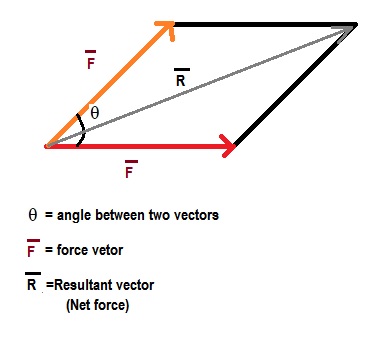
In order to calculate the resultant net force, when two vectors are acting on an object at certain angles between them; we have to use the parallelogram law of vectors.
That is, if two forces are acting simultaneously on an object are represented in direction and magnitude by using two adjacent sides of the parallelogram, while the resultant force can be represented in direction and magnitude as the diagonal of the parallelogram.
As two applied forces are equal,
The resultant net force vector is given by,
\(\bar{R}=\sqrt{\bar{F}+\bar{F}+2 \overline{F F} \cos \theta}\)
Where \(\bar{R}\) is the resultant net force, \(\bar{F}\) is the applied force, \(\theta\) is the angle between the two applied forces.
Subscribe to view the
full solution
full solution
Title
Conceptual Physics 11
Author
Paul G. Hewitt
ISBN
9780321568090
Answer: As seen from above, a stubborn stump is pulled by
Chapter 5 textbook questions
-
Chapter : Problem 1 Conceptual Physics 11
-
Chapter : Problem 1 Conceptual Physics 11
Problem 1P A boxer punches a sheet of paper in midair and brings it from rest up to a speed of 25 m/s in 0.05 s. (a) What acceleration is imparted to the paper? (b) If the mass of the paper is 0.003 kg, what force does the boxer exert on it? (c) How much force does the paper exert on the boxer?
Read more -
Chapter : Problem 1 Conceptual Physics 11
As seen from above, a stubborn stump is pulled by a pair of ropes, each with a force of 200 N, but at different angles as shown. From greatest to least, rank the net force on the stump.
Read more -
Chapter : Problem 1 Conceptual Physics 11
Problem 1PC Calculate the resultant of the pair of velocities 100 km/h north and 75 km/h south. Calculate the resultant if both of the velocities are directed north.
Read more -
Chapter : Problem 1 Conceptual Physics 11
Problem 1RQ When you push against a wall with your fingers, they bend because they experience a force. Identify this force.
Read more -
Chapter : Problem 2 Conceptual Physics 11
Problem 2E The photo shows Steve Hewitt and daughter Gretchen. Is Gretchen touching her dad, or is dad touching her? Explain.
Read more -
Chapter : Problem 2 Conceptual Physics 11
Problem 2P If you stand next to a wall on a frictionless skateboard and push the wall with a force of 40 N, how hard does the wall push on you? If your mass is 80 kg, show that your acceleration is 0.5 m/s2.
Read more -
Chapter : Problem 2 Conceptual Physics 11
Problem 2PC Calculate the magnitude of the resultant of a pair of 100-km/h velocity vectors that are at right angles to each other.
Read more -
Chapter : Problem 2 Conceptual Physics 11
Nellie Newton hangs motionless by one hand from a clothesline. Which side of the line, a or b, has the greater a. horizontal component of tension? b. vertical component of tension? c. tension?
Read more -
Chapter : Problem 2 Conceptual Physics 11
Problem 2RQ A boxer can hit a heavy bag with great force. Why can’t he hit a piece of tissue paper in midair with the same amount of force?
Read more -
Chapter : Problem 3 Conceptual Physics 11
When you rub your hands together, can you push harder on one hand than the other?
Read more -
Chapter : Problem 3 Conceptual Physics 11
Problem 3P If raindrops fall vertically at a speed of 3 m/s and you are running at 4 m/s, how fast do they hit your face?
Read more -
Chapter : Problem 3 Conceptual Physics 11
Problem 3PC Calculate the resultant of a horizontal vector with a magnitude of 4 units and a vertical vector with a magnitude of 3 units.
Read more -
Chapter : Problem 3 Conceptual Physics 11
Problem 3R Here we see a top view of an airplane being blown off course by wind in three different directions. Use a pencil and the parallelogram rule and sketch the vectors that show the resulting velocities for each case. Rank the speeds of the airplane across the ground from fastest to slowest.
Read more -
Chapter : Problem 3 Conceptual Physics 11
Problem 3RQ How many forces are required for an interaction?
Read more -
Chapter : Problem 4 Conceptual Physics 11
For each of the following interactions, identify action and reaction forces. (a) A hammer hits a nail. (b) Earth gravity pulls down on a book. (c) A helicopter blade pushes air downward.
Read more -
Chapter : Problem 4 Conceptual Physics 11
Problem 4P Forces of 3.0 N and 4.0 N act at right angles on a block of mass 2.0 kg. Show that the acceleration of the block is 2.5 m/s2.
Read more -
Chapter : Problem 4 Conceptual Physics 11
Calculate the resultant velocity of an airplane that normally flies at 200 km/h if it encounters a 50-km/h wind from the side (at a right angle to the airplane).
Read more -
Chapter : Problem 4 Conceptual Physics 11
Problem 4R Here we see top views of three motorboats crossing a river. All have the same speed relative to the water, and all experience the same river flow. Construct resultant vectors showing the speed and direction of the boats. Rank them from most to least for a. the time for the boats to reach the opposite shore. ________________ b. the fastest ride.
Read more -
-
Chapter : Problem 5 Conceptual Physics 11
Problem 5E You hold an apple over your head. (a) Identify all the forces acting on the apple and their reaction forces. (b) When you drop the apple, identify all the forces acting on it as it falls and the corresponding reaction forces. Neglect air drag.
Read more -
Chapter : Problem 5 Conceptual Physics 11
Problem 5P Consider an airplane that normally has an airspeed of 100 km/h in a 100-km/h crosswind blowing from west to east. Calculate its ground velocity when its nose is pointed north in the crosswind.
Read more -
Chapter : Problem 5 Conceptual Physics 11
Consider hitting a baseball with a bat. If we call the force on the bat against the ball the action force, identify the reaction force.
Read more -
Chapter : Problem 6 Conceptual Physics 11
Problem 6E Identify the action–reaction pairs of forces for the following situations: (a) You step off a curb. (b) You pat your tutor on the back. (c) A wave hits a rocky shore.
Read more -
Chapter : Problem 6 Conceptual Physics 11
You are paddling a canoe at a speed of 4 km/h directly across a river that flows at 3 km/h, as shown in the figure. (a) What is your resultant speed relative to the shore? (b) In approximately what direction should you paddle the canoe so that it reaches a destination directly across the river?
Read more -
Chapter : Problem 6 Conceptual Physics 11
Problem 6RQ Consider the apple and the orange (Figure 5.9). If the system is considered to be only the orange, is there a net force on the system when the apple pulls?
Read more -
Chapter : Problem 7 Conceptual Physics 11
Problem 7E Consider a baseball player batting a ball. (a) Identify the action–reaction pairs when the ball is being hit and (b) while the ball is in flight.
Read more -
Chapter : Problem 7 Conceptual Physics 11
Problem 7P When two identical air pucks with repelling magnets are held together on an air table and released, they end up moving in opposite directions at the same speed, v. Assume the mass of one of the pucks is doubled and the procedure is repeated. a. From Newton’s third law, derive an equation that shows how the final speed of the double-mass puck compares with the speed of the single puck. ________________ b. Calculate the speed of the double-mass puck if the single puck moves away at 0.4 m/s.
Read more -
Chapter : Problem 7 Conceptual Physics 11
Problem 7RQ If the system is considered to be the apple and the orange together (Figure 5.10), is there a net force on the system when the apple pulls (ignoring friction with the floor)?
Read more -
Chapter : Problem 8 Conceptual Physics 11
What physics is involved for a passenger feeling pushed backward into the seat of an airplane when it accelerates along the runway during takeoff?
Read more -
Chapter : Problem 8 Conceptual Physics 11
Problem 8RQ To produce a net force on a system, must there be an externally applied net force?
Read more -
Chapter : Problem 9 Conceptual Physics 11
Problem 9E If you drop a rubber ball on the floor, it bounces back up. What force acts on the ball to provide the bounce?
Read more -
Chapter : Problem 9 Conceptual Physics 11
Consider the system of a single football. If you kick it, is there a net force to accelerate the system? If a friend kicks it at the same time with an equal and opposite force, is there a net force to accelerate the system?
Read more -
Chapter : Problem 10 Conceptual Physics 11
When you kick a football, what action and reaction forces are involved? Which force, if any, is greater?
Read more -
Chapter : Problem 10 Conceptual Physics 11
Problem 10RQ Earth pulls down on you with a gravitational force that you call your weight. Do you pull up on Earth with the same amount of force?
Read more -
Chapter : Problem 11 Conceptual Physics 11
Problem 11E Is it true that when you drop from a branch to the ground below, you pull upward on Earth? If so, then why is the acceleration of Earth not noticed?
Read more -
Chapter : Problem 11 Conceptual Physics 11
If the forces that act on a cannonball and the recoiling cannon from which it is fired are equal in magnitude, why do the cannonball and cannon have very different accelerations?
Read more -
Chapter : Problem 12 Conceptual Physics 11
Problem 12E Within a book on a table, there are billions of forces pushing and pulling on all the molecules. Why is it that these forces never by chance add up to a net force in one direction, causing the book to accelerate “spontaneously” across the table?
Read more -
Chapter : Problem 12 Conceptual Physics 11
Problem 12RQ Identify the force that propels a rocket.
Read more -
Chapter : Problem 13 Conceptual Physics 11
Two 100-N weights are attached to a spring scale as shown. Does the scale read 0, 100, or 200 N, or does it give some other reading? (Hint: Would it read any differently if one of the ropes were tied to the wall instead of to the hanging 100-N weight?)
Read more -
Chapter : Problem 13 Conceptual Physics 11
Problem 13RQ How does a helicopter get its lifting force?
Read more -
Chapter : Problem 14 Conceptual Physics 11
Problem 14E If you exert a horizontal force of 200 N to slide a crate across a factory floor at constant velocity, how much friction is exerted by the floor on the crate? Is the force of friction equal and oppositely directed to your 200-N push? If the force of friction isn’t the reaction force to your push, what is?
Read more -
Chapter : Problem 14 Conceptual Physics 11
Can you physically touch a person without that person touching you with the same amount of force?
Read more -
Chapter : Problem 15 Conceptual Physics 11
Problem 15E When the athlete holds the barbell overhead, the reaction force is the weight of the barbell on his hand. How does this force vary for the case in which the barbell is accelerated upward? Downward? Step-by-step solution
Read more -
Chapter : Problem 15 Conceptual Physics 11
Fill in the blanks: Newton’s first law is often called the law of _____; Newton’s second law is the law of _____; and Newton’s third law is the law of _____ and _____.
Read more -
Chapter : Problem 16 Conceptual Physics 11
Problem 16E Consider the two forces acting on the person who stands still—namely, the downward pull of gravity and the upward support of the floor. Are these forces equal and opposite? Do they form an action–reaction pair? Why or why not?
Read more -
Chapter : Problem 16 Conceptual Physics 11
Problem 16RQ Which of the three laws deals with interactions?
Read more -
Chapter : Problem 17 Conceptual Physics 11
Problem 17E Why can you exert greater force on the pedals of a bicycle if you pull up on the handlebars?
Read more -
Chapter : Problem 17 Conceptual Physics 11
Cite three examples of a vector quantity and three examples of a scalar quantity.
Read more -
Chapter : Problem 18 Conceptual Physics 11
Does a baseball bat slow down when it hits a ball? Defend your answer.
Read more -
Chapter : Problem 18 Conceptual Physics 11
Problem 18RQ Why is speed considered a scalar and velocity a vector?
Read more -
Chapter : Problem 19 Conceptual Physics 11
Why does a rope climber pull downward on the rope to move upward?
Read more -
Chapter : Problem 19 Conceptual Physics 11
Problem 19RQ According to the parallelogram rule, what quantity is represented by the diagonal of a constructed parallelogram?
Read more -
Chapter : Problem 20 Conceptual Physics 11
Problem 20E A farmer urges his horse to pull a wagon. The horse refuses, saying that to try would be futile, for it would flout Newton’s third law. The horse concludes that she can’t exert a greater force on the wagon than the wagon exerts on her and, therefore, that she won’t be able to accelerate the wagon. What is your explanation to convince the horse to pull?
Read more -
Chapter : Problem 20 Conceptual Physics 11
Consider Nellie hanging at rest in Figure 5.25. If the ropes were vertical, with no angle involved, what would be the tension in each rope?
Read more -
Chapter : Problem 21 Conceptual Physics 11
You push a heavy car by hand. The car, in turn, pushes back with an opposite but equal force on you. Doesn’t this mean that the forces cancel one another, making acceleration impossible? Why or why not?
Read more -
Chapter : Problem 21 Conceptual Physics 11
Problem 21RQ When Nellie’s ropes make an angle, what quantity must be equal and opposite to her weight?
Read more -
Chapter : Problem 22 Conceptual Physics 11
The strong man will push the two initially stationary freight cars of equal mass apart before he himself drops straight to the ground. Is it possible for him to give either of the cars a greater speed than the other? Why or why not?
Read more -
Chapter : Problem 22 Conceptual Physics 11
When a pair of vectors are at right angles, is the resultant always greater in magnitude than either of the vectors separately?
Read more -
Chapter : Problem 23 Conceptual Physics 11
Problem 23E Suppose that two carts, one twice as massive as the other, fly apart when the compressed spring that joins them is released. What is the acceleration of the heavier cart relative to that of the lighter cart as they start to move apart?
Read more -
Chapter : Problem 24 Conceptual Physics 11
If a Mack truck and Honda Civic have a head-on collision, upon which vehicle is the impact force greater? Which vehicle experiences the greater deceleration? Explain your answers.
Read more -
Chapter : Problem 25 Conceptual Physics 11
Problem 25E Ken and Joanne are astronauts floating some distance apart in space. They are joined by a safety cord whose ends are tied around their waists. If Ken starts pulling on the cord, will he pull Joanne toward him, or will he pull himself toward Joanne, or will both astronauts move? Explain.
Read more -
Chapter : Problem 26 Conceptual Physics 11
Which team wins in a tug-of-war—the team that pulls harder on the rope, or the team that pushes harder against the ground? Explain.
Read more -
Chapter : Problem 27 Conceptual Physics 11
Problem 27E In a tug-of-war between Sam and Maddy, each pulls on the rope with a force of 250 N. What is the tension in the rope? If both remain motionless, what horizontal force does each exert against the ground?
Read more -
Chapter : Problem 28 Conceptual Physics 11
Problem 28E Your instructor challenges you and your friend to each pull on a pair of scales attached to the ends of a horizontal rope, in tug-of-war fashion, so that the readings on the scales will differ. Can this be done? Explain.
Read more -
Chapter : Problem 29 Conceptual Physics 11
Problem 29E Two people of equal mass attempt a tug-of-war with a 12-m rope while standing on frictionless ice. When they pull on the rope, each of them slides toward the other. How do their accelerations compare, and how far does each person slide before they meet?
Read more -
Chapter : Problem 30 Conceptual Physics 11
Problem 30E What aspect of physics was not known by the writer of this newspaper editorial that ridiculed early experiments by Robert H. Goddard on rocket propulsion above Earth’s atmosphere? “Professor Goddard … does not know the relation of action to reaction, and of the need to have something better than a vacuum against which to react … he seems to lack the knowledge ladled out daily in high schools.”
Read more -
Chapter : Problem 31 Conceptual Physics 11
Problem 31E Which of the following are scalar quantities, which are vector quantities, and which are neither? (a) velocity; (b) age; (c) speed; (d) acceleration; (e) temperature.
Read more -
Chapter : Problem 32 Conceptual Physics 11
Problem 32E What can you correctly say about two vectors that add together to equal zero?
Read more -
Chapter : Problem 33 Conceptual Physics 11
Problem 33E Can a pair of vectors with unequal magnitudes ever add to zero? Can three unequal vectors add to zero? Defend your answers.
Read more -
Chapter : Problem 34 Conceptual Physics 11
Problem 34E When can a nonzero vector have a zero horizontal component?
Read more -
Chapter : Problem 35 Conceptual Physics 11
Problem 35E When, if ever, can a vector quantity be added to a scalar quantity?
Read more -
Chapter : Problem 36 Conceptual Physics 11
Problem 36E Which is more likely to break—a hammock stretched tightly between a pair of trees or one that sags more when you sit on it?
Read more -
Chapter : Problem 37 Conceptual Physics 11
Problem 37E A heavy bird sits on a clothesline. Will the tension in the clothesline be greater if the line sags a lot or if it sags a little?
Read more -
Chapter : Problem 38 Conceptual Physics 11
The rope supports a lantern that weighs 50 N. Is the tension in the rope less than, equal to, or more than 50 N? Use the parallelogram rule to defend your answer.
Read more -
Chapter : Problem 39 Conceptual Physics 11
Problem 39E The rope is repositioned as shown and still supports the 50-N lantern. Is the tension in the rope less than, equal to, or more than 50 N? Use the parallelogram rule to defend your answer.
Read more -
Chapter : Problem 40 Conceptual Physics 11
Problem 40E Why does vertically falling rain make slanted streaks on the side windows of a moving automobile? If the streaks make an angle of 45°, what does this tell you about the relative speed of the car and the falling rain?
Read more -
Chapter : Problem 41 Conceptual Physics 11
A balloon floats motionless in the air. A balloonist begins climbing the supporting cable. In which direction does the balloon move as the balloonist climbs? Defend your answer.
Read more -
Chapter : Problem 42 Conceptual Physics 11
Consider a stone at rest on the ground. There are two interactions that involve the stone. One is between the stone and Earth as a whole: Earth pulls down on the stone (its weight) and the stone pulls up on Earth. What is the other interaction?
Read more -
Chapter : Problem 43 Conceptual Physics 11
Problem 43E A stone is shown at rest on the ground. (a) The vector shows the weight of the stone. Complete the vector diagram showing another vector that results in zero net force on the stone. (b) What is the conventional name of the vector you have drawn?
Read more -
Chapter : Problem 44 Conceptual Physics 11
Problem 44E Here a stone is suspended at rest by a string. (a) Draw force vectors for all the forces that act on the stone. (b) Should your vectors have a zero resultant? (c) Why or why not?
Read more -
Chapter : Problem 45 Conceptual Physics 11
Here the same stone is being accelerated vertically upward. (a) Draw force vectors to some suitable scale showing relative forces acting on the stone. (b) Which is the longer vector, and why?
Read more -
Chapter : Problem 46 Conceptual Physics 11
Suppose the string in the exercise 1 breaks and the stone slows in its upward motion. Draw a force vector diagram of the stone when it reaches the top of its path.
Read more -
Chapter : Problem 47 Conceptual Physics 11
What is the acceleration of the stone of Exercise 1 at the top of its path?
Read more -
Chapter : Problem 48 Conceptual Physics 11
Here the stone is sliding down a friction-free incline. (a) Identify the forces that act on it, and draw appropriate force vectors. (b) By the parallelogram rule, construct the resultant force on the stone (carefully showing that it has a direction parallel to the incline—the same direction as the stone's acceleration).
Read more -
Chapter : Problem 49 Conceptual Physics 11
Problem 49E Here the stone is at rest, interacting with both the surface of the incline and the block. (a) Identity all the forces that act on the stone, and draw appropriate force vectors. (b) Show that the net force on the stone is zero. (Hint 1: There are two normal forces on the stone. Hint 2: Be sure the vectors you draw are for forces that act on the stone, not by the stone on the surfaces.)
Read more -
Chapter : Problem 50 Conceptual Physics 11
Problem 50E The strong man can withstand the tension force exerted by the two horses pulling in opposite directions. How would the tension compare if only one horse pulled and the left rope were tied to a tree? How would the tension compare if the two horses pulled in the same direction, with the left rope tied to the tree?
Read more