
What product or products are obtained when d-galactose reacts with each of the following substances? a. nitric acid + \(\Delta\) b. \(\mathrm{Ag}^{+},\ \mathrm{NH}_{3},\ \mathrm{HO}^{-}\) c. \(\mathrm{NaBH}_{4}\), followed by \(\mathrm{H}_{3} \mathrm{O}^{+}\) d. excess \(\mathrm{CH}_{3} \mathrm{I}+\mathrm{Ag}_{2} \mathrm{O}\) e. \(\mathrm{Br}_{2}\) in water f. ethanol + HCl g. 1. hydroxylamine/trace acid 2. acetic anhydride/\(\Delta\) 3. \(\mathrm{HO}^{-} / \mathrm{H}_{2} \mathrm{O}\)
Read moreTable of Contents
1
Remembering General Chemistry: Electronic Structure and Bonding
2
Acids and Bases: Central to Understanding Organic Chemistry
2.T
3
An Introduction to Organic Compounds: Nomenclature, Physical Properties, and Representation of Structure
4
Isomers: The Arrangement of Atoms in Space
5
Alkenes: Structure, Nomenclature, and an Introduction to Reactivity • Thermodynamics and Kinetics
6
The Reactions of Alkenes • The Stereochemistry of Addition Reactions
7
The Reactions of Alkynes
8
Delocalized Electrons and Their Effect on Stability, pKa, and the Products of a Reaction
9
Substitution Reactions of Alkyl Halides
10
Elimination Reactions of Alkyl Halides • Competition Between Substitution and Elimination
11
Reactions of Alcohols, Ethers, Epoxides, Amines, and Thiols
12
Organometallic Compounds
13
Radicals • Reactions of Alkanes
14
Mass Spectrometry, Infrared Spectroscopy, and Ultraviolet/Visible Spectroscopy
15
NMR Spectroscopy
16
Reactions of Carboxylic Acids and Carboxylic Derivatives
17
Reactions of Aldehydes and Ketones • More Reactions of Carboxylic Acid Derivatives • Reactions of A,B -Unsaturated Carbonyl Compounds
18
Reactions at the A- Carbon of Carbonyl Compounds
19
Reactions of Benzene and Substituted Benzenes
19.T
20
More About Amines • Reactions of Heterocyclic Compounds
21
The Organic Chemistry of Carbohydrates
22
The Organic Chemistry of Amino Acids, Peptides, and Proteins
23
Catalysis in Organic Reactions and in Enzymatic Reactions
24
The Organic Chemistry of the Coenzymes, Compounds Derived from Vitamins
25
The Organic Chemistry of the Metabolic Pathways • Terpene Biosynthesis
26
The Chemistry of the Nucleic Acids
27
Synthetic Polymers
28
Pericyclic Reactions
Textbook Solutions for Organic Chemistry
Chapter 21 Problem 46P
Question
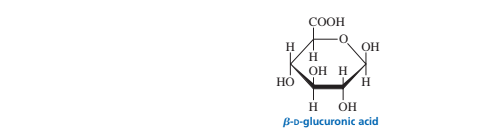
?-Glucuronic acid is found widely in plants and animals. One of its functions is to detoxify poisonous HO-containing compounds by reacting with them in the liver to form glucuronides. Glucuronides are water soluble and therefore readily excreted. After ingestion of a
poison such as turpentine or phenol, the glucuronides of these compounds are found in the urine. Draw the structure of the glucuronide formed by the reaction of \(\beta\)-?-glucuronic acid and phenol.
Solution
Solution 46P
Subscribe to view the
full solution
full solution
Title
Organic Chemistry 7
Author
Paula Yurkanis Bruice
ISBN
9781269406772
D-Glucuronic acid is found widely in plants and animals.
Chapter 21 textbook questions
-
Chapter 21: Problem 31 Organic Chemistry 7
-
-
Chapter 21: Problem 33 Organic Chemistry 7
Identify the sugar in each description. a. An aldopentose that is not d -arabinose forms d -arabinitol when it is reduced with NaBH 4 . b. A sugar that is not d -altrose forms d -altraric acid when it is oxidized with nitric acid. c. A ketose that, when reduced with NaBH 4 , forms d -altritol and d -allitol
Read more -
Chapter 21: Problem 34 Organic Chemistry 7
d -Xylose and d -lyxose are formed when d -threose undergoes a KilianiFischer synthesis. d -Xylose is oxidized to an optically inactive aldaric acid, whereas d -lyxose forms an optically active aldaric acid. What are the structures of d -xylose and d -lyxose?
Read more -
Chapter 21: Problem 35 Organic Chemistry 7
. Answer the following questions about the eight aldopentoses. a. Which are enantiomers? b. Which are C-2 epimers? c. Which form an optically active compound when oxidized with nitric acid?
Read more -
Chapter 21: Problem 36 Organic Chemistry 7
What is the coni guration of each of the asymmetric centers in the Fischer projection of a. d -glucose? b. d -galactose? c. d -ribose? d. d -xylose? e. d -sorbose?
Read more -
Chapter 21: Problem 37 Organic Chemistry 7
The reaction of d -ribose with one equivalent of methanol plus HCl forms four products. Draw the products
Read more -
-
Chapter 21: Problem 39 Organic Chemistry 7
A student isolated a monosaccharide and determined that it had a molecular weight of 150. Much to his surprise, he found that it was not optically active. What is the structure of the monosaccharide?
Read more -
Chapter 21: Problem 40 Organic Chemistry 7
Propose a mechanism for the formation of d -allose from d -glucose in a basic solution.
Read more -
Chapter 21: Problem 41 Organic Chemistry 7
Treatment with sodium borohydride converts aldose A into an optically inactive alditol. Wohl degradation of A forms B, whose alditol is optically inactive. Wohl degradation of B forms d -glyceraldehyde. Identify A and B.
Read more -
Chapter 21: Problem 42 Organic Chemistry 7
Treatment with sodium borohydride converts aldose A into an optically inactive alditol. Wohl degradation of A forms B, whose alditol is optically inactive. Wohl degradation of B forms d -glyceraldehyde. Identify A and B.
Read more -
Chapter 21: Problem 43 Organic Chemistry 7
Draw the mechanism for the interconversion of a - d -glucose and b - d -glucose in dilute HCl.
Read more -
Chapter 21: Problem 44 Organic Chemistry 7
An unknown b -d-aldohexose has only one axial substituent. A Wohl degradation forms a compound which, when treated with sodium borohydride, forms an optically active alditol. This information allows you to arrive at two possible structures for the b -d-aldohexose. What experiment can you carry out to distinguish between the two possibilities?
Read more -
Chapter 21: Problem 45 Organic Chemistry 7
The 1 H NMR spectrum of d -glucose in D 2 O exhibits two high-frequency doublets. What is responsible for these doublets?
Read more -
Chapter 21: Problem 46 Organic Chemistry 7
d -Glucuronic acid is found widely in plants and animals. One of its functions is to detoxify poisonous HO-containing compounds by reacting with them in the liver to form glucuronides. Glucuronides are water soluble and therefore readily excreted. After ingestion of a poison such as turpentine or phenol, the glucuronides of these compounds are found in the urine. Draw the structure of the glucuronide formed by the reaction of b - d -glucuronic acid and pheno
Read more -
Chapter 21: Problem 47 Organic Chemistry 7
Determine the structure of d -galactose, using arguments similar to those used by Fischer to prove the structure of d -glucose.
Read more -
Chapter 21: Problem 48 Organic Chemistry 7
A d -aldopentose is oxidized by nitric acid to an optically active aldaric acid. A Wohl degradation of the aldopentose leads to a monosaccharide that is oxidized by nitric acid to an optically inactive aldaric acid. Identify the d -aldopentose.
Read more -
Chapter 21: Problem 49 Organic Chemistry 7
Draw the mechanism for the formation of b -maltose from a - d -galactose and b - d -glucose in dilute HCl.
Read more -
Chapter 21: Problem 50 Organic Chemistry 7
Hyaluronic acid, a component of connective tissue, is the l uid that lubricates the joints. It is a polymer of alternating N -acetyld -glucosamine and d -glucuronic acid subunits joined by b@1,3 -glycosidic linkages. Draw a short segment of hyaluronic acid.
Read more -
Chapter 21: Problem 51 Organic Chemistry 7
In order to synthesize d -galactose, a student went to the stockroom to get some d -lyxose to use as a starting material. She found that the labels had fallen off the bottles containing d -lyxose and d -xylose. How could she determine which bottle contains d -lyxose?
Read more -
Chapter 21: Problem 52 Organic Chemistry 7
The aldonic acid of d -glucose forms a i ve-membered ring lactone. Draw its structure.
Read more -
Chapter 21: Problem 53 Organic Chemistry 7
The aldaric acid of d -glucose forms two i ve-membered ring lactones. Draw their structures.
Read more -
Chapter 21: Problem 54 Organic Chemistry 7
Draw the mechanism for the acid-catalyzed hydrolysis of b -maltose.
Read more -
Chapter 21: Problem 55 Organic Chemistry 7
How many aldaric acids are obtained from the 16 aldohexoses?
Read more -
Chapter 21: Problem 56 Organic Chemistry 7
A hexose is obtained when the residue of a shrub Sterculia setigeria undergoes acid-catalyzed hydrolysis. Identify the hexose from the following experimental information: it undergoes mutarotation; it does not react with Br 2 ; and d -galactonic acid and d -talonic acid are formed when it reacts with Tollens reagent.
Read more -
Chapter 21: Problem 57 Organic Chemistry 7
A hexose is obtained when the residue of a shrub Sterculia setigeria undergoes acid-catalyzed hydrolysis. Identify the hexose from the following experimental information: it undergoes mutarotation; it does not react with Br 2 ; and d -galactonic acid and d -talonic acid are formed when it reacts with Tollens reagent.
Read more -
Chapter 21: Problem 58 Organic Chemistry 7
Draw each of the following compounds: a. b - d -talopyranose b. a - d -idopyranose c. a - d -tagatopyranose d. b - d -psicofuranose e. b - l -talopyranose f. a - l -tagatopyranose
Read more -
Chapter 21: Problem 59 Organic Chemistry 7
Calculate the percentages of a - d -glucose and b - d -glucose present at equilibrium from the specii c rotations of a - d -glucose, b - d -glucose, and the equilibrium mixture. Compare your values with those given in Section 21.10 . ( Hint: The specii c rotation of the mixture equals the specii c rotation of a - d -glucose times the fraction of glucose present in the a -form plus the specii c rotation of b - d -glucose times the fraction of glucose present in the b -form.)
Read more -
Chapter 21: Problem 60 Organic Chemistry 7
The specii c rotation of a - d -galactose is 150.7 and that of b - d -galactose is 52.8. When an aqueous mixture that was initially 70% a - d -galactose and 30% b - d -galactose reaches equilibrium, the specii c rotation is 80.2. What is the concentration of the anomers at equilibrium?
Read more -
Chapter 21: Problem 61 Organic Chemistry 7
An unknown disaccharide gives a positive Tollens test. A glycosidase hydrolyzes it to d -galactose and d -mannose. When the disaccharide is treated with methyl iodide and Ag 2 O and then hydrolyzed with dilute HCl, the products are 2,3,4,6-tetra- O -methylgalactose and 2,3,4-tri- O -methylmannose. Propose a structure for the disaccharide.
Read more -
Chapter 21: Problem 62 Organic Chemistry 7
Predict whether d -altrose exists preferentially as a pyranose or a furanose. ( Hint: In the most stable arrangement for a i ve-membered ring, all the adjacent substituents are trans.)
Read more -
Chapter 21: Problem 63 Organic Chemistry 7
Trehalose, C 12 H 22 O 11 , is a nonreducing sugar that is only 45% as sweet as sugar. When hydrolyzed by aqueous acid or the enzyme maltase, it forms only d -glucose. When it is treated with excess methyl iodide in the presence of Ag 2 O and then hydrolyzed with water under acidic conditions, only 2,3,4,6-tetra- O -methyl- d -glucose is formed. Draw the structure of trehalose.
Read more -
Chapter 21: Problem 64 Organic Chemistry 7
Propose a mechanism for the rearrangement that converts an a -hydroxyimine into an a -aminoketone in the presence of a trace amount of acid (page 1027) .
Read more -
Chapter 21: Problem 65 Organic Chemistry 7
All the glucose units in dextran have six-membered rings. When a sample of dextran is treated with methyl iodide and Ag 2 O and the product is hydrolyzed under acidic conditions, the i nal products are 2,3,4,6-tetra- O -methyl- d -glucose, 2,4,6-tri- O -methyl- d -glucose, 2,3,4-tri- O -methyl- d -glucose, and 2,4-di- O -methyl- d -glucose. Draw a short segment of dextran.
Read more -
Chapter 21: Problem 66 Organic Chemistry 7
When a pyranose is in the chair conformation in which the CH 2 OH group and the C-1 OH group are both in axial positions, the two groups can react to form an acetal. This is called the anhydro form of the sugar (it has lost water). The anhydro form of d -idose is shown here. Explain why about 80% of d -idose exists in the anhydro form in an aqueous solution at 100 ?C , but only about 0.1% of d -glucose exists in the anhydro form under the same conditions.
Read more -
-
Chapter : Problem 2 Organic Chemistry 7
Problem 2P Draw Fischer projections of L-glucose and L-fructose.
Read more -
Chapter : Problem 3 Organic Chemistry 7
Indicate whether each of the following structures is ?-glyceraldehyde or ?-glyceraldehyde, assuming that the horizontal bonds point toward you and the vertical bonds point away from you (Section 4.6)
Read more -
Chapter : Problem 4 Organic Chemistry 7
a. Are D-erythrose and L-erythrose enantiomers or diastereomers? b. Are L-erythrose and L-threose enantiomers or diastereomers?
Read more -
Chapter : Problem 5 Organic Chemistry 7
Problem 5P a. What sugar is the C-3 epimer of D-xylose? b. What sugar is the C-5 epimer of D-allose? c. What sugar is the C-4 epimer of L-gulose? d. What sugar is the C-4 epimer of D-lyxose?
Read more -
Chapter : Problem 6 Organic Chemistry 7
Problem 6P What are the systematic names of the following compounds? Indicate the configuration (R or S)of each asymmetric center. a. D-glucose b. D-mannose c. D-galactose d. L-glucose
Read more -
Chapter : Problem 7 Organic Chemistry 7
Problem 7P What sugar is the C-3 epimer of D-fructose?
Read more -
Chapter : Problem 8 Organic Chemistry 7
Problem 8P How many stereoisomers are possible for a. a ketoheptose? b. an aldoheptose? c. a ketotriose?
Read more -
Chapter : Problem 9 Organic Chemistry 7
Problem 9P Show how an enediol rearrangement can move the carbonyl carbon of fructose fromC-2 to C-3.
Read more -
Chapter : Problem 10 Organic Chemistry 7
Problem 10P Write the mechanism for the base-catalyzed conversion of D-fructose into D-glucose and D-mannose.
Read more -
Chapter : Problem 11 Organic Chemistry 7
Problem 11P When D-tagatose is added to a basic aqueous solution, an equilibrium mixture of monosaccharides is obtained, two of which are aldohexoses and two of which are ketohexoses. Identify the aldohexoses and ketohexoses.
Read more -
Chapter : Problem 12 Organic Chemistry 7
Problem 12P What products are obtained from the reduction of a. D-idose? ________________ b. D-sorbose?
Read more -
Chapter : Problem 13 Organic Chemistry 7
Problem 13P a. What other monosaccharide is reduced only to the alditol obtained from the reduction of 1. D-talose? 2. D-glucose? 3. D-galactose? b. What monosaccharide is reduced to two alditols, one of which is the alditol obtained from the reduction of 1. D-talose? 2. D-allose?
Read more -
Chapter : Problem 14 Organic Chemistry 7
Problem 14P a. Name an aldohexose other than D-glucose that is oxidized to D-glucaric acid by nitric acid. ________________ b. What is another name for D-glucaric acid? ________________ c. Name another pair of aldohexoses that are oxidized to identical aldaric acids.
Read more -
Chapter : Problem 15 Organic Chemistry 7
Problem 15P What monosaccharides would be formed in a Kiliani-Fischer synthesis starting with each of these compounds? a. D-xylose b. L-threose
Read more -
Chapter : Problem 16 Organic Chemistry 7
Problem 16P What two monosaccharides can be degraded to a. D-ribose? b. D-arabinose? c. L-ribose?
Read more -
Chapter : Problem 18 Organic Chemistry 7
Problem 18P Identify A, B, C, and D in the preceding problem if D is oxidized to an optically inactive aldaricacid; if A, B, and C are oxidized to optically active aldaric acids; and if interchanging thealdehyde and alcohol groups of A leads to a different sugar.
Read more -
Chapter : Problem 19 Organic Chemistry 7
Problem 19P 4-Hydroxy- and 5-hydroxyaldehydes exist primarily as cyclic hemiacetals. Draw the structure of the cyclic hemiacetal formed by each of the following: a. 4-hydroxybutanal b. 4-hydroxypentanal c. 5-hydroxypentanal d. 4-hydroxyheptanal
Read more -
Chapter : Problem 20 Organic Chemistry 7
Problem 20P Draw the following sugars using Haworth projections: a. ?-D-galactopyranose b. ?-D-tagatopyranose c. ?-L-glucopyranose
Read more -
Chapter : Problem 21 Organic Chemistry 7
Problem 21P D-Glucose most often exists as a pyranose, but it can also exist as a furanose. Draw the Haworth projection of ?-D-glucofuranose.
Read more -
Chapter : Problem 22 Organic Chemistry 7
Problem 22P Draw the anomers of D-erythrofuranose.
Read more -
Chapter : Problem 23 Organic Chemistry 7
Problem 23P Which OH groups are in the axial position in a. ?-D-mannopyranose? ________________ b. ?-D-idopyranose? ________________ c. ?-D-aliopyranose?
Read more -
Chapter : Problem 24 Organic Chemistry 7
Problem 24P Draw the products formed when ?-D-galactose reacts with ethanol and HCl.
Read more -
Chapter : Problem 25 Organic Chemistry 7
Problem 25P Why is only a trace amount of acid used in the formation of an N-glycoside?
Read more -
Chapter : Problem 26 Organic Chemistry 7
Name the following compounds and indicate whether each is a reducing sugar or a nonreducing sugar: Solution to \(26a\) The only OH group in an axial position in part a is the one at \(C-3\). Therefore, this sugar is the \(C-3\) epimer of ?- glucose, which is ?- allose. The substituent at the anomeric carbon is in the \(\beta\)-position. Thus, the sugar’s name is propyl \(\beta\)-?- alloside or propyl \(\beta\)-?-allopyranoside. Because the sugar is an acetal, it is a nonreducing sugar. Equation Transcription: Text Transcription: 26a C-3 beta
Read more -
Chapter : Problem 27 Organic Chemistry 7
Problem 27P What is the specific rotation of an equilibrium mixture of fructose? (Hint : The specific rotation of an equilibrium mixture of glucose is +52.7.)
Read more -
Chapter : Problem 28 Organic Chemistry 7
Problem 28P What is the main structural difference between a. amylose and cellulose? ________________ b. amylose and amylopectin? ________________ c. amylopectin and glycogen? ________________ d. cellulose and chitin?
Read more -
Chapter : Problem 29 Organic Chemistry 7
Problem 29P Explain why the C-3 OH group of vitamin C is more acidic than the C-2 OH group.
Read more -
Chapter : Problem 30 Organic Chemistry 7
Refer to Figure \(21.5\) to answer the following questions: a. People with type O blood can donate blood to anyone, but they cannot receive blood from everyone. From whom can they not receive blood? b. People with type AB blood can receive blood from anyone, but they cannot give blood to everyone. To whom can they not give blood? Equation Transcription: Text Transcription: 21.5
Read more -
Chapter : Problem 31 Organic Chemistry 7
What product or products are obtained when d -galactose reacts with each of the following substances? a. nitric acid + \(\Delta\) d. excess \(\mathrm{CH}_{3} \mathrm{I}+\mathrm{Ag}_{2} \mathrm{O}\) g. 1. hydroxylamine/trace acid b. \(\mathrm{Ag}^{+}, \mathrm{NH}_{3}, \mathrm{HO}\) e. \(\mathrm{Br}_{2}\) in water 2. acetic anhydride/\(\Delta\) c. \(\mathrm{NaBH}_{4}\), followed by \(\mathrm{H}_{3} \mathrm{O}^{+}\) f. ethanol + HCl 3. \(\mathrm{HO}^{-} / \mathrm{H}_{2} \mathrm{O}\) Equation Transcription: Ag+, NH3, HO NaBH4 H3O+ CH3I + Ag2O Br2 HO/H2O Text Transcription: Delta Ag^+, NH_3, HO NaBH_4 H_3O^+ CH_3 I+Ag_2 O Br_2 HO^-/H_2O
Read more -
-
Chapter : Problem 33 Organic Chemistry 7
Problem 33P Identify the sugar in each description. a. An aldopentose that is not D-arabinose forms D-arabinitol when it is reduced with NaBH4. b. A sugar that is not D-altrose forms D-altraric acid when it is oxidized with nitric acid. c. A ketose that, when reduced with NaBH4, forms D-altritol and D-allitol.
Read more -
Chapter : Problem 34 Organic Chemistry 7
Problem 34P D-Xylose and D-lyxose are formed when D-threose undergoes a Kiliani–Fischer synthesis. D-Xylose is oxidized to an optically inactive aldaric acid, whereas D-lyxose forms an optically active aldaric acid. What are the structures of D-xylose and D-lyxose?
Read more -
Chapter : Problem 35 Organic Chemistry 7
Problem 35P Answer the following questions about the eight aldopentoses. a. Which are enantiomers? b. Which are C-2 epimers? c. Which form an optically active compound when oxidized with nitric acid?
Read more -
Chapter : Problem 36 Organic Chemistry 7
Problem 36P What is the configuration of each of the asymmetric centers in the Fischer projection of a. D-glucose? b. D-galactose? c. D-ribose? d. D-xylose? e. D-sorbose?
Read more -
Chapter : Problem 37 Organic Chemistry 7
The reaction of D-ribose with one equivalent of methanol plus HCl forms four products. Draw the products.
Read more -
-
Chapter : Problem 39 Organic Chemistry 7
Problem 39P A student isolated a monosaccharide and determined that it had a molecular weight of 150. Much to his surprise, he found that it wasnot optically active. What is the structure of the monosaccharide?
Read more -
Chapter : Problem 40 Organic Chemistry 7
Problem 40P Propose a mechanism for the formation of D-allose from D-glucose in a basic solution.
Read more -
Chapter : Problem 41 Organic Chemistry 7
Problem 41P Treatment with sodium borohydride converts aldose A into an optically inactive alditol. Wohl degradation of A forms B, whose alditolis optically inactive. Wohl degradation of B forms D-glyceraldehyde. Identify A and B.
Read more -
Chapter : Problem 42 Organic Chemistry 7
Problem 42P A hexose was obtained after (+)-glyceraldehyde underwent three successive Kiliani–Fischer synthesis. Identify the hexose from the following experimental information: oxidation with nitric acid forms an optically active aldaric acid; a Wohl degradation followed by oxidation with nitric acid forms an optically inactive aldaric acid; and a second Wohl degradation forms erythrose.
Read more -
Chapter : Problem 43 Organic Chemistry 7
Draw the mechanism for the interconversion of \(\alpha\)-D-glucose and \(\beta\)-D-glucose in dilute HCl.
Read more -
Chapter : Problem 44 Organic Chemistry 7
Problem 44P An unknown ?-D-aldohexose has only one axial substituent. A Wohl degradation forms a compound which, when treated with sodium borohydride, forms an optically active alditol. This information allows you to arrive at two possible structures for the ?-D-aldohexose.What experiment can you carry out to distinguish between the two possibilities?
Read more -
Chapter : Problem 45 Organic Chemistry 7
Problem 45P The 1H NMR spectrum of d -glucose in D2O exhibits two high-frequency doublets. What is responsible for these doublets?
Read more -
Chapter : Problem 46 Organic Chemistry 7
?-Glucuronic acid is found widely in plants and animals. One of its functions is to detoxify poisonous HO-containing compounds by reacting with them in the liver to form glucuronides. Glucuronides are water soluble and therefore readily excreted. After ingestion of a poison such as turpentine or phenol, the glucuronides of these compounds are found in the urine. Draw the structure of the glucuronide formed by the reaction of \(\beta\)-?-glucuronic acid and phenol. Equation Transcription: Text Transcription: beta
Read more -
Chapter : Problem 47 Organic Chemistry 7
Problem 47P Determine the structure of D-galactose, using arguments similar to those used by Fischer to prove the structure of D-glucose.
Read more -
Chapter : Problem 48 Organic Chemistry 7
A D-aldopentose is oxidized by nitric acid to an optically active aldaric acid. A Wohl degradation of the aldopentose leads to a monosaccharide that is oxidized by nitric acid to an optically inactive aldaric acid. Identify the D-aldopentose.
Read more -
Chapter : Problem 50 Organic Chemistry 7
Problem 50P Hyaluronic acid, a component of connective tissue, is the fluid that lubricates the joints. It is an alternating polymer of N-acetyl-D- glucosamine and D-glucuronic acid joined by ?-1,3?-glycosidic linkages. Draw a short segment of hyaluronic acid.
Read more -
Chapter : Problem 49 Organic Chemistry 7
Problem 49P Draw the mechanism for the formation of ?-lactose from ?-D-galactose and ?-D-glucose in dilute HCl.
Read more -
Chapter : Problem 51 Organic Chemistry 7
Problem 51P In order to synthesize D-galactose, a student went to the stockroom to get some D-lyxose to use as a starting material. She found that the labels had fallen off the bottles containing D-lyxose and D-xylose. How could she determine which bottle contains D-lyxose?
Read more -
Chapter : Problem 52 Organic Chemistry 7
Problem 52P The aldonic acid of D-glucose forms a fi ve-membered ring lactone. Draw its structure.
Read more -
Chapter : Problem 53 Organic Chemistry 7
Problem 53P The aldaric acid of D-glucose forms two five-membered ring lactones. Draw their structures.
Read more -
Chapter : Problem 54 Organic Chemistry 7
Problem 54P Draw the mechanism for the acid-catalyzed hydrolysis of ?-maltose.
Read more -
Chapter : Problem 55 Organic Chemistry 7
Problem 55P How many aldaric acids are obtained from the 16 aldohexoses?
Read more -
Chapter : Problem 56 Organic Chemistry 7
Problem 56P A hexose is obtained when the residue of a shrub Sterculia setigeria undergoes acid-catalyzed hydrolysis. Identify the hexose from thefollowing experimental information: it undergoes mutarotation; it does not react with Br2; and D-galactonic acid and D-talonic acid areformed when it reacts with Tollens reagent.
Read more -
Chapter : Problem 57 Organic Chemistry 7
Problem 57P When D-fructose is dissolved in D2O and the solution is made basic, the D-fructose recovered from the solution has an average of1.7 deuterium atoms attached to the C-1 carbon per molecule. Show the mechanism that accounts for the incorporation of these deuterium atoms into D-fructose.
Read more -
Chapter : Problem 58 Organic Chemistry 7
Problem 58P Draw each of the following compounds: a. ?-D-talopyranose b. ?-D-idopyranose c. ?-D-tagatopyranose d. ?-D-psicofuranose e. ?-L-talopyranose f. ?-L-tagatopyranose
Read more -
Chapter : Problem 59 Organic Chemistry 7
Problem 59P Calculate the percentages of ?-D-glucose and ?-D-glucose present at equilibrium from the specific rotations of ?-D-glucose, ?-D-glucose, and the equilibrium mixture. Compare your values with those given in Section 15.9. (Hint: The specific rotation of the mixture equals the specific rotation of ?-D-glucose times the fraction of glucose present in the ?-form plus the specific rotation of ?-D-glucose times the fraction of glucose present in the ?-form.)
Read more -
Chapter : Problem 60 Organic Chemistry 7
Problem 60P The specific rotation of ?-D-galactose is 150.7° and that of ?-D-galactose is 52.8°. When an aqueous mixture that was initially 70%?-D-galactose and 30% ?-D-galactose reaches equilibrium, the specific rotation is 80.2°. What is the percentage of ?-D-galactose and?-D galactose at equilibrium?
Read more -
Chapter : Problem 61 Organic Chemistry 7
Problem 61P An unknown disaccharide gives a positive Tollens test. A glycosidase hydrolyzes it to D-galactose and D-mannose. When the disaccharide is treated with methyl iodide and Ag2O and then hydrolyzed with dilute HCl, the products are 2,3,4,6-tetra-O-methylgalactoseand 2,3,4-tri-O-methylmannose. Propose a structure for the disaccharide.
Read more -
Chapter : Problem 62 Organic Chemistry 7
Problem 62P Predict whether D-altrose exists preferentially as a pyranose or a furanose. (Hint: The most stable arrangement for a five-membered ring is for all the adjacent substituents to be trans.)
Read more -
Chapter : Problem 63 Organic Chemistry 7
Problem 63P Trehalose, C12H22O11, is a nonreducing sugar that is only 45% as sweet as sugar. When hydrolyzed by aqueous acid or the enzymemaltase, it forms only D-glucose. When it is treated with excess methyl iodide in the presence of Ag2O and then hydrolyzed with water under acidic conditions, only 2,3,4,6-tetra-O-methyl- d -glucose is formed. Draw the structure of trehalose.
Read more -
Chapter : Problem 64 Organic Chemistry 7
Propose a mechanism for the rearrangement that converts an \(cx\)-hydroxyimine into an \(cx\)-aminoketone in the presence of a trace amount of acid (page \(1027\)) Equation Transcription: Text Transcription: Cx 1027
Read more -
Chapter : Problem 66 Organic Chemistry 7
When a pyranose is in the chair conformation in which the \(\mathrm{CH}_{2} \mathrm{OH}\) group and the \(C-1\) OH group are both in axial positions, the two groups can react to form an acetal. This is called the anhydro form of the sugar (it has “lost water”). The anhydro form of ?-idose is shown here. Explain why about 80% of ?-idose exists in the anhydro form in an aqueous solution at 100 C , but only about 0.1% of ?-glucose exists in the anhydro form under the same conditions. Equation Transcription: CH2OH Text Transcription: CH_2OH C-1
Read more -
Chapter : Problem 65 Organic Chemistry 7
Problem 65P All the glucose units in dextran have six-membered rings. When a sample of dextran is treated with methyl iodide and Ag2O and the product is hydrolyzed under acidic conditions, the final products are 2,3,4,6-tetra-O-methyl- D-glucose, 2,4,6-tri-O-methyl- D-glucose,2,3,4-tri-O-methyl- D-glucose, and 2,4-di-O-methyl- D-glucose. Draw a short segment of dextran.
Read more